This is a great news source for people with no time to tune into news basically. It’s called “Now This News” and it delivers news stories as fas as 15 second instagram video. This shows how we can make quick packages by simply using shocking data along with quick photos. This video used the technique of animating each image to not make people get bored looking at it for more than 2 seconds, it also used big colored text to emphasis on facts and stats. The music also matches the speed of the piece perfectly. I think thats where news is going nowadays because most of our generation uses social media as their number one source of news.
-
Now This News (Instagram Edition)
October 17, 2013 by oaldakhe@uoregon.edu
Category Week 2, Weekly Inspiration | Tags: | 5 Comments
-
Interactive Multimedia Feature from NY Times
October 16, 2013 by kblack7@uoregon.edu
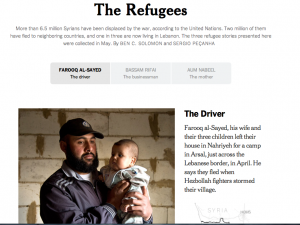
As technology continues to grow and change around us, Multimedia is an ever-evolving mechanism of storytelling. As we are all discovering, that may come in many different shapes and platforms to maximize how we understand and effectively absorb the material. I found the NY Times article Syrian Refugees in Lebanon to be a very powerful and contextualizing form of multimedia. Now this is not quite a form of “Snowfall” but it provides us with a great example of a smaller scale and more simplified version of the same general idea. The Times presents stories from three different families who have been fled from Syria to Lebanon in attempts to escape the horrors they left behind. I particularly like the interactive photograph of the families in their home because it allows the viewer to see an entire 360 degree view around the room (oftentimes the only room shared amongst multiple families). It gave me a sense of perspective on exactly how big the room was and how many people were sharing that space on a daily basis. Overall, I think this is an effective piece of Multimedia Journalism and left me with an overall feeling of empathy for these people that have lost their homes to warfare.
Category Week 1, Weekly Inspiration | Tags: , interactive, multimedia, new york times, ny times, refugees | 60 Comments
-
Jarritos Gringos Commerical (ACE 2)
October 16, 2013 by amandae@uoregon.edu
This is inspiring to me 1) because it’s funny 2) because it was made without a big production company 3) I know them…and this makes me think that all is, indeed, possible.
In terms of production quality with one camera and no budget, I appreciate a number of parts of this video.
1) The first is the use of the 1,2,3 in the opening scene that gets closer and closer to the singer’s face. They break up the jump cut with a blur, which makes it feel authentic.
2) I also appreciate how it’s clear that they’ve staged it, and have long scenes where the camera is following them down an aisle and keeping them framed well, going around corners of fruit. It just seems like they’ve got a tight space to work with but they’re creating all sorts of dynamic shots.
3) They greenscreened. Love it.
Jarritos Gringos Commercial from Elizabeth Shapiro on Vimeo.
Category Week 2, Weekly Inspiration | Tags: , humor, jarritos, sketch comedy | 3 Comments
-
The Making of Malala Yousafzai
October 16, 2013 by jarrattt@uoregon.edu
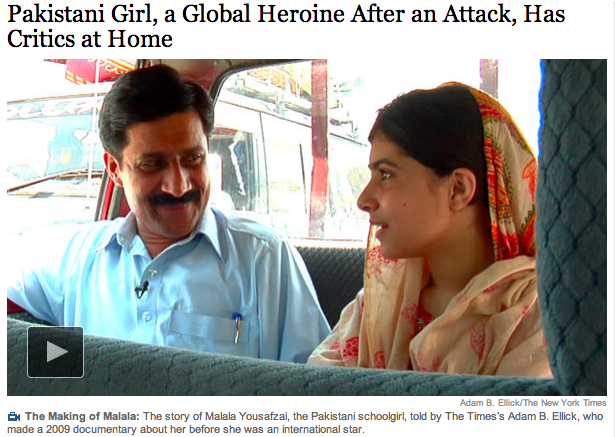 In the wake of all of the press this last week about Malala Yousafzai I thought this video would be interesting. The documentary relies on different documentary styles to tell the story of how Malala became who she is today. It uses the journalist as a first person narrator who balances a personal story with a journalistic perspective. He tells of his experience making the documentary and getting to know the family, but even as he reveals his close connections to the family he steps back and explores the complexities of Malala’s father. Her father is at once a champion of education for women, a businessman that profits off this education, and the husband of a woman who can’t read. He also may be using Malala for his own personal gain. Yet, as Malala develops her own beliefs and ability to voice them, whether or not her father influenced her falls away, as she makes a strong case for her own education as well as the education of all girls.
The video coupled with an article that explores the current situation in her town seems like a great example of transmedia. It continues the story. We are able to delve further into the challenging situation that began with Malala’s father’s interests and the shooting by the Taliban. Now there is a deeper understanding of what people mean in the article when they express resentment or appreciation for Malala and her father.
Category Week 2, Weekly Inspiration | Tags: | 1 Comment
-
Adventure without Words
October 15, 2013 by bjh@uoregon.edu
Adventure Is Calling from Shane Black on Vimeo.
For this week I went back to the Viemo staff picks page, now mind you that was not my intention, I was planning on going on a search for something but one of the first videos there caught my eye and my imagination. The video “Adventure is Calling” is a five minute long piece of several time lapse shots by Shane Black. Now this is would normally be something that isn’t that inspiring until you read the story behind it. Black and two of his friends left their jobs of six years to travel around the country in a truck, camping out and basically seeing what this world has to offer. Now don’t tell me no one of us have ever had dreams of packing everything up and going on an adventure. I maybe dream of it once a year myself, and that is what is so inspiring about this these guys just did it, and these images of the mountains, deserts, and forests are what they have to show for it.
Look i’m a sucker for good timelapse photography. I love being able to watch the world fly by in a matter of seconds in what takes hours. Putting the camera on a dolly to move it while the sky moved around as well added an extra dimension to the piece and the shot itself. The scenery is of course what makes the video as it is all scenery, just the beauty and the backdrop of the great outdoors.
The other reason this video grabbed me was because there was no talking in the video, all of the images are set to a rock song that perfectly captures the majesty of the environment. Since we are focusing on our stories without words this week and next I thought this would be an interesting video to share and talk about. It really does tell a story of travel and discovery, the protagonist is the environment, and how it is vastly different across the country and world. I hope you watch this and feel as good as I did when I watched, now if you’ll excuse me I have a sudden urge to go for a hike.
Category Week 2, Weekly Inspiration | Tags: , No Words, Photography, weekly inspiration | 5 Comments
-
Birds without words (Allyson)
October 14, 2013 by awoodard@uoregon.edu
So, I’ve been thinking about how to tell a story without words, and I keep coming back to this movie. In my disgustingly oversimplified view, there are three types of nature documentaries: 1) a narrator tells you things about plants and animals, with video of them; 2) intrepid adventurers show you rare creatures you will never have a chance of seeing in real life; 3) filmmakers exploit their medium to highlight aspects of nature we would never pay attention to otherwise. Personally I like when my nature flicks lean towards option 3: I like documentaries that trust the power of their shots, and don’t necessarily depend on narration or how exotic their subjects are.
Which is probably why I differ from everyone I know and prefer Winged Migration to Planet Earth. It went to just as absurd lengths to get the raw footage, but instead of filming creatures bound to get a “wow!” it took boring ole’ geese, went on this crazy mission TO FLY IN THE AIR WITH THEM, and through skillful cinematography, editing, and a perfectly-matched score, turned them into protagonists that are just achingly beautiful.
I wish I could find a higher-definition clip to do this film justice (for those who haven’t seen it). But I think these 3.5 minutes do tell a great story without words, and it could exist in no other medium.
Category Week 1, Weekly Inspiration | Tags: | 4 Comments
-
Media as a Democracy?
October 14, 2013 by lpaters5@uoregon.edu
MediaChannel.org describes itself as “a non-commercial and not-for-profit network of media analysis presented in the public interest.” This segment, featuring a discussion between the Editor-In-Chief of MediaChannel.org Danny Schechter and economist and professor Richard Wolf, addresses people who are media consumers and also media creators to discuss the changing landscape of media, problems with concentration in media ownership, and ideas to change media to better serve the needs of the people.
Along with interesting political and economical insight into what is happening in America and in the world, it does serve as an example of a one camera, two-person interview set-up. It’s interesting to see how and when they display their credentials on screen, but to also note that they don’t seem to use any other visuals such as stills or b-roll footage. Whether or not this interview style works or not is up to you. Maybe the content is interesting enough to hook you into finishing the video, and for others that might not be the case. What I love about this video is the lively discussion and major question it poses: should the structure of media function as a democracy?
Category Week 2, Weekly Inspiration | Tags: , democracy, interview, media | No Comments
-
False Perceptions Of Wealth Equality in The U.S.
October 14, 2013 by abk@uoregon.edu
Besides the obvious information this video presents about wealth inequality inAmerica, much can be learned from this video about alternative ways to get your somewhat disheartening message across.
First off, the information being compared is slightly unusual. Instead of the normal financial numbers being thrown together, we are adding in the notion of what Americans believe the ideal economic distribution to be. It’s a merging of the actual and the hypothetical, and adds an interesting take on the way we each personally interact with and interpret numbers. The next outstanding feature about this short video is the method of visualization. The creators use two different infographics to emphasize their point – it’s a powerful use of reiteration without falling into redundancy. Equally, I think there’s something to be said about the use of colors here. This is a depressing topic and I could potentially see a good number of viewers not wanting to sit through the whole thing. The use of bright colors though, and the accompanying visually stimulating motion draws you in and in a way lightens the mood a touch. That being said, there’s also this dark piano music playing lightly in the background so as to let you know this is an issue that shouldn’t be taken lightly. Overall the entire presentation has a perfect mesh of light and dark, both visually and emotionally.
The other thing to note about this video is the fact that most people came across it via the website Upworthy. I’d be willing to wager that if you ask facebook users if they’ve ever been to Upworthy’s homepage, the majority would say no. And this would be in direct contrast to the number of people who would say yes when asked if they’ve ever watched a video on Upworthy. The site is a powerful tool for producing virality on the web – so much so in fact that it allows the videos and pieces to stand alone without their message being lost in the mode of presentation. It’s an inspiring way to reach the masses.
Here’s the link to the Upworthy blog, where you can see the time line commentary by their staff. http://www.upworthy.com/9-out-of-10-americans-are-completely-wrong-about-this-mind-blowing-fact-2?g=3&c=bl3
Here’s the video itself:
Category Week 1, Weekly Inspiration | Tags: , Economy, week 1 | 2 Comments
-
Awesome Music Video/Doc_Summer Hatfield
October 12, 2013 by summerh@uoregon.edu
Django Django – WOR from Jim Demuth on Vimeo.
This is a really well done short documentary/music video. It is very original and is a great example of how to tell a good story in a short amount of time. We get a good sense of the people and characters by the way they have been captured. The filmmakers begin with some dialogue from the characters before they are ever shown, and this establishes what the video is about. Then they introduce each character by showing a shot of them in front of their bikes, which really establishes who they are and what the environment is. It is important when trying to really capture something to really get in there, show perspective shots, establishing shots, close-ups, shots where the characters are being really candid. This video is a great example of all of that. It also shows how extreme close ups make nice transitions and help avoid jump cuts. And sometimes music over a video can be too much, or kill the natural sounds. But this is a good example of where the music really works for the piece, and the natural sounds are allowed to come through.
Category Week 1, Weekly Inspiration | Tags: , music video, week 1, weekly inspiration | 4 Comments
-
Perfect is Boring
October 11, 2013 by lpaters5@uoregon.edu
Emmy award-winning multimedia journalist Richard Koci Hernandez shares insight in this piece on using any tool available to capture moments for story telling, from old traditional means to apps on an iPhone. Stressing that “perfect is boring,” Hernandez discusses techniques for obtaining shots you want as well as how to make your photographs more interesting. He also touches on the rise of blurb books, a site allowing Instagram users to create books from photos they have taken.
It’s an interesting piece that bounces between interviewing your subject and also using stills to tell a multimedia story. A quick and inspiring watch for anyone interested in the multimedia arts, Hernandez clearly knows what’s “now.”
Street photography and Instagram photobooks by @koci from Blurb Books on Vimeo.
Category Week 1, Weekly Inspiration | Tags: | 3 Comments