Student Spotlight: Kaleb Stubbs

Kaleb Stubbs is a current LTS student who will be graduating this Summer.

– blog post by Emma Snyder, LTS student

Hi Kaleb! Tell us a bit about yourself and your background

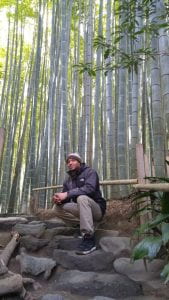
Kaleb sitting on stone steps in front of a bamboo forest

Kaleb in a garden in Kamakura, Japan

I was born and raised in Eugene, Oregon. My father is also from Eugene while my mother is from Panama. I grew up playing baseball, basketball, and football all the way through my high school years. I ended up becoming the ASB President (all student body) of my high school at Sheldon where I gave many speeches, including one at graduation and organized the assemblies for the school. I attended Lane Community College where I received my Associate’s of Arts degree and transferred to the UO where I completed my undergrad in Linguistics and the Second Language Acquisition and Teaching (SLAT) certificate.

What brought you to language teaching? To the UO?

In high school, I always aspired to become a writer, but was unsure on how to go about it at the time. During my years at Lane, I switched my degree many times from business to music, then to EMT until I eventually found my passion in language learning. I discovered this through travelling when I was working at the airport and had the opportunity to use the free flight benefits to travel to places such as Italy, Israel, the Netherlands, Canada, Guatemala, Panama, and Japan. It wasn’t until I visited Japan that I found out what direction I wanted to go as far as higher education. I noticed that language is the key to the world and there were many job opportunities as an English teacher in Japan. When I returned to America, I immediately started studying Japanese and Linguistics at the U of O and now I am in the LTS Masters program. I also found that the passion doesn’t just stop with teaching. When we know a language and how language works, there are many opportunities that can be had in many different areas.

What have some of your past experiences been with language teaching? Do you have any specifically fond memories?

Since my time at U of O, I have had many great teaching opportunities such as working with international students from all over the world while tutoring at AEI, interning with Li-Hsien Yang at CASLS, and with the OIIP program. Classes through the LTS program offer opportunities to teach as well, such as Talking with Ducks, and the times have been unforgettable. I have met so many interesting people and was able to expand my cultural and linguistic knowledge even further by making friends and using the Japanese language and other languages every day. I have gone on many fun adventures with my international friends such as going to the coast, hiking Spencer’s Butte, snowboarding, surfing, skateboarding, and many other things. These memories I will always cherish and remember and at a time when I knew no one from Japan, I now have many friends in different places of the country so I will not be lonely and there are many opportunities to be discovered.

Kaleb exiting the torii gates, in front of Tsurugaoka Hachimangu shrine

Kaleb in front of torii gates in front of Tsurugaoka Hachimangu shrine

What has been the highlight of your time in the program so far?

Aside from learning the logistics of how language teaching works, the LTS program has offered so many insights that were new to me such as curriculum designing, program evaluations, creating lesson plans, learning about different modes and tactics of language teaching especially in a world where things are more digital and online, and how to optimize the experience for the students in classroom. I would have to say the highlight of the LTS program is the amount of awesome people I get to meet and work with while in the program. It’s awesome to part of a team of likeminded individuals who are bright and driven in their field. The professors in the program are all great as well and each one offers a viewpoint that is extremely beneficial in many ways.

How do you hope to work in the language teaching field in the future?

After I graduate, I plan to utilize the knowledge I have gained throughout my years at UO and the LTS program by travelling and teaching English. My main goal is to live and work in Japan while increasing my knowledge of the Japanese language, but I am always open to travelling to new places as well and learning about the languages and cultures as much as I can. I hope to work in education with students of all age ranges who are interested in learning English and to help them on their linguistic journey. Another goal is to work for an international company where I can travel and use my language ability to bridge linguistic and cultural gaps and make connections around the world.

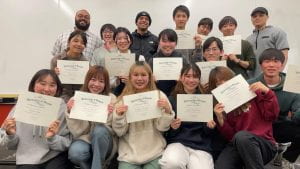
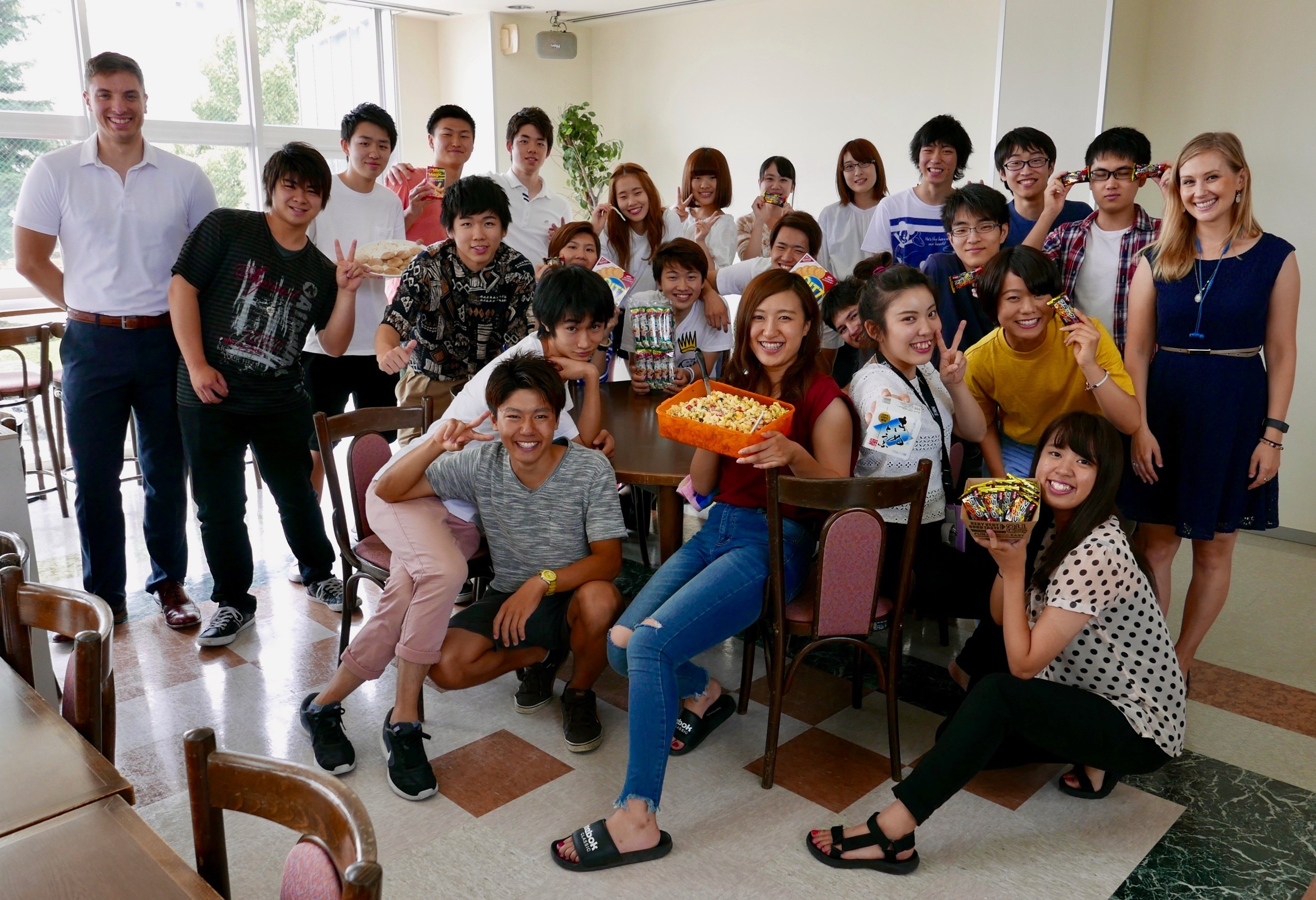
Kaleb with co-teachers and English students from Nagoya, Japan in Eugene

Kaleb (third from left in back) with co-teachers and English students from Nagoya, Japan in Eugene

What is something outside of language teaching that you are passionate about? A fun fact about yourself that others may not know?

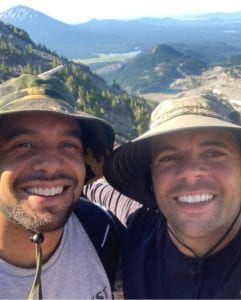
Kaleb and his brother on top of a mountain with a view of mountain ranges and rivers behind them

Kaleb (left) and his brother at the summit of the South Sister, Oregon

Outside of language teaching, I have a passion for music, photography, manga, video games, and the outdoors. I play the drums, a bit of piano, and the bass guitar on my free time and also make music on my computer. Recently, I have had the opportunity to be the drummer of a band which has always been a dream of mine. I often take photos of nature when I’m on a hike or bike ride and find it extremely grounding. I love to skateboard, mountain bike, and surf with my older brother as well who was the one who got me into outdoor sports. I also recently have reconnected with my love for writing and have began writing brief short stories and hope to eventually transfer those into short films.

Multi-level teaching internship for LTS students

This post is the 3rd of an awesome 3-part series this Spring/Summer on internship experiences in LTS (see the first here and second here). It is written by Laura Holland, faculty member in LTS and the American English Institute (AEI), and 3 of the 4 interns (Elaine Sun, Tigre Lusardi, Ellie Collins, all LTS students) who assisted her with a remote multi-level Speaking-Listening class.

Team “One-Room-Schoolhouse” rocks the house!

Laura G. Holland 

The global pandemic has taken a toll on enrollments in Intensive English Programs (IEPs) throughout the country and UO/AEI is no exception. Late in winter term we were informed that we only had enough students to offer one each of our core courses in the IEP, one Speaking-Listening, Grammar and a Reading/Writing class. Each class would serve all levels in a “one-room-schoolhouse” model. I was offered the Speaking-Listening class, my favorite to teach, but I confess I was initially skeptical of our ability to deliver a great student experience with this new constraint, and I wondered how in the world I might make successful, meaningful experiences for such a diverse level of student proficiencies.

In my heart (and teacher’s brain), I knew that the only way this might be even remotely possible would be to recruit interns. I put out the call to Keli Yerian, Director of the LTS Program and she in turn, sent out a message to the MA cohort. Within 2 days, I had four eager interns, 3 of whom I had worked with previously, and ready to take on this further experiment in online education (because teaching languages online IS still a bit experimental after only a year). I can safely say that without the interns, we would never have had the simply amazing experience that we had. Going into the term I was praying to stave off disaster; within the first week, I knew we were on to something big and by the end of term, we had delivered one of my favorite courses of my long and varied career.

Throughout the course and especially in the final weeks we requested IEP student feedback, asking what they liked, what they would like more of, which lessons and activities “stuck with them.” We asked in multi-modalities: in-class small group discussions, their weekly homework videos and writing in the chat in whole group. In each of these queries, students highlighted working with the interns, their ability to engage daily with UO students, both domestic and international. They were inspired by all and as a teacher, it was SUCH a luxury to have 4 talented and enthusiastic co-teachers to help plan ideas I never in 100 years would have thought of. The balance and variety they brought took our content over the top. Because we had “ditched” the textbooks this term (which one would we use with 6 different levels?!), we were free to develop our own passions and materials and as a result, we all thrived. Our team met weekly to plan and discuss, and to brainstorm ways to adapt all our lessons and activities to both in-person and online formats, so as to be prepared and ready for all contexts. As a teacher at the doorstep of retiring, I found this to be so inspiring and am grateful to be going out with a bang.

Our team of 4 interns included more variety than I could have hoped for: undergrad and graduate students, male and female, native and non-native speaking, novice and experienced teachers, people who had always wanted to be teachers and people who had begun careers elsewhere and found their way to teaching for a second act. From moment one, they were on it and together, we created one of the most exciting courses I’ve had the privilege to teach. They developed lessons incorporating pre-, while- and post-listening activities and discussed facing fears, and many other topics of interest; they incorporated poetry in the most successful poetry lesson I’ve seen; they compared “Bucket Lists” and they asked the students to tell stories from the past and look to the future; we discussed their hopes, fears and dreams for themselves and for the world; we watched videos and gave speeches and developed everyone’s academic discussion skills.

Thank you to the interns—I am being perfectly honest when I say this term could never have been this amazing without each of your many contributions and full-on presence. I will remember this experience forever and I’m positive our students will too.

Thank you, Gracias, Xi xie nie, Merci, Tack, Arigato, Shokran, Sulpayki!

Ellie Collins 

Though the prospect of an online speaking and listening class that spanned 6 levels was certainly intimidating, this internship ended up being one of my favorite experiences of the LTS program. During this internship, I had the opportunity to watch Laura Holland’s excellent teaching in action—I learned so much by observing her interact with students. One of the things that Laura does best is encourage her students to step outside their comfort zones to grow into better learners and speakers. At the same time, she encouraged me to step outside my comfort zone to plan and lead activities for the course. I grew as a teacher while learning to plan out lessons as well as teach lessons that were planned by someone else. Throughout this internship, I learned more about how to manage a classroom and differentiate lessons between many different proficiency levels and interests. I am so grateful for the opportunity to intern in this course, and I look forward to implementing the many things I’ve learned into my own classroom in the future!

Elaine Sun

I feel glad to work with Laura and the other three interns during this past Spring term. Also, working with students from all over the world was a precious experience. It was a wonderful chance for me to test the materials I designed for language teaching in a real language classroom. Ten weeks passed much faster than I thought. As an intern, I really enjoyed working with the students. While they were practicing English, they were also sharing their personal stories and some fun facts about their culture. Some of the stories were truly touching and made me think deeper about the target topic. It was also the first time for me to lead an English class as the main teacher. I feel grateful for Laura giving us this chance. This intern experience gave me the courage and helped me to get ready for being an L2 teacher. Finally, I just want to say “thank you” to everyone I met in this class. It wouldn’t be a wonderful trip without each of you.

Tigre Lusardi 

Interning with Laura’s multi-level Speaking and Listening class this spring was a seriously fun and wild ride! As a new teacher I really appreciated getting a glimpse of how a veteran teacher like Laura approached planning and executing a class for learners who varied so widely in their previous English language study and in their comfort and proficiency levels with speaking. Balancing every learner’s needs and goals and making sure that they were all participating and progressing was no small feat! One of the most delightful things to observe was how the learners’ comfort with expressing their ideas grew by leaps and bounds throughout the term. By far one of my favorite parts of this experience was noticing when learners felt confident enough both with their English and with us, the teaching team, to crack jokes or to tease us gently. Expressing humor in a second language is sophisticated both linguistically and inter-personally, especially given the idiosyncrasies of Zoom and online classes. I only wish I had had more than 10 weeks to spend learning alongside Laura and such an engaged and engaging group of learners!

Alumni Spotlight – Ryan

Hi, I’m Ryan, and I graduated with the LTS cohort of 2013. Since then I’ve been teaching at Tokyo International University in charming Kawagoe, Japan, about an hour northwest of Tokyo by train. Positions for full-time English teachers are usually limited to a few years in Japan, so last year it was time to begin the hunt for another job.

Hello Ryan! Thanks for catching up with us on the LTS blog! The last time we heard from you, you described your work at Tokyo International University. Now you are about to start a new adventure. What are you doing next?

I was really excited (and extremely relieved) to land a spot at Kanda University of International Studies, a school that focuses exclusively on foreign language studies. It’s in Chiba, about an hour east of Tokyo. With the arrival of COVID-19, everything has changed. Like schools around the world, Kanda has made all courses online for the first semester, my entire orientation to the university has been on Zoom, and collaboration with colleagues from afar. It looks like this will be the new norm for the foreseeable future! Let’s hope we can make more of a human connection in the fall.

What is interesting or exciting to you about this new position?

I’m particularly interested in getting involved in their Self-Access Learning Center, where students can be trained to direct their own learning (related to my final project in LTS!).  I’ll be starting at the end of March, and I’m really looking forward to what’s in store.

You’ve said you had a good experience at TIU as your first teaching position after LTS. Looking back on your 6 years at TIU, what do you think is key to a positive and growth-oriented workplace? What should our LTS graduates be looking for when they interview for positions?

I really lucked out with TIU. It was the first opportunity for employment after LTS (Thanks for the heads up, Keli!) and was a wonderful experience. Both the administration and my colleagues were very supportive; at no time did I feel I couldn’t turn to someone for help or information. There were also plenty of opportunities for professional development and learning. I hope new LTS graduates can sense such an environment when they begin looking for jobs.

It’s been 6 years since you graduated. What do you hope to learn, experience, or discover in the next 6 years?

Looking forward, I’ll continue to develop professionally and enjoy my life here. I intend to get more involved in research at KUIS’ center for autonomous learning, a subject I’m very interested in. I also want learn about my new community: find new haunts, meet locals, and participate in neighborhood events. And, of course, continue my life-long study of Japanese!

A last question – how important do you think it is to stay in touch with colleagues from the past as you move through different phases in your life? 

Life after LTS has been a real adventure, just like the program was. It’s always fun to hear what old classmates have been up to. Many of us have been lucky enough to see each other at various celebrations in our lives. Staying connected is sometimes a way to learn about professional opportunities, but it’s always a way to remember and enjoy good times.

Student Spotlight Shiyun (Jasmine) Li

Jasmine Li is a current LTS student who is graduating this Summer 2019. She has focused on English materials and teaching in the program, and is completing her project on a topic she loves: stimulating English learners’ interest in authentic literature  through the the careful integration of both modified and authentic texts.

Jasmine with some poster materials in her curriculum class winter term

Could you tell us a little about yourself?

My name is Shiyun Li, but everyone just calls me Jasmine. I’m from China, but I’ve spent most of my undergraduate and graduate years in the US. I have a BA in English Literature and I went back to China and taught English for a year before coming to Eugene to continue my studies. I’m always enthusiastic about short stories and detective novels. And traveling by myself is what I like to do the most in my spare time outside the school. I love to meet with different people along the way and listen to their stories, which to me is even more exciting than travel itself. The counties that are still on my travel list are: Japan, Italy and Jamaica. I hope I can visit these countries in the near future and have more exciting adventures along the way.

What are you working on in your MA project, and how are you feeling about it now that you are halfway done?

I’m currently working on the topic of use extensive reading approach in EFL context and integrating modified and authentic materials to teach reading for adult and young adult English learners. I feel like everything I’ve been creating for the project is finally coming together now. It is never easy when you are writing, but at the same time you are looking forward to write more about it. And I really like how my perspective has changed during the process of writing and how much I’ve learned so far by working on my project.

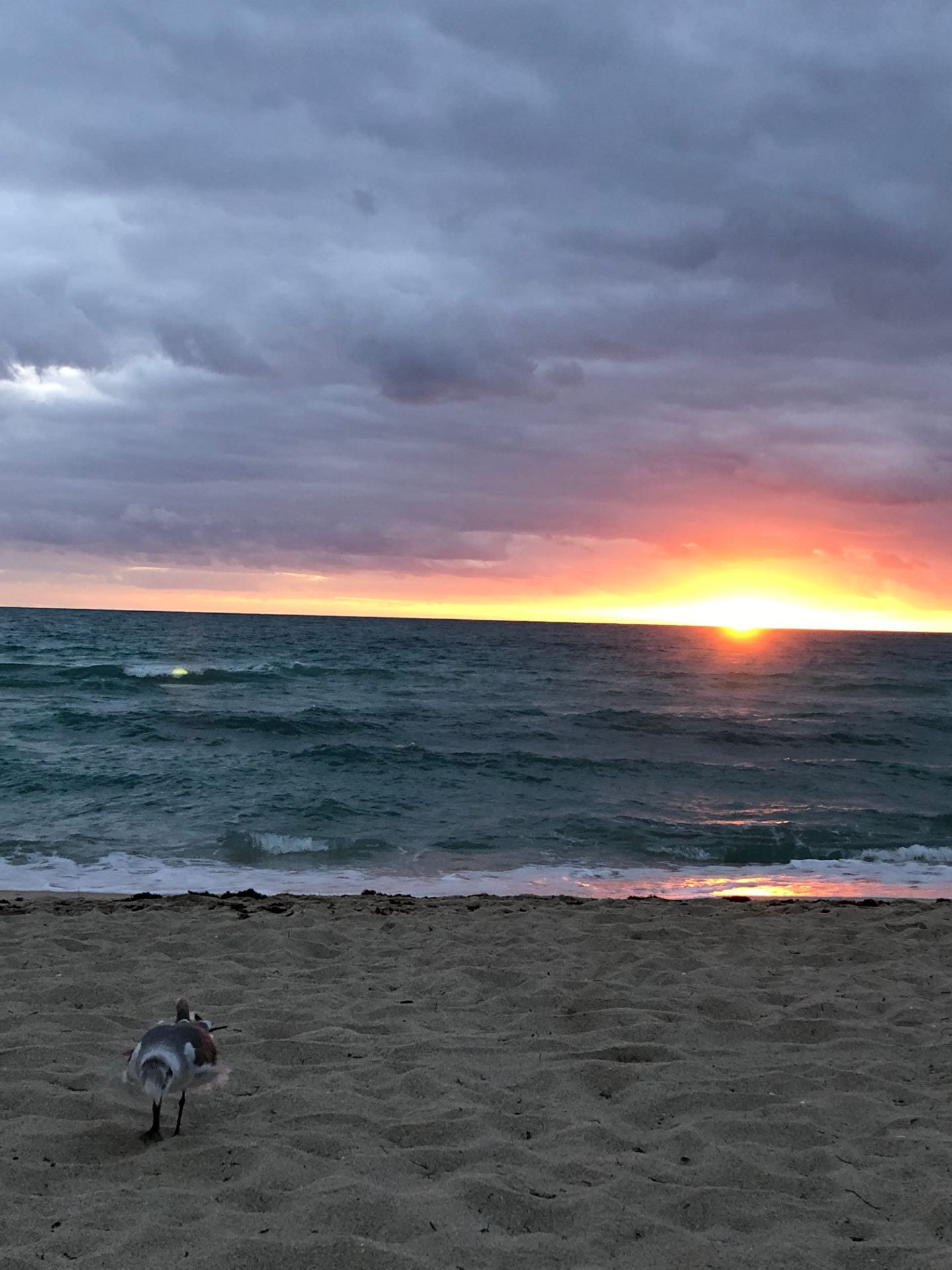
Sunrise at Miami Beach

What was most interesting for you in your English and Chinese language teaching internship experiences this past term?

The most memorable part about my internships is the teaching I did in AEIS (Academic English for International Students) because it was the first time I taught a cross-cultural language class at the university level. In the program I’ve learned how to plan a lesson and create materials according to learners’ needs and abilities, so it was a great opportunity for me to put what I’ve learned in practice. It is really rewarding to see students are doing a good job and learning new things from what I’ve prepared for them.

What are you hoping to do after LTS?

After what I’ve learned in the LTS, I’m hoping that I could be given an opportunity to continue my education and doing research in the language teaching field. I’d like to pursue a PhD in Second Language Acquisition and put my focus on bilingualism and second language learning process. But still, I wish to always be a good language teacher in my students’ perspective.

Student spotlight Zuxuan Ni and Yang Li

This month’s LTS blog post features Zuxuan Ni and Yang Li, who are both interested in teaching Mandarin to older children in the U.S. In LTS they have been taking some classes specifically focused on Chinese linguistics and teaching, as well as assisting middle and high school learners of Chinese at Oak Hill School in Eugene.

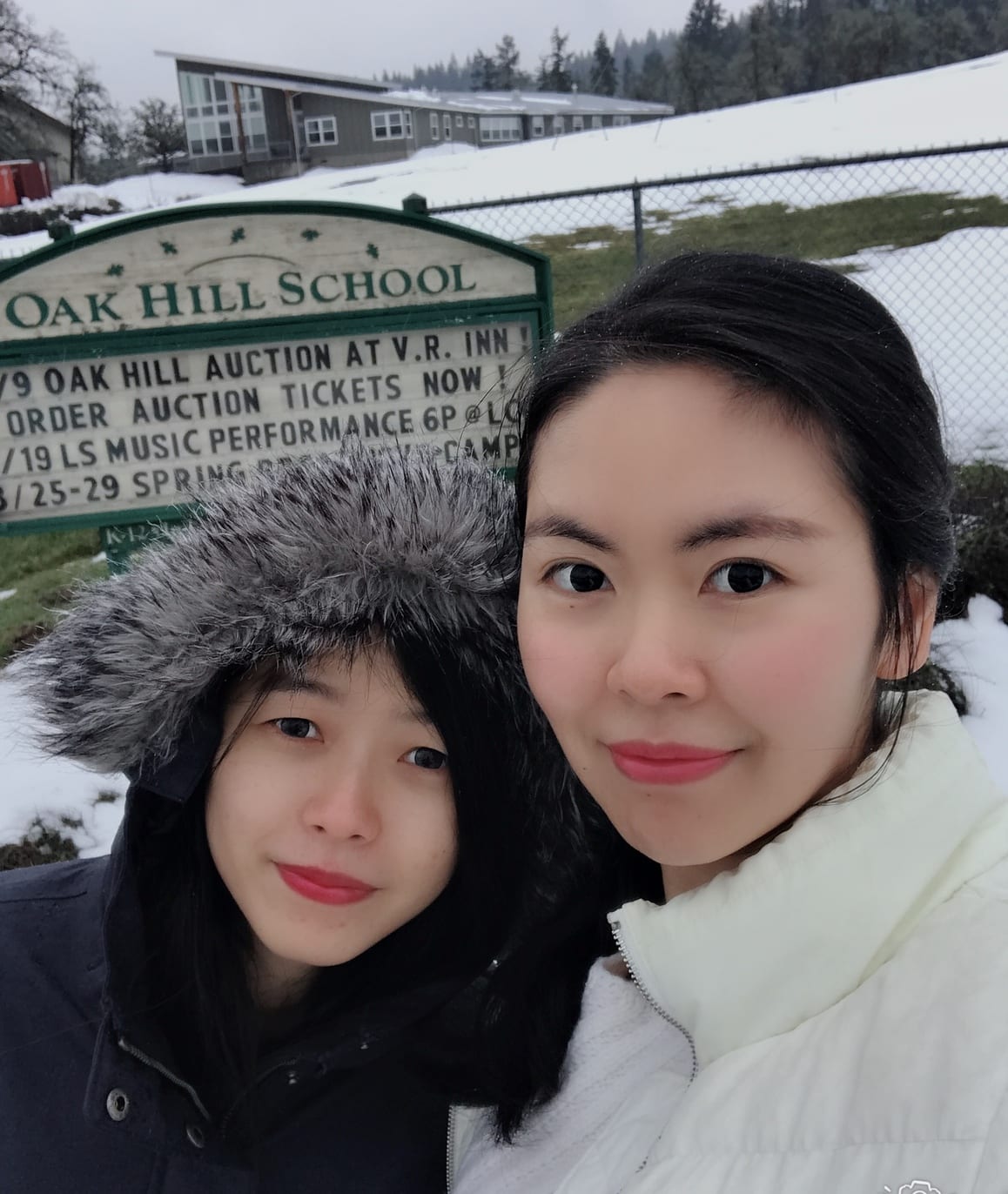
Yang and Zuxuan in front of Oak Hill School where they are assisting learners in Chinese. The snow is rare in Eugene!

Hello Xuan and Yang! Tell us a little about yourselves.

(Zuxuan) My name is Zuxuan Ni, sometimes my friends call me Xuan. I am from Beijing, China. I got married in Seattle and moved with my husband to Eugene three years ago. My interests include second language teaching and psychology and education. I like traveling. When I was studying for my first MA in psychology and education in England, I visited several European countries among which Denmark was my favorite. Now I am enjoying my time studying language teaching here in Oregon. I love this beautiful state very much and hope to become a Chinese language teacher after graduation.

(Yang) My name is Yang Li, and I’m from Hunan, China, where foods are known for being spicy. It’s no surprise that I love spicy foods. I got married in my hometown two years ago and came to the US with my husband, who is studying at Oregon State University right now. I’m really happy to study in LTS program and met new friends, this is a valuable treasure for my life.

What experiences in teaching did you each have before starting the program?

(Zuxuan) I worked as an L2 English teacher at an international high school in Beijing for half a year. During this period, I planned and delivered English lessons to seven classes with 20 students in each class. It was a great experience in which I engaged in creating a stimulating learning environment and varying my students’ learning activities in class by providing more interactive tasks to practice.

(Yang) I taught English grammar and TOEFL and IELTS reading before starting LTS. After graduating in 2013, I started working in an International high school for two years. During that time, I was responsible for teaching English grammar and tutoring students with their TOEFL reading. Then, in order to have more chances to gain teaching experience and work near my hometown, I got another job to teach TOEFL and IELTS reading in a private Language training center. Normally, the class size was pretty small, with three or four students per class. I enjoy teaching students and being one of their supporters. However, I desperately felt that I myself needed to improve before I could really help my students to a larger extent. So that’s why I’m here.

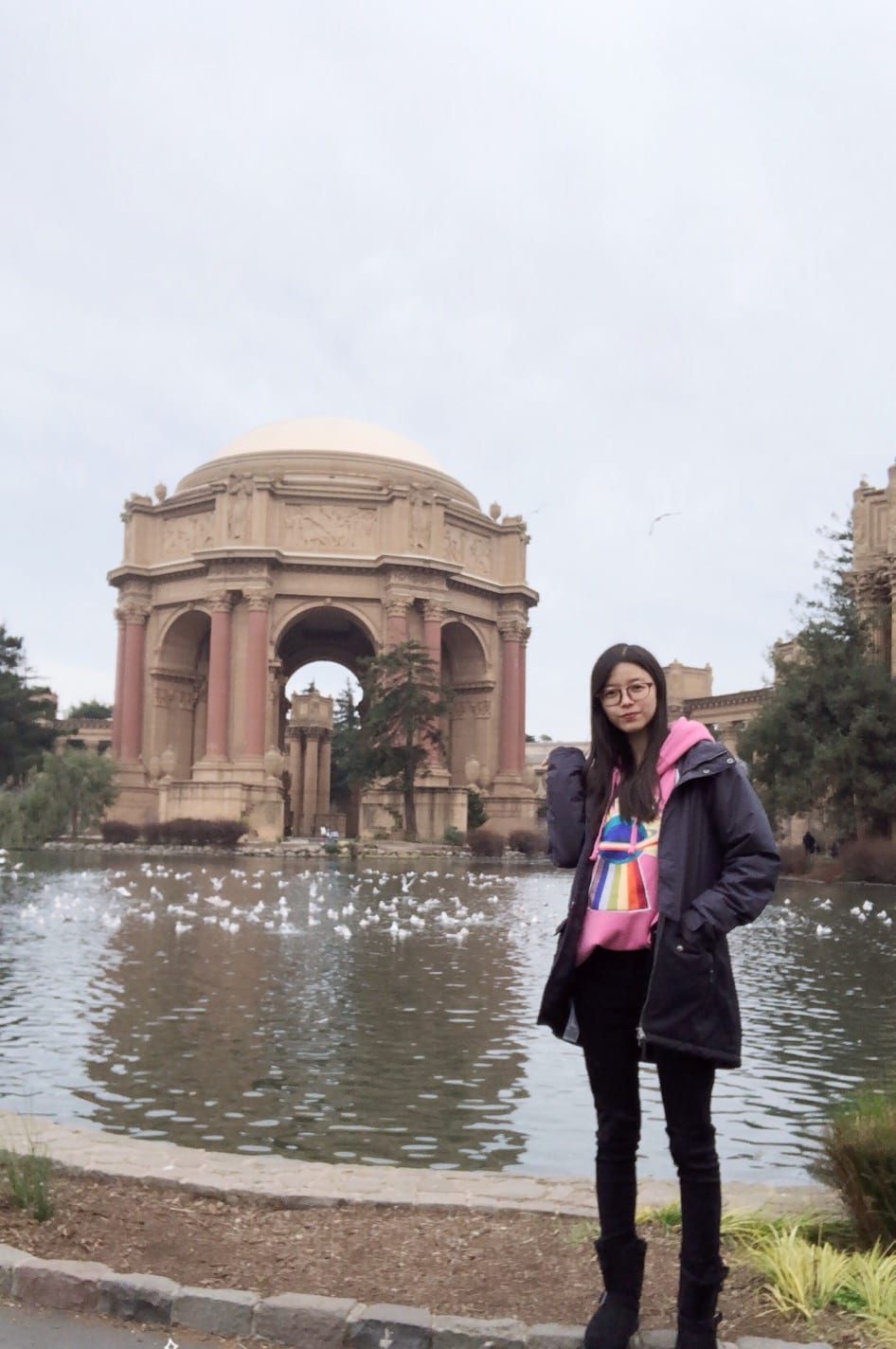
Yang Li visiting San Francisco

What attracted you to a program like LTS?

(Zuxuan and Yang) As we delved deeper into our English teaching work in China, we encountered some practical problems of developing our course designs and fostering students’ autonomous learning, which made us realize that we lacked some professional training in language teaching. This is why we are here in the LTS program. The courses offered by LTS are what we are expecting to learn. For example, in Second Language Teaching Planning, we learned how to analyze and examine the major methods used by L2 teachers to teach target languages as well as the principles and concepts associated with the L2 teaching. Such course perfectly met our learning needs and helped us build a firm foundation for a further career. We are very grateful for it and looking forward to the following terms!

We’re glad to hear that! What are you doing now in the program?

(Zuxuan and Yang) We are learning to develop language course designs for our target learners in the program. It is very helpful for us to learn to analyze our specific teaching contexts and set appropriate learning outcomes so that we can make our future language teaching successful. In addition we are working as Chinese language partners to teach speaking and listening at Oak Hill School (a K-12 private school in Eugene). We meet with two intermediate-level students aged 16 once a week to provide them with more language input and encourage them to talk with us about some cultural topics. We are happy to see that the students become more and more confident in speaking Chinese and they start accurately
using higher-level constructions when talking to us. It is always a pleasant time with the students.

What are you thinking of doing for your final MA capstone projects?

(Zuxuan) For my final MA project, I plan to design a task-based Chinese as a Foreign Language (CFL) course for the purpose of reinforcing middle and high school students’ oral skills by using authentic materials. I want to develop a course which is suitable for young students and offers helpful scaffolding for those lower-proficiency learners in the K-12 context. Since Chinese pronunciation, especially the tones, is generally considered to be a critical challenge for non-tonal language speakers, my project will focus on engaging students in meaningful tasks which involve a variety of tonal practice. Besides, I will also utilize a usage-based constructionist approach to offer form-function mapping to
students to learn distinctive Chinese structures. Hopefully, my final MA project can be useful for my future language teaching after graduation.

Zuxuan in San Antonio before joining LTS

(Yang) After graduation, I want to have more experience studying or working in the US. Therefore, for my final project, I’m thinking of teaching Chinese in a CFL context and to build learner agency by utilizing task-based language teaching principle in classrooms. And I’m seeking to see the effectiveness of the task-based approach in motivating students and in optimizing their learning experience. As a foreign language, there are not many opportunities for learners to practice Chinese, and mostly the learning behaviors are triggered by external incentives. So, I believe there is an urgent need to find how to encourage students to take initiative in learning Chinese. I hope my final project will be beneficial for my future teaching career.

Finally, this program is intensive, and we are now more than halfway through it! Are you looking forward to the last spring and summer terms?

(Zuxuan and Yang) Yes, definitely. We are definitely looking forward to the spring and summer terms. Because we may start guest teaching in different elementary schools in Spring and get more familiar with classrooms in the US. We are so excited about having these opportunities and experience. Also, we’ll start to write our final project and research for the topic we are interested in. Furthermore, we are really looking forward to the courses of these two terms, like the assessment and pronunciation course, which would benefit us a lot for our final project and future teaching career.


Student Spotlight: Logan Matz (2017-2018)

It is my pleasure to introduce you to 2017-2018 LTS MA student Logan Matz!

Hi Logan! Please tell the world a little bit about yourself.

Logan and Polly

Oh gosh. My love for language really started growing up around a bunch of different, really robust immigrant communities. So everywhere I went, I heard more than just English being spoken, and I thought that was pretty neat! I got my undergraduate degree in linguistics from Western Washington University in Bellingham, WA, so the move to Oregon wasn’t really too far. I’m a quarter Hungarian (sziasztok!) and the bulk of my extra-continental travel has been to Denmark. I also really enjoy anything related to bikes and dogs. Cooking and hiking are up there as well, although cleaning up afterward is something I struggle with…

Have you been enjoying the LTS program so far?

Logan on his bike

I’ve been enjoying it a lot! It’s great having such a small cohort because it really allows you to work closely with your fellow students and get a lot out of professors because of the small class sizes. I also really like the balance between scaffolded assistance from faculty and dedicated “struggle time”; I think it fosters a sense of independence that’s important to have as a teacher combined with the knowledge that although I can work well on my own, I don’t have to, and there are TONS of resources, people and otherwise, at my disposal to help me learn and create the best project I can.

What are you hoping to learn/gain from the program?

In undergrad, I knew I really wanted to teach. But I also knew that I would need to learn how to teach first. I applied for the program knowing that I didn’t have any language teaching experience, and I’m so pleased to have taken the practicum class with Laura Holland– what a fun formative entry into the world of teaching! I’m really looking forward to developing pragmatics-related curricula, although I still have a lot to learn.

And I know you have two internships this term–Harrisburg and CASLS. How have those been going?

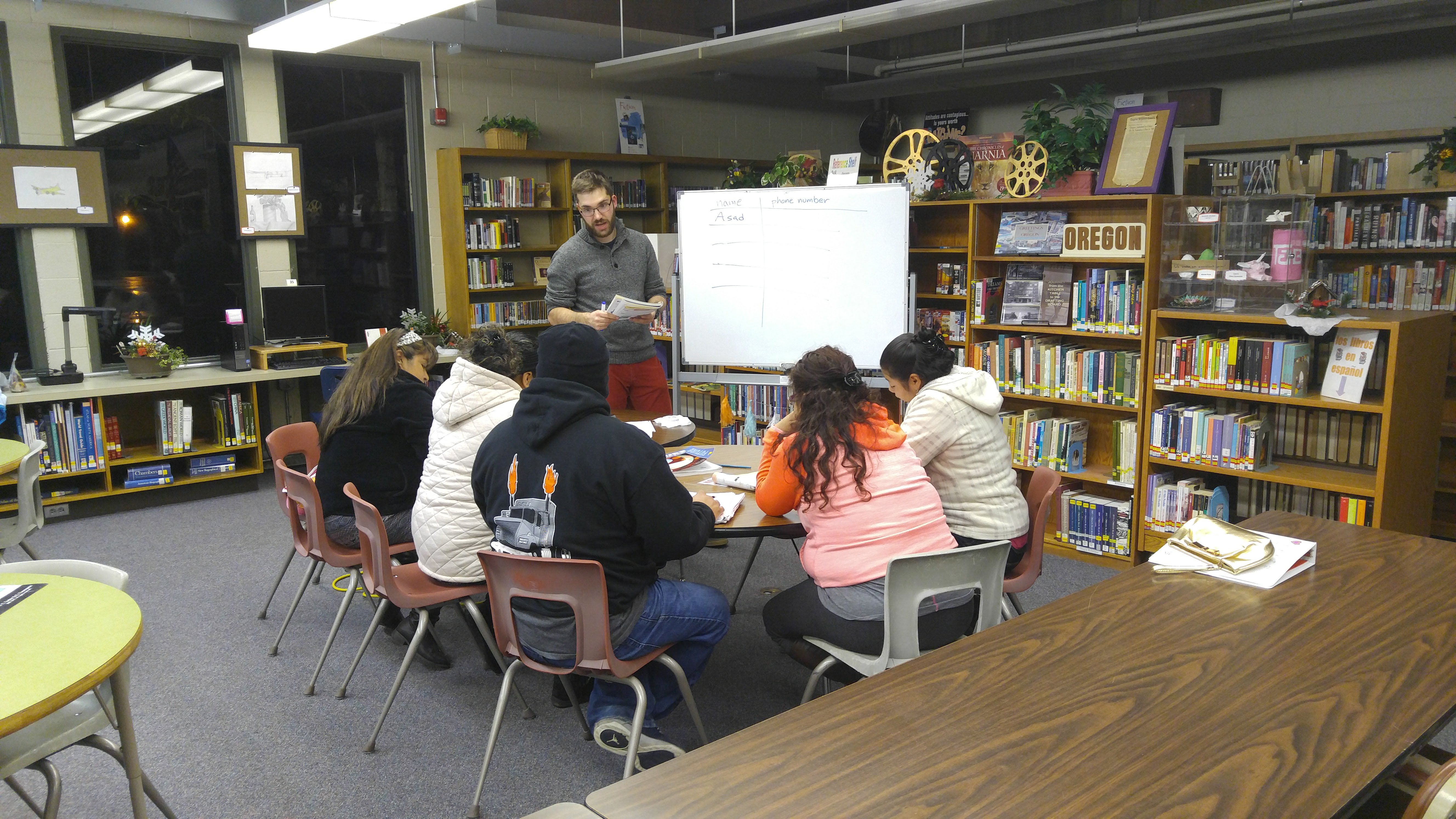
Logan teaching Adult Basic Skills in Harrisburg through Linn-Benton Community College

Harrisburg is great. I’m volunteering with Amy Griffin (LTS alum!), who’s teaching an Adult Basic Skills Community English Language Acquisition course through Linn-Benton Community College, and although I helped out once a week last quarter, I made it official this quarter and I’m teaching twice a week now. The class size and proficiency distribution means that there’s a beginner group and an intermediate group, and I’m very grateful to Amy for letting me swap between groups during the week. I work with the beginners on Tuesdays, and then Thursdays work with the intermediate group. Of course, I couldn’t do it without Amy, who’s putting in twice the work by writing both her own lesson plan and a lesson plan for me to follow. All I have to do is drive north, show up, and teach!

Logan monitoring Adult Basic Skills students

It’s a fantastic experience, and I couldn’t ask for a better on-the-ground teaching practice opportunity. The students are all great fun to work with, and I’m continuously impressed with how much effort they put into a two-hour class, at the end of a long workday, with families waiting at home. Amy’s lesson plans are always great, and I’m allowed to put my own spin on them when I see the chance to. I need to mock up a class schedule for Spring, but I’d love to go back and help again next quarter!

My internship at CASLS has been super rewarding. It’s great working with such a cool team, and of course it’s awesome to have my own desk! I was worried when I first started, knowing that Julie has a very hands-off managerial approach; but it’s been plenty easy to check in with her when necessary, and the rest of the team is super accessible for any questions or help I might need. My first project was working on a set of lessons for Games2Teach for the game Papers, Please, which is a super fun puzzle game that just so happens to naturally brim with pragmatic goodies. I’m all done with the rough drafts, and I’m just awaiting some feedback now. While that finishes up, I’m starting to work on cleaning up another existing CASLS project, called the Place- and Experience-Based Database for Language Learning (PEBLL). Basically, it just needs a little TLC to make sure current entries are up-to-date before more are added. I also get to attend the weekly curriculum meetings, which have been super fun and useful for developing my curriculum designer’s intuition. It’s also so inspiring to hear everyone throwing ideas around!

Any final thoughts?

Mmm…nope!

Thanks so much for taking the time for this interview! Hope you have a great last few weeks of Winter term!

Six LTS Alumni Teaching at Tokyo International University

LTS student George Minchillo submitted this report on LTS alumni currently teaching at Tokyo International University. George is there now serving as an intern and will graduate from University of Oregon at the end of this term.

Please Give us a Brief Overview of Tokyo International University
Brick wall with shield and title of Tokyo International University

Welcome to Tokyo International University!

Tokyo International University is a Japanese university in the greater Tokyo area. Although the Global Teaching Institute (the university’s English language program and faculty) has only been around for close to 5 years, you wouldn’t be able to tell from its staff of about 50 instructors and the wide variety of activities and events that it sponsors for the university and surrounding community!

One of the biggest and most important missions of the GTI is cultural globalization and international cooperation, which is evidenced by the E-Track program (English Track: classes are taught primarily in English with some Japanese as a Second Language courses) comprised of students from many different countries who have come to Japan seeking a degree in Business, Economics, or English communication. The other program the GTI offers is the J-Track (Japanese Track: mostly Japanese students earning a Japanese degree) and this is comprised of the required English courses that all students at the university are required to take.

Six LTS alumni are currently members of the TIU faculty: Becky Lawrence, Ryan Felix, Annelise Marshall, Brandon Bigelow, Kodiak Atwood, and LeeAnn Genovese.
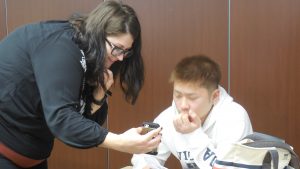
A woman showing a cell phone to a student

Becky Lawrence showing her Basic Writing student a photo about her experience at a Japanese festival.

What classes do you teach at TIU?

Becky: I teach four classes in the Global Teaching Institute. Three are core classes for J-Track students learning English. For these core classes, I teach Sections 3 and 4, which are pretty beginner levels (the levels go from 1-28). I teach English Comprehension (Reading) to both Sections 3 and 4, and Basic Writing to Section 4. The other class that I teach is Advanced Reading and Writing, and I teach the highest level of this particular class, which is an elective for J-Track students who are mostly juniors and seniors. I really enjoy all of my classes because they each present unique challenges. I like that I get to experience teaching beginner students and advanced students at the same time. It makes me more creative, and I regularly use techniques and activities that I learned in LTS!

Ryan Felix warming up his students with an exercise in frequency adverbs!

Ryan: I’ve been at TIU for four years now! Each year I’m assigned different classes to teach; this year I have reading and writing classes with Japanese students. I’ve also been teaching public speaking for the last three years in a separate program for international students studying business or international relations. At first, I was nervous about teaching it, having little public speaking experience myself, but I’ve learned so much!

Brandon: I graduated from the LTS program in 2013, and have been at TIU since September 2016. I teach English Comprehension and Basic Writing for freshmen Japanese students. I also teach Academic Composition for international students from countries including Vietnam, Uzbekistan, and Indonesia.
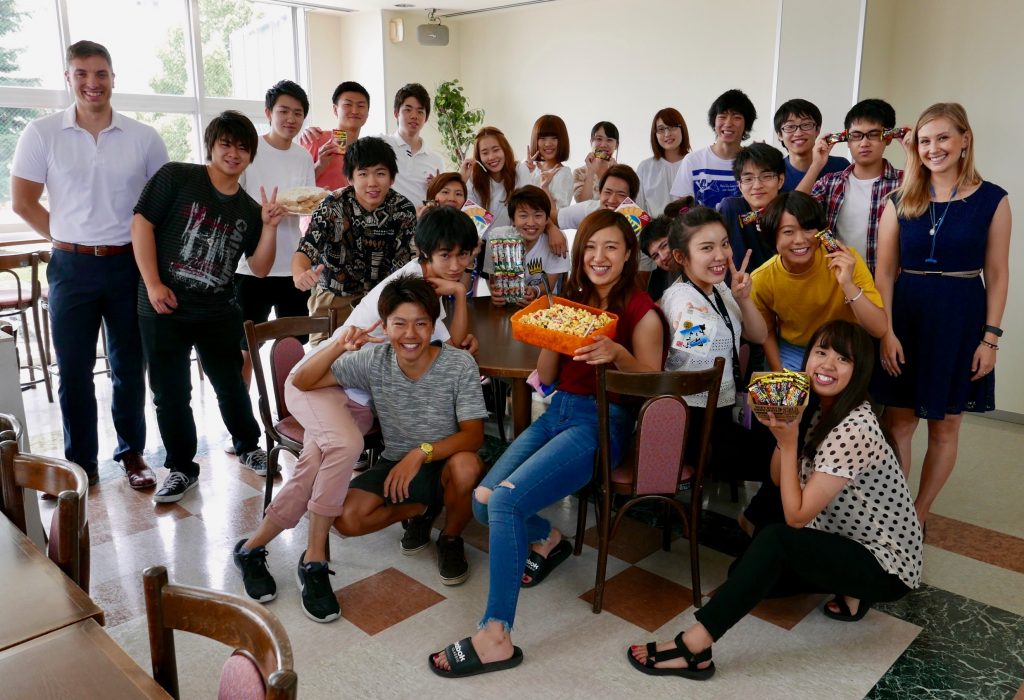
Kodiak Atwood posing for a photo with his students and co-teacher.

Kodiak: I’m currently teaching two listening classes and one speaking class to Japanese freshmen. The Japanese freshmen are really fun to work with and I have a lot of room to experiment and try new things out in the classroom. I’m currently implementing a gamified curriculum where all of the students are characters in a role-playing game and that’s going really well! I also teach an analytical reading and critical thinking course to international students. The international students are all advanced and occasionally native speakers, which is a welcome challenge and change of pace. We are able to cover really interesting topics and discuss complicated issues in class that I normally wouldn’t be able to do.Annelise: This year I’m teaching first year listening and speaking classes and a composition class focused on research writing.

George: I’m here as an intern, so I’m not regularly participating at the front of a classroom. However, there will be weekly opportunities for me to run a variety of workshops based on topics, skills, or functions that interest me (and hopefully interest the students). I also get to participate in a series of workshops for local Honda employees who are coming to the university for TOEIC training.

Which committee are you a part of?

Becky: All faculty are part of a specific committee that works to provide students to GTI faculty and students and make the GTI and TIU the best university it can be. I’m the SLI (Student Leadership Internship) Coordinator, which means that I work closely with J-Track and E-Track students who work part-time in the English Plaza. As Faculty Advisor, I’m responsible for ensuring that they have the support and training that they need to make the English Plaza a welcoming and educational place for all TIU students who want to come practice their English.
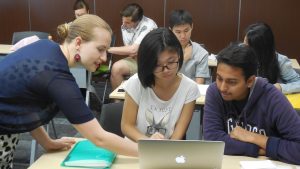
Annelise Marshall working with students in her Academic Composition class.

Ryan: I’m part of a committee that’s responsible for gathering and creating materials that teachers can use in their lessons.

LeeLee: Kodiak and I started our coordinator role: International Education Team. We started this role based on our observation that there is a lack of support for students interested in going abroad not related to the ASP (American Studies Program). The ASP is the largest study abroad program we have through TIU, where we send 120-130 students to Willamette University in Oregon for 10 months. ASP students have a lot of support, but other study abroad students are left to figure life out on their own. So, we decided to start doing what we could to help them. We do things like pre- and post-study abroad orientations, we advise and help students through the process of finding programs, we have even interviewed applicants to go abroad, and kept up communications with students as they were studying abroad. We have held multiple study abroad fairs in conjunction with the IEO (International Exchange Office). We discovered, encouraged, motivated and mentored international students (E-Track) currently at TIU to give cultural and educational presentations about their home countries in our plaza!

Kodiak: I am one of the International Education Coordinators. We are responsible for giving study abroad students the resources they need to be successful, creating opportunities for students to experience different cultures, and promoting internationalism around campus. We have been responsible from organizing the annual freshman trip to Oregon each year and give workshops and lessons related to study abroad.

Brandon: My committee focus is with the English Plaza Library, where I help maintain over 2,500 English books and continually add new and diverse options.

George: As the intern, you get to participate in all of the committees! I have a weekly rotation throughout all of the GTI committees that allows me to familiarize myself with their roles and duties, as well as help out with any of their current projects. At first it can be a bit overwhelming, but it’s also a unique opportunity and very insightful to see how the entire program comes together as a whole through these committees.
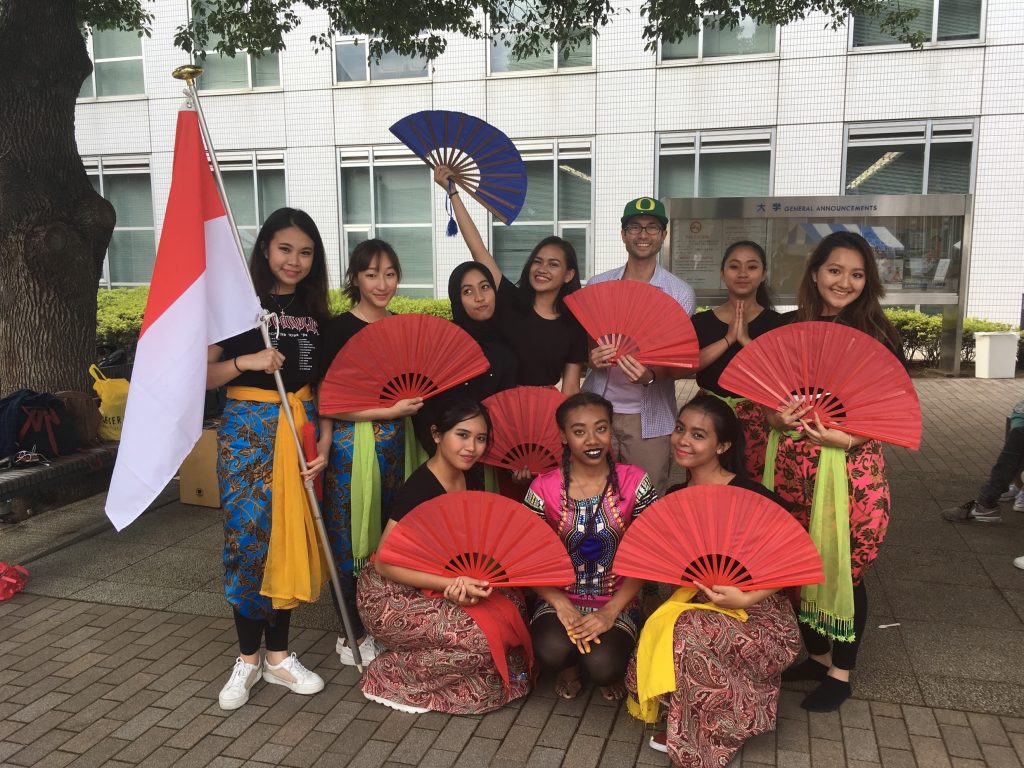
Brandon Bigelow posing with a group of students representing Indonesian culture for the TIU international fair.

What else do you do at TIU?

Becky: In addition to teaching, all faculty have to participate in either English Lounge, which is conversation time with students, or Academic Advising, which is helping with homework and essays. I chose to do English Lounge because I love talking with students every day. It’s awesome watching them blossom and try out new vocabulary and grammar as they talk about subjects they’re interested in.

Brandon: Additionally, I have the opportunity to chat with students on comfy couches about less formal, relaxing topics during English Lounge time.

Annelise: I also supervise the English-Speaking Society, a student-led club concentrated on using English for discussion and formal presentations.

George: I also get to participate in English Lounge and Academic Advising, which is pretty similar to the Conversation Partner program at UO. This has probably been my most favorite part of being at TIU, just because the students are fun to hang out with. At first it’s a little bit intimidating and it can be difficult to think of what to say, but then you realize that most of the students just want the opportunity to learn more about people from other countries and it becomes a very relaxing, fun experience.

Anything else you would like to share about TIU?

Becky: I really love working at TIU for many reasons. I love the wide range of students that I get to teach. I also love the working environment. All of the faculty are friendly and supportive. It’s nice to come to work and enjoy the people I am working with. It’s definitely like a family! We do things outside of work together, which is really nice when you’re living in a foreign country. It’s also nice to have a co-teacher that shares my same students, because we can plan our classes together and lean on each other for support. Not really TIU related, but I also really enjoy the Japanese semester system, because we have lots of vacation time. I’m looking forward to exploring South Korea, China, Thailand, and Taiwan in the upcoming months!  Finally, I really love that I have a network of LTS alumni here at TIU. It feels like a little piece of home even though I’m thousands of miles away!

Ryan: Teaching in Japan and at TIU has been an invaluable experience. I’m learning another language and culture—making friends and participating in local events has been personally very fulfilling. I’m also getting a better sense of what it means to be a professional in this field. Being a member of the Japanese Association for Language Teaching gives me access to talks and literature, as well as my own professional development opportunities. A great big thank you to LTS professors, and our great leader, Keli, who prepared us well to be in the field. It’s working!!
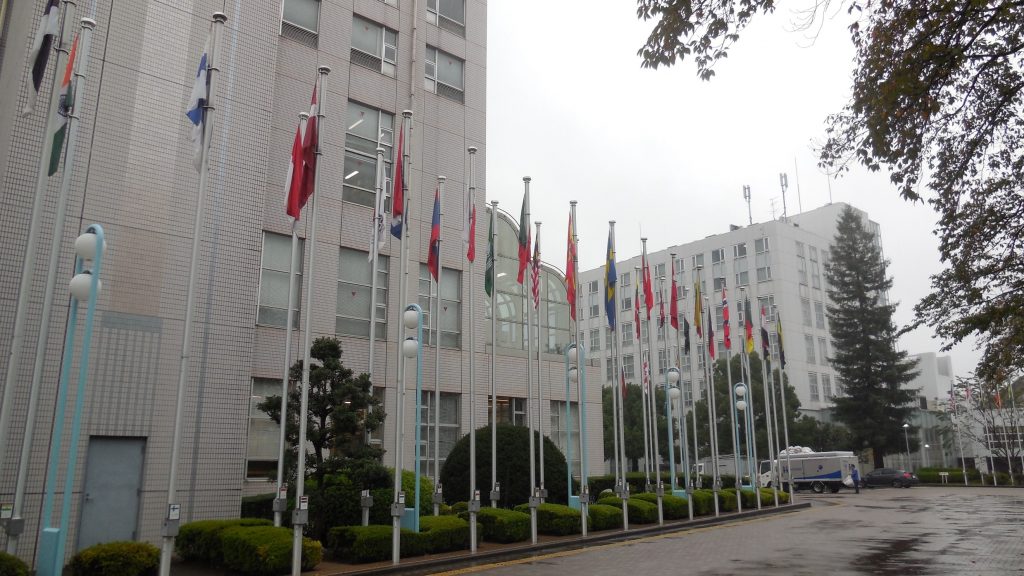
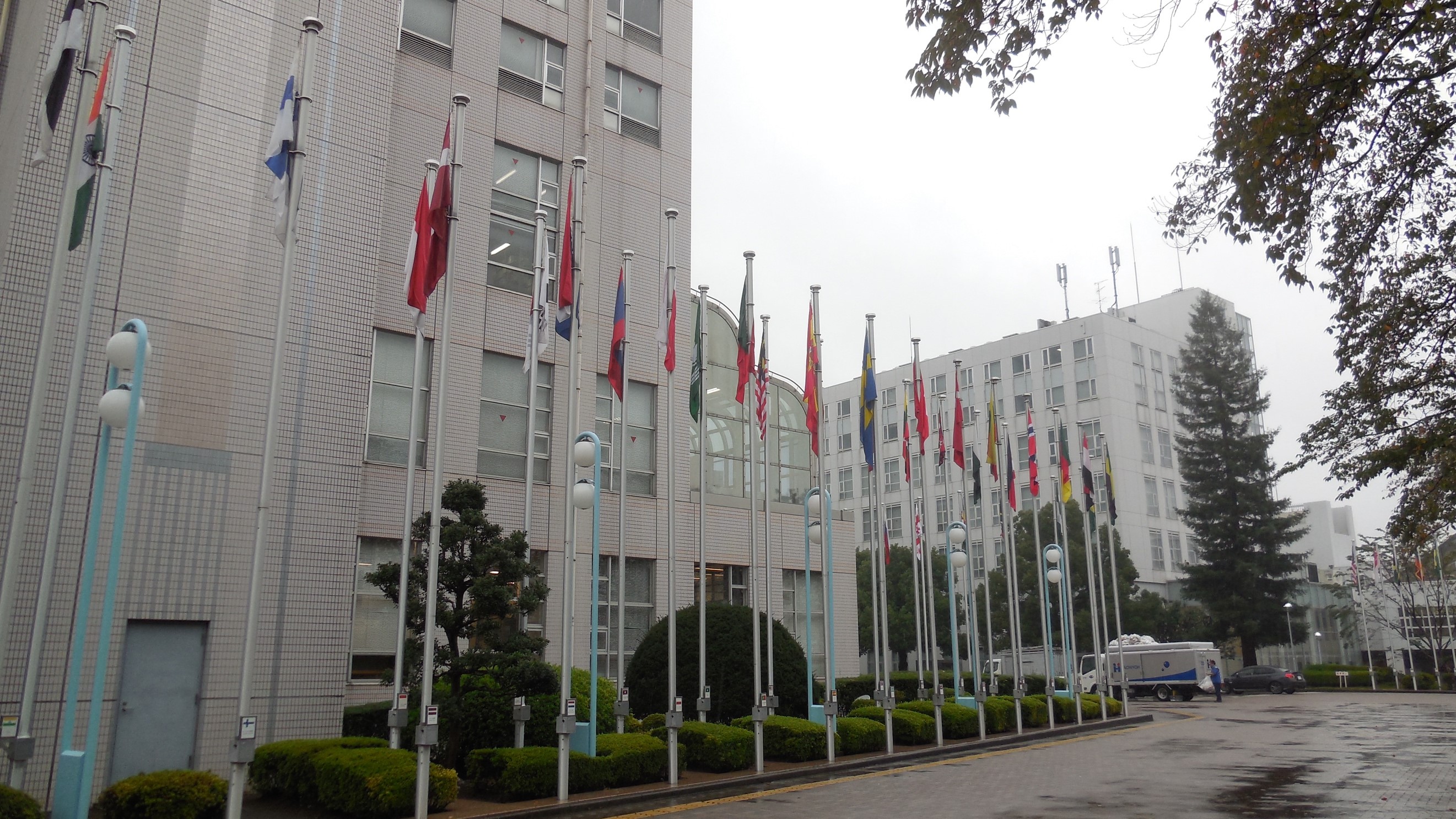
Walking into the TIU Campus Plaza, one can view the flags from many nations around the world.

Annelise: I love that at TIU I get to work with both Japanese students and international students from all over the world!

Brandon: TIU is incredibly welcoming. There is abundant respect and consideration for both the students and instructors. Being a part of the TIU community has been a true privilege.

Kodiak: I really enjoy working here! My coworkers and students are great, the class sizes are small, and I am able to try new and interesting things out in the classroom! 

George: One of the best things about TIU is that the working environment is very low stress. In my previous experiences studying Japanese and learning about Japanese culture, I had heard that the working environment in Japan is often one of high stress and long work hours. While each member of the GTI team is certainly busy, and may occasionally need to work a few additional hours, there is no sense of stress and everyone really seems to enjoy their time here. I really hope that I can become part of the team myself one day!

 

LTS 2016 – 2017 Cohort Final Presentations: A Brief Summary and a Fond Farewell

LTS 2016 – 2017 Cohort Final Presentation: A Brief Summary

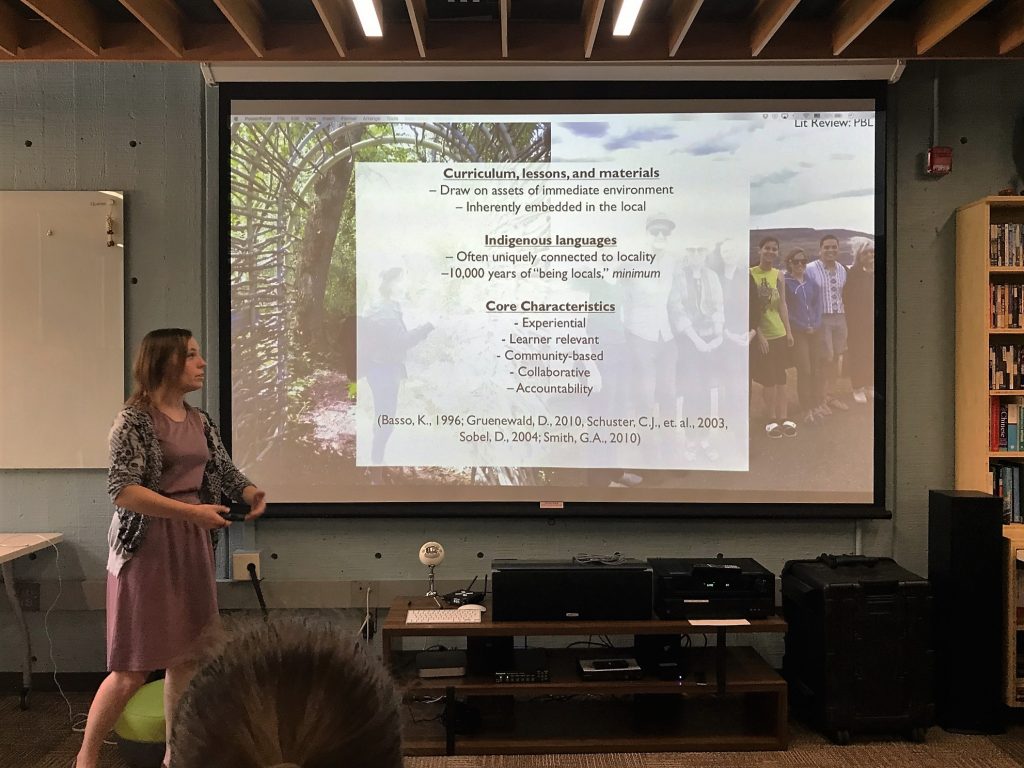
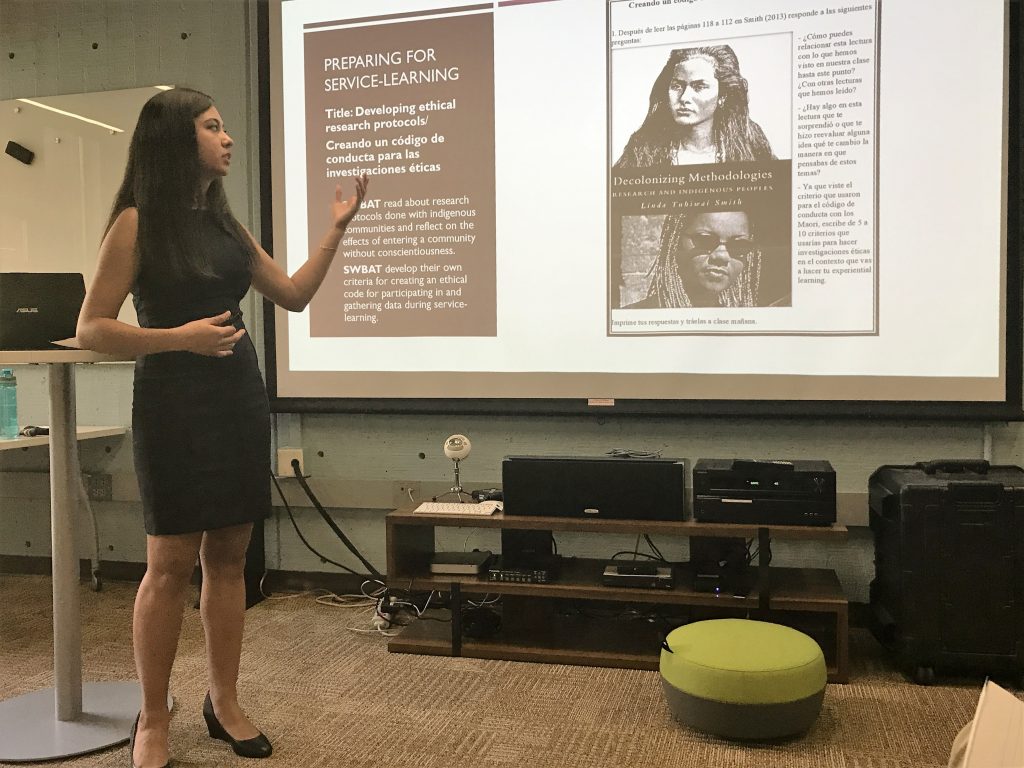
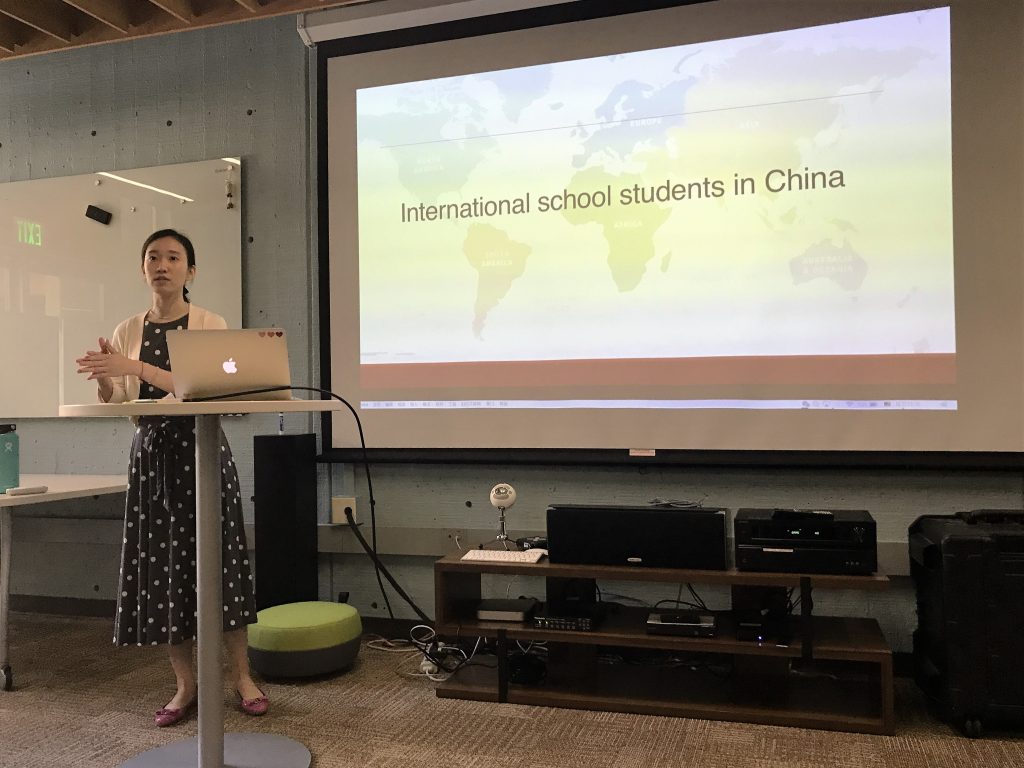
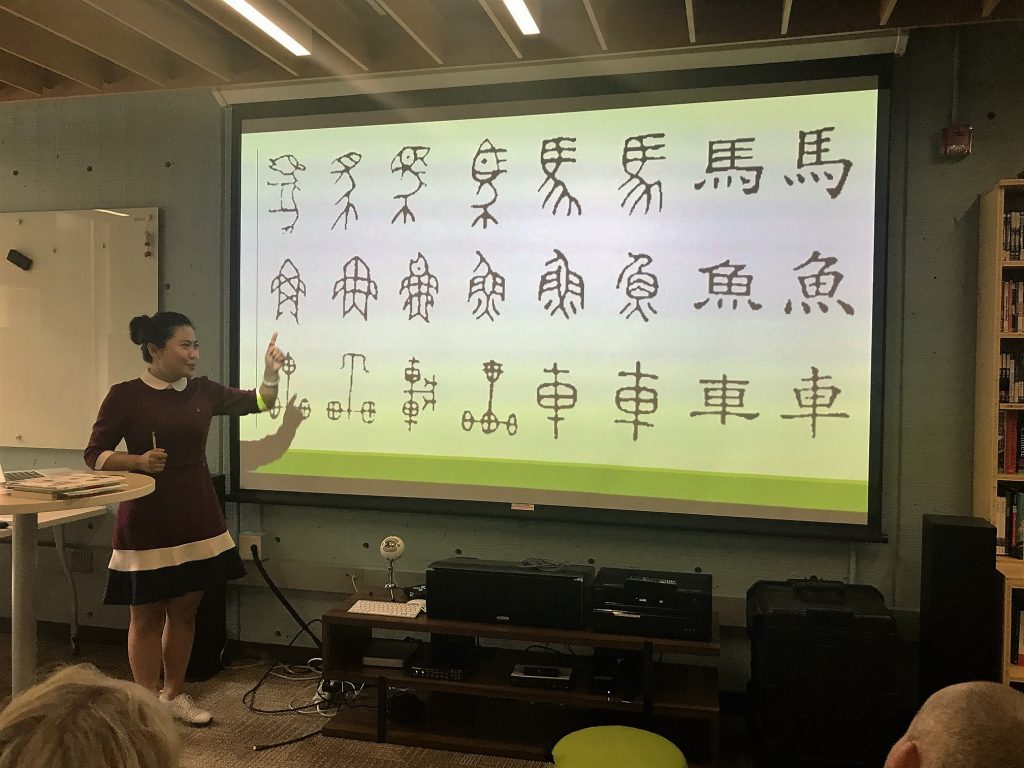
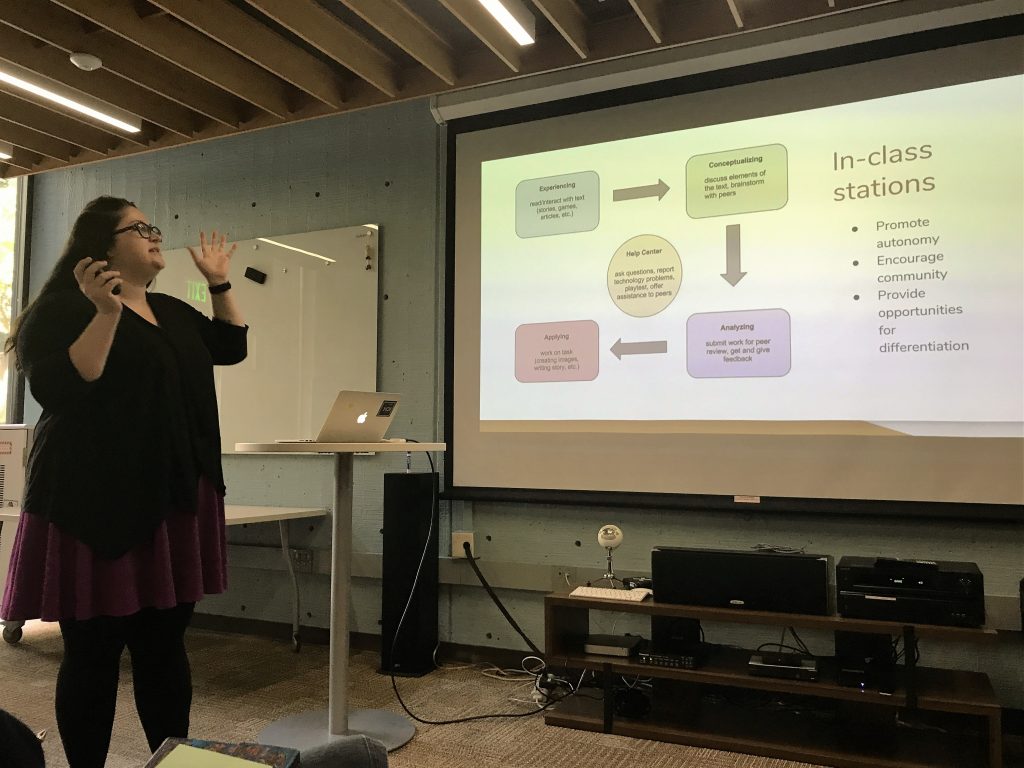
As the 2016-2017 LTS program comes to a close, the presentations are finished and the finalized projects are rolling in! As this year’s cohort gets ready for their next big adventures in the wilds of language teaching around the globe, this final blog post for the Summer 2017 term will provide a brief glimpse of the hard work and dedication the graduates have put into bettering themselves as language educators, and into bettering the world of language education as a whole. If you missed out on the presentations this year, here is a small gallery of snapshots of each presenter’s work!

Women Teaching Women English: A Contemporary Women Writers Course for Female English Language and Literature Students in Egyptian Universities by Devon Hughes


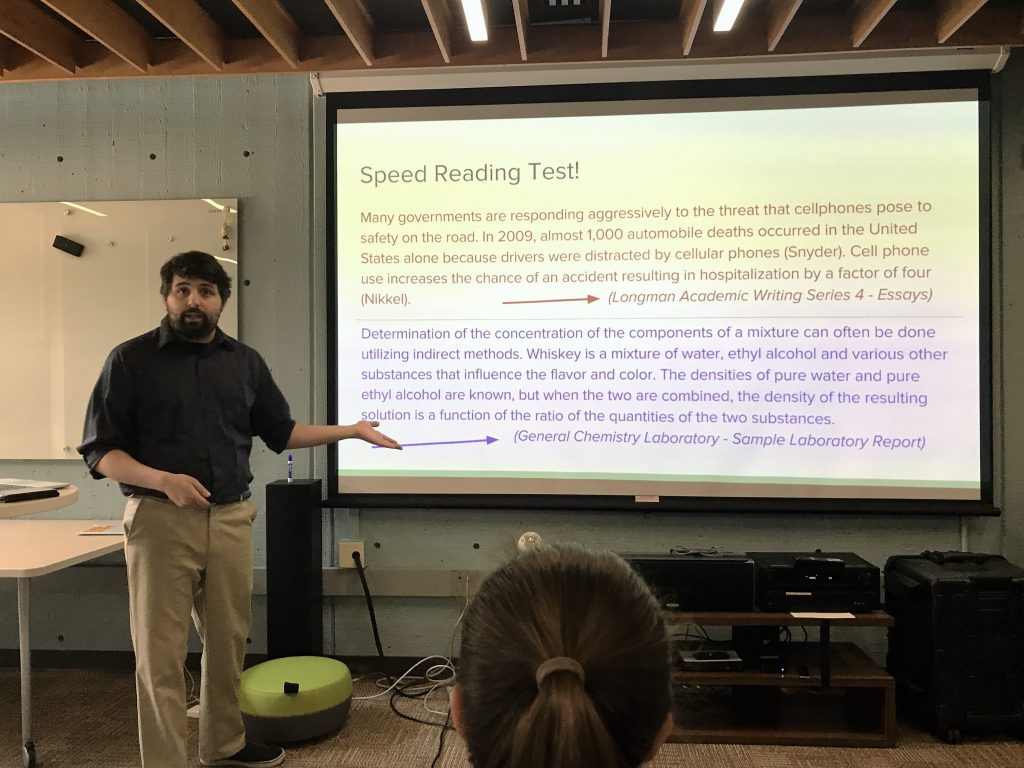
Academic Writing Skills for International Students of Chemistry at a U.S. University by George Minchillo


Marching to Different Drummers: Teaching a Mixed Class of Heritage and Non-Heritage Learners of Russian with Motivation in Mind by Iryna Zagoruyko


Korean as a Second Language for English Speaking Husbands: a Multi-cultural Family Situation-based Curriculum by Jiyoon Lee


An Adaptive Place–Conscious Ichishkíin Materials Portfolio by Joliene Adams


Crafting a Brand in English for English Language Learning (ELL) College Athletes by Juli Accurso


Using TBLT to Address Locative Phrase Word Order Transfer Errors from English L1 to Chinese L2 by Lin Zhu


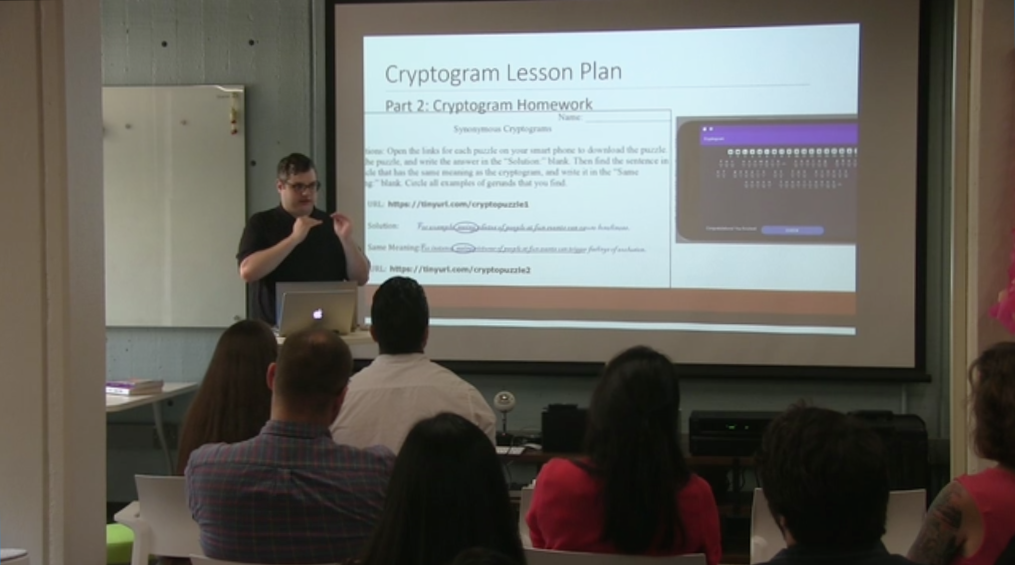
Deciphering the Cryptogram: A Word Puzzle Supplement to Traditional Lexicogrammatical Acquisition by Dan White


Using Literature to Develop Critical Thinking and Reading Skills in an EFL Class at University by SeungEun Kim


Integrating Service Learning into University Level Spanish Heritage Language Classes in the United States by Valeria Ochoa


A Career Exploration Course in Mandarin Chinese for Young Learners in East Asia by Reeya Zhao


Using Graphic Novels and Children’s Literature Books in U.S. 2nd year CFL University Courses by Yan Deng


Creative Writing in the Digital Age: A Course Design for Intermediate ELLs Majoring in English at an American University by Becky Lawrence


Using Podcasts to Teach Academic Listening for International Undergraduate Students through Metacognition: A Flipped Portfolio by Chris Meierotto

As a means of “paying forward” all of the help and support that we received from our professors, fellow classmates, and previous cohorts, the 2016-2017 cohort wrote up a short collection of thoughts and suggestions for future/prospective students regarding the final presentations:

How did it feel leading up to the presentations?

“I was able to learn a lot from the other presentations I saw. I learned how to make a good introduction to my project.” – Yan Deng

“It was definitely nerve wrecking at times. However, by this point in the program, I think us cohort members start viewing ourselves as a productive, contributing members of the field rather than students trying to play catch up, so I also viewed it as a chance to show what I could do as an educator.” – George Minchillo

“I felt great since it was a showcase of all my work, and I was happy to share my project with the cohort and faculty. It was a final milestone, and I tried to do my best for the audience to be interested and engaged in what I was presenting.” – Iryna Zagoruyko

How does it feel to know that you have the presentations behind you?

“I feel good because this was an opportunity to share what I have been engaged in for so long with the audience. After doing so many things during my time in LTS, I still felt supported when preparing for the presentations.” – Lin Zhu

“I feel free at last! However, I do think back to some parts of my presentation that I think could have gone better.” – Heidi Shi

“After doing the 2 year option and finally getting to the end of my final project and presentation, I feel exhilarated, excited, and exhausted! I’d been working on my project for a long time and it has morphed and evolved throughout my time in LTS. To present it in its final form in front of my peers, faculty, friends, and family was such an amazing feeling.” – Becky Lawrence

“It is always a bit sad to be done with anything in life. But, I feel that I did everything I could in my project, and hope very much that it could be useful in teaching mixed classes of Russian. I hope activities from my project will be implemented in the REEES curriculum here at the UO.” – Iryna Zagoruyko

What were the most difficult or the easiest parts of giving the presentations?

“I really tried to focus my presentation on entertaining the audience. I tried to leave out most of the minor details, and instead focus on showing the more ‘flashy’ parts of my project.” – Dan White

“The easiest part for me was making the draft of the slides, because I have so many things that I can pick and choose from my whole project to put in the presentation. The most difficult part was tackling audience questions, because some of them were unexpected!” – Lin Zhu

“The easiest part for me was actually having the chance to show my project! The hardest part was having a lot of information, and choosing which ones I should include in the presentation.” – Yan Deng

“For me, the most difficult part was having the confidence in the work I had done, and in portraying myself as an ‘expert’ in front of experts. The most useful part of the presentation was receiving additional feedback from peers and faculty that could be implemented in the final revisions of the project.” – George Minchillo

Any suggestions for future cohorts?

“For future cohorts, I would advise you to start thinking of project ideas early. Be creative, and try to combine your passions and interests with sound language teaching pedagogy. Take advantage of the built-in support of a cohort system, and ultimately just enjoy the process, because it will fly by before you know it!” – Becky Lawrence

“Prepare ahead of time, practice at least five times, and don’t make the slides too text-heavy! Be confident in yourself :)” – Heidi Shi

“Have confidence in the work you’ve done. You will undoubtedly be one of the most well-read and knowledgeable people about your context and materials in the room!” – George Minchillo

“Even though at this stage in the program, you will have completed 98% of your project. However, adequate time should be set aside to prepare for the presentation.” – Lin Zhu

“Enjoy the moment! Be nice to your cohort! They will be the greatest wealth in your academic life.” – Yan Deng

“Definitely be serious about your project! View it not only as an exercise, but strive to do everything possible to ‘break the ground’ in your field and context. Do not underestimate yourself – you have all the potential to create great activities/course designs for somebody to use in their teaching!” – Iryna Zagoruyko

A Fond Farewell

No matter where we go, and no matter what we do in the future, let’s always remember and think back to the knowledge, experience, and camaraderie we shared with one another as we grew into professional educators together. Even if we lose contact, or never find ourselves in a shared space again, we can always provide inspiration to one another to achieve our best, and to work hard to mold the world of academia as we see fit! For these reasons, I believe it is not necessary to say goodbye, but simply to say good luck to the 2016 – 2017 LTS cohort. I know we will all move on to do great things!

Thank you to my cohort members for all of their support! I hope to see you all again soon.
George Minchillo

“Die Grenzen meiner Sprache bedeuten die Grenzen meiner Welt. The limits of my language are the limits of my world.” – Ludwig Wittgenstein

Student Spotlight – Saba Alamoudi

Student Spotlight – Saba Alamoudi

Tell us about yourself! Where are you from? What kind of work have you done? Do you have any hobbies?

My name is Saba Alamoudi. I am from Mecca, Saudi Arabia. The holy city for Muslims and one of the oldest cities in the world.  It’s a crossroads and melting pot of many world cultures. People come to this city from many places around the world every year.

I was born in Makkah and lived in this city for my whole life, and I got my bachelor’s degree in Arabic literature from Umm Alqura University in the same city. After I graduated, I tried to find a job there related to my major, but I did not find anything. I decided to apply for a scholarship through the Saudi government to come to the U.S. I came to the U.S in 2012 and I started learning English. I was planning to teach Arabic as a second language and the LTS program was the perfect program for me to achieve this goal. Therefore, I decided to apply. I have tutored Arabic learners and lead the Arabic circle in the Mills International Center when I was an English learner in the AEI. I also was involved in many activities to introduce Arabic culture to American and international students through the Saudi and Muslim Students’ Association of the UO. After I enrolled to the LTS program, I got a job as a language instructor in Umm Alqura university in my hometown, which I will start after I graduate from the LTS program.

Could you tell us about any internships or GE positions you had at the UO?

I did an internship to work with Arabic instructors at the UO in some Arabic language classes that focused on teaching modern standard Arabic and the Egyptian  dialect.  It was a great experience for me. I learned from the teacher a lot of things related to teaching Arabic in an EFL context with students speak the same native language. I got the chance to teach in these classes and I learned a lot from the experience such as managing class time. One big challenge was to teach Arabic by speaking English in the classroom. For example, explaining many grammar rules or explaining vocabulary meaning using the English language. Arabic language classes in the UO helped me to realize the challenges that students face when they communicate and interact with native speakers. Arabic diglossia was the main challenge. The students were learning in most of their classes the Modern Standard Arabic which is used in very formal context such as academic context while native speakers use their own dialect to communicate with each other. The standard and the spoken languages are very different and it was hard for the students to understand native speakers when they speak. After spending some time helping students to realize the differences between the standard and the dialect, and after attending a Arabic class that focus on teaching the Egyptian dialect, I realized that the main difference is the pronunciation. That led to the focus on teaching pronunciation to clarify the problem of comprehensibility and intangibility in the communication between Arabic learner and native Arabic speakers.

Could you tell us a little bit about the ideas that you have for your Master’s project?

My Master’s project focuses on integrating teaching Pronunciation In Arabic curricula as a second language through some activities. I focus on both segmental and suprasegmental features for modern standard Arabic and the western Saudi dialect. My goal is to help students learn how to use what they’ve been learning in the modern standard Arabic language classes to interact and communicate with native speakers. Learning more about the differences in the the sound systems for both varieties of Arabic can help them avoid a lot of intelligibility and comprehensibility problems.

What is the most valuable thing that you’ve learned during your time at the UO?

Professors at the UO, especially the LTS program, have different teaching styles than most professors in my country. One main valuable thing that I learned is how a great teacher should be. Other valuable things that I learned and appreciated during my time in the program are the teacher and peer feedback in the classroom, the classroom discussions, the microteaching activities and practice that I have had during my learning journey. It helped me to apply and experience a lot of things that I learned theoretically in the program, and it helped to shape my teaching perspective and style. Finally, I learned that language is more than vocabulary and grammar rules. Also, culture is always associated with learning languages; therefore, including pragmatic, sociolinguistic and suprasegmental aspects is very important to teaching a language effectively.

Student Spotlight – Iryna Zagoruyko

Student Spotlight – Iryna Zagoruyko

Tell us about yourself! Where are you from? What kind of work have you done? Do you have any hobbies?

My name is Iryna Zagoruyko and I am originally from Ukraine. I moved to the U.S. 5 years ago. I got my first Master’s degree in Business Administration in Ukraine. After graduation, I worked as a manager of foreign economic relations at the Korean International Company in the capital of Ukraine, Kyiv. Also, in Ukraine I worked as an Interpreter of English for foreign economic delegations. After I moved to the U.S., I worked as a student specialist in the ESL Department at Lane Community College in Eugene. After that, I did my second Master’s degree with the Russian, East European, and Eurasian Studies Department at UO, simultaneously teaching first- and second-year Russian courses as a GE for two years (2014-2016). Being a Russian GE really changed my life goals: I understood that language teaching is my passion and decided to receive more knowledge on that. Now I am a graduate student at the LTS program of the Linguistics Department of the UO, and plan to receive my third Masters’ degree in language teaching this Summer.

This year was quite intense for me. Juggling being a graduate student in the intense LTS program, working at CASLS, and having a small baby (who was born three weeks after I started the LTS program) was quite a challenge. I did not manage to have a lot of free time for hobbies or interests and had to plan smartly to balance all aspects of my life. But every spare minute I have I try to spend with family: my baby and my husband. We really enjoy hiking together, going to the coast in Florence, and just being together at home.

Could you tell us more about your GE position at UO?

This year I was a graduate employee (GE) at CASLS (Center for Applied Second Language Studies) at UO. I worked on the Russian version of CASLS’ Bridging Project, a year-long hybrid course centered on exploring student identities. This project encourages students with high levels of proficiency, especially heritage students and those who graduate from immersion programs, to continue language study at the college level, which has become increasingly more challenging. CASLS is a great environment where people support and value each other. It was a big honor for me to work in such a highly-valued and highly-recognized National Foreign Language Resource Centers as CASLS. I truly believe that work which is done at CASLS will improve teaching and learning of world languages.

Could you tell us a little bit about the ideas that you have for your Master’s project?

My master’s project is called “Marching to Different Drummers: Differentiated Instruction for Teaching Mixed Classes of Heritage and Non-Heritage Learners of Russian with Motivation in Mind.” The motivation for this project is to offer language teachers access to the concepts of differentiated instruction, and strategies for applying it to their specific teaching context – mixed/homogeneous classes of heritage and non-heritage learners of Russian of novice to intermediate levels of proficiency.

What is the most valuable thing that you’ve learned during your time at the UO?

Probably, that we, LTS students, are all in a perfect place to gain very valuable knowledge on teaching which we can later apply in our lives. Professors in the LTS program possess extremely high levels of expertise in language teaching and offer us great support. Being a part of a single cohort of LTS students who are taking the same classes and doing the same projects together is really fun.