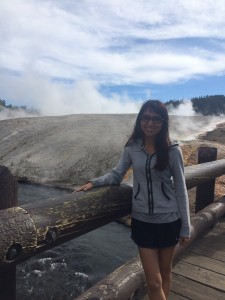
Student Spotlight: Xiaoshuang Wei

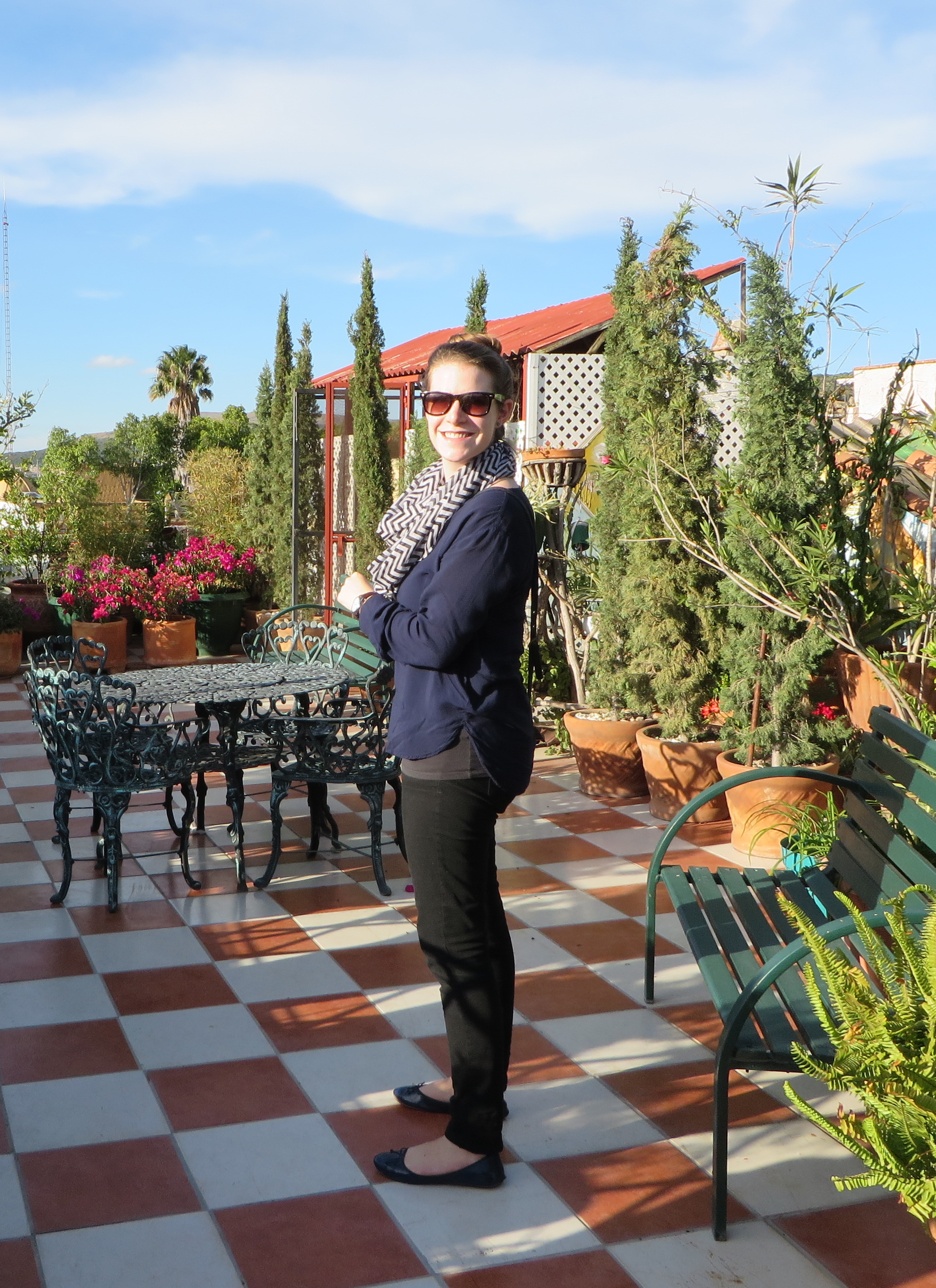
IMG_0184Xiaoshuang Wei is from the Northwest of China. Her undergraduate major was English literature. In her senior year in college, she went on an exchange program in Eugene for five months. After getting her BA, she went back to U of O to pursue her Master’s degree.

What do you think about your learning experience here?
I really like the friendly and supportive cohort environment in this program. LTS is a program that encourages cooperation and highly values cultural diversity. I benefited just as much from working with my cohort members as learning from the teachers. Coming from China I’m used to passively listening to teachers lecture in class. In LTS classes, I experienced different teaching styles, which gave me great inspiration in developing my own teaching philosophy.

What is your MA topic? Why do you choose this MA topic?

My MA topic is Grammar and Cohesion — developing discourse ability in American learners of Chinese. I was interested in this topic from when I was doing my GTF as a Chinese tutor for the Chinese Flagship program in U of O. Grading and giving feedback on students’ writing has always been a challenge. Many students’ writing sounds alien; however when you look at individual sentences, they are mostly grammatically correct. This makes me wonder what it is that makes their writing incoherent and what the teachers can do to help improve students’ overall discourse ability.

What process have you experienced to finish it? What is the most challenging part?

I took a more linguistic approach in finishing this project. Unlike most of my cohort members who did surveys in their needs analyses, I created a mini corpus of all the students’ writing samples and did a writing analysis. The most challenging work is to create teaching material and activities that use the methodology we’ve learned in LTS classes to tackle the problems identified in the writing analysis. It is a valuable experience for me to modify teaching methods and activities that were originally designed for TESL/TEFL context to teach Chinese, a language that’s drastically different from English.

Do you have any suggestions for our cohort who haven’t finished our MA projects?
I believe that interest is the biggest motivation. Find out a real need or something you want to investigate and start from there. It is normal to feel stuck or overwhelmed. Talk to your advisors with specific questions that you have and ask for recommendations for big names in the field or important literature. The teachers are always happy to help you and they all want us to succeed.

Alumni Spotlight: Misaki Kato

Misaki Kato graduated from LTS in 2014. Her MA project was titled, “The Effects of Peer Review Training on ESL Upper-Intermediate Students’ Individual Writing Skills”. Below she shares how the practical teacher training in LTS helps her think about applications of theoretical concepts in the UO theoretical Linguistics program which is where she is studying now.misaki_hike (1)

What is the work that you are doing now?

I’m currently a second year PhD student in the theoretical Linguistics program at UO. My focus is in second language acquisition, especially in speech production, perception, and the relationship between the two (which is one of the big projects I’ve been working on outside of coursework). I’m also interested in production and perception of foreign accented speech. Also, I’m part of the LTS social media team and managing posts on facebook and twitter pages, which I enjoy very much.

In what ways did the degree from the LTS program lead you to where you are now?

The LTS program gave me opportunities to think about theoretical issues from practical sides and also further strengthened my interests in SLA theories. Especially because I hadn’t had experience in teaching as a full-time teacher, it was helpful for me to talk about ideas with my classmates and faculty who were more experienced teachers who had taught in many different contexts. My “learning by doing” experiences, such as microteaching in LT classes, internships in the AEI, and GTF-ing in Japanese classes, gave me so much insight into how to approach real classroom issues in various ways.

The faculty members were very helpful and flexible. Even though the LTS program doesn’t prepare students for PhD program in terms of its coursework, the faculty members never stopped me from thinking about practical issues from theoretical point of view, and they encouraged me to explore my questions in creative ways. I was very grateful that my MA project advisor and the second reader worked with me patiently to construct my action research project and gave me insightful theoretical and practical advice. These unique and supportive characteristics of LTS led me to where I am now.

Now in my theoretical program, when I think about abstract ideas or theories, I often think about the potential practical application of the question that I’m trying to explore (e.g. Why does this matter? What could this possibly mean for second language learners and teachers?). Sometimes I easily get confused with the significance of theoretical linguistic concepts, but my experiences in LTS remind me of the things that language learners and teachers do and what actually matters in the classroom.

Why did you initially choose to pursue an MA degree in Language Teaching?

After having teacher training in my home country, I wanted to pursue more solid knowledge and experiences about language learning and teaching before I actually had a job as a full-time language teacher. When I was an undergraduate exchange student from Japan at UO, I met Keli and she introduced me to the LTS program and one of its alumni. I thought it would be a great place to pursue my theoretical interests and to explore options to apply what I had learned in practical ways.

Do you have any advice for LTS graduates who might pursue jobs other than language teaching after their degrees?

One of the big things (skills) that I learned in LTS is to interact and collaborate with classmates. I think being able to collaborate with people at a professional level is a really important skill whatever you are doing. Sometimes it’s not easy (especially for a person like me who is not always good at socializing), but talking with people about whatever ideas you have (or they have) really helps to broaden your perspective. It’s helpful to actually explain your idea to somebody else too, to organize your own thoughts. So, my advice would be to use the collaborative skill that you built in LTS wherever you go.

Student Spotlight: Becky Lawrence

12027657_10207248667071914_7717221249091627894_n

Becky Lawrence, originally from Lafayette, Louisiana, double majored in English and Spanish Linguistics. She is currently learning Japanese as her third language and dreams of teaching English at a university in Japan. She is interested in integrating digital games and creative writing into her future classrooms.

Why did you choose the LTS program?
 
I chose the LTS program at the UO because it offered something I couldn’t get anywhere else I researched: the ability to obtain a Master’s degree through an intensive one-year program completed with a small cohort of peers under the guidance of excellent faculty. During the day, I am a busy graduate student with classes and work. When I go home, however, I hang up my backpack and leave the student life at the door because I have a three and a half year old who has missed me all day. Being able to get such an amazing education in half the time allows me to get into my desired career sooner than anywhere else. It is almost too good to be true!
 
What are you involved in outside of your LTS classes?
 

I am currently a Conversation Partner and Help Desk Writing Tutor at the American English Institute (AEI), an intern at the CASLS, the Center for Applied Second Language Studies, and an English Language Circle Leader at Mills International Center.

How do you balance everything that you do?

I wake up every morning and look at my child. It really is that simple. Seeing her young, innocent face and imagining the dreams I want her to be able to achieve one day gives me the motivation to do everything I can to not only provide for my family, but to show her that she can do anything she dreams of as long as she never gives up.

What advice would you give to other parents about going to grad school?

Don’t ever limit or label yourself. Don’t think that you’re too old, or too busy, or too anything. If you want to go to graduate school, do it! The hardest part is believing in yourself. The only things that are impossible in life are the things you have never tried doing.

What are you most looking forward to this year in class or in your other involvements?

I am looking forward to starting on my Master’s Project! Although it’s going to be a long and most likely difficult road (which is why energy drinks were invented !),  I am so excited to create something that will be useful to me in my career as a language teacher.

Faculty spotlight Deborah Healey

Could you tell us a little bit about your connection to the LTS program?

I have taught in the LTS program and online teacher education courses from the American English Institute since I came to the University of Oregon in 2009. Appropriate use of technology in teaching is a passion of mine. I’ve done workshops in a wide range of countries and contexts to encourage teachers to understand the technology available to them – and what might be available in future – so that teachers can make good choices about the resources they use.

Could you briefly describe the course you teach?

I teach the Computer-Assisted Language Learning (CALL) Workshop in Fall and Winter terms. The courses are designed to give a sense of ways that technology can be used to achieve teaching and learning goals, both as an LTS student and as a language teacher. Aside from our learning management system, Canvas, the CALL course uses freely-available resources that are accessible outside the UO so that LTS grads will be able to take what they’ve worked on and use it wherever they go.

What is the best part about your work?

I greatly enjoy the way that the different aspects of my professional life fit together. Currently, I’m co-teaching a massive open online course (MOOC) with Jeff Magoto and Elizabeth Hanson-Smith. We co-developed the two 5-week courses that have been taken by over 50,000 people in the past two years. I’ve also developed and taught several fully online courses to English language teachers around the world, and I’ve been privileged to give workshops internationally as an Academic Specialist with the US Department of State. My face-to-face teaching has benefitted from all of this. Sometimes I can see the results of the work, as with the Gabon Oregon Center project. I did teacher training in Gabon with Keli Yerian with the goal of enabling Gabonese teachers to become teacher trainers. This June, that paid off with the opening of the Laboratoire de Langue in Libreville, offering general English and teacher training courses and staffed by Gabonese teachers. We were also able to provide an internship opportunity to 2015 LTS alum Tiffany Van Pelt in Gabon, where she is right now.

What advice would you give to LTS students?  (video answer below)

Student Spotlight: Katie Carpenter, a new GTF at CASLS

Katie Carpenter is originally from Anchorage, Alaska. She speaks Spanish, and some Japanese and Portuguese, and is interested in learner engagement and motivation, and curriculum and materials planning. She has taught English at a language school in San Luis Potosí, Mexico, working with all levels.

IMG_1528

Why did you choose the LTS program?

I chose the LTS program because of the experience I had at the UO, in the Language Teaching and Linguistics Departments, while an undergrad. I originally wanted to go into elementary education, and was taking classes to do that. Since I love languages and travel, I decided late to try out some LT and LING classes, and loved the material and faculty I got to work with. I really liked how I found everything I was learning to have a real-world application in the areas I was interested in, and I got a lot of support from others in LT and in the Linguistics department. After that, it felt like the obvious choice for me.

What is your GTF context?

I am the Curriculum Development Assistant at CASLS, the Center for Applied Second Language Studies. A lot of what I have been doing so far is helping on projects where they need some extra assistance–doing transcription, helping get the game app Ecopod (which was recently used in its first class at UO!) ready, helping at a freshman orientation booth, etc. I’ve been able to learn a lot about many different projects at the center. One project I am working on now that I really enjoy is writing classroom materials/activities for InterCom, our weekly newsletter, and that will be a portion of materials taken to this year’s ACTFL convention.

What is the most challenging part of your GTF?

A lot of the materials/resources developed at CASLS are intended to be used in a language classroom in the United States, which is not where my past experience has been. CASLS also has projects that are very game/interactive technology focused, and I don’t have much experience using that type of technology in the classroom. I’m finding that I often need to do some extra research, or ask questions of those around me, to expand upon my own experience and knowledge. I think this helps me create materials that are applicable in a wider variety of contexts than I am used to, so that they are useful to more teachers and classes. Luckily, CASLS has a really supportive environment, and I’ve been able to get lots of advice.

What is the most rewarding part of your GTF?

I’m learning so much, and I’m getting really valuable experience. It also makes me proud that the materials that I write, or projects that I help with even a little, are going to be resources that are used in language classrooms, and that will help students learn. Like I said, it’s a really supportive environment, and they’ve already made a point to not only put me on projects where they need help, but also give me work that will help me develop my own skills and qualifications.

What are you most looking forward to this year in your GTF or in the
LTS program?

In my GTF, I’m looking forward to learning from what everyone at the center has to offer, getting more resource development experience, and, short term, hopefully going to the ACTFL convention this year with them.
In the LTS program, I’m hoping to take advantage of all the opportunities for skill development they offer. I’m looking forward to doing an AEI internship, to starting on my MA project, and to developing more relationships with faculty.
Both contexts provide me with a lot of opportunities, and I’m eager to take advantage of them!

Alumni Spotlight Norman Kerr

Norman Kerr graduated from LTS in 2007. His MA project was titled, “Preparing University Students for Self-Directed Study: An Online Chinese Course”. Below he talks about how his experiences in LTS and also in subsequent teaching career led him to his current job at the Yamada Language Center at UO.
 Kerr_LTS

What is the work that you are doing now?

I’m currently working for the Yamada Language Center at the University of Oregon as a CALL expert and analyst programmer. We develop web applications for language teachers not only at the University of Oregon, but also around the world. We just released a new version of our application, ANVILL (A National VIrtual Language Lab), that provides teachers with several speech-based tools for online and blended learning classes.

 In what ways did the degree from the LTS program help prepare you for this position?

There are several ways the LTS program helped me succeed in my current job, and also at my last job as a EFL teacher in Taiwan. The first was providing theory and practice at curriculum design. With my current job it’s been very useful for understanding how to build software that can be used to either supplement the main class curriculum or as the sole curriculum for the class.

The second way it prepared me was by giving me the chance to co-teach with an experienced ESL teacher here at UO, particularly since I went into the program with no teaching experience. This was very helpful in getting my first EFL job in Taiwan.

Lastly, the CALL classes were very useful, not so much from a technical perspective, since I already had an extensive technical background, but in providing an overview of different CALL technologies and the ways to integrate these technologies into the classroom. It has been immensely helpful to know what software is already available and what purpose/problem that software is trying to solve, when developing new language learning applications with new and upcoming technologies.

Why did you initially choose to pursue an MA degree in Language Teaching?

I’ve been passionate about language learning for a long time. My bachelors degree was in Chinese, and I’ve also spent time learning Thai and Spanish. My initial reason for choosing the LTS program was mainly to enrich my own language learning skills and to extend that passion into a career that gave me the ability to work and travel and continue to learn languages.

Do you have any advice for LTS graduates who might pursue jobs other than language teaching after their degrees?

My advice, based on my own experience, is that it’s worth spending some time actually teaching before going into a different or related field. I gained a great deal from the three years I spent teaching in Taiwan, and I’m constantly putting to use that knowledge and experience, particularly in understanding the teaching process and classroom requirements for an audience I’m no longer exposed to on a daily basis, but are the end users of the software I develop. Having a mixed background of both technical and pedagogical was essential in getting my current job.


Faculty Spotlight Keli Yerian

Could you tell us a little bit about your connection to the LTS program?

I am a faculty member in the Linguistics Department, and have been the Director of the LTS MA program since 2010. I have taught in the LTS program since 2007. Until recently, I also taught classes in the American English Institute (AEI), so I have a connection to the AEI as well.

Could you briefly describe the course(s) you teach?

I teach a few of the core courses in the program, including Language Teaching Planning in Fall term, Curriculum and Materials Development in Winter term, and the Master’s Project class in the final Summer term. In the Planning class, students practice designing motivating lessons for language learners while aligning student learning outcomes and assessments. In the Curriculum class, students build their own language courses week by week. In the Master’s Project class, students are intensively working on creating their own capstone projects. I also organize an LTS Orientation class in Fall and facilitate a Microteaching workshop class in Spring. I’m pretty busy!

What is the best part about your work?

There are many best parts! I love being part of the whole cycle of the program and getting to know all the cohort members so well. As program advisor, I meet each new graduate student from the start, get to know them during the year in classes, and am one of the first to congratulate them the day they submit the official final draft of their project manuscripts. I also value hearing ideas and suggestions for improving the program from students and faculty and then being able to help actually make them a reality as Director.

What advice would you give to incoming LTS students?  (video answer below)

Alumni spotlight Fernanda Gonçalves

Fernanda Gonçalves (formerly Nunes) graduated from LTS in 2013. Fernanda was already an experienced English teacher in Brazil who had participated in the American English Institute’s E-Teacher program before she joined LTS. In 2013 while she was at the UO, Fernanda was the subject of a slideshow project by UO Journalism student Nicole Trumbo, who documented some of Fernanda’s hopes and dreams as an international graduate student (while Fernanda also was learning Salsa dancing).

Screenshot 2015-09-23 14.29.15

http://blogs.uoregon.edu/ntrumbosu13gateway/audio-slideshow/

Looking back on this slideshow, what is your reaction now?

In this slideshow I cite the goals that made me go to the US. And now looking back I see they were all accomplished.  Now I have a better job, I am a better teacher and I have more time for my daughter…which means that I am also a better mom!

What and where are you teaching now?

I am teaching English as a foreign language at a Federal Institution for high school students and it has been the job of my dreams. I am deeply happy and grateful for being a federal teacher now.

What is an example of something you learned in the LTS program that you still use today?

To better plan my classes, there is no better lesson plan format than the one I learned in the LTS program. It has helped me tremendously and thanks to it, my lessons have become more coherent and my students have been learning much more and much better now.

What is your best memory of LTS?

To choose a best memory is almost impossible because I had so many. I learned so much with all the classes that I had. All the professors not only taught me unforgettable lessons, but they also inspired me for life. The cohort was also so amazing. Each unique classmate was so special to each other that we all became a big family. We were always together…to study or to party…we could always count on each other. However, if I have to mention a very special moment, it is my master’s project presentation. I could not believe it when I saw most of my friends there for me, not only from the cohort, but also the friends I had made inside and outside the University of Oregon. My AEI students were also there and some of my professors. So, when I started my project presentation, I knew I was among friends…and it gave me the strength and confidence I needed to try my best. Seeing that room full of friends not only gave me one of the best experiences/memories of my life, but it also showed me that when one has friends, one has it all!

Alumni spotlight Sothy Kea

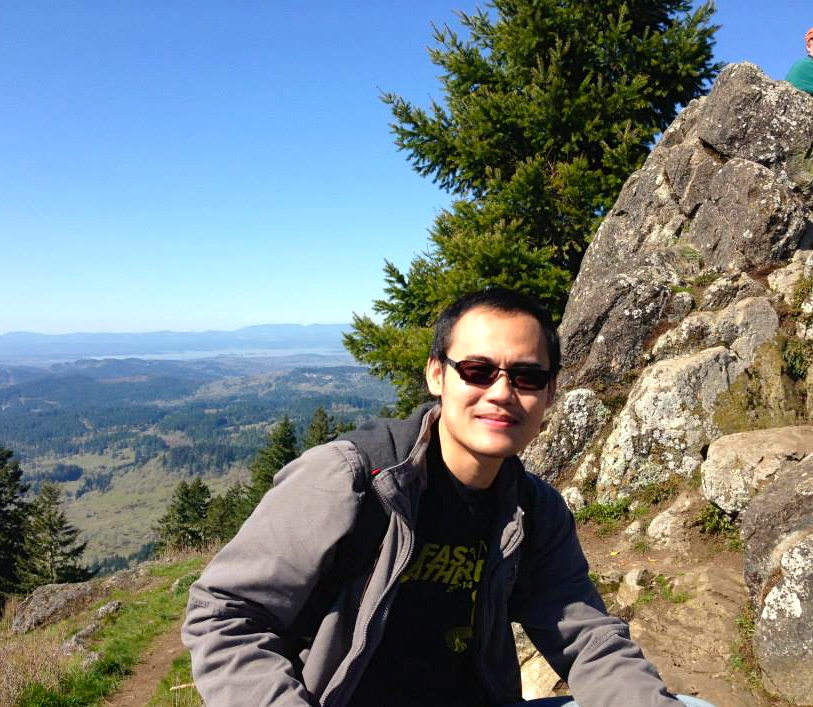
Sothy Kea was a Fulbright student from Cambodia who graduated in 2014. His MA Project was titled, “An Integrated Oral Skills English Pronunciation Course for Cambodian College Students”. Below he shares his current perspective on what was most useful and memorable from his time in LTS (photo below is at Spencer Butte, Eugene, OR).

What did you want to accomplish when you applied to the LTS program?

When I first applied to the program, I wished to improve my knowledge about English language teaching methodology, research, linguistics, and curriculum design. Upon program completion, I was hoping to provide assistance in revising curricula, conducting workshops, and teaching in the undergraduate and graduate teacher training programs at my workplace: Institute of Foreign Languages, Royal University of Phnom Penh.

KEA Sothy 1What is your teaching or administrative position now?

Now I am holding two positions. I am a university lecturer teaching in a Bachelor’s Degree in a TEFL program and a Master’s Degree in TESOL at the Institute of Foreign Languages, Royal University of Phnom Penh. I am also a Language Program Manager at CIA First International School in Phnom Penh, Cambodia. In this position, I am responsible for managing various language programs at the school. At the moment, I am managing the General English Program, and in the future, I will expand this program and develop other language programs.

Now that you have returned home, what do you think was most useful from the LTS program?

The curriculum of LTS Program is of sound quality. A large number of subjects that I took are both directly and indirectly relevant and useful for my current work. For instance, I am currently teaching the same subject of Academic Writing for Graduate Students in MA in TESOL and teaching Applied Linguistics subject in BA in TEFL Program at my university in which a great deal of knowledge and content of English Grammar and Linguistics Principles and Second Language Acquisition courses  are relevant and useful. Plus, working as the Language Program manager, I have to revise the current curriculum and develop new ones. Thus, the Curriculum and Materials Development course and my curriculum design Master’s project are of great help to me. They allow me to analyze the program, effectively identify its problems, and propose feasible solutions. The rest of the subjects in LTS have also indirectly contributed to my understanding about language learning and teaching and better teaching performance.

What is one of your favorite memories from your time in Oregon?

If I could recall, one of my favorite memories in Oregon is my graduation day. This is one of the best moments of my academic life at UO. It marked the achievement of a milestone and the great result of hard work throughout the program. I was so excited to have such achievement and to see my cohort having the same feeling. It was also fantastic to have the presence of my professors, friends, and relatives on this special occasion. The moment I received the certificate on stage was when I thought to myself that “this is the result of not only over one year of sweat and blood at the UO in the USA but also a whole life of education, and I am thankful to all the people who are part of this”.

Alumni spotlight Beth Sheppard

Beth Sheppard graduated from LTS in 2008 and is now an Instructor at the American English Institute (AEI). Her MA project title is, “Bringing Your Language Home: A Workshop and Materials for Pacific Northwest Families Involved in Language Revitalization”.

What did you value most from the LTS program?

My favorite part was the sense of community among our cohort of students and with our instructors. I really enjoyed getting to know every single person I studied with, whether it was collaborative class work, cohort lunch gatherings, professor office hours, or learning from my project advisor. I also remember how much I enjoyed the taste of theory we were treated to in the first summer term. These were yummy classes!

What did you learn in LTS that you still use in your teaching today?

I’d say the attitude we worked under was more important than any piece of information. In the LTS program we practiced cooperating with colleagues and focused our explorations of teaching on meeting students’ actual needs. These key principles are still the basis for my teaching.

What advice would you give to new LTS students?bethandtoby

Try to open yourself to every topic in every class. The ones you don’t think you’re excited about might end up being the most memorable. Pick a topic early for your project. Read your way into the literature over winter break.