Student Spotlight: Christopher Daradics

LTS-Photo.fw

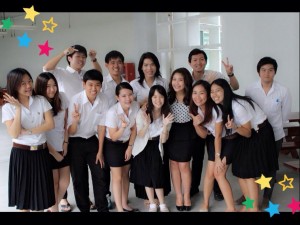
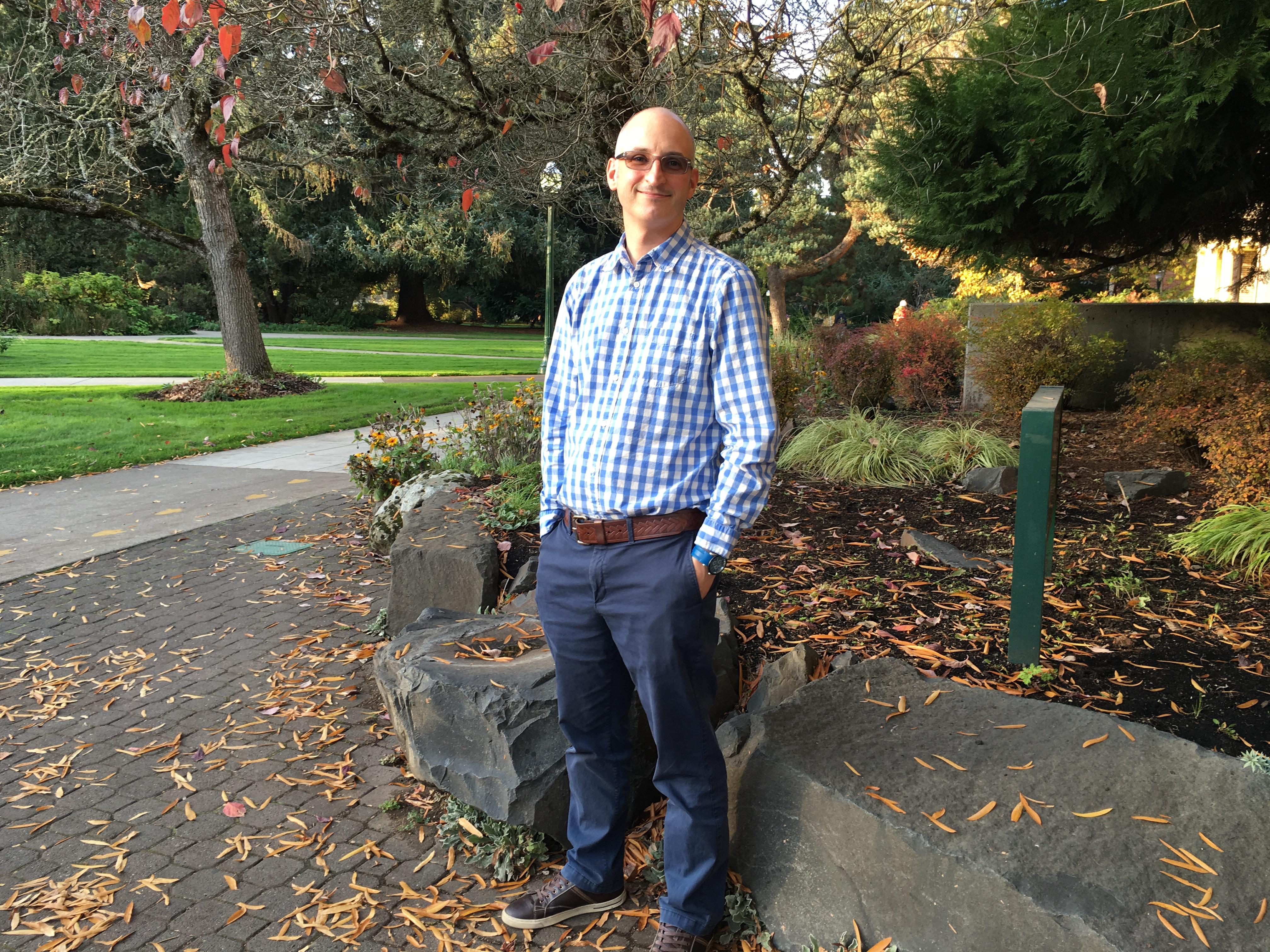
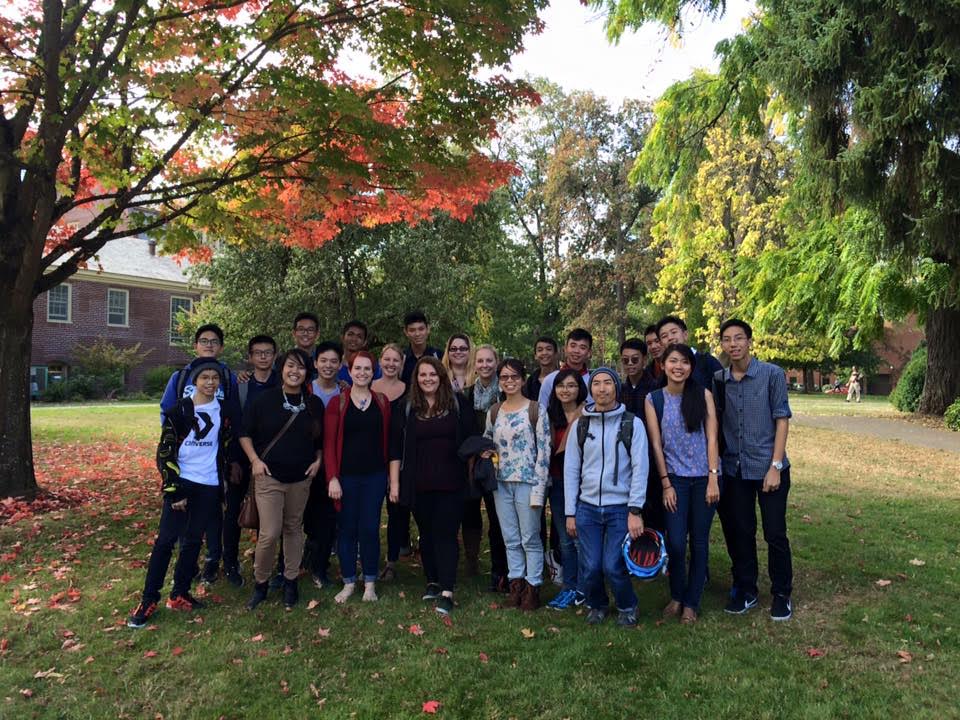
“This photo caught me in the act of describing exactly how one goes about catching a unique rabbit. I’m a repeat grad student (MA in Liberal Arts from St. John’s College) with a strong bias for visual communication and design. I love soup, cleaning my house, and find myself playing unrelenting zookeeper to the various wildlife I encounter lurking around my neighborhood.”– Christopher Daradics

Why did you choose to enter the LTS program?
After teaching, in one form or another, for over a decade I’d never felt entirely satisfied being constrained to a single context. I was looking for a way to integrate my passion for teaching with my other major life interests: international travel; graphic, communication, and experience design; and language(s). The LTS program presented itself as an opportunity to integrate my core strengths and passions and work my way towards a career in curriculum design.
XXX
What is it like doing the LTS program with years of experience teaching in a different context?
Wow, this is a tough question to answer. It’s both orienting and disorienting, I guess. Often in life I find myself approaching things from an unconventional position, my teaching practice included. Although I see this as one of my strengths, having a creative mind and strong point of view, the LTS program is grounding me in the professional context and community of international language education. Another way of putting it would be to say that the LTS program is affirming and building on what I’m good at while at the same time bolstering and filling in the gaps where I need some work.
xxx
Tell us about your internship this term.
This term I had the distinct privilege of interning with the American English Institute on campus in an English for Academic Purposes writing course. Much like my last answer, it’s been encouraging to see how directly my experience teaching in other contexts translates to this setting. Along the same lines,  it has been a huge delight to work with such talented and professional folks at the AEI.
xxx
What are you most looking forward to in your remaining time in the program?
The truth of it is, I’m having a blast. Classes have been great, our instructors are phenomenal, there are some upcoming electives that I’m hoping will blow my mind. But, it would be a lie to not say, loud and clear, that I’m most looking forward to digging into my capstone project. I can hardly stop thinking about it, and not because I’m stressed, but because I’m so dang excited. Like I said before, I’ve come to this program in order to integrate my primary passions and my capstone project is doing just that.

 

Alumni Spotlight: Marcella Roberts

Marcella with her students in Switzerland.

Marcella with her students in Switzerland.

Marcella Roberts graduated from LTS in 2010. Her MA Project was titled: Pronunciation for Integrated Skills English Courses: A Teaching Portfolio. Below, she shares how she has used things that she learned in LTS in many different teaching contexts.

Where did you teach after graduating from the LTS MA program, and where are you now?

Since graduating, I’ve taught both in the U.S. and abroad in Switzerland and China. Immediately after finishing the LTS program in August 2010, I taught at the American English Institute (at the U of O) for one year. After that I moved to Switzerland, where I taught on and off for three years at a residential summer camp for children aged 10-17 from many countries all over the world. I also taught for one semester at Arizona State University (between summers in Switzerland), and then taught at a university in China for 8 months in 2014. As of September 2014, I’ve been teaching in the INTO Intensive English Program at Oregon State University in Corvallis, OR.

Is there anything you use in your teaching now that you first learned in LTS? 

Definitely. The focus on Communicative Language Teaching, as well as all the practice developing curriculum and materials, has continued to help me throughout my career as a teacher. When I was teaching in Switzerland, I was given a class of students and pretty much no guidance on what to teach except for an estimate of their level. I therefore had to draw on all of my practice and knowledge learned in LTS with needs analyses, adapting, creating and using materials, as well as ways to make language learning authentic, communicative and fun for students. Throughout the rest of my teaching experience, which has been in university programs, where more guidance, materials and textbooks have usually been provided, the basic language acquisition and teaching principles that I encountered in the LTS program have still been invaluable.

What was your MA project about, and did you apply it later in your teaching?

My MA project focused on pronunciation, and specifically how to integrate it into classes focused on other skills (or on integrated skills). To do the project, I had to really delve into pronunciation and learn about it in depth, which has definitely helped me in my teaching experience since graduating. While teaching in Switzerland, I often did pronunciation focused lessons, as well as integrated it into other content and skill focused lessons. During the time I was teaching in China, I developed a four week mini course on pronunciation for university students, which included a focus on the International Phonetic Alphabet and in depth practice of segmentals and suprasegmentals. Since having started teaching at INTO OSU, I’ve also taught specific pronunciation elective courses, during which I’ve drawn on, and added to, the experience and knowledge I gained while doing my MA project all those years ago.

What was most challenging for you as a new teacher?

It was challenging at first to have the confidence in myself as a teacher to be able to adapt my original lesson plans to what was happening in the classroom. Through experience, I’ve learned that sometimes going with the flow, adapting activity lengths, and responding to questions or issues as they arise can be more beneficial than rigidly sticking with a lesson plan even when it’s not working. But this definitely took time for me to realize, as well as time to understand how to do it in a way that helps students and keeps everyone focused and learning.

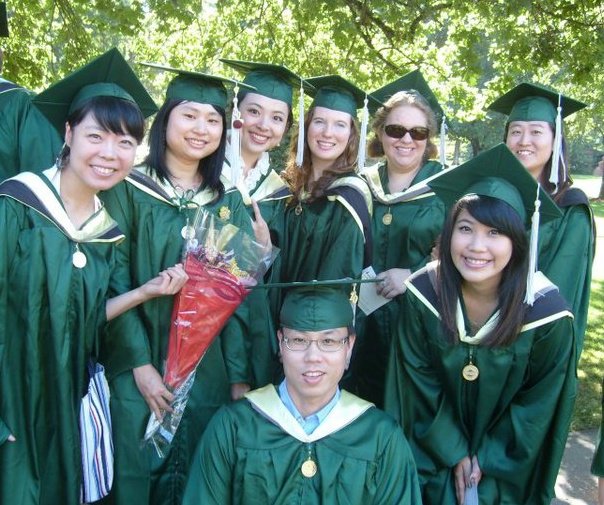
Marcella with some of her cohort at graduation in August 2010. She is the one in the middle top of the photo.

Marcella with some of her cohort at graduation in August 2010. She is the one in the middle top of the photo.

What advice do you have for students looking for language teaching positions after graduation?

Use your time in the LTS program to learn and share with such a wonderfully diverse group of students from all over the world. Many of the language teaching positions (especially in teaching English) are in countries all over the world and knowing something about countries other than your own, as well as being willing to travel and/or live abroad, will be valuable assets in finding rewarding teaching positions.

Alumni Spotlight Yanika Phetchroj

My name is Yanika Phetchroj, from Thailand. I enrolled in the LTS program in summer 2009 and graduated the following summer.

What and where are you teaching now?

Now I’m teaching English at the English Department at Thammasat University, the second oldest and one of the most prestigious universities in Thailand. I 644227_212153002263945_1461405675_nhave been teaching here for three years. My students are undergraduates from various departments and years. The classes that I normally teach are English Listening and Speaking, Reading for Information, Paragraph Writing, English Structure, and English for Hotel Personnel.
What was your MA project about?

My MA project was “Activities and techniques for improving oral skills in Thai high school EFL classes”. I did this because I have strong interest in teaching oral skills. Also, from my experience as a learner and as a native Thai speaking teacher of English, I found that Thai students have problems when it comes to English speaking and listening skills. Most Thai students start learning English with native Thai speaking teachers who teach English by emphasizing grammatical rules (the traditional Grammar Translation Method), and oral skills are overlooked. Thai ELT teachers predominantly speak Thai in the English classroom and most of the major examinations such as the university entrance examination only test students’ understanding of English grammar and their reading skills. Also, many Thai teachers find it difficult to teach English speaking skills since they don’t have a native accent. The consequence from this is thIMG_0489at after many years of learning English, Thai students still can’t speak English. After taking classes in the LTS program, I was enthusiastic to do something that could improve Thai students’ oral skills and help Thai teachers teach English oral skills with confidence and comfort. So, my project combined many activities that Thai teachers can use in their classrooms to help their students learn and practice oral skills. These activities have been adapted and designed especially for Thai students.
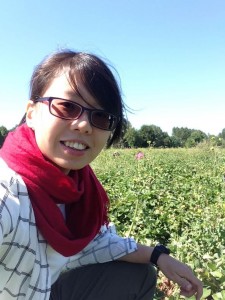

What did you find most valuable from the LTS program? What did you learn in LTS that are you using as a teacher now?

Since I didn’t have any background knowledge in the second language acquisition before I entered the program, everything seemed new to me. Right from the beginning, it was very useful to learn the different principles and methods of language teaching. For me, I grew up with Grammar Translation Method, so it was the only way of teaching and learning English that I knew. When I learned about CLT, Communicative Language Teaching, I was very excited and couldn’t wait to apply this method to my future classes. Another favorite class of mine was Computer Assisted Language Learning (CALL). I had so much fun exploring new technology that could help me teach. Nowadays, I still use some of the programs I learnt from that course in my classroom. As a teacher now, I have found myself using what I learnt from the Curriculum and Materials Development class most. Every semester I have fun creating new materials and supplements for my students based on current issues and on my students’ interests.

What did you find most challenging when you were a new teacher?

When I started teaching, I found that it was very difficult to stick to my class plan. Some activities took longer than I expected and it turned out that I couldn’t finish what I had planned at first. I also think that besides a teacher, students can make the class very enjoyable or so bland too. Some activities that I thought would be interesting to students turned to be boring. So, I had to make some changes right away. I also found that what works for some students doesn’t work for others. Some activities or teaching techniques may work well one semester, but don’t work at all the next semester with different groups of students. So it is important to find out what students like or are interested in as fast as I can to design the activities that suit them the most. 

What advice would you give current students in the program?

My advice from me will be that everyone should find the areas they are interested in the most as soon as they can, such as teaching, designing testing and assessment, or developing curriculum and materials. Because when they know your interest, they can make use of every class by doing assignments or reading something relating to it, and that will help them and their MA project a lot. Also, since the students in the LTS program are so diverse, they should take this opportunity to exchange their thoughts and experiences with their classmates who may come from different countries and culture in order to learn more and expand their knowledge.


Student Spotlight Seung Eun Kim

Blog photo

SeungEun Kim is originally from Korea. Like Sue Yoon (see our earlier blog post in November), she is pursuing an MA in LTS and an MA in East Asian Languages and Literatures at the same time.

You were an English major before entering the LTS program. What attracted you to English?

English was the first language that I fell in love with. So majoring in English was the one thing that I really wanted to do no matter what. Since I like reading literature in both Korean and English, I wanted to spend my undergraduate years reading and exploring my thoughts about the books that I read, and being an English major really made my dreams come true. I was able to spend my years as an undergraduate reading a lot of books, but more importantly, I learned how to read literature from more critical perspectives. I am glad that I have a background in English literature from my years as an undergraduate since I believe it has prepared me for how I will go about educating my future (language) students.

Now you are doing two concurrent MA degrees in LTS and East Asian Languages and Literatures (EALL). How did you shift over to a love of Korean as well?

Since being a foreign student here in America, I am proud that my national language of Korean is being taught here. I think my patriotism and love of my culture motivated me a lot to want to teach Korean. Also, as a bilingual speaker, I wanted to be more available to others who are learning Korean. Since I am a native speaker of Korean, I thought it would be great if I could be a source for those studying the language here.

What do you like best about teaching at the university?

I am thankful that I have the opportunity to teach Korean at a university in America. This opportunity has allowed me to collaborate with both international and American students together in my classes. Although my students are from different countries and cultures, and speak different languages, it has been great to see how they come together as Korean language speakers. When the students have the will to learn Korean, their passion for the language and love of Korean culture and literature really boost their improvement and are a great source of motivation. Moreover, teaching at the university is even more special to me because not only can I teach, but I can continuously increase my knowledge as well.

What is your idea for your MA project you will do in LTS?

I am interested in teaching language using literature. I am researching how literature as an authentic material should be used in the language classroom and appropriately chosen depending on the students’ language proficiencies.

What advice would you give applicants who might want to do concurrent MA degrees like you are?

The first advice I would give someone, based on my own experiences, is to believe in yourself when you are very busy and things are extremely stressful from all the classwork that you have to do. You need to stay strong, keep a positive outlook, and believe in yourself that you can do it.  Know that you are not alone, and that there are people like the LTS program director, your advisors, and other teachers who are here to help and support us.

Student Spotlight: Sara Li


Sara Li (Chinese name Hsin-Jung, Li) is an LTS graduate student from Taiwan. She has 3 years of high school EFL teaching experiences and 5 years of educational administrative experiences and  loves language teaching and learning. unnamed (2)

Why did you choose to come to the UO for the LTS program?
 I chose to come to the UO for the LTS program because it provides rich language learning and teaching courses for future teachers of all kinds of languages. Apart from many other TESOL programs in the United States, the LTS program stands out because it is an intense program with integrative courses in linguistics and pedagogy.
—–
Tell me about your work with the Chinese club?
Thanks to Dr. Yerian’s suggestion, I joined the Chinese Language and Culture Club (CLCC) this term as one of the three Chinese teachers in the Chinese club. We design a Chinese course for 3-5 graders in Edison elementary school, who show interest in learning Chinese and some of whom have family members from Chinese speaking countries. The purpose of this Chinese club is for students to enjoy learning Chinese language and culture. In the fall term the theme of the course is Daily Life in China, and the topics include basic Chinese greeting, Chinese etiquette, Chinese pictographic, body parts, famous sports in China, and many useful sentence structures. Every week we co-design and co-teach a 105 minute class, and we implement many interactive group activities to facilitate students’ comprehension and learning motivation.
—-
 What has been most rewarding about working with the Chinese club?unnamed (1)
This is my first time teaching both Chinese and elementary school students, so it has been quite a special and inspiring experience. This teaching experience allows me to reexamine my understanding of Chinese language and culture, and I find students’ genuine feedback, enthusiasm and curiosity in Chinese language and culture really motivating and rewarding. I am often surprised at how much they already know about Chinese and how much more they would like to learn. It has been a blessing to be their teacher to guide and participate in their learning process.
—-
What is one thing that you’re looking forward to in your remaining time in LTS?
I would really love to spend more time with my LTS cohort, all of whom are supportive, innovative, and compassionate about language teaching. Looking back at the past 5 months, we have had so much fun in class where our ideas emerge and took off like rockets, as well as out of class where we share our beliefs, cuisine, and love for each other and language education. There are many things that I look forward to, such as intensive in-class discussion, group collaboration, useful seminars and lectures, doing the MA project, and many more times to hang out and form dreams. Coming to UO for the LTS program has been one of the wisest choices I have ever made.

Faculty Spotlight Lucien Brown (East Asian Languages & Literatures)

Lucien photoHow are you connected to the LTS program?

I teach courses on Korean and East Asian linguistics in the department of East Asian Languages and Literatures (EALL). LTS students who are interested in teaching East Asian language often take our courses as electives, and I sometimes advise LTS final projects. Also, we currently have two students who are doing concurrent MA degrees in LTS and Korean Linguistics and Pedagogy in EALL.

Are the classes you teach related to your own research?

Very much so! I’m interested in socio-cultural language learning and teaching, and I incorporate these perspectives into my second language acquisition and pedagogy classes, such as EALL 542 Second Language Acquisition of Chinese, Japanese and Korean and EALL 543 Chinese/Japanese/Korean Pedagogy. I also research multimodal aspects of politeness in Korean, which relates to my class EALL 586 East Asian Sociopragmatics.

What advice would you give to applicants who are considering a concurrent MA degree in EALL?

First, remember that the EALL deadline for grad admission is earlier than the LTS date (EALL January 1, whereas LTS is February 15)!

In your application it is really important to articulate a clear reason for wanting to do a concurrent degree and be a member of both programs. From our side, we really want to see a clear reason or goal for wanting to study Korean linguistics and pedagogy.

Many Korean students who apply to LTS focus on English language teaching (EFL), but some of them also become interested in teaching Korean. Why do you think this happens?

In Korea, the idea of foreign language teaching is focused so much on Koreans needing to learn English, and the awareness that people from other countries need to learn Korean is not so high. But coming here broadens student’s horizons. Korean students get to know about our strong Korean language program, and meet students who are learning Korean as a second language, possibly for the first time. They get to see the importance and value of Korean language education. Besides, even if you plan to become an English teacher, having experience of teaching your native language (Korean) will give you a different perspective on what it means to teach and learn a second language.

What do you enjoy about working with graduate students?

Student Spotlight: Sue Yoon

IMG_4547


Sue Yoon is originally from Korea and completed her Bachelor’s degree in Linguistics and the Certificate in Second Language Acquisition and Teaching (SLAT) at the U of O. She is now working on concurrent MA degrees in Linguistics LTS and East Asian Languages and Literatures.

You are doing concurrent MA degrees in both Linguistics with a language teaching specialization (LTS) and East Asian Languages and Literatures (EALL). Can you tell us why you chose to do both degrees? How do you benefit from each department?

I got my undergraduate degree in linguistics from the University of Oregon and wished to continue studying linguistic characteristics of my native language in depth. I believed that having sufficient knowledge of linguistics would benefit me as a language teacher, which has always been a dream of mine, so I decided to apply to the M.A. Korean linguistics and pedagogy program at the University of Oregon as well as to LTS. I really enjoyed learning different language teaching techniques and approaches from a variety of LT courses at the undergraduate level, and they helped me broaden my perspective of language teaching to a large extent. I certainly benefit from both programs in many different ways. They perfectly match my areas of interest and allow me to develop a deeper understanding of language teaching and the Korean language system in order to become a more successful Korean language teacher. It is also intriguing to learn both theoretical knowledge and practical knowledge from the two programs.


What do you like best about teaching at the university?

There are a number of benefits of being a language GTF at the University of Oregon. First of all, I can gain professional knowledge about my fields of interest and more teaching experience simultaneously during my graduate studies. I also find it very helpful to apply what I have learned from the LT courses to my own teaching as the LT courses have certainly helped me understand what makes a good language teacher. Moreover, learning various aspects of the Korean language system from EALL (East Asian languages and literatures) courses helps me to better explain features of the Korean language to my students in the most effective manner when teaching at the university. Finally, I am so glad that I got the chance to meet my awesome students who are learning Korean at the University of Oregon!


For you, what is similar or different about teaching English vs. teaching Korean?

I have taught both English and Korean at a few different places in Korea and the U.S. I found teaching English quite different from teaching Korean. As I was teaching Korean, I have realized that being a native speaker of the language does not mean that it is easier to understand the language system. I learned English as my second language, and this helps me identify and understand areas of potential difficulty faced by learners of English as I underwent the same language learning. I usually feel more comfortable and confident when teaching Korean as it is my native language, but it is sometimes quite difficult to provide my learners with what they really need in order to understand a specific aspect of the language and understand their problems and difficulties from their perspective. However, I have really enjoyed the experience of teaching both languages!


What advice would you give applicants who might want to do concurrent MA degrees like you are?

There are a lot of great courses provided at the University of Oregon, and I believe that being able to do a concurrent MA degree can help students further broaden their knowledge in two different areas of study that they are interested in. It has been a wonderful experience taking a variety of courses and meeting such a great group of people in the two programs!


Alumni Spotlight Mylece Burling

webmail.uoregon

Mylece Burling received her BA degree from UO with a major in Romance languages in Portuguese and Spanish. She joined LTS in 2012 and graduated in 2013. Her MA project was titled, “A Teaching Portfolio of Workshop Tasks for Brazilian English Teachers Applying for the HE/Capes Scholarship”. She is shown here (on right, as Malificent, the evil stepmother of Snow White) with another teacher and some of her students at Halloween.

What was your MA project about?

My MA project was a teaching portfolio of English language tasks for English teachers in Brazil. The objective was to help non-native English teachers to navigate the pragmatic and linguistic language barriers of the scholarship application, in order to enable them to continue their professional development as English teachers.

What did you learn in LTS that are you using as a teacher now?

LTS has helped me to begin to develop the ability to effectively select activities and plan lessons that are relevant and useful for my students. It provided a framework that I have been using as a way to structure my lessons. It has helped me to organize and analyze my teaching in a way that I can view my lessons objectively, evaluate and try to change and improve.

What did you find most challenging as a new teacher?

Student motivation. Of course as a new teacher my lessons could be more effective; however, if students are not also somewhat self-motivated they will not learn. The importance of student motivation was something I could not understand without real life teaching experience and it is something I wish I would have spent more time on during LTS. Inspiring one’s students to teach themselves is the ultimate goal of any teacher.

You are now teaching English in Spain, but also pursuing other interests dear to your heart. Can you describe what you are doing, and why you chose Spain?

I first came to Spain through the “Auxiliares de Conversación” program and taught English to all levels in a public elementary school for one year in the city of La Coruña, in the Northwest of Spain. Currently I am teaching English part time at a private academy in Madrid. I teach all levels and all ages from primary to retired adults, absolute beginners to nearly bilingual. Due to the economic situation in Spain many citizens are searching for work outside the country. As English is the language used for communication among citizens of different countries for matters of business and tourism, there is a high demand for English education in Spain. My LTS degree has been indispensable in finding work here as it provides access to better positions in better schools.

In addition to my work I am also studying sculpture at one of the official state-sponsored art schools, for which I moved to the capital, Madrid. After this first year I intend to specialize in wood or stone. Europe is the basis of the history of Western civilization and art. Being in this environment has contributed to my continuing education of art history, providing inspiration and a solid background for my artwork. I intend to stay in school as long as possible, though it has proved considerably more challenging to study art on a professional level than I originally thought.

I also enjoy rock climbing which has been popular in Spain since the birth of the sport in France and is world famous for its limestone cliffs in the northeastern mountain ranges. Last year I was able to find more time to travel and climb, while this year it has been hard to find time for everything.

What advice to you have for current or prospective LTS students?

My advice to current and prospective LTS students is not to forget the importance of your peers as a resource. While you are together try to learn as much as possible from one another.

Internship Spotlight: Emily Letcher

Emily Letcher is from the Eugene area and is an alumnus of both the University of Oregon and the Second Language Acquisition & Teaching (SLAT) certificate program. She majored in Italian and recently taught English Conversation in Piedmont, Italy. She’s interested in the use of film and TV series to teach pragmatics.

unnamed

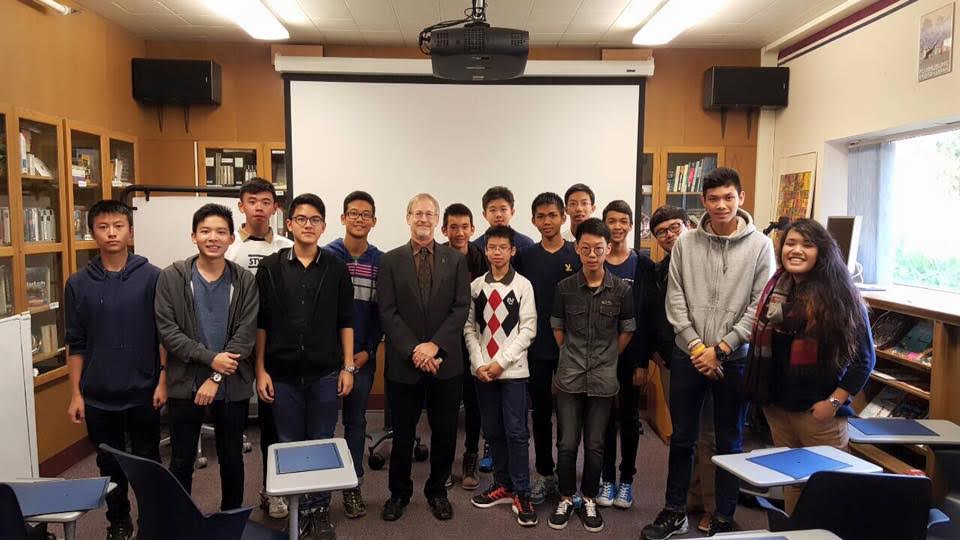
The Thai students’ last day of class with guest Vice Provost for Academic Affairs, Ken Doxsee (center), their chaperoning professor Jae Charinwit (third to the right) and Emily Letcher (right)

Could you describe your internship experience?

My internship was with the US Thai Distance Learning Organization. The program is a short-term study abroad experience for Thai high school students that the University of Oregon hosts in Fall and Spring term. This term I had the pleasure of working with 13 students visiting from St. Gabriel’s College, located in Bangkok.

What was most challenging about your internship?

unnamed3

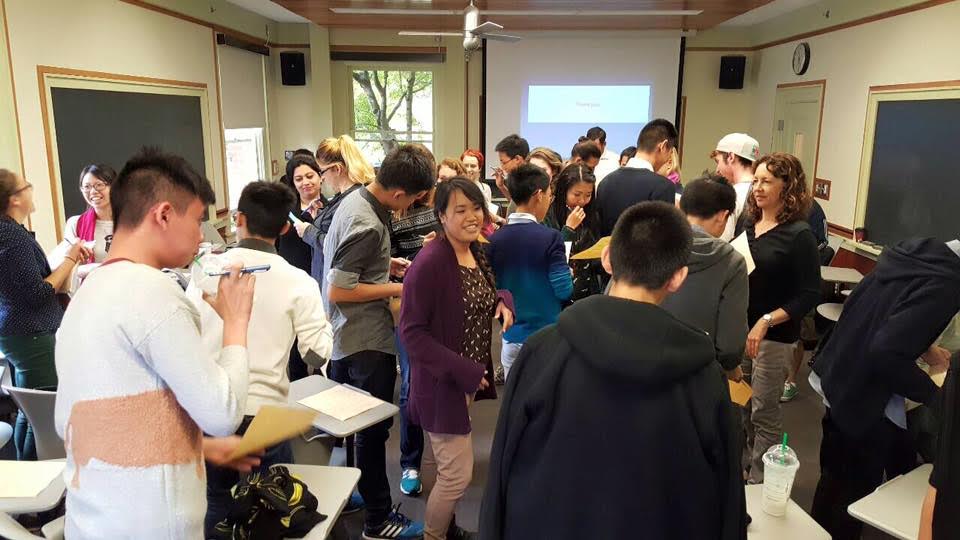
Emily Letcher (center) with the Thai students as they do a fun activity with the LTS students in LT 428/528.

The most challenging thing was planning lessons that were cohesive with all the other activities students were doing outside the classroom. We really wanted students to be practicing language that they could go out and use right away. For example, on the first day we talked about how to navigate the Eugene bus system. At the end of the class, students had to find their way to the shopping mall on their own. It brings a whole new mindset when planning lessons if you know that students aren’t just going to be doing role-plays in the class, but that they actually are depending on you to help them do this task in real life and that the consequences, whether good or bad, will be immediate and tangible. That was a bit of a contrast from when I taught in Italy.

What was the most rewarding part of your internship?

What was truly rewarding was seeing high school students, within days of arriving in the U.S. for the first time, get out of their comfort zone and be so successful. The best example of this was their interaction with fellow LTS students. The Thai students had a couple of opportunities to sit down and get to know the cohort, and we were also generously welcomed into Trish Pashby’s culture and literature class to give presentations on Thai culture. I know from some of the Thai students’ heartfelt comments afterwards that they benefited immensely from these experiences and made meaningful connections with the LTS students that will, hopefully, inspire them to come back soon.

How do you think your internship experience will influence your future teaching?

This question is easy! Ever since being a part of the SLAT/LTS cohort the first time around, I’ve been hoping to go teach in Southeast Asia. Now, with the help of the US-TDLO director and of course my adviser and our director Keli Yerian, it looks like that dream might happen… in Thailand!

2

The Thai students with LTS students after a fun coffee hour together at the EMU


Faculty spotlight Trish Pashby

webmail.uoregon-2

What is your connection to the LTS Program?

I’ve had the pleasure of teaching in the program since its beginning in 2004 and was director for four years (2007-2010). I love my colleagues, who are a very talented group of teacher educators, and the students we serve: new and/or developing language teachers from all over the world. I also teach at UO’s American English Institute, where a number of graduates from the LTS program are now employed. It’s wonderful to see evidence everyday of their success as professional, skilled, creative, enthusiastic language teachers.

What courses do you teach?

Currently I’m teaching LT 528 (Teaching Culture & Literature), where we explore culture from a sociolinguistic perspective and work on approaches for effectively bringing culture and various kinds of literature into language instruction. The other course I regularly teach is LT 541 (Teaching English Pronunciation). In this class, we study English phonetics/phonology, focusing on both segmental and suprasegmental features, and then apply this knowledge to a teaching context: What do our learners need? How can we provide this? In both courses, we work as a group on principles and basic approaches but students must then apply these to their individual teaching contexts to demonstrate mastery of the subjects and ability to adapt these to their learners.

What do you like best about your work in the LTS Program?

The people! I love working with colleagues and students who are motivated, open-minded, curious, and willing to work hard. I also really appreciate the opportunity it gives me to continuously increase my knowledge. I learn as I prepare to teach my courses (keeping up with new research, developments in the field, etc.), but I learn even more from what the students bring to the courses (their ideas, their experiences) and the innovative approaches they come up with when interacting with the coursework.

I hear you’ve had some interesting international experiences this past year…

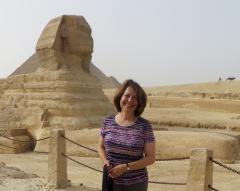
Yes, this past year has been especially exciting. I traveled to Pakistan twice, where I visited Karakorum International University in Gilgit as part of their partnership with UO (through the U.S State Dept.). My job there was to work on faculty development in terms of teaching and publishing in English. I also had a quick trip to Colombia where I facilitated a 3-day workshop for faculty at Universidad Del Norte in Baranquilla. And then at the beginning of September I was in Egypt for two weeks working with faculty at Ain Sham University in Cairo to create a certificate program for English language teachers. I loved all of these adventures!

Do you have any advice for LTS students?