LTS faculty friend spotlight: Ted Adamson, American English Institute

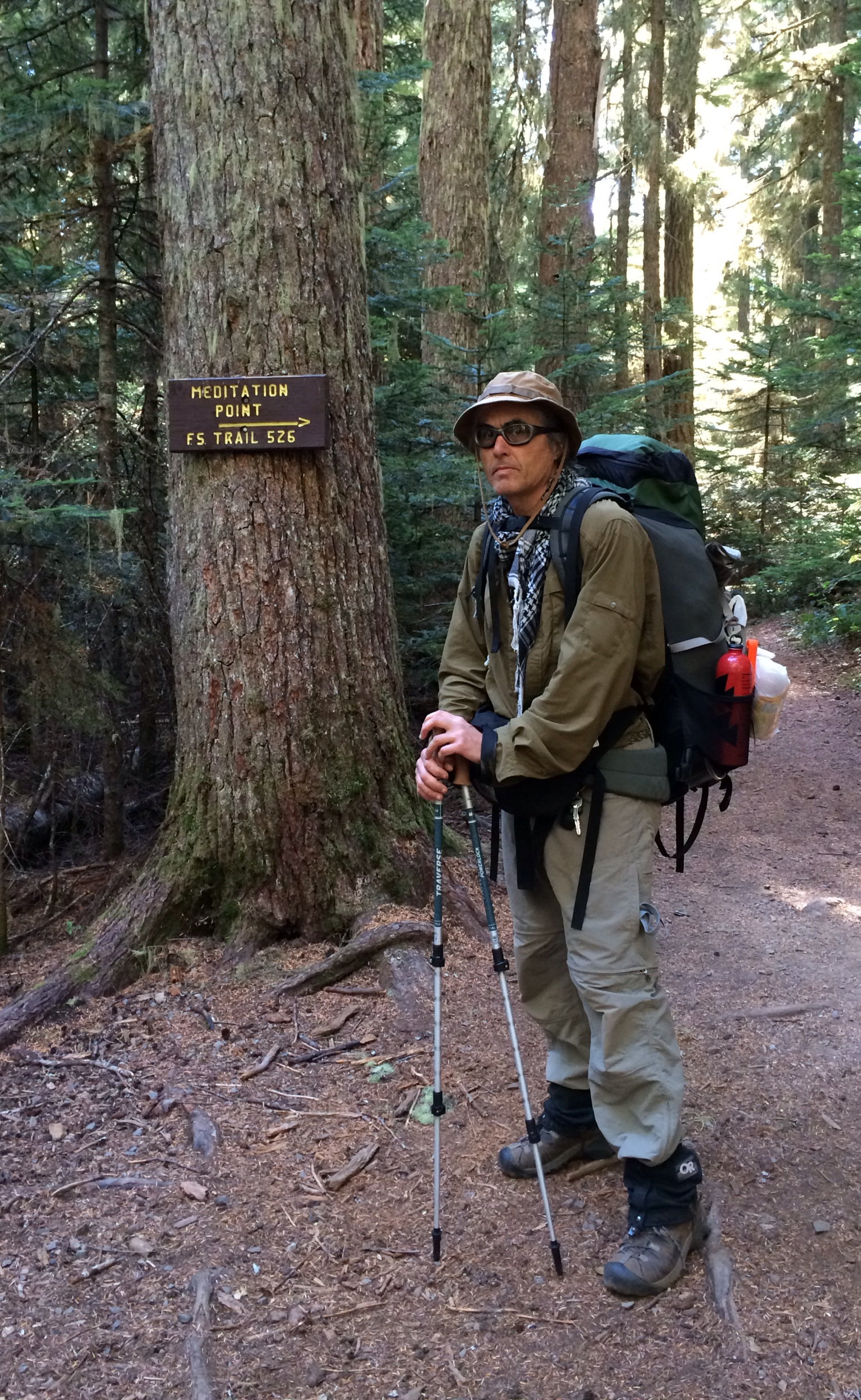
Ted Adamson is an instructor at the American English Institute who is supervising a small group of LTS students this Winter term who are co-teaching a class for international students at the AEI. He observes every class and provides guidance and feedback.

What is most interesting about supervising this course for you as a teacher-educator?

One of the brilliant features of this practicum is that regularly scheduled reflection is designed right into it. When you’re in the field and you’re teaching a full course load, you’re not always doing as much reflection as you would like. So for me, having the chance to observe four highly motivated teachers in action has been a catalyst for my own reflection. We all need to revisit those old assumptions and shake up our patterns and habits.

What other things do you do as faculty in the American English Institute?

I’ve been lucky enough to serve on the Intensive English Program (IEP) Assessment Subcommittee (ASC) with Tom Delaney, Nancy Elliott and many others. The ASC attempts to help ensure that assessment practices in the IEP are valid and reliable. I’ve worked as the lead teacher for English-Prep Oral Skills many times since 2012. In that time, I’ve been lucky enough to have a robust LTS graduate student presence in the class: both long and short-term observers and a wonderful intern in Fall 2015. More recently, I’ve designed and taught an AEI elective course called Teaching Vocabulary From Movies for lower level students in the IEP. The course meets for 2 hours per week, during which time we use entire motion pictures as primary texts for the purpose of developing language.

What was your own path to the UO?

I got my start in ESL through a series of volunteer opportunities and jobs in K-12 education in my hometown of Minneapolis, Minnesota. In that time, I worked extensively with immigrant and refugee populations in high school, junior high and adult education settings. I worked as a technology proctor, a substitute teacher, a tutor and an unlicensed social studies teacher before going back to get my M.Ed. I did a working summer in New York City in 2006. This was my introduction to the world of the language institute. I then spent 4 years teaching at Global Language Institute, a wonderful IEP in St. Paul, MN. My wife and I relocated to Eugene in 2011, at which time I began my work at the AEI.

What do you think is most important for new language teachers to learn or experience?

Having the chance to conduct classroom observations came immediately to mind. I’d advise new language teachers to visit as many different classrooms as possible. Seeing different instructors implementing different objectives with different learners is an absolute boon. I never pass up the chance to observe another teacher. There’s never an instance where I fail to come away with one or two nuggets of insight. It could be something as straightforward as an idea for classroom systems or a lesson plan. More often than not, I leave an observation with a basketful of ideas. And sometimes, you come away thinking, “Wow, I feel like I really got a sense of what this person stands for, as an educator.” This is one of the things that I love about our profession: that a profound experience like that can come out of a simple classroom visit.

LTS Alumni Spotlight: Daniel Chen-Mao Wang

Daniel Chen-Mao Wang graduated from the LTS program in 2008. His project was titled “Rethinking the Teaching of Beginning Reading: The Role of Reader’s Theater in the Taiwanese EFL Curriculum”.
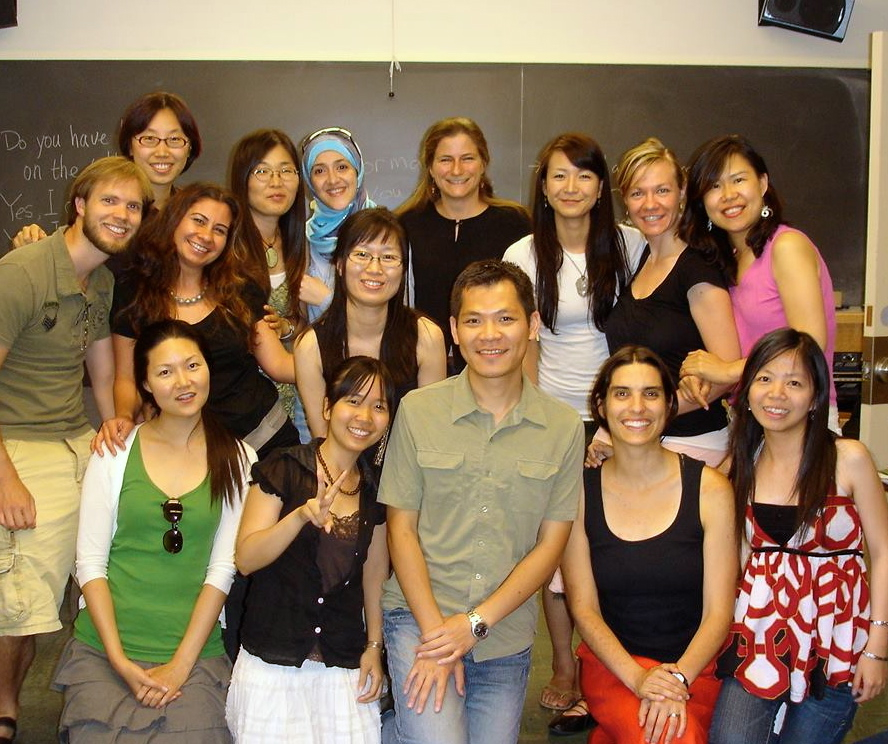
Daniel (center) with his cohort in 2008

Why did you originally decide to study in the US?

Before I applied to the LTS program in 2008, I had been teaching in a public elementary school for a few years with a BA degree in Language and Literature Education in Taiwan. After a few years of mundane teaching that literally drained my inspiration, I started to look for graduate studies to both enrich my teaching career and energize my life of learning as a practicing teacher. The LTS program at the UO stood out as one of few programs that catered to my needs. The quarterly system guaranteed me very intensive five-term solid training and studying that my home country could never offer. When I read and compared many graduate programs, few addressed both the pedagogical and theoretical issues at the same time in their plan of graduate studies. While the course titles of many distinguished TESOL programs mostly featured on the theoretical issues, few stressed the pedagogical phase of language learning. With an educational background, I was certain that I wanted to be a practitioner but yet undecided for a theoretical route. Therefore, the LTS program gave me greater flexibility to take the courses I was interested in as a language trainer. Meanwhile, as LTS was in a Linguistics Department, this enabled me to associate with PhD students and participate in Professor Susan Guion Anderson’s advanced second language acquisition class. Although the LTS program was not fully research-based, the practical but research-oriented program design laid the groundwork for later research-based projects and presented me with opportunities to observe, learn, and experience a “scaffolded, elicited, and formative” language learning class. This helped me a great deal in my current job as an EFL elementary school teacher and adjunct assistant professor at the National Kaohsiung Normal University.

Where and what are you teaching now?

Less than half a year after graduating from the UO, I began the journey of being a full-time teacher and doctoral student at National Kaohsiung Normal University. I was fortunate enough to establish all the ground work at the UO with LTS and LING, and this experience has made me who I am now. My doctoral dissertation, titled “Effectiveness of a Reader’s Theater Project on English Silent Reading and Prosodic Reading Performance of Sixth-graders in Southern Taiwan”, took root in the framework of the project I did in the LTS program and used the phonetic analysis tool, Praat, that Dr. Pashby introduced in her pronunciation class.
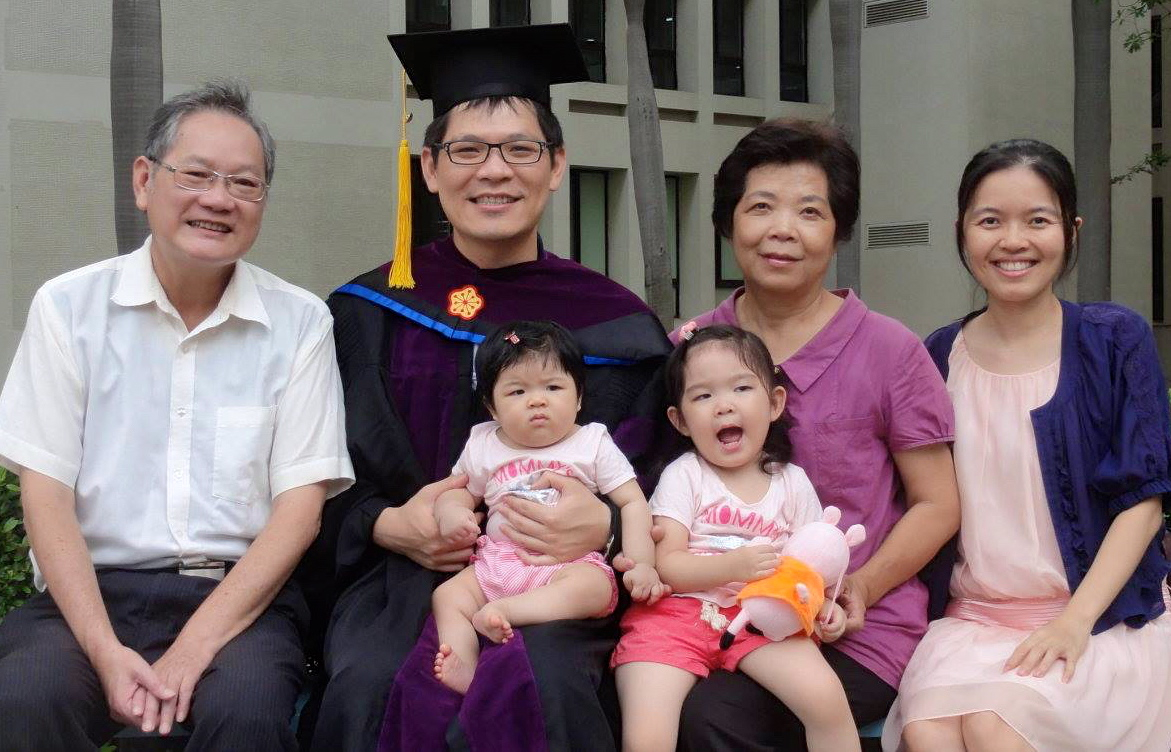
Daniel in a recent photo with his family

Currently, with a PhD in TESOL, I also work with Taiwanese local college students teaching them Freshman English. The days nourished by the LTS program become the nutrients. The LTS program gave students the open space to develop and experiment with their teaching ideas, innovative or extended. In addition, the cohort format made us learn from each other, brainstorm many great ideas, and work all angles to possibly solve the issues language teachers faced on a day-to-day basis. Serving as a teacher of college students, I now still go back to my graduate assignment work to seek inspiration and I still keep in mind the very lesson that LTS taught me so well—analyzing students’ learning needs. Without the nourishment of LTS, I cannot imagine being the person I am now.

What do you enjoy most about your work?

I enjoy the pleasure of teaching because I like to associate with people and especially with students. Many people regarded teaching jobs as repetitious and laborious, while I appreciate the beauty of individual difference and students’ willingness to learn and improve. Last year, I had classes with first-graders up to college freshmen. They were a huge range in population, but I experience the fun and joy to see the spark in their eyes when they find language learning interesting and are willing to go the extra mile to learn with the teacher. As a language teacher, I can always practice what I believe, and experiment with all kinds of variables to motivate my students and enhance their proficiency in English as a global language.

Looking back, what do you think was most valuable about your time in Oregon and LTS?

Three things stick to my mind during the days I was in Oregon: a) the live language teaching observations, b) the freedom to choose interesting courses from other departments, and c) the supportive learning and advising atmosphere.

To begin with, I benefited so much by writing observation journals about many language teaching classes. Given the privilege to sit in class and observe what the teacher did, I witnessed how language teachers deal with the teaching issues with students at different language levels and with different language backgrounds. I ended up observing very diverse types of language classes: Howard Elementary School’s reading class, a South Eugene High School’s English literature class, and a college-level CFL (Chinese as a Foreign Language) class. It was as good as I could wish for—to see what is demonstrated in a real class—more effective than any workshop or lecture could have been.

Secondly, I adored being given a few flexible time slots to take courses from other departments. I remembered that I attended a pedagogical grammar class, a culture diversity class, and a statistics class offered by the School of Education. Those classes required me to interact with the native speaking college students on education-related issues and develop educational professionalism. This experience enriched my career path and helped me become not only a professional “language teacher” but also a professional “educator”.

Lastly, the supportive learning environment in UO and LTS has made this adventure rewarding and worth admiring. Looking back, I enjoyed the time to work with the international cohort and hang out with each other outside the campus. The combination of students in LTS was like no other on campus. It was made up of experienced teachers, students with language learning interests, and ESL teacher wanna-bes, NNS or NS alike. Because of this mix, a lot of negotiation was involved. You needed to pay attention to listen, mentally process, comprehend, clarify, and then react to others in the classes because they were from all different backgrounds. Each person interpreted things in a different way. To be participatory, you had to put yourself into their shoes, consider from their perspectives to understand what they were trying to express, and then provide your own opinions. But the beautiful thing was: the more positively you interacted with one another, the better and closer relationship you built with your cohort. We felt like a family in this foreign country and the camaraderie support brought us together. A similar positive atmosphere was also between the teachers and the students. I always valued, although scared to death at that moment, the advisory office hours with each faculty member. The teachers did feel distant and authoritative; they were actually very helpful and considerate. They offered academic advice, helped clarify some thoughts on studies, suggested directions to do a term paper, etc. I talked to most of the teachers privately in office hours and I guaranteed what I say is true. The friendliness and thoughtfulness was not something you could only find in your imagination. It was genuinely felt.

What advice would you give to current or future LTS students?

LTS seems to be a program that is too good to be true. However, you have to keep in mind that this is a five-quarter program. Basically, you will have to squeeze the length and endure the intensity of five semesters into 15 months in order to fulfill all the requirements. Some take longer than 15 months to accomplish it. In order to make the most of your time and enjoy the intensity, my suggestions are:

  1. Start early to collect research literature that interests you.
  2. Frequent the library and establish your personal teacher resource library.
  3. Read the assigned readings and be a productive contributor in classes.
  4. Take advantage of every opportunity to make friends (or to know more people).
  5. Experiment with what you believe is feasible in your future language classes and explore it with back up literature.

With all these things to do in fifteen months, this short journey is going to be like a sealed time capsule—it will store valuable and memorable events and keep you rejuvenated every time you look back!
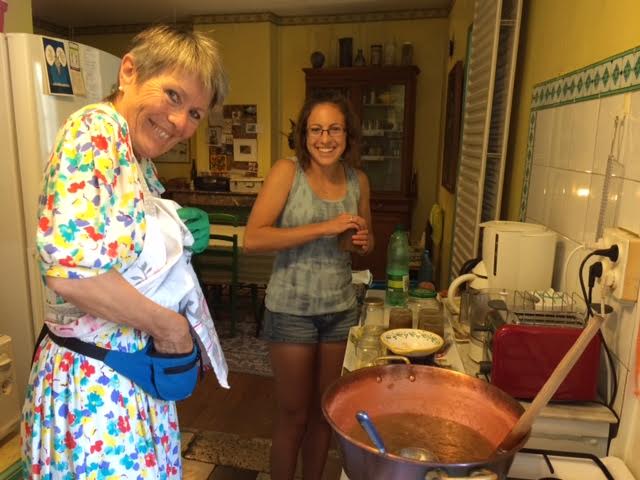

Student Spotlight: Juli

Juli was made in Ohio (specifically Casstown & Athens), but bits of France and now Oregon have more recently begun to run through her blood.  She’s on a quest to sharpen her Banagram-playing, language-teaching, French-speaking, bread-making and distance-running skills.

Juliblog

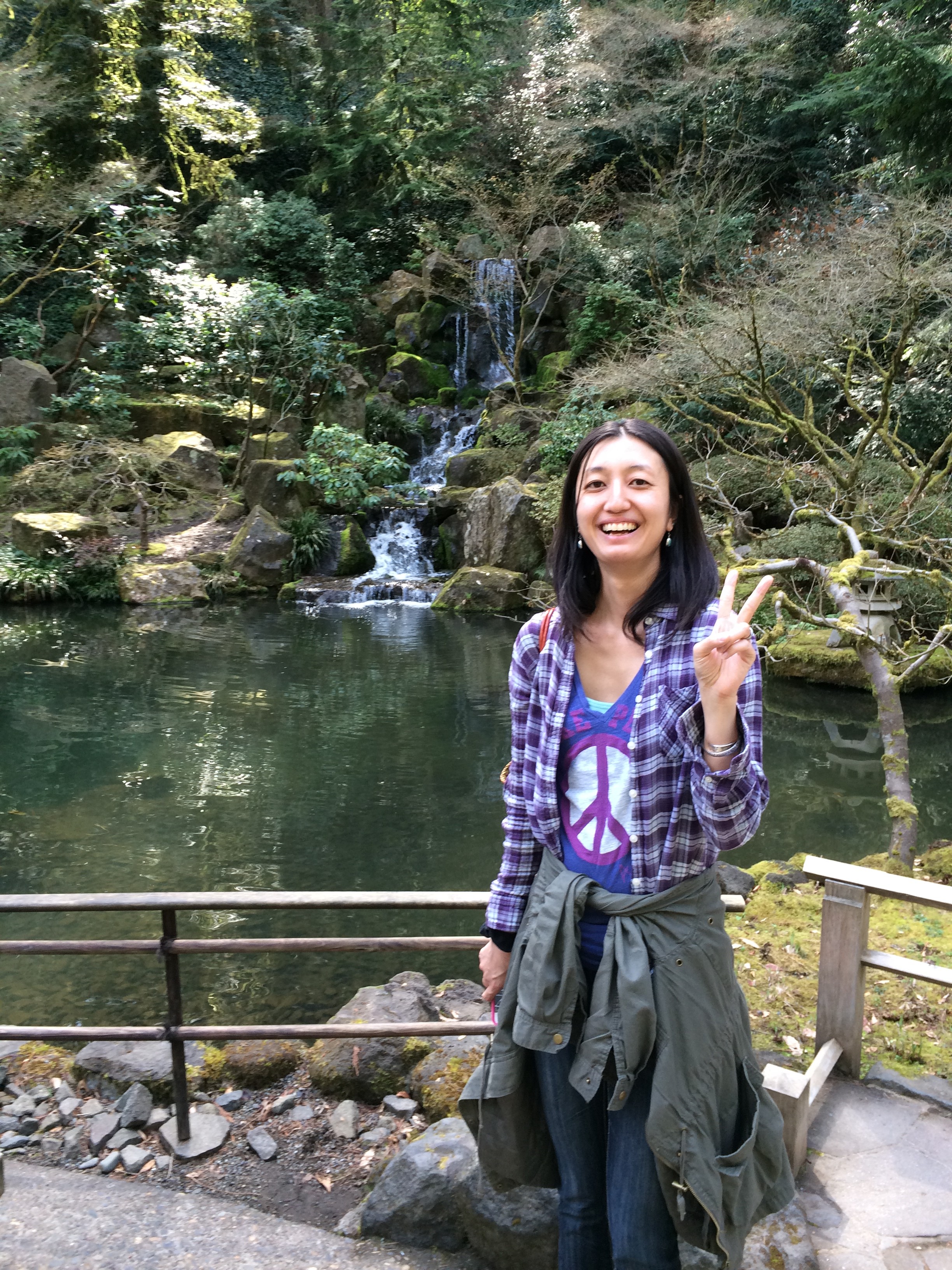
“This was taken at the bed & breakfast I WWOOFed (World Wide Opportunities on Organic Farms) at in France. Odette, the owner, and I are in the finishing stages of making jam. The couple behind the camera were fellow WWOOFers, Kanji and Misaki, from Japan. For us, the kitchen served as an epicenter of soaking up new languages, new perspectives, new laughs. It was ultimately memorable exchanges like these that guided me to pursuing a Master’s in language teaching.”

What is your GTF context and how has that experience supported you in LTS?
I am a Writing Learning Assistant GTF with Services for Student Athletes; I work with student athletes and provide writing support. Several of the students I work with are international student athletes.  I help these students develop their English language skills as well as their writing skills. Although it’s different from a traditional language classroom, the GTF position provides hands-on language teaching experience, which in turn, has enhanced and supported my experience in the LTS program. This opportunity blends all of my interests & is one for which I am truly grateful.
x
What has been most rewarding about your GTF?
Integrating content learned in the LTS program with my work as a GTF, and bringing my experiences as a GTF to the classroom has been the most rewarding part of this combination. I am challenged because the context in which I work is unique; before applying a concept learned from the LTS program I have to ask “Will this work for my students? What adaptations can be made to meet their needs?”.  Problem solving like this is fun.
x
What are you most excited about for your remaining time in the program?
There are three things I am most excited about for the remainder of the program:

1. Continuing to grow with and learn from the 2015-2016 cohort.  Having taken the 2-year option, I entered into the program late. A delayed arrival didn’t stop the group from warmly welcoming me in.  It was similar to entering the home of your Italian relative: before you have time to slip off your shoes, Italian gravity is pulling you toward engulfing hugs, a slew of questions and a big plate of spaghetti. The LTS cohort is stellar. Period.

2. Expanding my knowledge of all things language & teaching related over the next 4.5 terms.  There’s so much to learn!

3.  Continuing LTSEOTT (LTS Eye of the Tiger running group (yes, we took a little linguistic liberty here)).  The cohort started meeting for weekly runs this term, and it has undoubtedly become the highlight of my week. We are constantly engaging in an environment where we are working our minds. I find it refreshing to meet outside of that context to one where we challenge our bodies. We get to know each other in a more complete way. Just like in the classroom, every LTSer brings something unique to the track & has a specific purpose for being there.  Everyone is fearless, willing to take risks and is seeking to improve. That makes the energy great & delicious & simply put, fun!

Tips for writing a personal statement for graduate school

For those who are applying to graduate programs in language teaching in the US, it’s that time of the year to craft your personal statement as part of your application. Here are a few tips for making a statement that will stand out to your readers:

The DOs:

  • DO…organize your statement as a ‘deductive’-style essay: with an introduction paragraph, body paragraphs, and a conclusion. The introduction should engage the readers but also make a fairly direct statement about why you are a good fit for the program. The body paragraphs can then provide specific supporting information for your qualifications, interests and goals, while the conclusion can restate how these qualifications will match well with the program you are applying to.
  • DO…highlight your past educational and professional experiences that have brought you to a career in language teaching. If you are an experienced language teacher, highlight your accomplishments, what you have learned from them, and how they have influenced your teaching identity and philosophy. If you have little experience teaching so far, describe what experience you do have and why it has inspired you to learn and do more in this profession.
  • DO…tailor your statement to the specific program. Write about what you hope to learn from the program and how your participation and strengths will contribute to the program. Most departments want to see that an applicant is ready to take advantage of the resources in the program (e.g. relationships with faculty, other departments or institutes, internships, specific coursework topics, etc.) and realize their own full potential with those resources.
  • DO…provide specific examples of your achievements, goals, and experiences that help to tell the story of your journey towards becoming a language teacher, curriculum development, or future administrator.
  • DO…write your statement well before the deadline, so you have time to revise and refine it before you submit it.

The don’ts:

  • Don’t…exaggerate or misrepresent your own teaching experience. If you have little experience so far, be honest about this.
  • Don’t…just list facts and statistics about yourself. Write also about what you have learned about your own interests and goals, and how these relate to the future.
  • Don’t…wait until the end of your essay to state why you want to attend the program. Readers want to see your ‘thesis’ near the beginning of the statement.
  • Don’t…ask someone else to write your statement for you! Readers will expect writing styles to naturally vary, and understand that bilingual and multilingual writers may have a unique writing ‘accent’. Do, however, revise and edit carefully for common errors and for typos.
  • Don’t… write it at the last minute.

In the end, faculty who are reviewing graduate program applications want to see a clearly written statement of who you are now, how you got to this point, and where you want to go, all in the context of your (future) professional identity as a language teacher.

Good luck with your application!

Keli Yerian, LTS Director


LTS faculty spotlight Melissa Baese-Berk

Melissa Baese-Berk is faculty in the Linguistics Department whose research focuses on 2nd language speech perception and production. She will be teaching a seminar in Spring that is open to LTS students.

How are you connected to the LTS program?

What are you most passionate about in your work?

I’m passionate about understanding how people learn languages and discovering how learning languages impacts cognition and our use of our first language. Although my research is more theoretically oriented, I am also very interested in the applied implications of the theoretical findings. I love working with students from various backgrounds to better inform my research questions, and hopefully to help inform their teaching practice!

What do you think students get out of the LTS program?

I think the LTS program has a number of strengths, including the support of a cohort. However, I think our greatest strength is the diversity of students and student interests in the program. Students are hoping to teach a variety of languages in a variety of settings after the program. Because of this, our students leave the program being quite well rounded, having thought not just about their target language and target context, but about language teaching much more broadly.

What advice do you have to applicants to the program this year?

I would encourage students to think about what they want from a graduate program and to try to convey that to the admissions committee. I’m always excited when an applicant makes it clear that they understand what our program offers and demonstrate how our offerings will help them achieve their goals.


Student Spotlight: Maggie Mitteis

a784f725-77df-4e78-9f30-66fe2417a615Maggie Mitteis is famous in her hometown of Ashton, Nebraska, just like the other 231 people who live there. She has taught University in Poland, coordinated a refugee literacy program in Lincoln, Nebraska, and served as a Peace Corps Volunteer in Ukraine. She likes to think her Ukrainian language skills are superb, but her host grandma has assured her they’re really “getting terrible”.

Why did you choose to enter the LTS program?
Finding UO’s LTS program was sort of a happy coincidence. I was living in Eugene and working at the UO Testing Office when I discovered the program. I immediately set up a meeting with Keli Yerian. I was extremely impressed the program’s multifaceted approach to teacher training and intrigued by all the available hand-on experience. Coupled with the opportunity to teach an advanced English course in an American university setting (something I had never done before), saying “YES!” to LTS was a no-brainer.
xx
What is your GTF context?
Right now, I’m teaching Oral Skills 6 in the Intensive English program. The course focuses on fine-tuning  listening and speaking skills that will help students succeed when they matriculate into the university, so we do a lot of work with note-taking, impromptu speaking, and asking follow-up questions. It’s the same course that I taught in the fall, so I’m excited to teach it again. Now that I have more of a grasp on how the course is structured, I can really work on tailoring it to fit the students’ needs. Plus, my cohort friends shared a lot of teaching ideas that I want to try incorporating.
xx
What is the most challenging part of your GTF?
Honestly, the amount of structure I am given in the IEP still takes me slightly aback. My pervious teaching situations–especially my Peace Corps years–were dominated by creating materials based on very general instructions or topic ideas. These materials were usually made of construction paper, and often, created the night before class. It took me awhile to become accustomed to being given a detailed, week-long lesson plan over a week in advance. It’s been great to have a teaching experience that requires a different kind of discipline, and it’s really made me grow as a professional.
xx
What is most rewarding about your GTF? 
I really enjoy the students in OS6. They’re motivated, they’re fun, and they’re not afraid to try new activities. The class is structured in a way that really allows them to grow in confidence and autonomy. And now, I see my students from the previous term around campus, and they’re so excited to be university students.
xx
What are you most looking forward to in your remaining time in the program?
Right now, I’m excited for Winter Term. My OS6 section is a great size and the group dynamic is building quite nicely. My class schedule is a mix of linguistic theory, curriculum development, and Eastern European history, so everyday feels genuinely interdisciplinary. And, the LTS cohort is coordinating a weekly jogging/running group. All the things I like are happening with a great group of people!


MA Project Spotlight Rich Houle

Rich Houle blog photo

Rich Houle just graduated from the LTS Program in December 2015. His capstone MA project was “Agency and Autonomy In English Academic Vocabulary Learning: A Student Centered Teaching Portfolio”.

What is your MA project?

My project is a teaching portfolio of activities to support learning the English Academic Word List. The emphasis of the portfolio is vocabulary learning, rather than vocabulary teaching, through strategy instruction and incorporating newer computer technologies such as vocabulary profiling, concordancing, and wikis.

Why did you choose this topic?

After a slight gap (24 years) between my graduate and undergraduate career, I started taking classes in the LTS program part time as a non-matriculating student.  The first class I took in the program was English Grammar, where I developed an interest in vocabulary  due to my attempts to read the notices in French posted in the hall outside the classroom. It seemed to me that meaning was primarily embedded and carried by words, and then shaped by morphology and syntax. In the Language Teaching Methods class I chose vocabulary acquisition as topic for the research paper, and I discovered a whole world I never knew existed! When I started the LTS program as a full time student I wanted to choose a topic that would use the research I had already done (having no wish to do much more work than I had to) as well as reflect the experiences I would have as a student in the program.

What advice would you give to new LTS students about their MA projects?

By the time you have completed your second term you will have (hopefully!) completed a research paper and a project or two.  Mine these for ideas for a project.  That way you will have some concept for a topic by the end of fall term, and you don’t have to research a whole new area from scratch.  You want to do as much reading as possible by the time Spring term starts. Also talk to your professors: they are very nice and they schedule time in their week just for this purpose.  As soon as you have a committee, schedule time with them.  They are there for you. Lastly I will quote the Hitchhiker’s Guide to the Galaxy (a project from my cohort): DON’T PANIC.

MA Project Spotlight Maile Warrington

IMG_0124

Maile Warrington just finished her capstone MA project in the LTS program, titled “Authentic Japanese Media Materials for Teaching Keigo (Honorific Speech) and Different Speech Styles to JFL Learners”.

What is your MA project?

I developed a teaching portfolio that provides options for Japanese instructors to teach keigo (Japanese honorifics/honorific speech) to college intermediate to advanced-level students through authentic Japanese media materials, specifically authentic contemporary Japanese talks shows and comedy shows.

Why did you choose this topic?

Using appropriate keigo and speech styles is one of the most important aspects of Japanese culture. However, ironically, it is usually not taught in balance and is said to be the one of the most difficult language aspects to acquire. I was a Japanese language Graduate Teaching Fellow for almost two years, and got many comments from students and teachers about how hard and challenging it is to both learn and teach appropriate speech styles only through the textbook. Many students will talk to their instructors using inappropriate speech styles and thus are “rude” unintentionally. From these experiences, I started to think that there should be a way to teach honorifics and different speech styles meaningfully and interactively using materials other than the traditional textbook.

What advice would you give new LTS students about their own MA projects?

The most important advice I would like to give new LTS students about the project is to try to decide the topic as soon as possible so that they can start gathering related research and literatures about that topic in the earlier stage of their program. I also advise students to (this might be something that I don’t even have to mention) choose the topic that most interests them so they can maintain their motivation throughout the program. Another advice is to use and manage their time efficiently, especially at the end of the program when they are trying to finish up their project.

What do you like most about your portfolio?

One of the things that I like about my project is how I used authentic Japanese talk shows and comedy shows as a material to teach different honorifics and speech styles instead of movies or dramas that are more common to be incorporated in language classes. I also liked how many of my activities for this portfolio could serve as “stand-alone” activities, which Japanese instructors could pick, modify, and integrate in their pre-developed daily lessons.

Faculty Spotlight Robert Davis (Romance Languages)

Robert Davis is professor of Spanish and Director of Language Instruction in the Department of Romance Languages. From 2009 to 2014, he was the director of the Middlebury at Mills Spanish School (at Mills College, Oakland CA), a language immersion program of the Middlebury Language Schools.

What is your connection to LTS students/the LTS program?

As one of the applied linguists on campus, I collaborate with the LTS faculty and occasionally have LTS students in my classes on Spanish linguistics. We have also had LTS students in Romance Languages as Graduate Teaching Fellows, and it has been a pleasure to work with these students who are so motivated to become language teachers. We are working on promoting the idea of a concurrent LTS-Romance Languages degree, which would offer students a GTF position while they complete two MAs in the two departments.

Could you tell us about your work in language pedagogy and Spanish linguistics?

My training was in both formal and applied linguistics, and since coming to UO, I have focused on applied topics. My specialty is the creation of language learning materials within the frameworks of content-based instruction and interculturality.

What do you enjoy most about working with graduate students? 

I always learn so much from my graduate students! In my most recent methods class, they designed action research projects that touched on topics from diverse learning styles to improving pair/group interactions in the L2 classroom. Their passion and hard work are always inspiring to me, and it’s a honor to be able to prepare the next generation of language teaching professionals.

What do you think is most important for new language teachers to remember? (video response below)


Alumni profile: Richard Niyibigira

Richard Niyibigira was a Fulbright recipient who graduated in 2014. His project was titled “ESP Course Design for the Tourism and Hospitality Industry in Rwanda”.

IMG_7731What and where are you teaching now?

Today, I teach English and communication skills at the Integrated Polytechnic Regional Center (IPRC)-Kigali. It is a college situated in Kigali, the capital city of Rwanda in Africa.

Tell us about your leadership responsibilities now.

Apart from my teaching responsibilities, I am an active founder member of the Association of Teachers of English in Rwanda (ATER) that started in 2008. I served as the Head of Professional Development and Partnership for ATER since my arrival from the UO until recently when I was elected by the General Assembly as the president of the Association. Today, ATER has approximately 100 primary and secondary teacher beneficiaries in the 5 of 30 districts of Rwanda.  The teachers receive a series of workshops and trainings for free in their Communities of Practice. The trainings are conducted by ATER members and an English Language Fellow (ELF) offered to ATER by the US Embassy in Kigali. Some of my achievements within the association as the Head of professional development and Partnerships are organizing the first ATER annual conference, the 1st US Embassy Access Microscholarship Program Conference and organizing workshops to teachers through their communities of practice.

Did your LTS MA project relate to what you are doing now?

My MA project is certainly related to what I am doing now. My LTS project was an ESP (English for Specific Purposes) course design for the tourism and hospitality industry. Although the specific course I designed has not been used in any school yet, the knowledge I gained through designing that course served me a lot in my job today. I conducted a workshop to revise a course called “English for Technology” within IPRC Kigali. Although the course was there since a long time ago, its content was in no way different from that of General English. We revised the course to make it specific to students in their different departments and in relation to their specific needs.

IMG_5283Are there any other important developments in your life ?

Apart from my professional life, I have also made some personal and social developments since I left beautiful Eugene. I got married three months after I left Eugene and now I have a 3.5-month-old son. I have a beautiful and happy family that I am proud of.  And yes, I got my driver’s license now, after trying to get it three times with failure when I was in Eugene!

Do you have any advice for current or future LTSers?

My advice to current and future LTSers is:

  1. Work as a group not as individuals: The LTS life does not end in class. One of the things that helped me enjoy my time in Eugene is the relationship with my LTS colleagues! You may find the courses hard and with very tight schedules sometimes. The only way you can go through that efficiently is to include your colleagues in your journey to the completion of the program. Do some self-studies together and have fun after class. Enjoy the beauty of Eugene and surroundings.
  2. Do your MA project in something you REALLY like! The terminal project process is a long and hard one. It might either take you longer to complete or make you quit before completion if you are working on something you don’t understand and like.
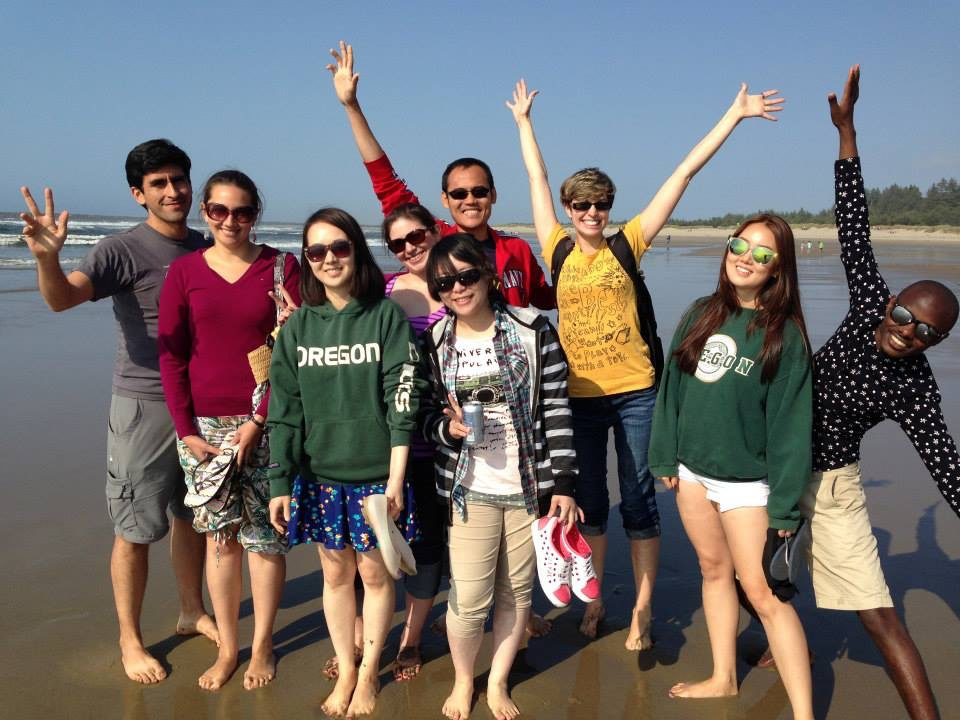
  3. Do NOT forget to visit the coast with your cohort! It’s so much fun.

IMG_5139