BIC Major Caitlyn Fields to Present at McNair Symposium February 10th
Posted on

UO Biochemistry major Caitlyn Fields will present her research at the 2016 McNair Scholars Symposium on Wednesday, February 10th, at  2pm in room 72 PLC. 

Every February, the University of Oregon celebrates the research achievements of its McNair Scholars during the McNair Symposium. These achievements are made possible by faculty mentors who guide Scholars through scholarship activities and help prepare them for the challenges and culture of graduate school.

McNair Scholars participate in paid summer research internships in their fields of study. During the internships, students are involved in original research culminating in a presentation of their findings. Held winter term, the McNair Symposium provides a public forum for students to share their work with peers, mentors, faculty and staff, family members, and the general public.

Caitlyn’s presentation is titled “Investigating Fundamental Cluster Chemistry: VT-NMR Studies of the Flat Ga13 Cluster at Multiple Concentrations.”  Her mentors are Darren W. Johnson, UO Chemistry and Biochemistry, Anna F. Oliveri, Post-Doctoral Fellow, Chemistry, UC Davis and William H. Casey, Chemistry, UC Davis.


Abstract: 

Group 13 metal clusters have been of interest in both materials chemistry and geochemistry because they are naturally occurring and make excellent precursors to thin films for various devices, such as solar cells and laptops. Unfortunately, the solution dynamics of these clusters are not well known; therefore a solution study of these clusters may give insight to both the naturally occurring mechanism of synthesis as well as assist in finding more efficient ways to manufacture the clusters for use in devices. Oliveri et al. identified simple and unique 1H-NMR spectra for gallium species clusters, making it possible for this study to characterize them even further with kinetic and thermodynamic data. Variable Temperature Nuclear Magnetic Resonance (VT-NMR) spectroscopy experiments were carried out on the Ga13 and Ga7In6 clusters in an effort to extract the μ2 int proton peak expansion. The rate constant k was extrapolated from the FWHM of this peak. The change in entropy and enthalpy of the transition states were calculated using k and the Eyring equation.

UO Team-Lead Project Receives 3.6M$ Templeton Award
Posted on
Andrew H. Marcus
Michael Raymer

A project co-directed by UO Chemistry and Biochemistry faculty Andrew Marcus and UO Physic’s Michael Raymer has received a 3.6 million dollar award from the John Templeton Foundation.

The project, titled “Quantum Simulators of Complex Molecular Networks,” is to support approximately twenty grant-supported researchers from the University of Oregon, Harvard University, the University of Oxford, and Ulm University.

Biochemist Ken Prehoda’s Research Sheds Light on Evolution
Posted on

photo: Ken PrehodaUO Chemistry and Biochemistry faculty Ken Prehoda is in the news this week, following the publication of a research paper in the open-access journal eLife.

The Prehoda Lab research examines a genetic mutation in single-celled organisms that helps to address several important questions that scientists have had about evolution, and also has implications for studying disease states, such as cancer. Their discoveries made the national news on January 11, 2016, with article in the Washington Post.

Listen to Prof. Prehoda talk about his research on OPB’s “Think Out Loud,” broadcast on January 14, 2016

Read more in the Washington Post, Discover Magazine and AroundTheO.

Boettcher Lab Article makes cover of Chemistry of Materials
Posted on
Cover artwork created by Shanna Zentner

An up-and-coming perspective by the Shannon Boettcher lab on H2O oxidation is on the cover of the November issue of Chemistry of Materials, a publication of the American Chemical Society.

The article, titled “Oxygen Evolution Reaction Electrocatalysis on Transition Metal Oxides and (Oxy)hydroxides: Activity Trends and Design Principles” by Michaela S. Burke, Lisa J. Enman, Adam S. Batchellor, Shihui Zou, and Shannon W. Boettcher, discusses new advances in understanding oxygen electrocatalysis on nickel−iron oxyhydroxides.

Read more at: http://bit.ly/21emBbH

Bailey/Prehoda Paper Examines Behavior of Enzyme Found in Human Cancers
Posted on

A paper authored by UO Chemistry and Biochemistry grad student Matthew Bailey and faculty Kenneth Prehoda was published in the October issue of Developmental Cell.  Titled “Establishment of Par-Polarized Cortical Domains via Phosphoregulated Membrane Motifs,” the paper highlights how an enzyme that is mutated in many human cancers functions to organize molecules in healthy tissues.

Matthew is the 2015 recipient of the Peter Von Hippel Graduate Scholar Award.  The award seeks to recognize a senior PhD graduate student both for their outstanding performance in thesis research, and for their concern for fellow students and colleagues during their time at the University of Oregon.

Professor Prehoda is a biochemist and the current director of the Institute of Molecular Biology.

Read their paper at http://bit.ly/1PjXYoe

Alum Khalifa’s UG Research Could Lead to New Drug Treatments
Posted on

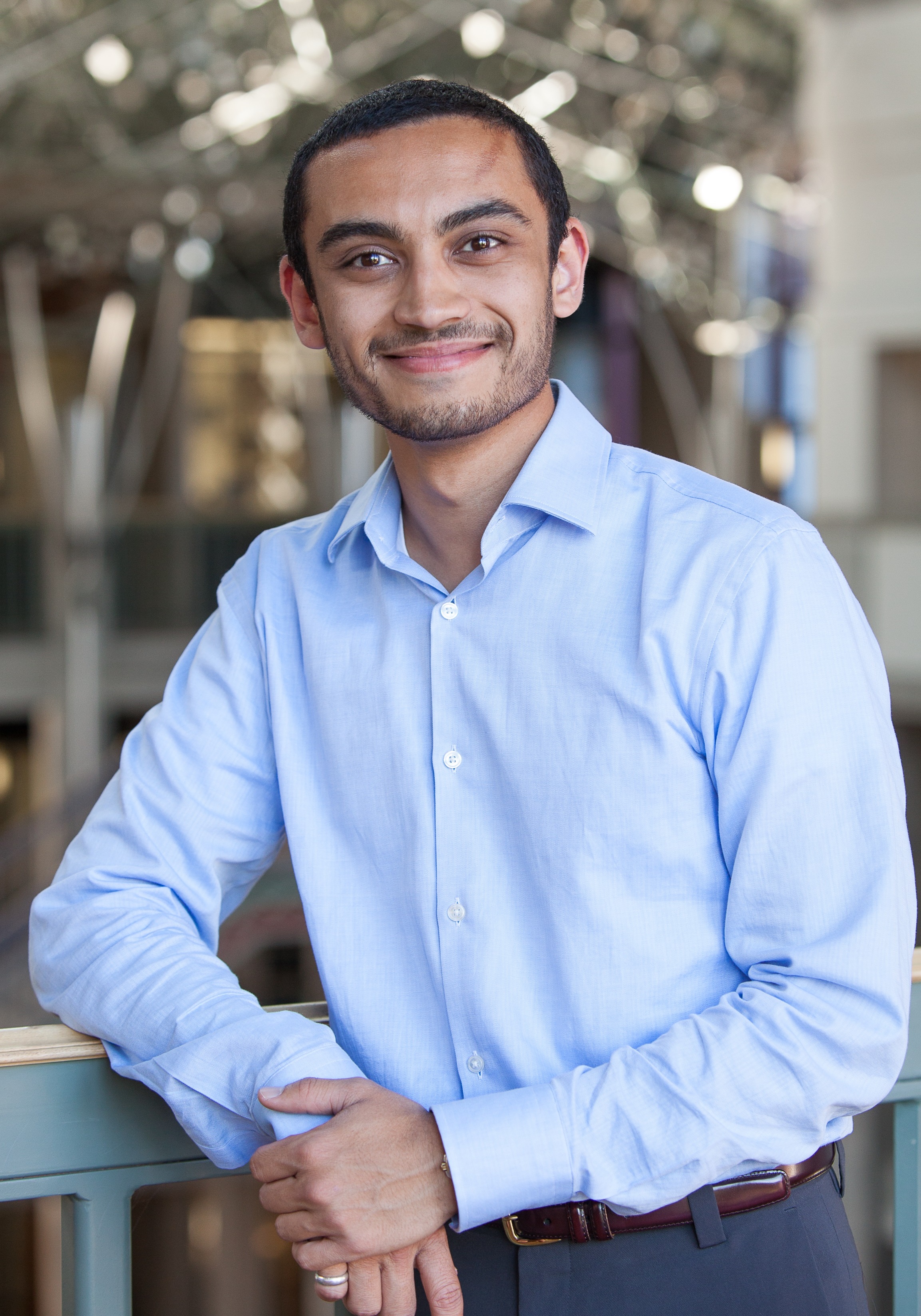
Khalifa2An article in the fall 2015 issue of Cascade magazine profiles research conducted by Muhammad Khalifa, class of 2014, while earning his BS degree in Biochemistry at the University of Oregon.  Khalifa worked for three years in the Haley lab and was listed as first author on a paper published this past July, an honor that identifies the person who made the greatest contributions to the project.

While at the UO, Muhammad was awarded the Chemistry and Biochemistry Department’s Kuntz-Swinehart Memorial Scholarship, which recognizes academic excellence in our majors.  He is currently pursuing his doctoral degree in pharmaceutical sciences at the University of Wisconsin, Madison.

Read more at http://bit.ly/1kI0Mk0

News from the Jasti Lab
Posted on

UO chemist Jasti aims to put his nanohoops into future devices

When Ramesh Jasti set out to make tiny organic circular structures using carbon atoms, the idea was to improve carbon nanotubes for use in electronics or optical devices. He quickly realized, however, that his technique might also roll solo.

Read more at AroundtheO

Bradley Nolen selected for MRF Richard T. Jones New Investigator Award
Posted on

UO Chemistry and Biochemistry faculty Bradley Nolen has been named a recipient of the 2015 MRF Richard T. Jones New Investigator Award by the OHSU Foundation. The Medical Research Foundation (MRF) presents annual awards to outstanding Oregon researchers, scientists and mentors.

The Richard T. Jones New Investigator Award is a competitively awarded research grant that supports promising biomedical exploration and the development of research careers in clinical investigation in Oregon.

The Nolen lab investigates the regulation of the cytoskeleton, a molecular framework that provides physical support for cells, in order to increase understanding of how phenomena observed at the cellular level are controlled at the molecular level. This research has provided new windows on the complexities of cellular structure, and suggested a potential future route to therapeutic targeting for use in medical treatments.

Professor Nolen will receive his award at a ceremony to be held November 12, 2015, at the Centennial Hotel in Portland, Oregon.

Pluth Lab Research Collaboration on the Cover of JACS
Posted on

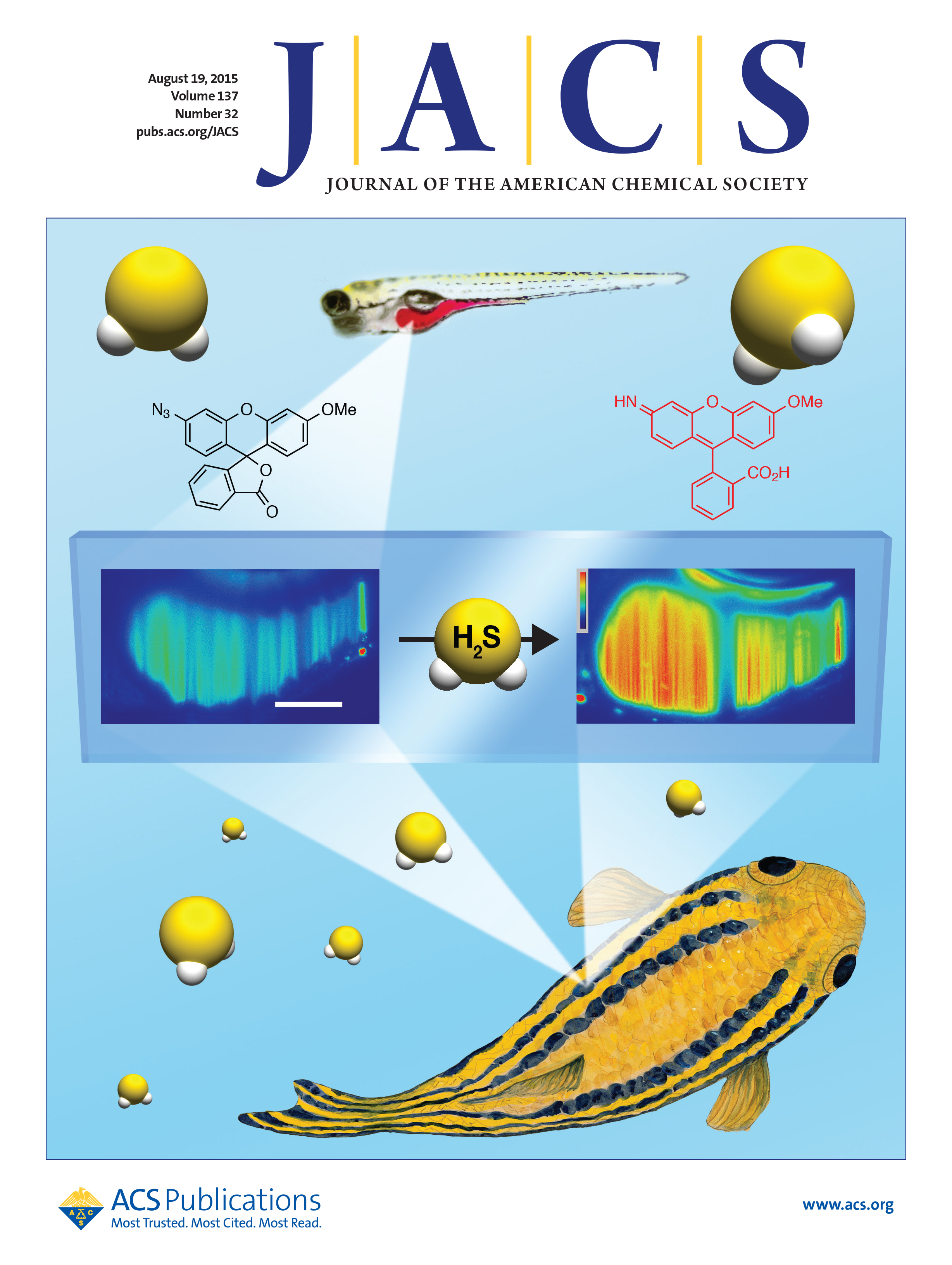
Journal of the American Chemical SocietyA collaboration between UO Chemistry and Biochemistry and Physics laboratories was featured as the cover article in the August 19th issue of the Journal of the American Chemical Society.

The research paper, written by Professor Michael Pluth‘s chemistry group and and Professor Raghu Parthasarathy‘s physics group is titled, “A Bright Fluorescent Probe for H2S Enables Analyte-Responsive, 3D Imaging in Live Zebrafish Using Light Sheet Fluorescence Microscopy.”

Read the paper at http://bit.ly/1KZPKjU

Andrew Wagner Receives AHA Research Training Grant
Posted on

UO Chemistry and Biochemistry graduate student Andrew Wagner has been awarded a 2015 American Heart Association Predoctoral Fellowship.

The $50,000 award will be distributed over two years, and is intended to help students initiate careers in cardiovascular and stroke research by providing research assistance and training. Research topics may be broadly related to cardiovascular function and disease and stroke, or to related clinical, basic science, bioengineering or biotechnology, and public health problems, including multidisciplinary efforts.

Andrew earned his BA in Biochemistry in 2011at Colorado College in Colorado Springs, CO., and entered the UO Chemistry doctoral program in the fall of that year.  He is currently doing his thesis work in the Nolen lab, and his proposal, “WISH/DIP1/SPIN90 (WDS) Proteins Seed Assembly of Branched Actin Networks,” was selected for funding by the AHA.  His research is focused on investigating the regulation of the actin cytoskeleton, a protein framework that provides a physical scaffold for cells. Actin molecules polymerize into helical filaments that undergo dynamic rearrangements to allow changes in cell shape during motility and provide tracks for material transport. Striated tracks of actin filaments play a fundamental role in muscle contraction like those of the heart.
After completing his PhD, Andrew plans to continue to lead a research driven career investigating mechanisms in biochemistry and cell biology in diseased and non-diseased states.