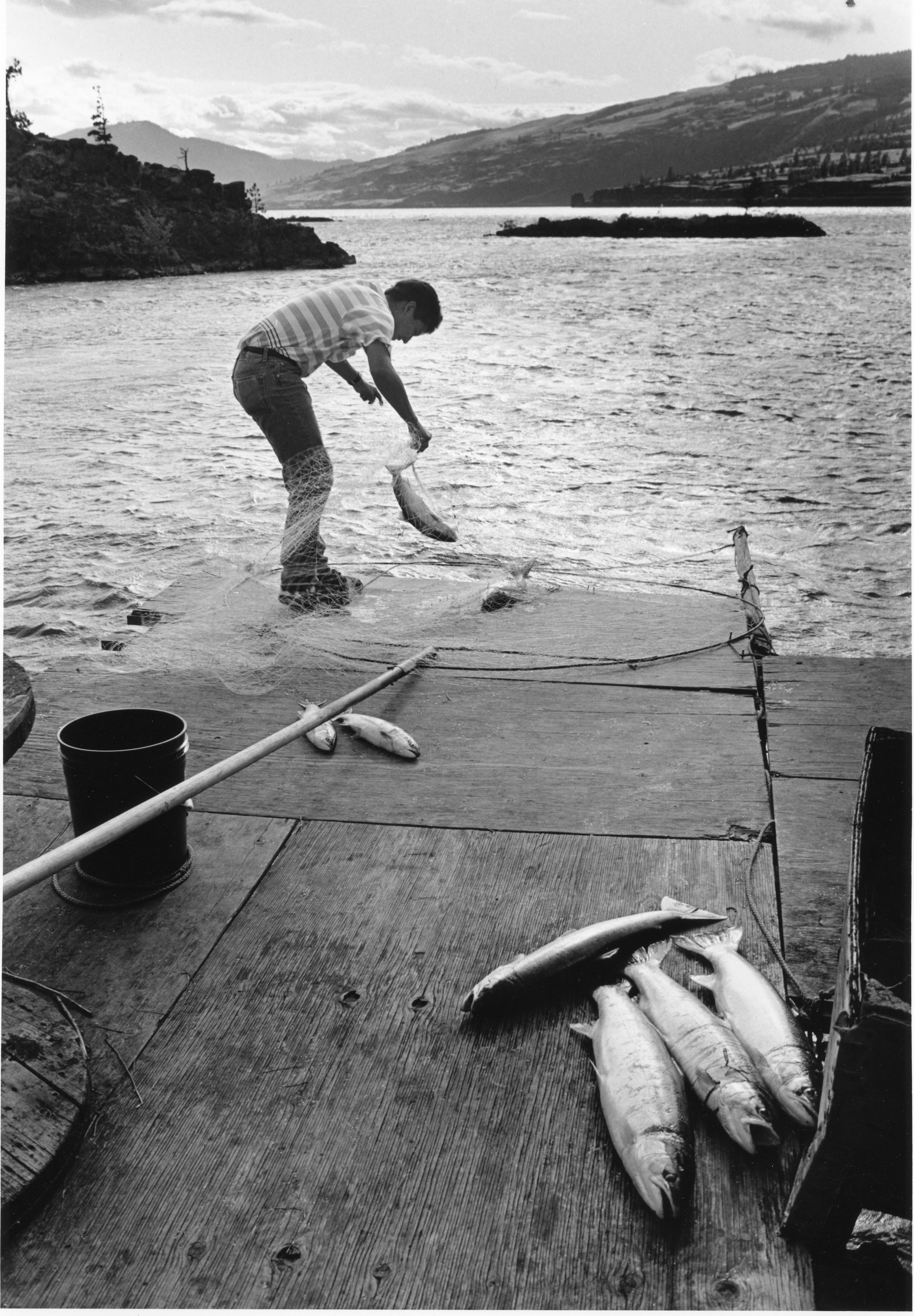
Roger Dick, Jr. (Yakama) harvesting blueback from scaffold off Highway 14 near Sauter’s Beach; Lyle, Washington. [Jacqueline Moreau papers, Coll 459, Box 10, Folder 4; Special Collections and University Archives, University of Oregon Libraries, Eugene, Oregon.]
–The Columbia River Inter-Tribal Commission
In honor of Native American Heritage Month the University of Oregon Libraries is pleased to announce an exhibit titled, Wy-Kan-Ush-Pum: We Are All Salmon People. This exhibit honors Oregon’s tribal communities and their traditional cultures, knowledges and lifeways that have sustained them since time immemorial. We first recognize and honor the Kalapuya people, who were the original indigenous inhabitants of the Willamette Valley, including the land that the University of Oregon resides. We are honored to now have the new residence hall, Kalapuya Ilihi Hall, named in honor of those who were here first and in recognition of their traditional homelands.
All of Oregon’s tribal communities share a common connection to their traditional homelands and natural resources provided by the creator that sustains life for their people. This exhibit highlights the tribal cultures along the Columbia River Basin that have a distinct sacred connection to salmon that has shaped their culture, diet, societies and religions for thousands of years. Salmon, or “wy-kan-ush” in the traditional language of Sahaptin, are revered as sacred and one of the most important aspects of tribal culture.
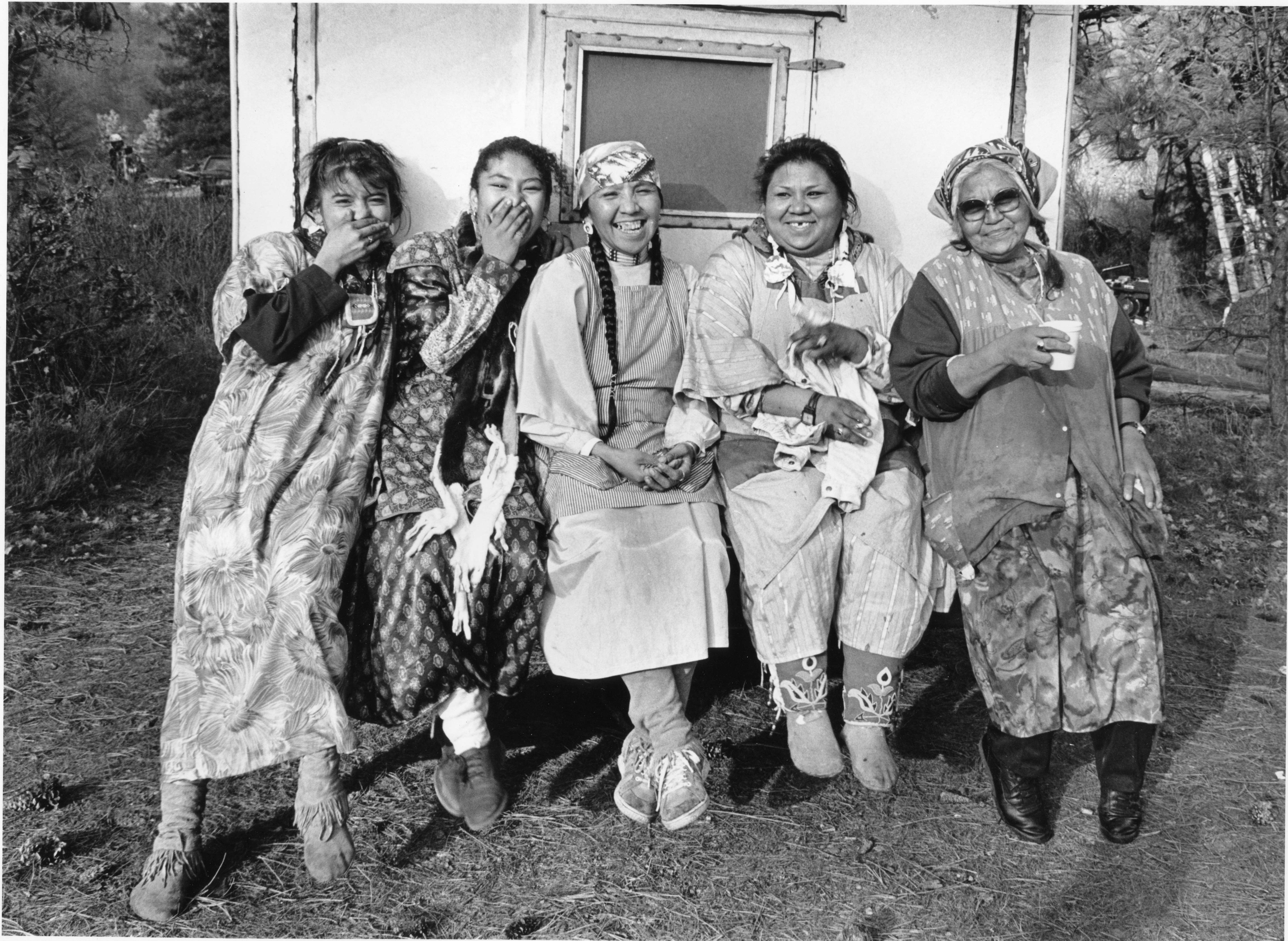
The Spino family: Mona, Geneva, Andrie, Joyce, and Delores (Yakama). [Jacqueline Moreau papers, Coll 459, Box 10, Folder 7; Special Collections and University Archives, University of Oregon Libraries, Eugene, Oregon.]
The Columbia River Inter-Tribal Commission coordinates management policy and provides fisheries technical services for the Yakama, Warm Springs, Umatilla, and Nez Perce tribes. For more information about the history and importance of salmon to the Columbia River tribes, see the Columbia River Inter-Tribal Fish Commission website.
Cover of “Salmon Is Everything: Community-Based Theatre in the Klamath Watershed,” Image courtesy of Oregon University Press.
In May 2011, the University of Oregon Theatre Department celebrated the salmon culture and history of the Klamath River basin in Oregon and California in the play Salmon is Everything, directed by Theresa May, Associate Professor in Theatre, with culture advisers Gordon Bettles (Klamath) and James Florendo (Warm Springs), and included numerous Native American actors from campus and the larger tribal community. The play details the thousands of salmon that died on the Lower Klamath River in 2001. It follows a young Native American woman, Julie, as she and her family cope with the emotional, political, and economic aftermath of the fish kill and fight to save their fish and river. The play is not only a story about a watershed in crisis, but is also about promoting healing and change. Further information about the play and its development can be found here and in the book Salmon Is Everything: Community-based Theatre in the Klamath Watershed.
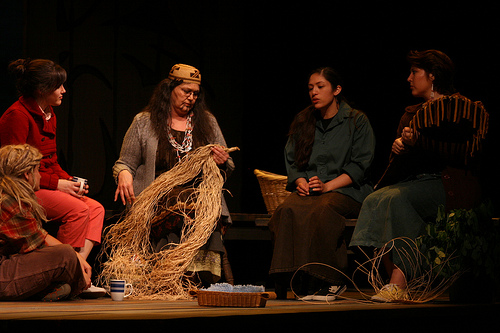
Marta Clifford (Grand Ronde elder) with Shayleen Macy (Warm Springs, UO Alumni) and Ada Ball (Siletz, UO Alumni), Image Courtesy UO Theatre Department, May 2011
According to Marta Lu Clifford, Grand Ronde Tribal Elder who played the role of Rose in the play, “Salmon are sacred to the Native people of Oregon. Salmon are one of the traditional foods of our ancestors and they have passed the responsibility of taking care of the Salmon down to us. As Rose says in the play Salmon is Everything ‘We need to once again take care of the Salmon physically and spiritually. This is the time, for their survival and ours.’ Being part of the play Salmon Is Everything has instilled in me that it is our responsibility to take care of the earth, which includes all the water and our scared Salmon.” Marta now serves as the Tribal Elder in Residence for the UO Native Theatre program.
The exhibit also highlights the importance of the trade that also occurred along the Columbia River watershed. One of the most prized trade items for indigenous peoples along the river was dentalium, a mollusk tooth shell harvested on the Pacific coast from the sea floor sediment, used for trade, jewelry, and for some tribes, currency. Dentalium make its was east as far as the Great Plains, and the further east it went, the more valuable it became.
A huge thank to those you contributed in developing the exhibit: Jan Smith (Kiowa), Jennifer O’Neal (Grand Ronde), Danielle Mericle, and Mandi Garcia.
Further information and additional images can be seen in the full exhibit on display now until January in the Knight Library, 1st floor lobby, in front of the circulation desk.
Please also see our research guides for:
Native American Primary Sources in Special Collections and University Archives
Law – Indian and Tribal Legal Research
Common Reading Book 2017-2018: “The Roundhouse” by Louise Erdrich
________________________
Jennifer R. O’Neal (Grand Ronde)
University Historian and Archivist