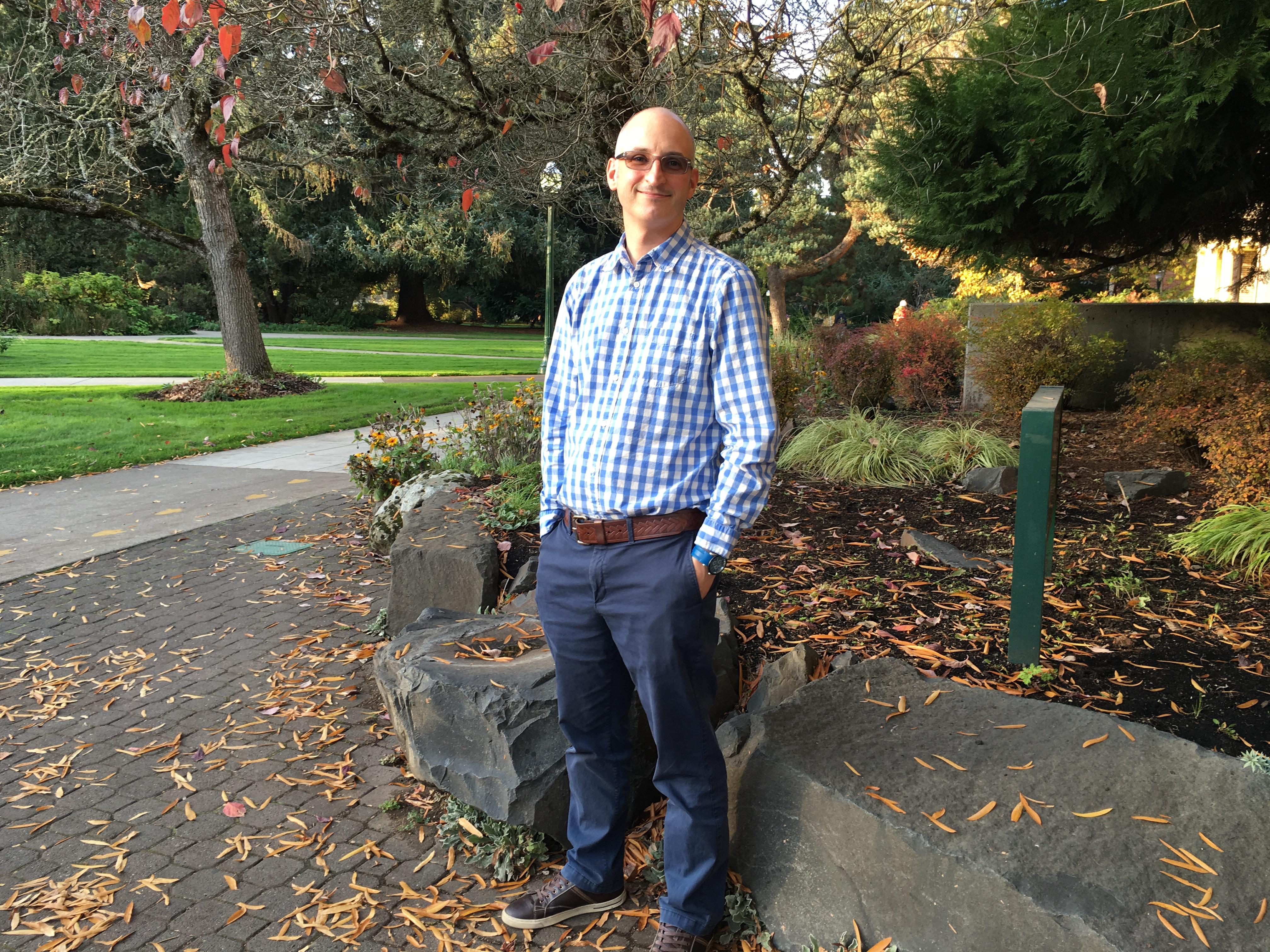
Faculty Spotlight Lucien Brown (East Asian Languages & Literatures)

Lucien photoHow are you connected to the LTS program?

I teach courses on Korean and East Asian linguistics in the department of East Asian Languages and Literatures (EALL). LTS students who are interested in teaching East Asian language often take our courses as electives, and I sometimes advise LTS final projects. Also, we currently have two students who are doing concurrent MA degrees in LTS and Korean Linguistics and Pedagogy in EALL.

Are the classes you teach related to your own research?

Very much so! I’m interested in socio-cultural language learning and teaching, and I incorporate these perspectives into my second language acquisition and pedagogy classes, such as EALL 542 Second Language Acquisition of Chinese, Japanese and Korean and EALL 543 Chinese/Japanese/Korean Pedagogy. I also research multimodal aspects of politeness in Korean, which relates to my class EALL 586 East Asian Sociopragmatics.

What advice would you give to applicants who are considering a concurrent MA degree in EALL?

First, remember that the EALL deadline for grad admission is earlier than the LTS date (EALL January 1, whereas LTS is February 15)!

In your application it is really important to articulate a clear reason for wanting to do a concurrent degree and be a member of both programs. From our side, we really want to see a clear reason or goal for wanting to study Korean linguistics and pedagogy.

Many Korean students who apply to LTS focus on English language teaching (EFL), but some of them also become interested in teaching Korean. Why do you think this happens?

In Korea, the idea of foreign language teaching is focused so much on Koreans needing to learn English, and the awareness that people from other countries need to learn Korean is not so high. But coming here broadens student’s horizons. Korean students get to know about our strong Korean language program, and meet students who are learning Korean as a second language, possibly for the first time. They get to see the importance and value of Korean language education. Besides, even if you plan to become an English teacher, having experience of teaching your native language (Korean) will give you a different perspective on what it means to teach and learn a second language.

What do you enjoy about working with graduate students?

Student Spotlight: Sue Yoon

IMG_4547


Sue Yoon is originally from Korea and completed her Bachelor’s degree in Linguistics and the Certificate in Second Language Acquisition and Teaching (SLAT) at the U of O. She is now working on concurrent MA degrees in Linguistics LTS and East Asian Languages and Literatures.

You are doing concurrent MA degrees in both Linguistics with a language teaching specialization (LTS) and East Asian Languages and Literatures (EALL). Can you tell us why you chose to do both degrees? How do you benefit from each department?

I got my undergraduate degree in linguistics from the University of Oregon and wished to continue studying linguistic characteristics of my native language in depth. I believed that having sufficient knowledge of linguistics would benefit me as a language teacher, which has always been a dream of mine, so I decided to apply to the M.A. Korean linguistics and pedagogy program at the University of Oregon as well as to LTS. I really enjoyed learning different language teaching techniques and approaches from a variety of LT courses at the undergraduate level, and they helped me broaden my perspective of language teaching to a large extent. I certainly benefit from both programs in many different ways. They perfectly match my areas of interest and allow me to develop a deeper understanding of language teaching and the Korean language system in order to become a more successful Korean language teacher. It is also intriguing to learn both theoretical knowledge and practical knowledge from the two programs.


What do you like best about teaching at the university?

There are a number of benefits of being a language GTF at the University of Oregon. First of all, I can gain professional knowledge about my fields of interest and more teaching experience simultaneously during my graduate studies. I also find it very helpful to apply what I have learned from the LT courses to my own teaching as the LT courses have certainly helped me understand what makes a good language teacher. Moreover, learning various aspects of the Korean language system from EALL (East Asian languages and literatures) courses helps me to better explain features of the Korean language to my students in the most effective manner when teaching at the university. Finally, I am so glad that I got the chance to meet my awesome students who are learning Korean at the University of Oregon!


For you, what is similar or different about teaching English vs. teaching Korean?

I have taught both English and Korean at a few different places in Korea and the U.S. I found teaching English quite different from teaching Korean. As I was teaching Korean, I have realized that being a native speaker of the language does not mean that it is easier to understand the language system. I learned English as my second language, and this helps me identify and understand areas of potential difficulty faced by learners of English as I underwent the same language learning. I usually feel more comfortable and confident when teaching Korean as it is my native language, but it is sometimes quite difficult to provide my learners with what they really need in order to understand a specific aspect of the language and understand their problems and difficulties from their perspective. However, I have really enjoyed the experience of teaching both languages!


What advice would you give applicants who might want to do concurrent MA degrees like you are?

There are a lot of great courses provided at the University of Oregon, and I believe that being able to do a concurrent MA degree can help students further broaden their knowledge in two different areas of study that they are interested in. It has been a wonderful experience taking a variety of courses and meeting such a great group of people in the two programs!