Upcoming Lecture: Erkki Huhtamo

The School of Architecture and Allied Arts is excited to announce the next A&AA Interdisciplinary Lecture – Thursday, February 27, 2017 at 6:00 p.m, LA 177. 

Erkki Huhtamo: “Screenology, or Media Archaeology of the Screen”

“Media screens are both present and absent, both well known and unknown. Pervasive use makes them ‘vanish.’ We look through them, not at them. Even cracked smartphone screens do not attract attention to their wounded surfaces. The users read messages and “realities” through the cracks which they barely notice. Screens not only disguise themselves; they hide the history of their own becoming. The media archaeologist’s task is to make the screens visible again and to excavate the cultural contexts where they have been used and given meanings – even hundreds of years ago. This lecture is based on the author’s forthcoming book Screenology, or Media Archaeology of the Screen. It demonstrates one possible way of researching screens, suggesting a new approach for media studies.”

***

Erkki Huhtamo is known as a founding figure of media archaeology. He has published extensively on media culture and media arts, lectured worldwide, given stage performances, curated exhibitions, and directed TV programs. He is a professor at the University of California Los Angeles (UCLA), Departments of Design Media Arts, and Film, Television, and Digital Media. His most recent book is Illusions in Motion. Media Archaeology of the Moving Panorama and Related Spectacles (The MIT Press, 2013).

This 2nd annual A&AA Interdisciplinary Lecture is sponsored by the School of Architecture & Allied Arts with special thanks to History of Art and Architecture Department, Product Design Department, Art and Administration Program and Art and Technology Program for their support.

Lecture: Abstract Video – The Moving Image in Contemporary Art

Gabrielle Jennings is an LA-based multi-media artist and Associate Professor teaching in the Graduate Art program at the Art Center College of Design in Pasadena. This lecture is associated with the recently published collection of essays edited by Jennings, entitled Abstract Video: The Moving Image in Contemporary Artwhich centers around the question of abstraction in the moving image arts.

PHIL 607: Seminar in Data Genealogy

Looking for an NMCC class to take this Spring? Interested in engaging with our contemporary data-driven society through a philosophical and historical lens? Try Colin Koopman’s PHIL 607: Seminar in Data Genealogy

“What makes possible the formatting of selfhood that we perform on social media?  What motivates our idyllic dreams for big and ever-bigger data?  What historical cunning informs the obsessive surveillance of today’s corporate and governmental surveillance regimes?  How new—and how old—are new media, cutting-edge information technologies, and the informatics of our present?

The course will have two aims in taking up these questions.  Firs, through the  philosophical methodologies of archaeology and genealogy associated with the work of Michel Foucault and media archaeologist Friedrich Kittler.  Equipped with this methodological apparatus, we will consider various approaches to what might be considered a genealogy (in a broader sense) of contemporary informational assemblages.  The class will draw on a variety of disciplines and read (at a relatively quick pace) texts authored by philosophers and historians of science, historians of technology, historians of literature, and a range of other critical genealogists.  Some of the books we will read from include Tung-Hui Hu’s A Prehistory of the Cloud, Bernard Harcourt’s Exposed: Desire and Disobedience in the Digital Age, and James Purdon’s Modernist Informatics: Literature, Information, and the State.”

***

Colin is currently working on a book manuscript project on these subjects, tentatively entitled How We Became Our Data: A Genealogy of the Informational Person.  The project engages with contemporary debates in new media theory and political theory in order to frame an argument around early twentieth-century informatics technologies in such domains as personality psychology, identity documentation, and the racialization of property. See more about Colin on his blog.

DMAC Fellowship

Announcing the Cindy and Dickie Selfe DMAC FellowshipThe Digital Media and Composition Institute (DMAC) is proud to announce the Cindy and Dickie Selfe DMAC Fellowship. This newly developed fellowship celebrates our commitment to increasing the diversity of students, teachers, and scholars in the field of digital media and composition studies, and to making it possible for individuals to attend DMAC who could not otherwise participate.  The fellowship is applied toward tuition costs for the Institute.

To Apply – write a one to two page letter to the organizers addressing the following:

  • Why does DMAC interest you?
  • What personal and professional goals do you hope to achieve by attending DMAC?
  • How will your participation in DMAC enhance and enrich the experience of other institute participants while you are here?
  • How might your participation in DMAC enrich the lives of colleagues and students at your home institution and in the field at large?
  • What means of funding to attend DMAC do you currently have?

Email application letter no later than February 8, 2017 to:

Scott Lloyd DeWitt:  dewitt.18@osu.edu
Erin Bahl:  erinkathleenbahl@gmail.com

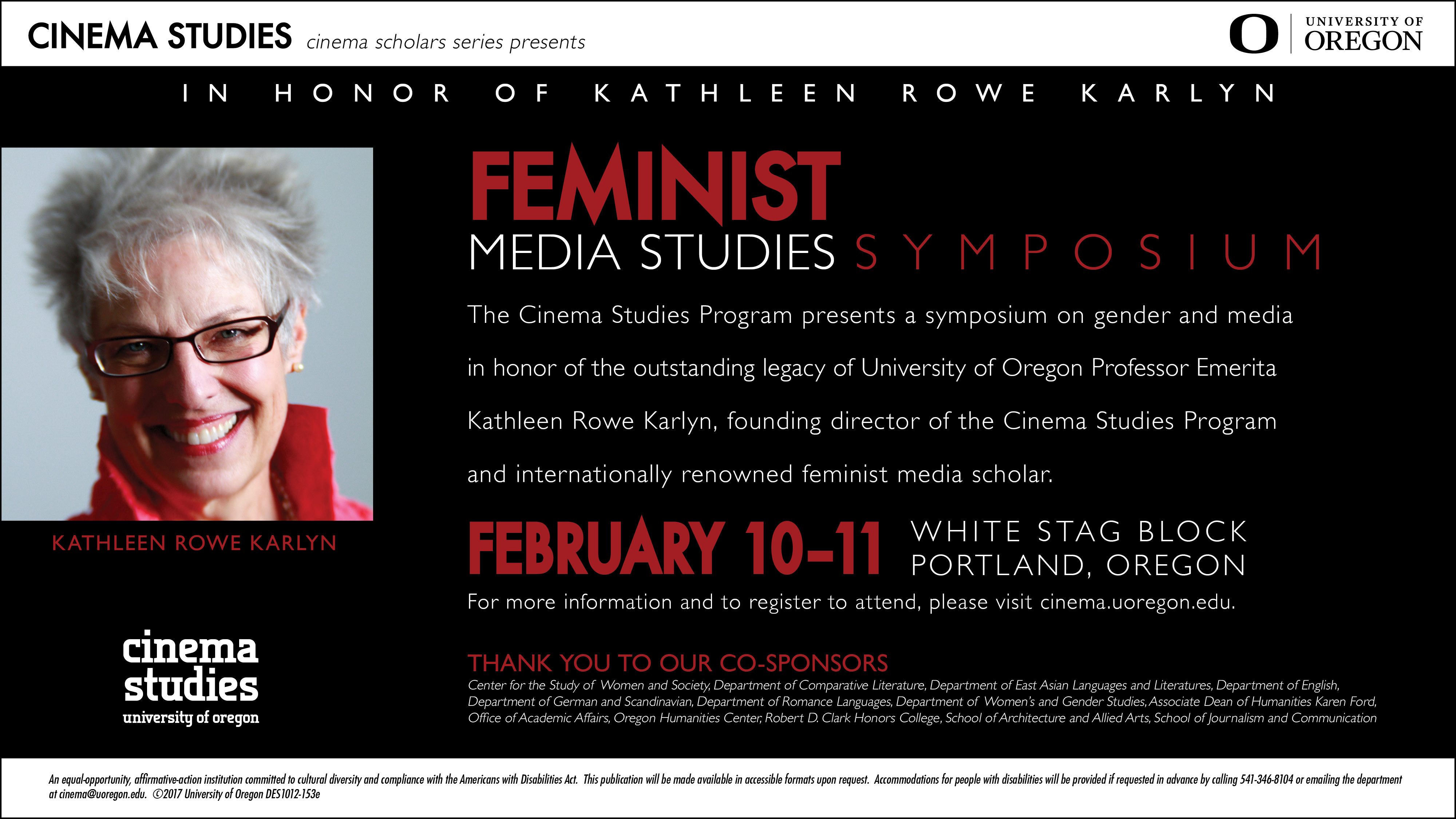
Feminist Media Studies Symposium in Portland

The University of Oregon Cinema Studies Program presents the Feminist Media Studies Symposium in honor of the outstanding legacy of Professor Emerita Kathleen Rowe Karlyn, founding director of the Cinema Studies Program and internationally renowned feminist media scholar.

This Symposium will bring together the most interesting research at the intersection of the fields that Professor Karlyn helped define in ways that both engage with the intellectual questions central to her oeuvre and build on them to suggest the new directions in which feminist media studies is now moving. This will include presentations by colleagues and former students of Professor Karlyn, UO alumni, and others who have high profile careers in media production and content creation outside of academia. The symposium will also showcase graduate and undergraduate research in film and media studies at the University of Oregon.

Welcome Reception: Friday, February 10, 5:00 pm – 8:00 pm, White Stag Block

Symposium: Saturday, February 11, 9:00 am – 4:30 pm, White Stag Block

Breakfast and lunch provided 

Pre-registration is required for attendance at this event.

Art/Science/Technology Conference in Greece

Taboo - Transgression - Transcendence in Art & Science 2017

The Department of Audio and Visual Arts of the Ionian University organizes for the second year in a row the interdisciplinary conference “Taboo – Transgression – Transcendence in Art & Science”, including theoretical and artwork presentations. The conference continues to focus: a) on questions about the nature of the forbidden and about the aesthetics of liminality – as expressed in art that uses or is inspired by technology and science, b) in the opening of spaces for creative transformation in the merging of science and art.

Conference held 26-28 May 2017 at Ionian University, Corfu Greece

Deadline for proposals: February 28, 2017

 See website for complete details on schedule, speakers, and registration

“Art is, in so many ways, a reflection of reality, its glorification as well as its challenger, in an instinctive understanding that nothing is stable despite the effort to keep a balance between the comfort of belief and the delusion of control. Art and science interrelations are not always clear and one could have the impression that the artist seems more permeable to the influence of science than the scientist to the influence of art. This year’s conference is dedicated to all those who keep pushing the limits further than the next gadget and understand the essential role of fantasy when synchronized with reality. One step further, one more time, knowing that the truly opening dimension might be towards the voyaging of consciousness.”

Submissions are welcome from all art and research fields with emphasis on filmmaking, illustration, video art, sound art/electroacoustic music, photography, animation, videogames, computer art, installation art, performance art, bio art, net.art, electronic art, robotic art and cutting-edge technology in art research.

Suggested, but not exclusive topics, are those associated, with:

  • Chemistry of the mind, natural healers and mind enhancement
  • Post gender, transgressive identities and social models
  • Cyborg, augmentation and bοdy modification
  • Psycho-pharmacology, somatechnology and post-humanism
  • Human-like machines, uncanny valley and sex technology
  • Biopunk, hybridity and aesthetics of mutation
  • Biotechnology, biophysics and music technology

Submissions: must be sent electronically through the EasyChair submissions system and include the following:

  • an abstract (which should be no more than 500 words),
  • presentation title,
  • author(s)/artist(s) name(s), affiliation(s),
  • e-mail address(es),
  • up to 5 keywords, along with a short CV /resume (no more than 150 words),
  • type of presentation: paper, poster or artwork presentation,

Proposals for artwork presentations should also include one or more links pointing to documentation material (photos, video, audio, etc.). Links like Dropbox or Google Drive can be used, but links with an expiration date (ex. Wetransfer) are not acceptable. In addition, if the link has a password, it should be included too.

Proposals for poster presentations should also include one link pointing to the a draft poster in pdf format uploaded in a cloud storage service. Links like Dropbox or Google Drive can be used, but links with an expiration date (ex. Wetransfer) are not acceptable. In addition, if the link has a password, it should be included too. Draft poster in PDF: A3 (29,7 × 42 cm) maximum 5 Mb / 200 dpi in CMYK colour mode. Please save the file as surname-name.pdf.

CFP: Textshop Experiments — Open Issue

The editors of Textshop Experiments invite submissions via essays and video essays, reviews, conference reports, and multimodal projects for its forthcoming Open Issue to be published in May 2017.  Textshop Experiments is an open access, peer-reviewed journal that aims to extend the work of Greg Ulmer and to foster experimental works that invent, operate in, or analyze the apparatus of Electracy.  We welcome innovative and hybrid works in new media and original scholarship on reading and writing, rhetoric, and culture.

Works can be submitted on any topic related to the following:

  • Electracy
  • Digital Humanities: the Arts, literature and the digital media
  • Cultural studies
  • Multimodal composition & pedagogy
  • Digital curation
  • Film & new media
  • Visual studies, design, and public art
  • Electronic literature
  • Memory studies
  • Internet studies & digital culture
  • Performance studies
  • Aesthetic studies: critical discussion, case-study, computational analysis
  • Interdisciplinary approaches to the arts
  • Emerging critical theories involving interdisciplinary studies
  • Interdisciplinary approaches to teaching and education

Traditional essay should be between 3000-5000 words. Multimodal projects can be arranged in consult with the Editors and the Advisory Board. Book, blog, or software reviews and conference reports should be between 1000-2000 words for single and/or double book reviews.

Please send essays and writing as a doc or docx files.  Works should be sent in MLA format.  For the formatting of other projects, please consult our Submission Guidelines on our website or query the editors at ulmertextshop@gmail.com

No unsolicited reviews are accepted, however, contributors are encouraged to query the editors before submission.

Deadline for submissions is March 1, 2017

Submissions must be made electronically as MS Word file attachment to: ulmertextshop@gmail.com


International Postdoctoral Fellowship in Global Media Studies Department of Modern Culture and Media

Brown University invites applications for a two-year International Postdoctoral

Fellowship in Modern Culture and Media, with a specialization in Global Media Studies.
This position is to be held jointly at the Cogut Center for the Humanities and the

Review of applications will begin January 27, 2017, and will continue until the position is filled.

The department emphasizes the theoretically informed analysis of film, television, video, new media, photography, sound technologies, and print in the context of modern and contemporary cultures. Scholars interested in challenging older conceptions of national culture, region, canons, and/or tradition are encouraged.
Possible research interests include:
  • the productions and receptions of one or more non-Western or Global South media practices, texts, and/or audiences
  • the translations and transformations of globally popular genres
  • media ecologies, economics, and geopolitics in an era of increasing transnational media trade
  • new media “publics” and “privates,” spatialities and temporalities
  • transnational media institutions and national media imaginaries
Position:
  • The Fellow will offer one course each semester of the two-year appointment devoted to questions of media texts and transmissions in a global context.
  • The Fellow will also be affiliated with the Cogut Center and is expected to participate in the weekly Tuesday seminars as well as other activities of the Center.
  • Research should critically engage the technological and theoretical transformations and media flows that are rapidly resituating all forms of media and social practices.


Ph.D. must be in hand by July 1, 2017 and must have been awarded by an institution other than Brown University within the past five years.
Application: submit the following electronically:
  1. letter of application
  2. curriculum vitae
  3. dissertation abstract or book abstract
  4. two sample syllabi
  5. three letters of recommendation
Brown University is committed to fostering a diverse and inclusive academic global
community; as an EEO/AA employer, Brown considers applicants for employment
without regard to, and does not discriminate on the basis of, gender, race, protected
veteran status, disability, or any other legally protected status.

DH in CAS Event Today!

 DH in CAS will hold the first RIG of  the season on Thursday, January 26, from 3:30-5:00 in The Oregon Humanities Center (159 PLC). Coffee and light refreshments will be served.

Parker Smith, Carmel Ohman, and Dina Muhić, all PhD candidates in the English department, will share their innovative and exciting projects.

Parker Smith is a PhD student studying American literature. In his talk, “Entertainment by Immersion: Towards a Spatial Conception of YouTube Temporality,” he works to make sense of the enormous amounts of data hosted by websites like YouTube by summoning the mass of electronic devices this data implies.

Carmel Ohman is a PhD student whose interests lie at the intersection of 20th C. American literature, ecocriticism, and race and ethnic studies. Her talk “OKCollaborate: Out-Of-This-World. Interdisciplinary. Fun!” is a mobile app that facilitates interdisciplinary collaboration through a fun visual and textual interface.

Dina Muhić is a doctoral candidate at the University of Oregon, specializing in film, television, and new media studies. Her project “Trauma and Queerness in Popular Culture: Performing Critical Closeness through Digital Form,” is rooted in the longstanding notion that form and content are inextricably linked, and posits digital spaces as a potentially revolutionary site for liberating academic scholarship from the normative, linear format of the printed word.

Head of Digital Scholarship Services at NYU

New York University seeks a Head of Digital Scholarship Services (full-time, tenure-track) to manage, envision, and expand a suite of innovative and sustainable digital scholarship services in support of faculty and student needs. Through deep engagement with NYU scholars, the head will support a growing community of researchers and instructors in meeting their technically intensive scholarship goals and position libraries services and collections for maximum utility in cutting-edge digital scholarship.

Applications will be considered through February 10th, 2017

Visit position posting for full details on position, requirements, and application

Job Duties:

  • directing the selection and implementation of appropriate technologies for our research community
  • providing high-quality consultation to scholars using digital tools and methods like text mining, data visualization, and mapping in their research and teaching
  • creating programmatic opportunities that support a growing community of practice in digital humanities and scholarship
  • intensive outreach activities and managing key internal relationships with affiliated library services or departments (Data Services, Digital Library Technology Services, Scholarly Communications) and university departments (University IT and Center for the Humanities
  • continual pursuance of personal research agenda and scholarship goals.

Qualifications:

  • Minimum one graduate degree (master’s level or higher). A second graduate degree will be required for tenure review. One of the two must be an ALA-accredited MLS or equivalent.
  • Minimum 5 years of relevant library experience.
  • Minimum 1-2 years supervisory experience.
  • Exceptional technology skills, knowledge of current digital scholarship trends, and ability to evaluate and apply new technologies.
  • Expertise with common web publishing tools (e.g. Omeka, WordPress), and demonstrated experience with state-of-the-art research methods in digital scholarship.
  • Progressively increased responsibility in planning, managing, and delivering complex digital humanities and digital scholarship projects in an academic setting.
  • Experience providing consultation as well as teaching or leading workshops on digital scholarship tools and/or methods to faculty and students.
  • Demonstrated ability to build and engage an active intellectual community, including working collaboratively and building partnerships across disciplines.
  • Ability to communicate effectively and tactfully with a wide variety of stakeholders, including faculty, students, and staff in a team environment.
  • Experience with project management
  • Experience with state-of-the-art research methods, including quantitative, qualitative, or geospatial methods is highly desirable.
  • Experience with programming languages, such as Ruby or Python and ability to deploy code in web contexts, such as HTML5, CSS, JavaScript, or similar.

To Apply:  submit the following electronically to: https://apply.interfolio.com/40048

  1. CV
  2. letter of application
  3. names, addresses, and telephone numbers of three references to

NYU’s Division of Libraries embraces diversity and is committed to attracting qualified candidates who also embrace and value diversity and inclusivity. EOE/AA/Minorities/Females/Vet/Disabled/Sexual Orientation/Gender Identity