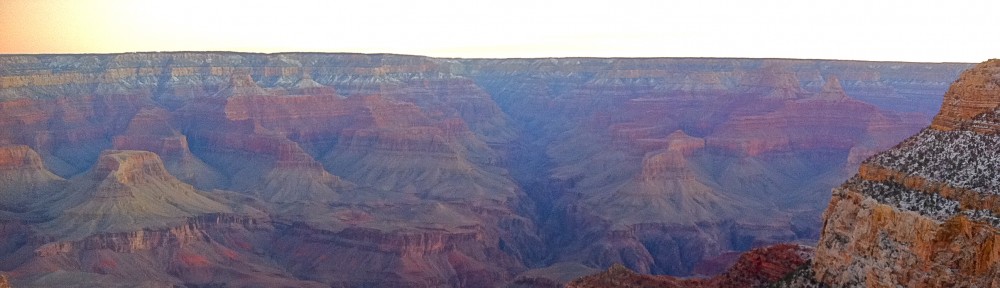
In Emerson’s essay “Nature” it is stated that adults are unable to see nature, and that what they do see is purely superficial. A person might see the sun, but they will not consider its warmth, illumination, and incredible significance. I find it magnificent that what he says here continues to ring true with the present day, as it seems fewer people truly embrace the beauty and glory that is the natural world. I believe this essay is attempting to show how nature should invoke these emotions, and that those who do not feel so are not only numb but also blind to the beauty of the world around them. Might this be why Emerson equates himself to a transparent eyeball? He sees and feels the world with no reservations and no barriers. By seeing the world through the eyes of a poet he is able to experience the earth the way it was intended and the way many adults cannot. There is, however, a place where one might remove this blindness and see firsthand the beauty of the natural world.
Daily Archives: October 16, 2012
Master Emerson, and Padawon Thoreau
The transcendentalist movement was being formed by Emerson and people with similar interests in the 1830s, with the majority of ideas being presented at the Transcendental Club. It consisted of a hand-full of members that originally met to talk about their critiques on societal institutions, among many other things (American Transcendental web). Thoreau was born 14 years after Emerson, and was not part of pioneering transcendentalism in these formative meetings, but was greatly inspired by Emerson’s essay Nature as a youth. He went on to refine the movement with a different voice than Emerson, one that’s particularly engaging, at least to me. Thoreau, the contemporary, was less poetic than the master, Emerson, but only by default. Emerson was abstract to an extreme, in order to push the limits of the movement he was a part of… the transparent eye-ball passage speaks for itself. His language was highly stylized, using regular rhetorical statements, like when talking about stars, “Seen in the streets of cities, how great they are!” As well as backward-Yoda-speak, “But every night come out, these envoys of beauty…” Both examples of this stylized language are found within the first paragraph of the first chapter of Nature.
Rowlandson vs. Environment
When reading Mary Rowlandson’s captivity narrative, I thought that it would be interesting to analyze and focus on the connection that links humans and the environment. There were many connections that played a part between the two topics, one in particular stuck out to me. I noticed that Mary Rowlandson used “leaving farther my own country, and traveling into a vast and howling wilderness” (318, Rowlandson) to describe the unknown territory that the Wampanoag people were taking her to. I found this interesting because it showed that Mary considered the wilderness and unknown to be a negative thing and that she was not willing to leave the comfort and familiarity of her old town, Lancaster. She wanted to return to her town even thought she knew that it was not the same place anymore and that she had no choice but to move on, she even relates this emotion to a biblical story, “…I understood something of Lot’s wife’s temptation, when she looked back” (318, Rowlandson). Like in the Lot’s wife, Rowlandson was leaving her familiar environment and going the new wilderness that she was not familiar with and to her this was a negative and dangerous thing. Rowlandson did not think of the new territory as a good and healthy environment but rather the wilderness as dangerous and scary, especially since she was being forced to go against her own will like Lot’s wife.
Another part in Rowlandson’s narrative where she talks about the wilderness and unknown environment in a negative way was during the second remove when they Indians moved them out again and she referred to the land as “the vast and desolate wilderness” (312, Rowlandson) again. During this particular part of her story she seemed to have given up for a moment when being taken from her familiar environment. There was a point where she quotes herself, “I shall die, I shall die” (312, Rowlandson). She clearly did not think that she was going to survive the new territory and that she was going to die like the rest of her family and town. These connections stand out to me because they display the clear sense of fear and negativity that the environment plays with Mary.

Thoreau in time
Henry David Thoreau, born July 12, 1817, is today considered to be a major influence in various domains in the United States. His works are widely spread, read and studied in a number of different contexts and he was a source of inspiration for a lot of people. He did multiple things in his lifetime, but he mostly dedicated his life to work. Looking to know more about his life brings a few things to my mind. I might be stating the obvious, but this is what strikes me when learning more about him.
The Cold
Rowlandson effectively uses the wintery season she was captured during to portray the bleak and desperate mood felt in this excerpt. Her having had to “sit all this cold winter night upon the cold snowy ground,” portrays a lack of control over her environment. For her captors, the Wampanoags, would not provide shelter to her and her sick child, and she had no ability to affect that. This exposure to the elements also sets the scene as cold, which is something she puts emphasis on by using it twice in that one phrase. That coldness can then be transferred to the Native Americans in a symbolic gesture, further portraying Rowlandson’s situation as bleak. And if her captors, her environment, and her mood are all cold and bleak, what will keep her motivated?
A Vimeo Film that Thoreau would have loved
This weeks readings on Thoreau, particularly “Sounds”, seem to me, to beautifully connect, however indirectly, with this video. The notion of time loosing meaning when we are directly experiencing nature is one of this short films’ motifs and reminded me of Thoreau. I hope you like it.
A Spiritual Awakening: Thoreau
Excerpt from Henry D. Thoreau, Walden
“It matters not what the clocks say or the attitudes and labors of men. Morning is when I am awake and there is a dawn in me. Moral reform is the effort to throw off sleep. . . . We must learn to reawaken and keep ourselves awake, not by mechanical aids, but by an infinite expectation of the dawn, which does not forsake us in our soundest sleep. I know of no more encouraging fact than the unquestionable ability of man to elevate his life by a conscious endeavor. It is something to be able to paint a particular picture, or to carve a statue, and so to make a few objects beautiful; but it is far more glorious to carve and paint the very atmosphere and medium through which we look, which morally we can do. To affect the quality of the day, that is the highest of arts. Every man is tasked to make his life, even in its details, worthy of the contemplation of his most elevated and critical hour. If we refused, or rather used up, such paltry information as we get, the oracles would distinctly inform us how this might be done.” Continue reading
Thoreau’s Still Standing
Last week we were assigned sections of Henry Thoreau’s Walden. His section on ‘Economy’ was interesting as a whole but there were a few pages and specific passages I thought still greatly apply to the world today. I wanted to take a further look at two of them.
First, Thoreau refers to the laborer as some one with “no time to be anything but a machine”. This phrase could very well be applied to the working force today in a few different ways. Although a ‘laborer’ in the time of Thoreau is very different than the ‘laborer’ of the 21st century, there is striking similarity between the lifestyles. Literally it can be applied because the majority of work is now done on/with machines. With the assembly line, laborers skill level is minimal. The laborer is one who is faceless to the consumer society. With the raging capitalism and mass production in corporations like Walmart, laborers are forced into factories where their face is irrelevant and their rate of production is all that matters. They are essentially a “machine”. If they break (get sick, injured, etc.) they can be easily replaced with a new part (employee) as there is no shortage of people entering the work force on a daily basis.
Connections & Reflection: Man and Nature
In Emerson’s Nature, the relationship between man and his environment is one of great importance. Though written in a time before global warming and over-harvesting was a problem, Emerson writes very wise words that reflect the idea that man and nature depend on each other. First off, Emerson states that finding a certain peace with nature is essential to finding delight in the natural world. Man and nature need to find a harmony. This brings me back to the last post I wrote where I stated that the wilderness was a place where a person faces themselves and has to fight and be at peace; for when left to their own accord it is up to man to decided whether he be evil or not.
Nature, God, or Spirit?
One of the topics that I found to be most intriguing from our class discussions were our talks about Emerson’s, Nature, piece. However, I found his spiritual associations with nature a bit confusing. The “transparent eyeball” piece we analyzed in class addresses this aspect of his perceptions, as do some other areas of the text.
We learned that Nature has come to be thought of as the “manifesto” of transcendentalism. We also learned that reason versus understanding and finding divinity in nature are interests of transcendentalists too. To myself, these ideas seem conflicting. Emerson writes, “In the woods, we return to reason and faith.” (29). This seems very foreign. Reason and faith are very different ways of thinking. I have always viewed faith as believing in something without needing reasoning, while reason seems like something involving little faith and mostly facts. So the juxtaposition of the two feels shocking and contradictory. Emerson abandoned his life of organized religion, so I wonder to what kind of faith is he referring? Especially, since later in the essay he writes that “religion and ethics” have an, “analogous effect with all lower culture, in degrading nature…” (48). Although Emerson references and makes many comparisons of nature with religious topics, I am led to believe that perhaps he is not directly referencing a religious faith, but rather faith in oneself, or perhaps something else?