I don’t think I’ve ever really thought or learned about bodily portraits and the topics discussed in the most recent reading assignment. The first reading I looked over was Bodyworlds and Human Remains by Michael Y. Barilan. My initial reaction was one of shock and disgust at the idea of an exhibit like Bodyworlds. What would have been an otherwise educational exhibit, seemed to me, from the author’s description, more of a stunt done for shock-value. The poses the cadavers are said to be arranged in horrified me! However, throughout the rest of the reading, Barilan brings up probing ideas and questions that I have never even thought about, such as: do we have an obligation to the living or the dead when it comes to a person’s remains? What is the best way to deal with unclaimed remains? Why do we have the cultural process and response that we do when it comes to burial and care after life? One particularly interesting point that Barilan makes is that all cultures and peoples have their ways of honoring the dead and their remains; it is human nature to respect and not defile a corpse. Somewhere, innately in us (unless there are psychological problems perhaps), we all know that there is a certain cultural respect we uphold for another human’s remains. Once I completed this reading, my final thoughts were similar to my initial ones: I find Bodyworlds morbid and an exhibit based more on shocking its visitors rather than educating them. I was disturbed by the concept Dr. von Hagans presented about two cadavers having sex in his newer exhibits. There are other, less controversial ways to display human anatomy and educate the public in my opinion. Dr. von Hagans clearly enjoys creating controversy in order to generate publicity for his exhibit, probably because he does not think it would gain popularity otherwise. Modern technology is so developed that there are so many ways to explore the body and study anatomy in a potentially less offensive manner.
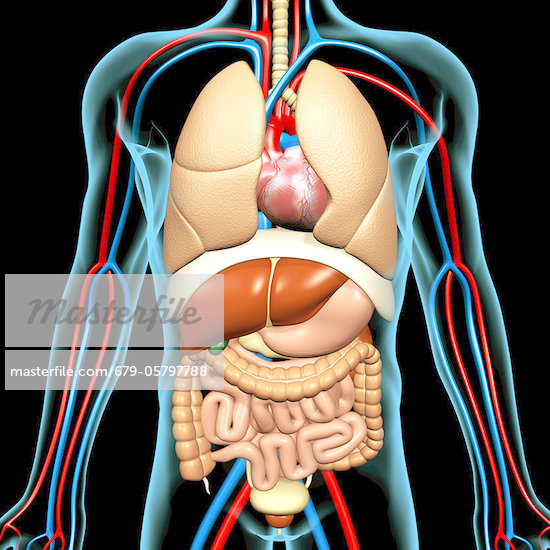
human anatomy
This leads me to my reflection on the next, much longer reading by Marita Sturken and Lisa Cartwright, Practices of Looking: An Intro to Visual Culture, brought up Bodyworlds amongst a myriad of other examples of science (specifically observation of the human body) and its influence on and from art and pop culture. I found this reading interesting although it was dense mostly with examples of countless ways the worlds of art and science have interacted. The reading overall addresses the question of whether or not it is actual possible to separate science from popular culture. From X-Rays to Anatomy Theaters to photography to ultrasounds, there has always been a general desire to see the unseen and visually understand the smallest workings of the world. Scientific images have been depicted in artistic formats and used to start conversation about political topics. Scientific images are used in advertisements and other areas of media and popular culture. The conclusion this reading left me with was that it is really almost impossible to separate science from art when you really think about all the ways these two worlds intersect.
The third and final reading was The Agnew Clinic, the Gross Clinic, the Crucifixion, and Swimming: Dissecting Eakins’ Paintings by Amy B. Werbel. I found it interesting that Eakins’ paintings could receive such mixed responses based on who his viewer was. I think it was interesting that Werbel brings up how during that time period it was acceptable to show the naked body as it was considered “fine art” but once the body is cut open, it is no longer decent.
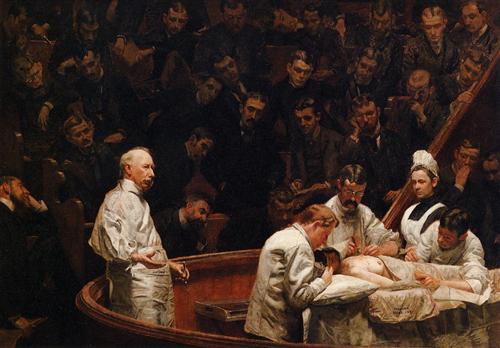
The Agnew Clinic by Thomas Eakins wikiart.org