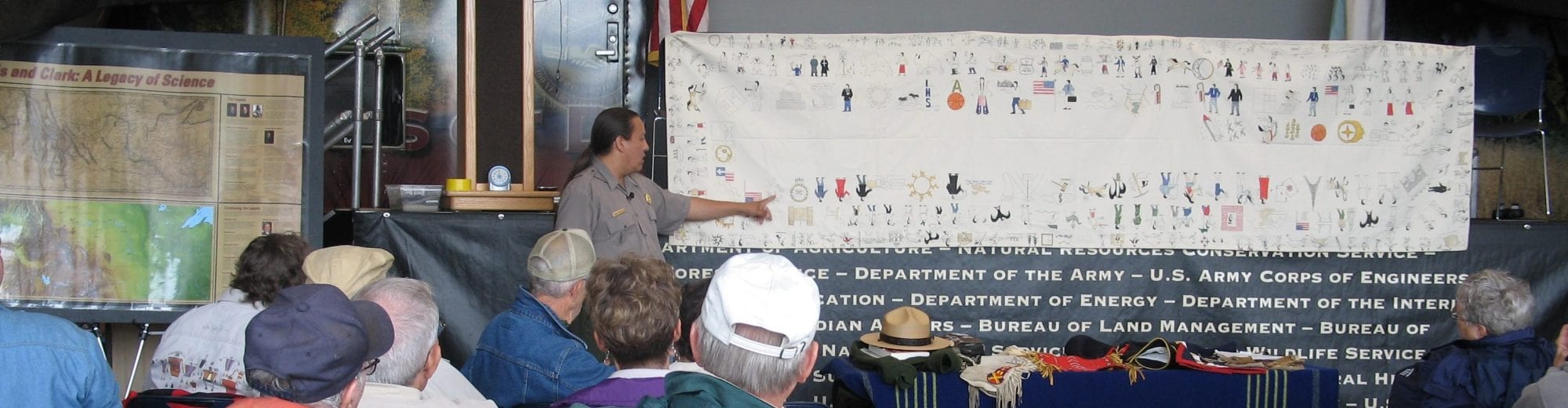
Introducing Newcomers to Oregon’s Indigenous Cultures and Histories through Ledger Art
-
-
- Targeted Grade Band(s): Newcomer Center middle and high school
-
-
-
- By: Elvia Mandujano
-
-
- Newcomer Center North Salem High School, Summer 2019
-
- Targeted Grade Band(s): Newcomer Center middle and high school
-
(Download the curriculum: “Introducing Newcomers to Oregon’s Indigenous Cultures and Histories through Ledger Art”)
Introducing Newcomers to Oregon’s Indigenous Cultures and their Histories was developed after having the privilege of attending the “Discovering Native Histories along the Lewis and Clark Trail” NEH Summer Institute in July of 2019. I, along with other talented, passionate, and driven teachers were awarded the opportunity to gain the knowledge we, and our students, are ready to learn, analyze, and absorb. This curriculum was developed to provide historical and contemporary background information about our local and international Indigenous groups that are represented in the community we live in and, at the end of our unit, in our classroom.
Students who enter the North Salem High School Newcomer Center are recent arrivals to the U.S. and the U.S. educational system. For many of them, such as those who travel with migrant farm-labor families and those who had to work to help their families make ends meet, this is the first time they have stepped into a classroom in years.
I most recently taught students from Mexico, Guatemala, Honduras, El Salvador, Colombia, Venezuela, China, Syria, Uganda, Tanzania, Mozambique, Burundi, Democratic Republic of the Congo, the Marshall Islands, Micronesia, and the Philippines. My students come to us speaking primarily Swahili, French, Portuguese, Spanish, Arabic, Acateco, Zapoteco, Quiché, or yet other indigenous languages. In a classroom such as this, it is crucial that we highlight our human similarities to foster community and ease the students’ uneasiness in the face of such diversity, all the while studying what is to them a foreign language (English) and on new soil.
The anchor book for this curricular unit, The Ledgerbook of Thomas Blue Eagle, is a story that really resonates with me, as I was once a tutor/mentor at a federally-run Indian boarding school, one of the last remaining in our country. When I was a college mentor and then student teacher at Chemawa Indian School in Salem, Oregon, I quickly realized that I was completely underqualified to teach such a diverse and underserved Native group from all over the country. This was the catalyst for me; I needed to learn about my students, their cultures, histories, and how some of their experience might parallel my own life and my family’s, from our own arrival, to the present, and into the future.
The anchor book for this unit highlights the life of an adolescent who is forced from his home to an unfamiliar world where he and his relatives must assimilate, change their name, and learn the English language. The story is full of pain, struggle, friendship, hope, and the confusing and heartbreaking path of duality; can one survive after losing/erasing so much of what they once were? How healthy is code-switching (moving between two languages, often in mid-sentence) for a person’s mind and soul? More importantly, this story centers around the age-old questions, “Who am I?” And, “Am I worthy?”
I love the humanity expressed in this book. And wish I had had the opportunity to read and use it while mentoring and teaching at Chemawa Indian School. Ultimately, this book teaches us about survival and ultimately healing and the ability to thrive.
I dedicate this to the students I once mentored and taught at Chemawa Indian School, who taught me more than I probably taught them and who graciously let me in even after questioning why I was teaching them Spanish and not their native language.
Below, other teachers will find our state benchmark standards listed. A list of beginning vocabulary words, learner objectives, lesson plans, enrichment activities, and additional resources are included so teachers can choose what will enrich their students’ learning and understanding.
This curriculum does highlight the state of Oregon. Oregon is a natural resource rich state that my students now call home after many were forced to flee theirs. It is my pleasure to help my students discover more about their new home and enrich their knowledge of it. But this lesson could be adapted for use in other states and territories as well.
As written in the Tamástslikt Cultural Center on the Umatilla Reservation: “We were, We are, and We will be.” This is exactly what my students need to understand and ponder while discovering the journey of our First People, as well as how it may help them communicate and understand their own past, present, and future in their new land amongst a new dominant language and culture.
This Unit Meets the Following Common Core Standards
(click on the links to learn more about each standard)
- Grades: K-12 2 Gain Knowledge and Understanding of Other Cultures
- Grades: K-12 3 Connect with Other Disciplines and Acquire Information
- Grades: K-12 5 Participate in Multilingual Communities at Home & Around the World
- U.S. History Grades 5-12 1.1A The student understands the patterns of change in indigenous societies in the Americas up to the Columbian voyages.
- U.S. History Grades 5-12 1.2 How early European exploration and colonization resulted in cultural and ecological interactions among previously unconnected peoples
- U.S. History Grades 5-12 2 Colonization and Settlement (1585-1763)
- U.S. History Grades 5-12 2.1B The student understands the European struggle for control of North America.
- U.S. History Grades 5-12 2.1B.1 Analyze relationships between Native Americans and Spanish, English, French, and Dutch settlers. [Compare and contrast different sets of ideas]
- U.S. History Grades 5-12 2.1B.3 Analyze how various Native American societies changed as a result of the expanding European settlements and how they influenced European societies. [Examine the influence of ideas and interests]
- U.S. History Grades 5-12 2 Colonization and Settlement (1585-1763)
English Language Proficiency Standards
- E.L.P. Standard 1 – construct meaning from oral presentations and literary and informational text through grade-appropriate listening, reading, and viewing
- E.L.P. Standard 2 – participate in grade-appropriate oral and written exchanges of information, ideas, and analyses, responding to peer, audience, or reader comments and questions
- E.L.P. Standard 3 – speak and write about grade-appropriate complex literary and informational texts and topics
- E.L.P. Standard 4 – construct grade-appropriate oral and written claims and support them with reasoning and evidence
- E.L.P. Standard 5 – conduct research and evaluate and communicate findings to answer questions or solve problems
- E.L.P. Standard 6 – analyze and critique the arguments of others orally and in writing
- E.L.P. Standard 7 – adapt language choices to purpose, task, and audience when speaking and writing
- E.L.P. Standard 8 – determine the meaning of words and phrases in oral presentations and literary and informational text
- E.L.P. Standard 9 – create clear and coherent grade-appropriate speech and text
- E.L.P. Standard 10 – make accurate use of standard English to communicate in grade appropriate speech and writing
Entry Questions:
- What has the territory that now comprises the state of Oregon had to offer to Indigenous peoples (e.g. natural resources, and what else)?
- If they were not already here since “time immemorial,” why did the First Nations people decide to move and stay in this region?
- What are the names of the cultures that have occupied Oregon territory the longest?
- Which of our state’s First Peoples continue living here today?
- How has their relationship to the land and quality of life changed as a result of removal and reservations?
- What did boarding schools contribute to their changing lives?
- Why did Europeans and European Americans want to move to Oregon in the nineteenth century and beyond that?
- Which more specific cultures did the Europeans who settled Oregon represent?
- Who were these people and what did they seek?
- How and when did Oregon become a state?
- When and why did my family decide to move to this state?
Essential Questions:
- What has been the long-term fate of Indigenous peoples in Oregon?
- What has been the long-term fate of European Americans in Oregon compared to other groups?
- What are the long-term consequences for First Peoples of colonization by European-Americans?
- Are there pros and cons to the boarding school experience for children of tribal nations?
- How have First Peoples survived colonization and, in some cases, even flourished?
- What similarities and differences can we identify between the First Nations of the state of Oregon and the Indigenous groups in my home country?
- What do more recent newcomers contribute to life in Oregon?
Starting Vocabulary:
| Native American | Indian | First Nation | First People |
| Native | Culture | Tradition | Powwow |
| Ceremony | Dance | Tribe/Tribal | Inter-tribal |
| Boarding School | Language | Dialect | Federally Recognized Tribe |
| Regalia | Trade | Route | Seasons |
| Colonization | Generation | Origins | Indigenous |
| Art | Ledger | Ledger book | Ledger art |
| Reservation | Traditional dance | Sacred | Oral history/histories |
Lesson Length:
- Each lesson will take a minimum of one hour, but it could occupy more time, depending upon how much time you wish to give to discussion, writing, and drawing. There are enough lessons in this unit to stretch over an 18-week semester, with one lesson per week. Or, one could have one lesson per day over a month’s time.
Multiliteracies:
- This unit encourages individual thinking, small-group brainstorming, large-group discussions, many writing exercises (typically structured for students with a low level of experience writing in English), and drawing exercises for those who are more visually oriented.
Final product:
- Students will create their own ledgerbook (autobiographical written and visual journal) that helps them express how they feel living in a new country while learning a new language. Exercises are designed to have them reflect on an Indigenous family’s experience and make connections to their own families.
- Each student will create and present a poster that highlights a First Nation/Indigenous group from their home country/birth country AND choose a Native group from the state of Oregon to compare and contrast to the group they chose from their home/birth country.
Materials needed:
- The Ledgerbook of Thomas Blue Eagle by Gay Matthaei and Jewel Grutman (anchor text).
- Composition notebook for every student and teacher and instructional assistant, for creating students’ own ledgerbooks.
- Colored pencils: to color their ledgerbook entries.
- Colorful cloth: students can bring their own or use cloth provided by the teacher in order to wrap their composition notebooks/ledgerbooks.
-
- This is a great opportunity for our students to bring in and share their traditional fabrics and designs from their home countries.
-
- Leather strips: to use for bookmarks.
- Handouts: printed prompts for writing exercises will be given to teachers, instructional assistants, and each student. (Alternatively, teachers could project the writing prompts.) Other handouts are found at the end of this unit, for example, maps of Oregon’s tribal nations, the Lewis and Clark Trail, the Oregon Trail, and more.
- Poster board: one for every student, to be used for their end of the year culminating projects. (Teachers and students can decide to use the front and back, fold the poster in half to create two sections, or provide students with two pieces of poster board for each of their groups – this will depend on the resources available/budget.)
Lesson 1: Introduction to Ledger Art
What is ledger art? Why is it historically significant? Why is it important?
Ledger art is a continuation of traditional pictorial art originally painted on buffalo hide robes and tipi covers. Plains Indian artists recorded battles, heroic deeds, ceremonies, and everyday customs as their way of life passed into history.
“Some are brilliant in color and detail, others are simple pencil sketches, never completed. Known as ledger drawings because of the paper on which they were drawn—typically ruled pages from account books acquired as a gift or through theft or trade—ledger art is a Plains Indian style created largely in the last third of the 19th century. As a genre, it is a continuation of traditional pictorial art originally painted on buffalo hide robes and tipi covers recording battles, heroic deeds, ceremonies, and everyday customs of Plains Indians as their way of life passed into history. In contrast to the traditional hide paintings, however, much of the ledger art was executed by artists held on reservations or in prison, using the tools and materials of a foreign culture—crayons, pencils, and paper.” https://texasbeyondhistory.net/spotlights/ledgerart/ledger-art.html
Project ledger art for students to see, analyze, and comment on. Students should create or receive a graphic organizer to help them organize and keep track of their observations and thoughts. Place students in pairs or groups to discuss/share. Bring the whole group together to discuss findings.
| Ledger Art # / Tribe | What do you see? | What are you wondering about? | Why did the artist feel the need to draw this? What are they feeling? |
| Ledger Art # / Tribe | |||
| Ledger Art # / Tribe | |||
| Ledger Art # / Tribe |
Lesson 2: Introducing the Anchor Text
Introduce the class to the anchor text: The Ledgerbook of Thomas Blue Eagle, by Gay Matthaesi and Jewel Grutman.
Note: I was able to convince my principal and librarians to add this book to our school classroom. I am happy to report that I now have a class set of thirty books that I get to share with the English 9 department. If you are not so lucky, you may have one book you read aloud or use your local library’s copy to use in your classroom. You may also order it on Amazon: https://www.amazon.com/s?k=the+ledger+book+of+thomas+blue+eagle&crid=2KESI9OEBA7EU&sprefix=The+ledgerbook+of+%2Caps%2C214&ref=nb_sb_ss_sc_1_18
Teachers: read the book title aloud and project the image or have students read and analyze the title on their own if they have their own copy. Encourage the students to foreshadow what this book will be about.
- Give students quiet time to think and write, using the table below. Have students work in pairs.
- Bring the whole group together and discuss the cover. Ask them: Who is the book about? What is the significance of his name? What can you tell me about the cover? The horse? The bow? The regalia?
- Ask students to then create their own “cover” with the title: The Ledgerbook of _________________ (have them complete the title with their first and last name). This is when the students will be told and realize that they, too, will be creating their own ledgerbook, similar to that of Thomas Blue Eagle.
Vocabulary word:
Regalia: special clothes and decorations, especially those used at official ceremonies/events.
| Ledger Art # / Tribe | What do you see? | What are you wondering about? | Why did the artist feel the need to draw this? What are they feeling? |
|
|
Lesson 3
Read aloud the first page of the ledgerbook. Have students follow along with their own copy of the book, if they have one. Make sure to have students analyze the picture as well. Ask students to fill in the following sentences:
Childhood / Important Item
I was born in ________________________. My mother’s name is _____________ and my father’s name is ______________. My mother/father gave me ______________ because __________________. It was always important to ______________________________________. Often I ______________________________________________.
After the students have completed their paragraphs, have them illustrate their paragraph, similar to the anchor text. As seen in the ledgerbook, students must use color and write and draw with the notebook being horizontal and not vertical. Help them expand their illustration so it continuous or repeats into the next two pages, similar to the anchor text.
Student writes on the top of the paper Student draws on the bottom half of the paper
Finally, students will complete the following graphic organizer about the ledger art on page 1:
| Ledger Art # / Tribe | What do you see? | What are you wondering about? | Why did the artist feel the need to draw this? What are they feeling? |
|
|
Lesson 4
Teacher reads aloud page 6 of the anchor text, projecting the text, and has students pair up to share ideas about the text. Students then fill in the following sentences:
Family Values and Traditions
My mother/father/grandparents taught me to ____________. He/She/They said it was far more important to _________ than to _____________. They also taught me to ___________________. He/She/They did this by ________________. All the people in my village/town value ___________________________________ tradition.
Students then complete the following graphic organizer about the ledger art on page 6 to complete the following:
| Ledger Art # / Tribe | What do you see? | What are you wondering about? | Why did the artist feel the need to draw this? What are they feeling? |
|
|
Student writes on the top of the paperStudent draws on the bottom half of the paper
Lesson 5
Teacher reads page 8 of the anchor text and projects the image. Students then pair up to share ideas about the text. Students then fill in the following sentences:
My Community of Origin
My family and I lived in the town/village of ____________. We had plenty of _________ and _____________. We lived side by side with ___________________. We had many ceremonies to ________________. The most important person in our town/village was ___________________. The worst event that occurred to our town/village was __________________.
Students then complete the following graphic organizer about the ledger art on page 8 to complete the following:
| Ledger Art # / Tribe | What do you see? | What are you wondering about? | Why did the artist feel the need to draw this? What are they feeling? |
|
|
Student writes on the top of the paperStudent draws on the bottom half of the paper
Lesson 6
Teacher reads page 10 of the anchor text and projects the image. Students then pair up to share ideas about the text. Students then fill in the following sentences:
Houses/Homes
While in my home country, my family and I lived in ____________. My ________ included _______ bedrooms, _____ bathrooms, and a ________ backyard where we kept our _____________________. Before we moved, my family and I had lived there for ___________ years. I miss ___________ and ____________ the most because__________________________.
Students then complete the following graphic organizer about the ledger art on page 10 to complete the following:
| Ledger Art # / Tribe | What do you see? | What are you wondering about? | Why did the artist feel the need to draw this? What are they feeling? |
|
|
Student writes on the top of the paperStudent draws on the bottom half of the paper
Lesson 7
Teacher reads page 12 of the anchor text and projects the image. Students then pair up to share ideas about the text. Students then fill in the following sentences:
Recorded History / Art
The majority of the people in my town or village __________ (did/did not) have books with words. We ________ (did/did not) have a lot of pictures and picture writing. More importantly, we had storytellers. The people who told the most stories in my town or village were _____________. They would tell stories of ________________ and when _____________________________.
Students then complete the following graphic organizer about the ledger art on page 12 to complete the following:
| Ledger Art # / Tribe | What do you see? | What are you wondering about? | Why did the artist feel the need to draw this? What are they feeling? |
|
|
Student writes on the top of the paperStudent draws on the bottom half of the paper
Lesson 8
Teacher reads page 14 of the anchor text and projects the image. Students then pair up to share ideas about the text. Students then fill in the following sentences:
Pastimes/Sports
The majority of the people in my town or village played ____________. We used ________ and ________ to play our games. We would play these games in ______________. The majority of the participants were ___________ while many ___________ looked and cheered on. In order to play, the players or participants would wear _______________________________________.
Students then complete the following graphic organizer about the ledger art on page 14 to complete the following:
| Ledger Art # / Tribe | What do you see? | What are you wondering about? | Why did the artist feel the need to draw this? What are they feeling? |
|
|
Student writes on the top of the paperStudent draws on the bottom half of the paper
Lesson 9
Teacher reads page 16 of the anchor text and projects the image. Students then pair up to share ideas about the text. Students then fill in the following sentences:
Primary Sources of Food/Harvest
Back home, we used to look forward to the _________ season. In my village or town, we ate a lot of ____________ and _____________. We would find/grow most of this food in ______________________. To prepare these foods, the _________ would prepare the food by _______________________. The food that reminds me most of home is __________________, because ___________________________.
Students then complete the following graphic organizer about the ledger art on page 16 to complete the following:
| Ledger Art # / Tribe | What do you see? | What are you wondering about? | Why did the artist feel the need to draw this? What are they feeling? |
|
|
Student writes on the top of the paperStudent draws on the bottom half of the paper
Lesson 10
Teacher reads pages 18–29 of the anchor text and projects the image. Students then pair up to share ideas about the text. Students then fill in the following sentences:
Conflict
My community was always very ________ (quiet/loud/calm). The only times my community was involved in conflict occurred when _____________. Other communities were in conflict with my community because ___________. However, other communities worked well with us because we ______________.
Students then complete the following graphic organizer about the ledger art to complete the following:
Pg. 19
| Ledger Art # / Tribe | What do you see? | What are you wondering about? | Why did the artist feel the need to draw this? What are they feeling? |
|
|
Pp. 20–21
| Ledger Art # / Tribe | What do you see? | What are you wondering about? | Why did the artist feel the need to draw this? What are they feeling? |
|
|
Pp. 22–23
| Ledger Art # / Tribe | What do you see? | What are you wondering about? | Why did the artist feel the need to draw this? What are they feeling? |
|
|
Pp. 24–25
| Ledger Art # / Tribe | What do you see? | What are you wondering about? | Why did the artist feel the need to draw this? What are they feeling? |
|
|
Pg. 27
| Ledger Art # / Tribe | What do you see? | What are you wondering about? | Why did the artist feel the need to draw this? What are they feeling? |
|
|
Pg. 29
| Ledger Art # / Tribe | What do you see? | What are you wondering about? | Why did the artist feel the need to draw this? What are they feeling? |
|
|
Student writes on the top of the paperStudent draws on the bottom half of the paper
Lesson 11
Teacher reads pages 30–31 of the anchor text and projects the image. Students then pair up to share ideas about the text. Students then fill in the following sentences:
My Name and its Significance
I was named by my ________________. My name means __________ in the __________ language. My _________ likes to call me ___________, especially when/because ________________. I prefer that people call me __________. I do not like when people call me or refer to me as ________________________.I am_____________________________________ (full name).
Students then complete the following graphic organizer about the ledger art on pages 30–31 to complete the following:
| Ledger Art # / Tribe | What do you see? | What are you wondering about? | Why did the artist feel the need to draw this? What are they feeling? |
|
|
Student writes on the top of the paperStudent draws on the bottom half of the paper
Lesson 12
The teacher reads pages 32–43 of the anchor text and projects the images. Students then pair up to share ideas about the text. Students then fill in the following sentences:
My Arrival to the United States
My family and I arrived in the United States in the year ___________. We moved to this country in order to _____________ and ________________. I have been living in the United States for ________ years. My first memory of this country is ____________________. What I enjoy most about this country is ________________________________________________.
Students then complete the following graphic organizer about the ledger art to complete the following:
Pg. 33
| Ledger Art # / Tribe | What do you see? | What are you wondering about? | Why did the artist feel the need to draw this? What are they feeling? |
|
|
Pg. 35
| Ledger Art # / Tribe | What do you see? | What are you wondering about? | Why did the artist feel the need to draw this? What are they feeling? |
|
|
Pp. 36–37
| Ledger Art # / Tribe | What do you see? | What are you wondering about? | Why did the artist feel the need to draw this? What are they feeling? |
|
|
Pg. 39
| Ledger Art # / Tribe | What do you see? | What are you wondering about? | Why did the artist feel the need to draw this? What are they feeling? |
|
|
Pp. 40–41
| Ledger Art # / Tribe | What do you see? | What are you wondering about? | Why did the artist feel the need to draw this? What are they feeling? |
|
|
Student writes on the top of the paperStudent draws on the bottom half of the paper
Lesson 13
Teacher reads page 42 of the anchor text and projects the image on page 43. Students then pair up to share ideas about the text. Students then fill in the following sentences:
Making the Decision to Attend an American School
The first person to attend an American school was ___________. They attended their first American school when they were _______ years old and entered the _________ grade. It was important for my family that they attend an American school because ____________. Back in my home country, I attended _____________ and was able to finish up to the ________ grade.
Students then complete the following graphic organizer about the ledger art on page 43 to complete the following:
| Ledger Art # / Tribe | What do you see? | What are you wondering about? | Why did the artist feel the need to draw this? What are they feeling? |
|
|
Student writes on the top of the paperStudent draws on the bottom half of the paper
Lesson 14
Teacher reads pages 44 of the anchor text and projects the image on page 45. Students then pair up to share ideas about the text. Students then fill in the following sentences:
Traveling to School
On my first day of school, I rode a _______________. I arrived with _____________. I remember how the outside of the school looked _______. I remember thinking ____________________. The first person I spoke to was _____________.
Students then complete the following graphic organizer about the ledger art on page 45 to complete the following:
| Ledger Art # / Tribe | What do you see? | What are you wondering about? | Why did the artist feel the need to draw this? What are they feeling? |
|
|
Student writes on the top of the paperStudent draws on the bottom half of the paper
Lesson 15
Teacher reads page 46of the anchor text and projects the image on page 47. Students then pair up to share ideas about the text. Students then fill in the following sentences:
What were you wearing? What was everyone else wearing?
On my first day of school, I wore ________________ and ___________. I had decided on this outfit because ______________. I remember how the other students were wearing _________________________. I remember thinking __________________.
Students then complete the following graphic organizer about the ledger art on page 47 to complete the following:
| Ledger Art # / Tribe | What do you see? | What are you wondering about? | Why did the artist feel the need to draw this? What are they feeling? |
|
|
Student writes on the top of the paperStudent draws on the bottom half of the paper
Lesson 16
Teacher reads page 48 of the anchor text and projects the image on page 49. Students then pair up to share ideas about the text. Students then answer the following questions using complete sentences.
Hairstyles
How did you wear or fix your hair that day? What did you think of some of the other hairstyles you saw during the first days of school? Were there many hairstyles you had never seen before? Explain.
Students then complete the following graphic organizer about the ledger art on page 49 to complete the following:
| Ledger Art # / Tribe | What do you see? | What are you wondering about? | Why did the artist feel the need to draw this? What are they feeling? |
|
|
Student writes on the top of the paperStudent draws on the bottom half of the paper
Lesson 17
Teacher reads page 50 of the anchor text and projects the image on page 51. Students then pair up to share ideas about the text. Students then answer the following questions using complete sentences.
Our Names at School
What is your name? What do your teachers call you? Do your teachers have difficulty saying your name? Are there teachers who can say your name correctly? Do your friends say your name correctly? What names do you answer to? What is your favorite name?
Students then complete the following graphic organizer about the ledger art on page 51 to complete the following:
| Ledger Art # / Tribe | What do you see? | What are you wondering about? | Why did the artist feel the need to draw this? What are they feeling? |
|
|
Student writes on the top of the paperStudent draws on the bottom half of the paper
Lesson 18
Teacher reads pages 53 of the anchor text and projects the images from pages 52–53. Students then pair up to share ideas about the text. Students then answer the following questions using complete sentences.
What do you like best about school?
What do you like most about school? Do you like to draw? What do you prefer to draw? What do you find yourself drawing the most while at school? When do you prefer to draw the most?
Students then complete the following graphic organizer about the ledger art on pages 52–53 to complete the following:
| Ledger Art # / Tribe | What do you see? | What are you wondering about? | Why did the artist feel the need to draw this? What are they feeling? |
|
|
Student writes on the top of the paperStudent draws on the bottom half of the paper
Lesson 19
Teacher reads page 54 of the anchor text and projects the image on page 55. Students then pair up to share ideas about the text. Students then answer the following questions using complete sentences.
Boarding School
What is a boarding school? Have you ever attended a boarding school? Do you know anyone who has attended a boarding school? Have you ever slept at school? What do you think about living at school for months without being able to see your family? What do you think of the idea of separating children from their parents?
Students then complete the following graphic organizer about the ledger art on page 55 to complete the following:
| Ledger Art # / Tribe | What do you see? | What are you wondering about? | Why did the artist feel the need to draw this? What are they feeling? |
|
|
Student writes on the top of the paperStudent draws on the bottom half of the paper
Lesson 20
Teacher reads pages 56 of the anchor text and projects the image on page 57. Students then pair up to share ideas about the text. Students then answer the following questions using complete sentences.
American Football
Do you play American football? What do you think of American football? Which sports do you play when you are not playing American football? How is American football different from sports played in your home country? Do you believe American football is the most popular sport at North Salem High School? Why or why not?
Students then complete the following graphic organizer about the ledger art on page 57 to complete the following:
| Ledger Art # / Tribe | What do you see? | What are you wondering about? | Why did the artist feel the need to draw this? What are they feeling? |
|
|
Student writes on the top of the paperStudent draws on the bottom half of the paper
Culminating Project
After researching local tribes in the United States, specifically the state of Oregon, students will be tasked with researching their home country and at least one Indigenous group in their home country that they would like to better understand. Every student will receive a poster board that will require the following information from a local Oregon tribe AND a native group from their birth/home country:

*This poster can be 1. Folded in half to create two sections, 2. Cut in half to create two smaller posters 3. You can use both sides of the poster 4. If budget permits, provide students with two poster boards so they can organize and visualize both indigenous groups (one from their home country and the other from Oregon).
In order to find this information, most students will require access to technology in order to research their country, its history, and, more importantly, an Indigenous group; preferably one that is different from their peers.
Once students have completed this research, students will be presenting their findings and their poster to the entire class.
*Note, many students would benefit from completing this activity with a specific group from the United States before researching an Indigenous group from their home country on their own.
Oregon Flag Coloring Sheet


Outline of Oregon

- What do the dots on the map represent? The dots represent _______________. (Label them in blue)
- What does the star on the map represent? The star on the map represents _____________________________________________________________. (Label it in red)
- Using the map and stars, identify the most populated cities in the state of Oregon. The most populated cities in the state of Oregon are: _____________, __________, ___________, __________, _____________, and ____________. (Label them in green)
- The capital city of the state of Oregon is __________________________. It currently has a population of _____________________. The current governor of the state of Oregon is ___________________. He/She is a member of the ________________ Party.
- List all the cities you have visited in Oregon and which ones you would like to visit:
| Cities I Have Visited | Cities I Would Like to Visit |
|
|
Students’ Family Tree
Directions: Use the following boxes to help you create a quick family tree (you, your parents, and your grandparents).
Paternal (Father’s) Maternal (Mother’s)
| Grandmother
Name:
Birthplace: |
Grandfather
Name:
Birthplace: |
Grandmother
Name:
Birthplace: |
Grandfather
Name:
Birthplace: |
Father/Dad Mother/Mom
| Name:
Birthplace: |
Name:
Birthplace:
|
Me
|
Name: Birthplace:
|
In your family, who was the first to move to the state of Oregon? Why/how did they decide to make the journey?
_______________________________________________________________________________
_______________________________________________________________________________
_______________________________________________________________________________
The Six Tribal Regions of the State of Oregon

List the Tribes/Nations that live in each of the regions in the state of Oregon:
| Lower Columbia Region
|
Coastal Region | Plateau Region |
| Inland Valleys Region
|
Klamath Lakes Region | Great Basin Region |
Chinook Jargon
Here are some words from the Chinook Jargon. You may recognize a few of the words. The Jargon changed as time went on. After the European settlers arrived, some of their words in their language were added. Highlight the Chinook Jargon you have heard before.

| Yaka = him or her | Klatawa = went | Ikt = one |
| Tenas = baby, little | Pe = and | Moxt = two |
| Tenas klootchman = girl | Mike = you | Klone = three |
| Tenas man = boy | Mitlite = wearing | Lokit = four |
| Klootchman = female | Pil = red | Kwinnim = five |
| Mama yaka mama, chitish = grandmother | Kawkawak = yellow | Tughum = six |
| Nem, yahul = name | Spooh = blue | Sinamoxt = seven |
| Seahpo = hat | Tenas chuck = creek | Wtotekin = eight |
| Klootchman coat = dress | Heehee = laugh | Kweest = nine |
| Tikitlipa = shoes | Cultuswawa = joke | Tahtlum = ten |
| Dly skin = leather | Klatawa pe nanitch = visit | Moxt tahlum = twenty |
| Mowich = deer | Nanitch = see | Tahtlum tahtlum – hundred |
| Mooluk = elk | Chakchak = eagle | Chuck = water |
Here is a sentence written in Chinook Jargon. See if you can write it in English in the lines below:
Tenas klootchman mitlite pil klootchman coat pe dly skin tikitlipa klatawa pe nanitch yaka chitish.
_______________________________________________________________________________
_______________________________________________________________________________
_______________________________________________________________________________
American Indians in Oregon
The original inhabitants of the area that is now Oregon included:

Get Oregonized – AITC.oregonstate.edu
Have you heard of any of these tribes or nations? Where? If you have not, why do you think you have not heard of these groups or people?
_______________________________________________________________________________
_______________________________________________________________________________
_______________________________________________________________________________
_______________________________________________________________________________
_______________________________________________________________________________
_______________________________________________________________________________
Discover the Columbia River

Which tribes depended on the Columbia River for food, water, and transportation? Have you ever seen and/or visited the Columbia River / Columbia River Gorge?
_______________________________________________________________________________
_______________________________________________________________________________
_______________________________________________________________________________
The Lewis and Clark Expedition (Present Day Map of the U.S.A.)

- Locate and label the following states:
a. Washington e. Wyoming i. Minnesota m. Illinois
b. Oregon f. North Dakota j. Iowa
c. Idaho g. South Dakota k. Wisconsin
d. Montana h. Nebraska l. Missouri
- Label and color the following rivers BLUE: Missouri, Columbia, Mississippi, Yellowstone.
- Draw a symbol of a small fort in the state of North Dakota to represent Fort Mandan, where Lewis and Clark hired Sacajawea to help them reach the Pacific Ocean.
- On the south side of the Columbia River at the Pacific Ocean draw a small fort to represent Fort Clatsop.
- Draw a small building to show where you go to school.
- Identify and label the Pacific Ocean
- Identify and label the country of Canada
How might this map look different today if Westward Expansion had not displaced and massacred thousands of Native Americans? Which tribal groups called these areas “home” and hunting and sacred ground? (compare to maps such as these: https://legacy.npr.org/assets/news/2014/06/Tribal_Nations_Map_NA.pdf)
_______________________________________________________________________________
_______________________________________________________________________________
_______________________________________________________________________________
_______________________________________________________________________________
_______________________________________________________________________________
_______________________________________________________________________________
The “Original” Oregon Trail
- Color the states yellow where the “original” Oregon Trail passes through.
- Color the “Old Oregon Trail” red.
- Color the forts brown.
How many forts are labeled and what are their names?
_____________________________________________________________
_____________________________________________________________
- Which states have you visited or passed through? Write them below and color them green.
_____________________________________________________________
_____________________________________________________________
- Using the map above, identify the states you would like to visit and write their names below. Additionally, explain why you would like to visit these states.
_____________________________________________________________
_____________________________________________________________
_____________________________________________________________
_____________________________________________________________

National atlas. Indian tribes, cultures & languages: [United States]

Digital Id – Library of Congres http://hdl.loc.gov/loc.gmd/g3701e.ct003648r http://hdl.loc.gov/loc.gmd/g3701e.ct003648v
Play for students: The Invasion of America: Time Lapse Video: https://youtu.be/pJxrTzfG2bo
Map of Native American Cultural Regions in the 1500s (General)

Here are nine federally recognized Indian tribes in Oregon today
Here are the addresses of Oregon’s Indian reservations. Circle the one that is closest to North Salem High School. (Teachers you may adapt this to your own state.)
- Burns Paiute Tribe: 100 Pasigo St, HC-71 Burns, OR 97720
- Confederated Tribes of Coos, Lower Umpqua, and Suislaw Indians: 455 South 4th St. Coos Bay, OR 97420
- Confederated Tribes of Grand Ronde: 9615 Grand Ronde Rd. Grande Ronde, OR 97347
- Confederated Tribes of Siletz: PO Box 549 Siletz, OR 97380
- Confederated Tribes of the Umatilla Indian Reservation: PO Box 638 Pendleton, OR 97801
- Confederated Tribes of Warm Springs: 1233 Veterans St. Warm Springs, OR 97761
- Coquille Indian Tribe: PO Box 1435 Coos Bay, OR 97420
- Cow Creek Band of Umpqua Indians: 2400 Stewart Parkway #300 Roseburg, OR 97470
- Klamath Tribe: PO Box 436 Chiloquin, OR 97624
WORDSEARCH. Find the names of the Oregon Native American groups in the wordsearch below.
| ALSEA | KALAPUYA | SIUSLAW |
http://www.native-languages.org/oregon-wordsearch.htm
Timeline: Sea Voyagers Who Reached the Pacific Seeking Trade & Colonization
(*have students visit p. 17 at this website: https://www.blm.gov/or/oregontrail/files/ED_GUIDE_FINAL.pdf and write down the last names of the sea captains)
| YEAR | WHO | WHAT | WHERE |
| 1513 | |||
| 1602 | |||
| 1774 | |||
| 1775 | |||
| 1778 | |||
| 1792 | |||
| 1807 | |||
| 1811 | |||
| 1824 |
Glossary
Assimilate: To absorb into the culture of a population or group.
c’waam: A fish known to the Klamath Tribes as c’waam is also called Lost River suckers. These fish were a primary food source for the Klamath and Modoc Indians from historic times until the 1980s, when severe declines in the fish populations caused the Tribes to close their fishery. Each spring the Tribes hold a “Return of c’waam Ceremony” as they have for hundreds of years. These fish are of enormous importance to the physical and spiritual well-being of the Klamath people.
Diverse: Differing from one another.
Ecosystems: The complex of a community of organisms and its environment functioning as an ecological unit.
Fancy Dance/ Shawl Dance: A style of dance occuring at Powwows. Clothing for the women’s fancy shawl dance outfit consists of a decorative knee-length dress, beaded moccasins with matching leggings, a fancy shawl, and jewelry. Fancy footwork is the chief element of the dance.
Indigenous: Having originated in and being produced, growing, living, or occurring naturally in a particular region or environment. It also describes people who originated in a particular region or area.
Jingle Dance: The dress worn by participants is lined with rows of tin cones which make a jingle noise as the dancer performs. The tin cones are often made by rolling the heavy metal tops of snuff cans.
Powwow (Pow Wow): A gathering for American Indian people across the country to celebrate connections to tradition and spirituality, to the Earth, and to one another, in a social, personal, and spiritual meeting.
Regalia: A word used to describe the unique adornments, implements, and clothing made for special occasions, celebrations, and ceremonial activities.
Stewardship: The careful and responsible management of something entrusted to one’s care. An example is the stewardship of our natural resources.
Women’s Traditional Dance: Women wear long dresses frequently decorated with heavy beadwork, ribbons, or shells. Beaded or concho belts are also worn, as well as hair ties, earrings, chokers, and necklaces. Most dancers carry a shawl, an eagle fan or a single feather. The dance consists of bending knees in time to the beat, giving slight up and down movements to the body while subtly shifting the feet to turn.
Field Trips for Student Groups
(Teachers: Look for opportunities in your own areas.)
Free Admission
- TAMÁSTSLIKT CULTURAL INSTITUTE 47106 WILDHORSE BOULEVARD, PENDLETON, OREGON 97801
- MAIN: 541.429.7700 STORE 541.429.7703
- CAFE: 541.429.7702 FAX: 541.429.7716
- https://www.tamastslikt.org/teacher-resources-2/
Website to Order Materials
- Native American Craft Supplies & Mountain Man Craft Supply
- https://www.crazycrow.com/
- https://www.crazycrow.com/strap-leather/strap-leather-pre-cut-strips
Download the curriculum: “Introducing Newcomers to Oregon’s Indigenous Cultures and Histories through Ledger Art”
Bibliography
- Get Oregonized: Oregon’s History, People, Natural Resources and Agriculture, Oregon Agriculture in the Classroom Foundation. AITC.oregonstate.edu
- American Indians of the Pacific Northwest (A–Z Historical Digital Collections) http://content.lib.washington.edu/aipnw/
- Where To, What Next? Educational Film Lesson Plans (Family Tree Lesson) https://www.nps.gov/carl/learn/kidsyouth/upload/wtwn%20lesson%20plan.pdf
- Native American Tribes of Oregon, http://www.native-languages.org/oregon.htm
- Latino Americans (video biographies and lesson plans) https://www.pbslearningmedia.org/resource/0685d348-4654-4c1d-b2a4-047f7f0226a2/digging-at-the-roots-of-your-family-tree/
- Latino Americans: Stories of Arrival (video biographies and lesson plans) https://www.pbslearningmedia.org/resource/15b19a60-db6b-4564-8c9a-21e116c8936b/latino-americans-stories-of-arrival-lesson-plan/
- Latino Roots (video documentaries about Latin American immigrants in Oregon) https://latinoroots.uoregon.edu/archives/
- Umatilla Language Video (students and adults speaking and singing) https://ctuir.org/history-culture/language-nixya%CC%81awii/watch-umatilla-language-video-files
- Confederated Tribes of Umatilla Indian Reservation First Foods and Life Cycles https://ctuir.org/history-culture/first-foods
“I wonder if the ground has anything to say? I wonder if the ground is listening to what is said? I wonder if the ground would come alive and what is on it? Though I hear what the ground says. The ground says, it is the great spirit that placed me here. The great spirit tells me to take care of the Indians, to feed them alright. The great spirit appointed the roots to feed the Indians on. The water says the same thing. The great spirit directs me, feed the Indians well. The ground, water and grass say, the great spirit has given us our names. We have these names and hold these names. The ground says, the great spirit has placed me here to produce all that grows on me, trees and fruit. The same way the ground says, it was from me man was made. The great spirit, in placing men on the earth, desired them to take good care of the ground and to do each other no harm…
Young Chief
1855 Treaty Council
- Student Magazine: Oregon is Indian Country: The Nine Federally Recognized Tribes of Oregon http://www.tamastslikt.org/wp-content/uploads/2016/01/OregonIsIndianCountryStudentMag.pdf Oregon Historical Society:1200 SW Park Avenue, Portland, OR 97205 (503) 222-1741 Fax http://www.ohs.org
- Trail of Tears: The Cherokee Fight Against Removal https://www.pbslearningmedia.org/resource/midlit11.soc.splcher/trail-of-tears-the-cherokee-fight-against-removal/
- Racing the Rez Documentary https://www.pbslearningmedia.org/resource/9853b06c-1c68-4139-bcdc-f239085261e8/racing-the-rez-documentary/
- Why Teach Native American History https://www.pbslearningmedia.org/resource/c801b8b3-ac32-48da-9ddf-6527f8197096/why-teach-native-american-history/
- Spotlight: The Schild Ledger Book: Drawing a Culture in Transition https://texasbeyondhistory.net/spotlights/ledgerart/ledger-art.html
- Texas and Buffalo Lesson Plan https://texasbeyondhistory.net/teach/images/redriverlesson.html https://texasbeyondhistory.net/teach/lessons.html
- Keeping History: Plains Indian Ledger Drawings (Information and images) https://americanhistory.si.edu/documentsgallery/exhibitions/ledger_drawing_2.html
- Chemawa Indian School https://chemawa.bie.edu/
- Conquest or Westward Expansion?: Native Americans and the Stories We Tell https://openendedsocialstudies.org/2017/02/27/conquest-or-westward-expansion-native-americans-and-the-stories-we-tell/
- Map: National Atlas. Indian Tribes, Cultures and Languages (USA) http://www.loc.gov/teachers/classroommaterials/presentationsandactivities/presentations/immigration/native_american.html