Student Spotlight: Olesya Rose

Olesya is pursuing 2 concurrent Masters degrees – one in LTS and one in Russian, East European, and Eurasian Studies (REEES). She is following a two-year schedule and is in her 2nd year.

Hi Olesya! Please tell us a bit about yourself and your background.

I’ve moved through many countries – first in the post-Soviet regions, and later in Western Europe. Eventually, my life brought me to the United States, and I fell in love with Oregon, with its incredible nature and kind-hearted people.

Usually, when someone asks me where I’m from, I have a hard time answering. I was born in the USSR, in the Republic of Moldova, while having a strong connection to my ancestral country, Ukraine, but my first language is Russian. I don’t consider myself as belonging to any one country, even though I feel deep pride for Ukraine and know that Moldova is my motherland. I truly believe I am a child of the Earth.

I love exploring new cultures, learning new languages, trying new foods and learning how to make it, which is why traveling will always be number one on my list of things to do. The only thing that stops me most of the time from taking another trip is my dog, Oliver. He is the sweetest thing that could have ever happened to me. We have a very special and strong bond, and we simply can’t be apart from each other. Oliver and I love hiking and taking trips to the coast, but unfortunately, he is getting old, so getting around is becoming harder for him.


Can you tell us a little about your concurrent MA degrees at UO and why you chose to do them both?

I have to say that I’ve always been a person who never knew for sure what I wanted to do with my life. So, I decided to try myself in many different directions until I found my true passion. My very first degree was from Moldova, and as a result I got my first job – which was very prestigious at the time – in the city administration as a specialist in the ecology office. My second degree I earned in Ukraine, where I became a bookkeeper. However, that didn’t make me happy either. Over the years, I tried myself in many different fields – from a Japanese car expert to a taxi driver – until I came here in 2013. My English was very poor at that time, so I had to begin my journey as an ESL student first. While completing my English classes, I started taking art classes at Lane Community College. That helped me immerse myself in U.S. society, learn English faster, and make friends. That is how I earned my first U.S. degree, an associate’s in art. Then I transferred to the University of Oregon after realizing that art was something I truly wanted to build my life around. I majored in Art and minored in Art History.

In 2023, while finishing my bachelor’s, I realized I was craving something bigger – that I could connect to my art degree. I applied to the LTS program as well as the REEES program. Honestly, I didn’t even think I would be accepted into both. That created a real dilemma for me, because I wanted to be in both programs. And that is how I became a concurrent graduate student without even planning to.

I love that I can study Russian, East European, and Eurasian Studies and combine it with my language-teaching studies at the same time. This mix of classes complements each other in exactly the way I had hoped for. I’ve had the opportunity to assist and work in Russian language classes with competent and fascinating professors whom I truly admire and who helped me believe in myself.

Working on two degrees at the same time, I believe, satisfies the hunger for education that I have always had.


What motivates you most as a teacher of languages? What inspires you?

When I was an LCC student, I volunteered in a beginner-level ESL class. I felt like I was doing something very important by helping immigrants immerse themselves in U.S. life through the language I was helping them learn. I felt appreciated and needed. That gave me an understanding that I could do something more than focus solely on the aesthetics of fine arts – I could combine art with teaching.

So, as soon as I started teaching Russian, I began doing exactly that. Using art in my teaching methodology makes me happy, especially when I see that my students enjoy this approach. It helps them comprehend the material with less stress and motivates them to learn.


As someone halfway through the 2-year schedule of the program, what would you advise to incoming LTS students?

I would say: enjoy your life, because we are only live once! Learn new things, be open-minded, and listen to your heart. School will always be challenging; however, you should remember that you’ll be able to cry with joy when you receive your diploma on stage! Make friends with your cohort, go on hikes, share food, and support one another. Many LTS students are far from their families—the best we can do is create our own little family within the UO walls.


What is a fun fact about yourself that others may not know?

I think I’m always afraid of trying new things; however, I’ve been doing them all my life. This might sound confusing, but that fear is what drives me and keeps me alive. I believe that challenges help us become better versions of ourselves – they reshape us, make us stronger, smarter, and more flexible. If only we could live longer as humans, we might eventually become perfect.

FTLA Experience

Hi, everybody! My name is Inês Bernardo Catarino and I am from Portugal. I assist in teaching Portuguese classes at the University of Oregon. In this special post I am interviewing this year’s Fulbright Foreign Language Teacher Assistants (FLTAs). They are hosted by the Yamada Language Center (YLC) and the LTS MA program. There are 5 FLTAs this year in 2023-24, including me, who teach different languages. 

– blog post by Inês Bernardo Catarino, FLTA-LTS

How would you describe your role in YLC and at UO? What kind of classes and students do you work with? 

Derrick teaching a Swahili class on traditional cuisines

Derrick teaching a Swahili class

Derrick: I began as a teaching assistant (GE) for the Swahili classes mostly. Afterwards, I started to teach Swahili classes once a week. I am also in charge of the Swahili Circle on Fridays, and I also assist in the grading of the aforementioned classes.  

Kesma during the FLTA Fulbright Conference in Washington, D.C.

Kesma during the FLTA Fulbright Conference in Washington, D.C.

Kesma: Hello. My name is Kesma Elzanaty. I am from Cairo, Egypt. I was honored to receive a Fulbright grant to come to the U of O and work as an Arabic teaching assistant. I have been working for the Religious Studies Department carrying out TA and teaching duties. The Arabic language seems to be sought after by different kinds of students such as heritage speakers, newly Muslim people who seek being able to read Qur’an in its authentic language, students majoring in Global Studies and students who are mostly interested in the MENA (Middle East and North Africa) region and the language spoken there. Also, I am finding joy and pride in conversing with students through the conversation session I have been leading and seeing how students are really passionate about speaking Arabic and seeking mastery in it. Even though I don’t work directly with YLC, it has provided a great support in facilitating cultural events that give students of Arabic more exposure to the Arabic language and culture.  

Ines, Derrick and Sohaib at the Portland Art Museum

Ines, Derrick and Sohaib at the Portland Art Museum

Sohaib: I am a Fulbright Foreign Language Teaching Assistant at Yamada Language Center UO but working as a primary instructor for Urdu and Hindi. I teach these languages in the Self Study Language Program of YLC and organize cultural events to give students and other people an enriching experience of cultural diversity. I’m also a member of the Disability Advocacy Committee in the Accessible Education Center in which I advocate for the rights and inclusion of students with disabilities on campus. I’m also part of the International Cultural Service Program in which I give presentations about my country, region and culture in schools and other community events.  I have small classes with mostly heritage learners who want to improve Urdu/Hindi to connect back with their families in Pakistan/India. Other students are interested in traveling or knowing more about that region as that part of the world has vibrant and colorful culture and history.  

Ines, Sohaib and Esma in Washington, D.C.

Ines, Sohaib and Esma in Washington, D.C.

Esma: I have been teaching Turkish as the primary instructor in the Yamada Language Center as a Fulbright Foreign Language Assistant. I also organize cultural events and lead conversation sessions. Turkish is one of the Less Commonly Taught Languages in the U.S., and the courses are offered by the Self Study Language Program. I prepare lesson plans and outlines according to the interests of the students. They fill out a survey stating what they would like to learn, and we design the course accordingly. My students are heritage Turkish speakers who would like to improve their speaking skills, native English speakers who are interested in Turkish language and culture, and academics who would like to improve their translation and writing abilities.

Coming to Eugene was a big move for all of us! Personally, I have enjoyed the nature and the sunny Spring weather, and was positively surprised with how people here are so friendly and kind! What about you? What have you enjoyed most about living in Eugene? Has anything surprised you?  

Derrick: Eugene is a serene and peaceful environment with friendly people. The weather has not been as extreme as I anticipated. 

Kesma: Living in Eugene has been a fantastic experience in terms of the charming natural landscapes Eugene is filled with. It has been a relaxing experience indeed! I guess it is hard for someone living in this green spot of the world to get any negative energy. Nevertheless, what was surprising for me is how hard it has been to find good food in Eugene. This forced me to buy groceries and cook my own food, and fail miserably at it LOL! 

Kesma Enjoying the Winter

Kesma Enjoying the Winter

Sohaib: Eugene is an amazing place with a lot of opportunities to be closer to mother nature and appreciate her. Its beautiful hiking trails, scenic waterfalls and lush green forest are mind-blowing and I cannot stop myself from appreciating its amazing weather. Here life seems slow, and I think almost stops with the sunset.😊 

Esma and Ines at Halloween during pumpkin-carving

Esma and Ines at Halloween during pumpkin-carving

Esma: I love the forest and hiking! There are so many places where I find peace in nature. I didn’t know I enjoyed outdoor activities before coming here. I tried so many new things I haven’t done before. I started archery, cycling, fishing and camping. Also, people here are super friendly and helpful. I didn’t have any difficulty adjusting to the environment. Whenever I had a problem, there was someone to help.  

Personally, I view language teaching as a great opportunity to help students become more confident expressing themselves in the target language and culture. Learning a language can be challenging, so seeing my students’ efforts makes me incredibly proud of them, and also of my work! What would you say is most rewarding and important about language teaching? 

Derrick: What is rewarding about language teaching is helping my learners make use of the language I am teaching them. And to see them improving in every meeting. 

Kesma co-hosting a cultural event at the YLC

Kesma co-hosting a cultural event at the YLC

Kesma: I would definitely say that being able to inspire a passionate student to learn your own culture and language has been the most rewarding thing for me. It is worth seeing myself making a difference in these students’ lives.  

Sohaib: Language teaching is rewarding and amazing at the same time. When you see your students unfolding the mysteries of a new language and appreciating the cultural differences, it feels like languages are a source of creating appreciation for diversity in the world. Language teaching provides me with a chance to take my students from the unknown to a known world where every difference is appreciable and lovable. The most rewarding thing in this job is when your student tells you that they are better able to connect with their families after learning the language.  

Esma: I feel so proud when I see my students speaking Turkish, taking their knowledge beyond the classroom, attending extracurricular cultural activities, and become culture representatives themselves. I think this is the most rewarding part about language teaching.

Esma and her supervisor, Professor Harinder

Esma and her supervisor, Professor Harinder


Student spotlight Madi Collins

Post prepared by Emma Synder, current LTS student

It’s Spring in Oregon and that means the sun and hail are taking turns ushering in a new term at UO! Congratulations to our students in LTS on another term finished. We’re ready for another great term to come!

This month’s student spotlight is Madi Collins. Welcome, Madi! Please, tell us a bit about yourself.

Madi working with a small group of English language students

I’m a student in the 15-month LTS program, and I’m set to graduate in August this year! I’ve lived most of my life in Oregon and found my love for language and language learning in high school when I started taking Japanese classes. Since then, I’ve been expanding my own language knowledge by continuing my study of Japanese while also adding some Ichishkíin and Korean to my linguistic repertoire. My main interests outside of working on growing my own understanding of languages and teaching lie in language revitalization, language change and pragmatics. 

That is quite an impressive repertoire of languages! Have you always been interested in language learning, then? What brought you to the LTS program? To UO?

Originally, I started at the UO in 2018 and graduated in 2022 with my BA in Linguistics. My experiences in the linguistics department at the UO eventually led me to the Center for Applied Second Language Studies (CASLS) where my passion for curriculum development and effective language pedagogy started to grow. This was also paired with the opportunity that I had to take Ichishkíin classes at the UO which helped me to gain more perspectives into language experiences in our society and further intensified my passion for language pedagogy and creating accessible learning spaces and materials for learners of all languages. The LTS program has provided me with opportunities to dig into these passions and uncover further questions and answers to my ideas and has helped me grow even more in my understanding of pedagogy and appropriate, effective approaches to material development. 

Madi standing in front of a class

Madi leading a session in the Talking with Ducks class

It sounds like you have had some incredible experiences at UO so far! Have you had many past experiences with language teaching? Do you have any especially fond memories?

I honestly don’t have much experience with language teaching, and my first experience happened in the fall term of this program in LT 537! This class was a conversations class that was collaboratively led by LTS and UO undergraduate students at the American English Institute (AEI). Collaborating with my peers on lesson plans and working with all 40 of the students really confirmed my pursuit of language teaching and reassured me that I wanted to continue teaching and engaging with students. We would create conversation topics and games for students to play with the language during class, and these class sessions were really fun for both me as an instructor and participant and the students. This class was overall a very positive experience for both myself and the AEI students, and I think of it very fondly as one of my first teaching experiences. 

LT 537 has certainly been a crowd favorite with our cohort, for sure! What have been some other highlights of the program for you?

I think that a highlight of my time within the program so far has been the supportive community within the LTS program. My peers continue to amaze and impress me with the work that we create inside and outside of class, and I really value all of the feedback that I’m able to get from them about my own projects and ideas! So I would say that working with my peers has definitely been a highlight in the program, and it’s so fun watching all of us grow!

The cohort community has certainly been wonderful. Now that you are moving toward the end of your time in the LTS program, what are your plans for the future? How do you hope to work in the teaching field?

Madi holding a plant and giving a thumbs up gesture

Madi shows a green thumb!

Based on my past experiences and experiences within the program, I hope to be able to create accessible language curriculum and materials for learners of any languages, but I am especially interested in creating accessible materials for LCTLs (less commonly taught languages). Online spaces are only continuing to grow in their potential for language learning, and I think that using this space to deliver language resources in culturally appropriate ways would greatly help to support learners of LCTLs and other disadvantaged languages. I hope to be able to use my skills in language teaching, linguistics, and pedagogical theory as a tool of support to communities looking to use online spaces for language learning. 

Outside of language learning, I enjoy caring for my houseplants! I started growing a ZZ plant, an umbrella tree and a rhaphidophora tetrasperma in 2020, and while some of these plants have gone to different homes or not made it through the winter, my tetrasperma is now as tall as me! I love taking some time each week to check in on, prune and water my plants, and I love having my plants in my living space! When I find a more permanent place to live I plan on building a greenhouse for even more plants and hopefully some vegetables!


Global Language Advocacy Day 2023: Language Rights Save Lives

– Post written by Emma Snyder, current LTS student

Winter term is coming to an end and warmer weather is right around the corner! We are sending thoughts and encouragements out to our students as they prepare for finals week. Make sure to rest well and take time to take care of yourself; we know you are all working hard. Today, I have been given the opportunity to spotlight a fantastic holiday, and speak a little bit on how it has impacted me personally, as well as how it can help LTS students in their paths as future educators.

Poster that says Language Rights Save Lives

Poster from https://www.coalitionforlanguagerights.org/

On February 22nd, we celebrated Global Language Advocacy Day, an event organized each year by the Global Coalition for Language Rights (GCLR). The GCLR has been dedicated to their mission of language rights for all people for many years, and are strong advocates for digitally-empowered linguistic rights through the intersection of digital, human, and linguistic rights. UO LTS shares GCLR’s passion for language empowerment, and has had a strong multilingual approach, working to best support multilingual and multicultural language learners towards their language learning goals. UO continues to work to support teachers of minoritized languages, such as indigenous languages in the US. The Yamada Language Center’s Self Study Program is allowing students to learn less commonly taught languages in small, tight-knit classrooms led by native speakers. And the Center for Applied Second Language Studies continues to develop resources and curricula that utilize digital resources in new and innovative ways.

Every year, Global Language Advocacy Day brings together advocates for language rights to spark conversations and raise awareness for language rights. Webinars are hosted, lectures are led, and programs are proposed. This year’s theme was “Language Rights Save Lives.” There were several key events hosted as part of it, including a screening of Breathing Through the Feet – a film created as a response to post-apartheid Johannesburg language ecology– and the 7000 Languages Workshop, which worked with the Indigenous Mapping Collective to show community members how they could create online language learning materials for endangered languages. GCLR also opened a GLAD#23 blog on their website, where people could post their own experiences, observations, and research around language rights, and how language could impact the lives of its speakers.

This concept, that language could be a matter of life and death, has been shown for centuries through the unequal treatment of speakers of non-dominant languages, and through the lack of resources for said speakers that has led to a noticeable disparity in public health. Recently, many groups that may have been unaware, or felt unaffected by such disparity were given an incredibly clear example with the onset of the COVID-19 pandemic. COVID-19 was largely advertised as being an absolutely grueling, but entirely survivable virus for the vast majority of Americans, save a small minority of various high-risk populations. This put many at ease. I was not fortunate to be among the many. As a severely immunocompromised person, COVID-19 was extremely dangerous, potentially life-threatening, and I spent the better part of two years absolutely terrified at the possibility of contracting it. The care, or lack thereof, in the way my friends and family interacted with COVID-19 permanently altered the relationships I had with them. 

Language rights are just as important in the classroom setting. COVID-19 was the first time that I found myself within a minoritized population, with resources that were not designed to account for or accommodate me, and public opinion and misinformation that was at times actively harmful. For many, this has been the case for much longer, both inside and outside the classroom. Many languages have been deemed inherently unequal by the cultures and the contexts they exist within, and students are fighting to maintain not only their identities as speakers of multiple languages, but their identities as people of multiple cultures. It is our job as language educators to support them, and be sensitive to the trials that they face inside and outside the classroom. Several myths regarding imagined harm caused by bilingual learning have been empirically proven false. However, to many outside linguistic and language teaching communities, these ideas are still alive and well, and heritage languages are often lost by the third generation. These trends toward language loss can be fought, and UO, GCLR, and others like them have done wonders to bring accessibility and resources to better support those fighting it. And as we look toward you, our future language educators, we cannot wait to watch you take up arms and do the same.

To learn more about the Global Coalition for Language Rights, visit their website at coalitionforlanguagerights.org

Student Spotlight Anna Krinitsyna

– by Emma Snyder, LTS student

December is upon us, and we welcome the intermittent snow, prepare for the holidays, and congratulate UO students on a successful and productive fall term. We hope you all take this time for some well-deserved rest and recharging! Today we are welcoming to the stage another member of the LTS grad cohort for our student interviews.

So happy to have you here with us, Anna, please, tell us a bit about yourself!

Hi, I’m Anna. This is my second year of the LTS two-year schedule, so I’ve taken most of the classes I need to graduate.

Anna at the Tulip Farm

I was born in Ukraine and moved to Oregon at seven years old. I have been in Oregon ever since, except for two years in Russia. I grew up speaking Russian, some Ukrainian, and English. Later, I learned Spanish. I would love to learn several more languages, such as Greek, Arabic, and Hebrew.

You’re on your way to becoming a regular polyglot, then! Have you been interested in languages for a while? What brought you to language teaching? To the UO?

I have been interested in languages and teaching for a long time, but I was not sure exactly what I wanted to do with my interests until I discovered the LTS program at UO. Prior to that, I worked in various medical fields, like optometry and pharmacy. At the same time, I kept coming back to short teaching experiences (mostly volunteering). After a while, I realized that if I keep dabbling in teaching, I must do something with it by finally getting a teaching degree. The LTS program stood out to me because of the flexibility it provides in choosing the language and age we would like to teach. I would like to have the flexibility to teach English, Spanish, and Russian, depending on where I am in life. I would also like to be able to teach both children and adults. 

It sounds like you’ve had such an interesting journey prior to joining us; we are excited to have you as part of the program! You spoke of short teaching experiences in the past, could you elaborate more on those? What is a fond memory or two you have of them?

During my undergraduate studies, I was a teacher’s assistant at a preschool. Eventually, I started teaching Spanish to the school-age children there. Before graduating, I completed an internship at an ESL class in a community college. I also taught English for a year to a small group of children in Russia. 

My most memorable experience was co-teaching Russian to pre-teen heritage learners at an evening school. These were children who were born to immigrants. The parents, but not the children, were interested in the children learning their heritage language. It was a challenge to motivate the children, as they were more interested in being as “American” as possible. This experience got me thinking about curriculum changes that Russian heritage evening schools could make. At the time, they were teaching from a curriculum intended for monolingual Russian learners. As it turns out, heritage language teaching must be approached differently. Curricula must be developed specifically for the needs of heritage learners.

What an interesting and fulfilling experience that must have been! Supporting heritage learners is certainly important. Now that you are in your second year of the LTS program, what has been a highlight for you of the program so far?

There are so many things I am grateful for in the LTS program, from the director and the professors, to my classmates, to the knowledge I have gained. I am especially thankful for the internship opportunities I have had at CASLS and in RUS 101. The internships have allowed me to try out some of the valuable theories on language teaching and learning that I have learned about in my classes. 

Anna and her husband at an Oregon beach

It is wonderful to hear that you have had so many opportunities and positive experiences with the UO. Looking toward the future, how are you hoping to work in the language field after your time here?

One of the reasons I applied to the LTS program was that I was opening a tutoring business and I wanted to provide high-quality language-teaching services. My short-term goal after graduating is to expand my business. Long term, I would like to create online resources and Russian language programs, especially for heritage learners. My very-far-away-in-the-future goal is to teach at a college or a university.

We wish you all the best in your business ventures, and your future teaching career. May both be filled with success! Finally, what is something outside of language teaching that you are passionate about? A fun fact about yourself that others may not know?

I am passionate about helping people with disabilities reach their goals. This might be related to being a teacher, but I do what I can to help people get over hurdles they might be facing. I have been involved in a Slavic special needs group for over 7 years. We organize events, teach weekend classes, help look for resources, and simply make long-lasting friendships.

I also like to explore different hobbies, such as hiking, playing the piano and the harp, painting, organizing, reading, gardening, and watching documentaries.

A wonderful year with our Fulbright FLTAs

It is the end of the 2021-2022 school year and we are saying farewell to this year’s wonderful group of Fulbright Language Teaching Assistants (FLTAs): Mehreen Mehreen from Pakistan, Erick Njue from Kenya,  Seçil Ayna from Turkey, and Laura Keidann Rodrigues da Silva from Brazil. These four have had a busy and enriching year, and have made some important connections with our LTS cohort. We interviewed them to let our wider LTS readership learn more about them and what they have been up to. Please see the end of the post to find out more about the FLTA program and the UO Self Study Language Program!

We will miss the four of you. Thank you for making 2021-22 a very special year for us, and please stay in touch with the communities you have found here in Oregon!

What has been your role in the Yamada Language Center and at UO? What kind of classes and students do you work with?

Seçil

I have been a Fulbright Foreign Language Teaching Assistant working as the primary instructor of novice level Turkish classes in the Yamada Language Center at University of Oregon. Turkish is one of the less commonly taught languages offered by our Self Study Language Program. Our students include heritage speakers and/or students who would like to get out of their comfort zone and learn a different language, meet a new culture.

Seçil in traditional Turkish dress

Aside from my primary responsibilities as a teacher, I’ve also taken one class per term a postgrad student. This term, I took a third-year Spanish class where we studied cultural products (e.g., art, literature, film, music) in Spanish-speaking societies in order to build on my Spanish language skills.

Last but not least, I’m a part of the International Cultural Service Program (ICSP). As a cultural ambassador, I share my culture with UO students, schools and community groups. So far, I have organized Turkish movie nights, Turkish coffee hours and celebratory events for Turkish holidays. We were also invited to North Eugene High School with a few other ICSPers where students interviewed us for their school projects to learn more about other cultures around the world. I love inspiring people, especially the young ones. If I can make a difference, I feel alive! That’s why I’m a teacher. 🙂

Erick

I have been a Fulbright Language Teaching Assistant (FLTA) for Swahili. My role has been assisting the primary teacher to instruct Swahili to Freshmen and Sophomore students. The classes range between 8 to 20 students and welcome to all who wish to learn a new language, interact, and have fun!

Laura

I worked as a teaching assistant to the senior instructor of Portuguese, the wonderful Bené Santos. I usually participate in her lessons, but I also get to develop and teach my own lessons sometimes. The UO offers three years of Portuguese courses. Some students already speak Spanish and want to add another Romance Language to their repertoire, while others have Brazilian or Portuguese family members. Outside the classroom, I organized the Portuguese Language Circle, which happens in the Mills International Center every week and is open for the broader UO community. Apart from that, I also created events to promote Brazilian culture, such as the Brazilian Movie Night.  

Mehreen

As a Fulbright FLTA (Fulbright Language Teaching Assistant), my primary responsibility was teaching Urdu/Hindi in the self-study program at Yamada Language Center. I usually work with 4-5 students each term who set their own (personalized) goals for language learning.  Since the self-study language program is open to all UO students as well as community members, learners have diverse backgrounds. Mostly, learners want to get exposed to the target language through culture, so I look for authentic material in the target language and incorporate those in class activities. 

I am also part of the ICSP (International Cultural Service Program) program. As an ICSPer, I represent my country Pakistan in different events and, give presentations in community events and schools. Being a cultural ambassador of my country, I feel immensely proud to remove the misconceptions of people about my country.  

Other than that, I have taken courses in Language Teaching Studies and Comparative Literature, both of which have been extremely rewarding for me. I have not only learnt about the different perspectives of teachers and students here, but also gained valuable knowledge about teaching methodologies and classroom management. 

Erick giving a cultural presentation about Kenya and Swahili

What have you enjoyed most about living in Oregon? Has anything surprised you?

Seçil

Outdoors! Hiking, cycling, running… I’m incredibly delighted to be able to do lots of outdoor activities here because they are not easily done back in İstanbul, Turkey – my over-crowded, chaotic home.

What surprised me here in Oregon is that the winter was warmer and drier than I expected. We can observe climate change consequences wherever we go now – at an alarming rate. We all need to ‘Act Now’.

Erick

The most enjoyable moments at Eugene have been Ducks home games, and the serene environment around. I am surprised that Eugene has no traffic and LTD buses are on schedule.

Laura

There are many things that I love about living in Oregon, but what I have enjoyed the most is the nature that surrounds us. I love that I can cycle to campus, which is something that brings me joy even on the most stressful days. When I am in the park or crossing the bridge over the Willamette River, I am amazed at how beautiful it is and at how the landscape somehow looks different every day. I was not aware of the outdoor culture in Oregon before coming here, and I was surprised to discover how much I like it. I was not an outdoorsy person in Brazil, but I have realized that I love hiking and spending time in nature. 

Laura on the UO campus

Mehreen

I love living around nature and Oregon has dense greenery with flowing waters around. During the Christmas snowfall, I remember, I was out in Alton Baker Park the whole time with my friends. think I enjoyed that the most. Silver Falls and the coast are my favorite places.

Since you have each taught languages across many contexts, what would you say is most rewarding and important about the profession of language education?

Seçil

Teaching is life-long learning. I think the most rewarding and important about my profession is learning about cultures. Language is inseparable from culture. It is priceless to experience the beauties brought by cultural differences and commonalities. I can sincerely say that I have become a more responsible, open-minded, action-taker world citizen thanks to learning and teaching languages.

Erick

Erick Njue

Language education is fun! The world is multilingual. There are people who want to learn the language you speak! Language education is a special way to access any part of the world!

Laura

For me, the most rewarding and important aspect of language education is the interaction with students. Learning their stories and their interests and motivations makes it easier to plan the content and the topics for the lessons, but establishing a connection goes beyond that. I am very thankful for all my teachers, because if I had not studied English, I certainly would not be at UO today. Having this kind of impact, by helping students figure out how they can learn a language and how they can communicate with people from other parts of the globe, is extremely rewarding. Besides, every lesson is different. Even the exact same lesson plan will not result in the same lesson when you are teaching two distinct groups. Students’ questions and comments about language and culture often make me reflect on interesting aspects which had not caught my attention before. Teachers never stop being learners, and that is a wonderful thing. 

Mehreen

For me, teaching is yet another chance of learning. In language classes, I see a great diversity which offers me multiple perspectives of thinking. The cultural aspects that I took for granted back in my home country were so meaningful in the language classroom that it made me love my culture even more. 

A trip to Silver Falls in Oregon

More about the FLTA program and the Self-Study Language Program at UO

The FLTA program, which is sponsored by the U.S. State Department, has three goals for their scholars: to teach their language; to become more skilled and well-rounded as language teaching professionals, and to provide cross cultural outreach on behalf of the university to schools and civic organizations in the local communities where they live.

Since 1997 the Self Study Language Program (SSLP) at the Yamada Language Center (YLC) has been one of the ways that FLTAs can come to the UO to teach their languages. The SSLP is a staple for UO students interested and motivated to learn Less Commonly Taught Languages (LCTLs). And since 2004 close to 30 of the teachers in this special program have been FLTAs. They’ve come from over 15 different countries and have taught Arabic, Hindi-Urdu, Korean Persian, Swahili, Thai, Turkish, Wolof, and Vietnamese. In exchange for offering the language and cultural outreach, they get the opportunity to study at the UO for a year tuition free.

At the UO our FLTAs are connected to three departments: the Yamada Language Center where they work, the Language Teaching Studies program where they are academically hosted, and the International Cultural Service Program (ICSP) where they’re part of a team of more than 40 international students providing education and insight.

Alums of this program have followed many different paths upon completion of their year of service. Several have stayed on or subsequently returned to UO and LTS where they have completed graduate degrees. Some now have jobs at prestigious universities around the world; most return to their country and become active members of their schools and universities.

In a time of limited funding for language study, there probably wouldn’t be an SSLP program without the FLTAs. UO students are deeply appreciative of the opportunities that the SSLP offers and the energy that their tutors bring to their intimate classrooms. Cultural learning is embedded in all that they do.

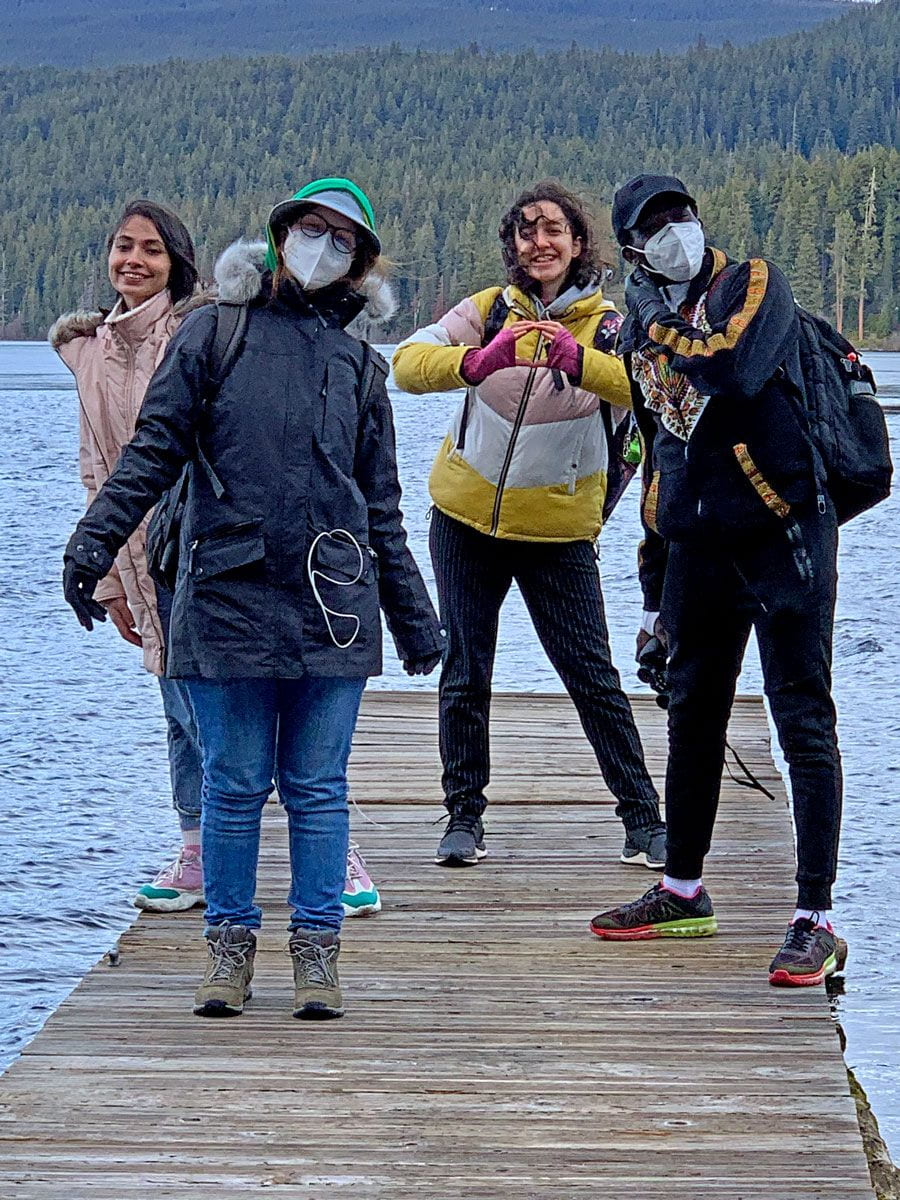
Hanging out at the Willamette River

The FLTAs out in the beautiful Oregon landscape

Why we love language – a post from Spring 22 LT 436/536

This term in LT 436/536, we wrote a few paragraphs about why we love language as part of a class exercise on how to incorporate process writing and genre awareness into writing instruction. We’re publishing them here so that we could write for a real audience.

Hermya & Aissa 

Learning a second language comes with many challenges, such as communicating with native speakers, learning new writing systems and coping with cultural differences. But these challenges are also opportunities for growth. As an English teacher in Japan, Aissa pushed herself to learn Japanese including all three Japanese writing systems so she can help her co-workers with everyday tasks. By doing this, she was able to develop better relationships with them and learned how to become a better team player along the way. Similarly, Hermya’s experience learning Japanese developed her life goals. She became an exchange student in high school to Japan, and now she loves to study Japanese on her own, and plans to teach there after graduation. We both saw the impact language learning has on our lives and relationships and how it contributed to our personal growth, which led us to a love of language learning.


Cameron & Keli 

For us, the beauty of language drives our interest and love for it. One thing that we find amazing is the puzzling nature of language and how it feels like discovering a new secret code. Different languages can provide us with very different structures that give us new perspectives on communication including grammar, sound systems, and pragmatics. 


For example, English has subjects and objects, but other languages like Abawiri structure information by reference, using topics and focus to order words. Sound systems differ so much throughout the world’s languages; learning to discover meaning with sounds we’re using for the first time creates unique exciting experiences we would never otherwise get to enjoy. Wolof, for example, has a single and double consonant system that creates entirely new meanings out of what seem to be imperceptible differences in pronunciation. Although we also find the cultural experiences and opportunities fascinating, originally the linguistic aspects of language are what drove us to pursue language learning and teaching. 

Yueyuan 

Culture affects our core traditions and values and how we communicate with others in society, and language makes communication easy. It is out of curiosity about different cultures that I have developed a strong interest in other languages when I enjoy watching foreign TV shows and movies such as Supernatural, Marvel series, Naruto. Other cultures are fascinating from so many aspects, such as art, music, literature, the ways people think. To learn more about them, we need the language to communicate. For example, English and Chinese have different perceptions and attitudes towards time. In English culture, time flows linearly and moves continuously, from the past to the present, to the future, while Chinese is not so complicated, and there is often no need for precise descriptions of when an action occurs. Culture and language are intertwined, and we cannot separate them. 

Meije 

For me, the aspects of language, and more specifically Spanish, that I am enamored with are more culture-related. I love how Spanish is spoken by different communities all over the world, and that there’s a cohesive Spanish-speaking community as well (a culture just associated with using and speaking Spanish). I really love the micro and macro levels of language reflected by and within communities, such as the phonetical elements that display references to people and places through accents. In addition to accents, I am also intrigued by linguistical elements that are affected by history such as the creation/change of colloquialisms. Additionally, I really admire the aligning target cultures within Spanish-speaking communities. I especially am interested in how the target cultures are quite interdisciplinary, especially in regard to art, politics, and, religion. In reflection on these ideas, and aspects of Spanish related to culture and language, I have found myself finding new ways of expressing myself through the process of learning and implementing Spanish in my daily life. I have so much respect and admiration for and toward the Spanish-speaking community and I feel very honored to be a small part of it.  


Student Spotlight- Anne

Anne is a current student in the LTS program.

Exploring the Real Alcazar gardens in Seville during my semester abroad in 2019


Hello Anne! Tell us a little bit about yourself and your background.

Hi! I’m originally from Eugene—I moved away for college and graduated from Linfield University last spring with a B.A. in journalism and Spanish. And now I’m back! I have realized how much I missed the local hiking trails, boba places, and the Trader Joe’s in Eugene.

Paddle boarding near Bend, OR, last summer

You are really interested in the context of teaching in Spain. What experiences or interests have influenced you about this context?

I studied abroad in Seville, Spain, during my junior year of college, and felt like I just clicked with the people I met and way of life there. I had some informal English tutoring and teaching opportunities that first interested me in language teaching. Until that point, I was pretty much set on a career in public relations, but the more I considered it, the more I felt that language teaching better suited me. I also became friends with some teachers from Seville, so I got to hear about teaching in Spain from their perspectives and consider what that type of experience could look like for me.

What are you working on for your LTS MA project? How is it related to your possible goals in Spain?

My project is a set of materials for a third grade EFL course in a K-12 school in Spain. The course highlights the cultures and language features of five different English-speaking regions around the world. I chose to focus on this particular teaching context because it is one I can realistically see myself teaching in. Although I’m able to be more creative for my MA project, I hope to be able to adapt these materials for a real third grade class in Spain.

Visiting castle ruins in Trujillo

What is most interesting to you about being a language teacher?

I find language learning to be highly frustrating yet highly rewarding. It is always worth it to help students persist through difficult areas so that they can arrive at the breakthrough moments. I get secondhand excitement from students who excite themselves with their newfound understanding of a concept or increased confidence when using the language.

What do you think might be most challenging? How does your project possibly help you think about those challenges?

A challenge I have been exploring since beginning the LTS program is how English as a second or foreign language should be presented. A language spoken by so many different people in different areas of the world has both benefits and challenges. Since I believe language should be presented in a way that is most accurate and best prepares learners to use it in real life, figuring out which varieties, dialects, and regions to focus on is a huge challenge for a language used by so many. My project aims to offer an introduction to World Englishes beyond what is typically offered in Spanish EFL courses.

What is a fun fact about yourself that others may not know yet?

This winter and spring, I have been training for my first marathon. I’m somewhat new to running, so the training has been a lot to say the least. Luckily, I have found that Eugene has a very welcoming running community, so it’s been easy to meet fellow runners. Friends make everything—including long runs—much better!

Post-race llama photo-op after completing my first half-marathon last October


Crafting a personal statement for a program in language education

For those who are applying to graduate programs in language education in the US, it’s that time of the year to craft your personal statement as part of your application. Here are a few tips for making a statement that will stand out to your readers:

The DOs:

  • DO…organize your statement as a ‘deductive’-style essay: with an introduction paragraph, body paragraphs, and a conclusion. The introduction should engage the readers but also make a fairly direct statement about why you are a good fit for the program. The body paragraphs can then provide specific supporting information for your qualifications, interests and goals, while the conclusion can restate how these qualifications will match well with the program you are applying to.
  • DO…highlight your past educational and professional experiences that have brought you to a career in language teaching. If you are an experienced language teacher, highlight your accomplishments, what you have learned from them, and how they have influenced your teaching identity and philosophy. If you have little experience teaching so far, describe what experience you do have and why it has inspired you to learn and do more in this profession.
  • DO…tailor your statement to the specific program. Write about what you hope to learn from the program and how your participation and strengths will contribute to the program. Most departments want to see that an applicant is ready to take advantage of the resources in the program (e.g. relationships with faculty, other departments or institutes, internships, specific coursework topics, etc.) and realize their own full potential with those resources.
  • DO…provide specific examples of your achievements, goals, and experiences that help to tell the story of your journey towards becoming a language professional, e.g. a teacher, curriculum designer, future administrator, researcher, etc.
  • DO…write your statement well before the deadline, so you have time to revise and refine it before you submit it.

The don’ts:

  • Don’t…exaggerate or misrepresent your own experience, such as with teaching. If you have little experience so far, be honest about this.
  • Don’t…just list facts and statistics about yourself. Write also about what you have learned about your own interests and goals, and how these relate to the future.
  • Don’t…wait until the end of your essay to state why you want to attend the program. Readers want to see your ‘thesis’ near the beginning of the statement.
  • Don’t…ask someone else to write your statement for you! Readers will expect writing styles to naturally vary, and understand that bilingual and multilingual writers may have a unique writing ‘accent’. Do, however, revise and edit carefully for common errors and for typos.
  • Don’t… write it at the last minute.

In the end, faculty who are reviewing graduate program applications want to see a clearly written statement of who you are now, how you got to this point, and where you want to go, all in the context of your (future) professional identity as a language teacher.

Good luck with your application!

Keli Yerian, LTS Director

Student Spotlight- Ailsa

Ailsa and her cat “Soymilk”

Ailsa is a current LTS student on the two-year schedule  and is at the beginning of her second year of study. 

Hello Ailsa! Tell us a little bit about yourself and your background.

Hello everyone! I’m Ailsa Li, a native speaker of Chinese who was born in Hebei province in China. Probably not many people have heard about my hometown, but it’s located in the northern part of China and is close to Beijing. 

I came here as an international student for my undergraduate degree 6 years ago. I was originally enrolled in the Economics department and minoring in Business at UO for my first two years. Although these are popular majors for many Asian students, I finally decided to quit due to my terrible calculation skills (what’s a shame!). But more essentially, I realized Economics is not the true interest for my whole life. Later I started learning Japanese and it was the most memorable experience that I personally enjoyed throughout my undergraduate studies (I will talk more about it in the next question). Finally I achieved a double major in both Japanese and General Social Science 2 years ago, and now I’m one of the grad students in the LTS program! 

For leisure time, one of my favorite hobbies is trying out cooking recipes of different cultures. I believe cooking is an amazing strategy to release stress and train patience. Also you can have a real taste for the little success! I also have a cat named “Soymilk”, she is my best “friend” but also the most annoying “roommate”! She likes staring at me or sleeping on my desk when I am working or studying. But deep down in my heart, I am really thankful that Soymilk has always accompanied me, especially during the pandemic when everyone had a tough time connecting with others. 

What made you interested in studying language education?

Here I’ll continue with my Japanese learning experience in UO. I was going into this cold; I had zero experience in learning Japanese except occasionally watching Japanese TV shows, and I needed elective credits at that time so my friends recommended that I take Japanese classes. I wasn’t very confident for the first couple days of starting Japanese class, but soon I realized I did a better job than I expected. To be honest, the main reason for me to choose a Japanese major is that all the professors I met are real experts in teaching. As a student, I could feel their contagious enthusiasm in every single class. I was learning the language with fun, and I still had the passion to learn Japanese after I graduated.

Soon I started thinking about the importance of a teacher’s role in language class. It reminded me of the English learning experience of TOEFL classes in China. I understand most extracurricular English courses are score-driven programs in many countries, and China is not an exception. But I still remember how stressful and tedious the class was. I questioned myself a lot during that period because of my shifting TOEFL test scores. Comparing  these two completely contrary language learning experiences, I was curious about becoming a language teacher who could make language courses more enjoyable and delightful. Now, I’m stepping on that path. 

A beautiful sunset in Eugene

What has been most interesting or motivating for you as an international student living in Oregon? What advice would you give other international students interested in LTS?

Eugene is a relatively small town but it has a mixed urban and suburban environment. You can enjoy a very peaceful life surrounded by plenty of greenery. Walking through campus, you can feel the changing of the four seasons by observing the colors of tree leaves, smelling the breeze and feeling the rain. Oregon is also famous for its beautiful landscapes, coastal scenery and outdoor activities. I was originally from an inland city without any sea around. But living here I experienced crabbing, fishing, snow skating and other fun outdoor entertainment. 

For international students who have a passion for language teaching or are interested in applying to the LTS program, welcome and please join our LTS family. We have many current cohort members and alums who are elaborating their creativity in language education. Some of them are mainly focusing on teaching the majority languages such as Spanish and English. But we also have people who prefer to do projects on minority languages or even endangered ones. In LTS, we encourage everyone to pursue their own path of teaching. Besides we have the kindest program director Keli, she is always willing to hear individuals’ needs and provide thoughtful advice. 

What would be your ideal career path after LTS?

Currently I really enjoy being one of the tutors in the Chinese Flagship program in UO. I’m offering one-on-one tutoring classes to Chinese learners with English L1 backgrounds. I’ve also participated in other Chinese teaching courses in past terms, such as a Chinese Honors class at Oak Hill high school in Eugene. My bilingual or even trilingual linguistic background helped me a lot in teaching, and I feel it’s beneficial if a teacher is able to share their language learning strategies with students. My ideal career path would be teaching Chinese to adult learners with native English backgrounds in a school setting. But teaching communicative or pragmatic focused English class in China or other EFL contexts also sounds appealing. 

Finally, how did you get your unusual name and spelling? I’ve always wanted to ask you that.

I’ve heard this question all the time, and now I can explain it to everyone. During my high school, one day there was a Caucasian looking man with a big smile walking into our classroom. He said he will be the teacher for our English speaking class for this year. The first task we had is that everyone needed to find a nickname they preferred to use in speaking classes. Then we needed to write down our nicknames on note cards and give them to the teacher. The teacher gave us 5 minutes for thinking, discussing or searching online. I just did a quick search on general English names for girls and originally planned to use the normal “A-L-I-S-A” name. But at that point, I didn’t notice my spelling was slightly different….

Soon an extremely interesting thing happened when the teacher started calling everyone’s name from the note cards. He found there were two girls who wanted to be called “Alisa”, but he compared our two name cards and noticed my spelling mistake. So he suggested why not just use “Ailsa” as my unique nickname and it sounded quite cute. I think being a little bit different indeed is a cool thing so I have been using Ailsa ever since. 

Sometimes I feel annoyed explaining my nickname’s spelling in every self-introduction situation. But thanks to my unusual name, people always remember me!

Visiting a Japanese Garden with friends in Portland