Objectives:
- Examine methods for evaluating qualities of art, such as product versus process, the difference between craft and fine art, must art be archival, and what is an aesthetic reaction.
- Explore the notion of food as an artform.
- Consider cultural differences in the production and consumption food.
Original Post:
The reading we had this week was, “Food as Art” by, E. Telfer.
Telfer says, “We naturally associate the word “aesthetic” with the arts, but we can also speak of an aesthetic reaction to natural things such as a beautiful landscape, or to man-made, non-art objects such as pieces of machinery”. I believe this to be true with food as you see this in many restaurants. If you went out for dinner and your plate was sloppy and thrown together without any form of presentation would that make you want to eat it? Some places may not take the time, and in those cases I would never consider those creations as “works of art”. The recipe may have been an artful skill, but the presentation would not be (in my opinion). If you walked into a restaurant that was filled with an unpleasing smell would you want to eat there? The taste of the food and drink as well as the look can give an aesthetic reaction.
There are considerable complexities when deciding if something constitutes as art. Telfer expands Urmson’s definition of “work of art” by saying, “If something is a work of art, then its maker or exhibitor intended it to be looked at or listened to with intensity, for its own sake”. So something may constitute as a work of art if it is meant to be looked at with intensity. One difficulty I have with this is that sometimes things may not be made for the purpose of art or intensity but then become viewed as such. One example was a church building that was not created as a work of art, but now is treated as one (Telfer, 12)
The struggle I have is determining where to “draw the line”. How should we determine which food deserves the title of “art”? One example is that I do not see fast food as art. I think as the food presentation explains, that “slow food” takes more time and dedication for its product. When thinking about which theory of art best describes how I feel, I find myself considering art in the Postmodernism: Art as Interpretation sort of way. Dissanayake explains this as, “…Interpreting it according to their individual and cultural sensibilities…hence taste and beauty and art for art’s sake are constructions that express class interests”. I can also see food as art in a species-centered type of way as we view aesthetic feelings as a behavior. Everyone feels differently about things, and it is how you feel and view certain things that can make them art in your own eyes. In this view it is the things that are viewed as “special” that we could consider a work of art (whether it be an activity, a landscape, or food).
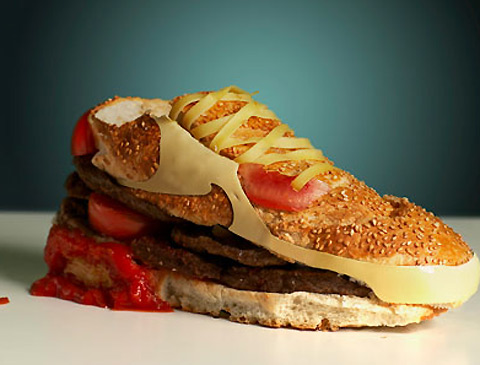
Reflection: This topic was very difficult for me in terms of how I felt about food as art. I saw this picture online and thought that it represented this topic in a great way. The main difficulty I had with this topic was figuring out how I would consider the physical presentation of art, the recipe as art, and the creator as an artist. This reading and reflection taught me the many things that can have an “aesthetic” appeal and how we may react to them. Telfer’s article explained many different views of food and how it could be represented in an art form. It was explained that someone who creates a recipe could be considered an artist, while the person who places the food on the plate would merely be a crafter who works with the artist. I found myself appreciating not only the appearance of how food can be represented (it’s appeal), but also the work that can go into a creation or recipe. No matter how it comes about, I agree with the overall idea that Telfer expands,“If something is a work of art, then its maker or exhibitor intended it to be looked at or listened to with intensity, for its own sake”.
Future: I hope that I can continue to have an open mind when it comes to art. As with many other topics, we can take our values and personal views into consideration when deciding what we may define as “art”. I definitely think food can be viewed as art, although where we draw the line may be a little confusing. I want to continue what I have learned in terms of appreciating the creator, the art forms, and the aesthetic appeals when considering various art forms.
Great reflection! I agree that the presentation and intention behind food are key in considering it as art. Telfer’s idea of aesthetic experience really applies to how we perceive and value food. Your point about fast food vs. slow food was interesting — it raises the question of whether mass-produced meals can still be seen as art. I recently explored a site that dives into the cultural side of iconic fast food like Whataburger, showing how even commercial food can have artistic and cultural value: https://whatburgermenu.com.
Thanks for highlighting how traditional print marketing still holds strong in the digital age. I’ve found vinyl banners especially effective for local businesses wanting to stand out—great visibility and reusable for multiple events. For anyone in the UK looking for custom banner printing, PressPrints.co.uk offers excellent vinyl banners at competitive prices with fast delivery. Definitely worth checking out!