Team Members:
Kenzo Lee, Kira Royce, Theo Willis, Hana Wilson
Methodology:
Objective
The goal of this project was to gain insights into how gender is represented in the Japanese language. In order to do so, we were assigned to compare two characters in fiction and the linguistic features used by these characters. Our first step was to find two male or two female characters in fiction who show noticeable differences in their expression and representation of gender. Due to our group’s similar interests and the characters’ noticeable differences, our group decided to compare Haruka and Michiru, two characters from Sailor Moon.
Background
“Sailor Moon” is a Japanese manga and anime series created by Naoko Takeuchi. The story revolves around Usagi Tsukino, a teenage girl who transforms into Sailor Moon, who protects the world from evil forces. The episode that we analyzed specifically is titled “A Handsome Boy? Haruka Tenoh’s Secret” (Ep 92). In this episode, Usagi and Minako follow the mysterious and charming Haruka Tenoh, mistakenly thinking she’s a boy, and become very invested in her. The episode introduces Michiru and Haruka, who later reveal themselves as Sailor Neptune and Sailor Uranus, aiding Sailor Moon in battling the evil force, Daimon.

Introduction of Characters
These two newly introduced characters, Michiru and Haruka, are both female however they exhibit distinct representations of gender. Michiru, also known as Sailor Neptune, is a female violinist and painter with long blue hair. Although Michiru’s outfits change throughout the show, she is generally seen wearing a skirt. Haruka, also known as Sailor Uranus, on the other hand, is a female race car driver with a gender affirming haircut. Although Haruka’s outfits also change throughout the show, she is generally seen to cross dress. Due to their differences in personalities and expression, Michiru and Haruka were able to provide us with a wide range of linguistic expressions and gender markers.
![Twelve Days of Anime 6: The Out-Of-This-World Fashion Synergy of Haruka and Michiru [Tailor Moon Part 2] | Isn't It Electrifying?](https://shibirerudarou.files.wordpress.com/2014/12/smc-sailor-moon-stars-168v2-r2-dvdh264-ac35ea2ce48-mkv_snapshot_05-12_2014-06-25_00-59-05.jpg)
Pictured Above: Michiru (Sailor Neptune) on left and Haruka (Sailor Uranus) on right.
Materials and Analysis:
Transcript

 Gendered Sentence Final Particles in Episode 92
| Masculine | Neutral | Feminine |
| だ、だな、だい、だろ、くれ | かな、よ、だよ、さ、ちゃ、から | ね、わ、かしら、のよ |


Types of Pronouns in Episode 92
| Character | Haruka | Michiru |
| First person pronouns | 僕 said 3 times | 私 said once |
| Second person pronouns | Refers to Usagi & Minako as
彼女 (1) 君 (1) 君達 (1) |
N/A |
| Third person | そいつ | その人 |
⇒ both Haruka and Michiru tend to call each other by their names (yobisute: 呼び捨て)
Haruka uses more masculine associated pronouns and presents a masc tone whilst Haruka expresses more femininity through feminine and neutral tones.
Discussion:
Comparing the Words Used by Each Character
Haruka and Michiru are both female characters in the popular Japanese animated show called Sailor Moon. They were introduced in episode 92, with characters assuming that Haruka was a boy for the majority of the episode.
Haruka

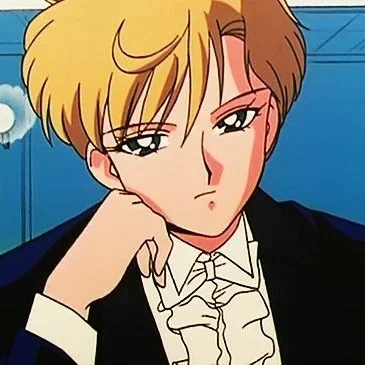
Pictured Above: Haruka (Sailor Uranus)
Haruka is very stereotypically male presenting, as she has a short haircut, crossdresses, and uses a lot of male gendered words and phrases. Haruka uses a variety of male gendered words, sentence endings, and phrases throughout episode 92. She uses the word 僕 to refer to herself, which is most commonly used by guys to refer to themselves, with the exception of formal situations where it is more polite to use 私 to refer to oneself. Haruka also says the phrase こんちは when she greets another character, instead of こんにちは, the version more commonly used by women, but the phrase used by Haruka is generally used by guys in Japanese. As for sentence endings, an area that can change based on the gender of the speaker, She uses だな, だろ, and other variations of な or だ endings instead of です. When using “da” at the end of a sentence, it implies that the person speaking is male as they are phrases considered to be masculine. Haruka also uses くれ at the end of sentences which is another phrase that usually implies masculinity.
Michiru


Pictured Above: Michiru (Sailor Neptune)
In contrast, Michiru is more female presenting, as she has long hair, wears a skirt, and uses female gender words and phrases. Michiru uses a variety of female gendered words, sentence endings, and phrases throughout episode 92. In the episode, you can hear Michiru refer to herself using 私,which is the usual expression used by women. You can also hear Michiru, who is of the same gender as Haruka, use phrases like かしら, ね (as opposed to だね), よ, and わ. These are all typically female gendered expressions and are associated with femininity; all of them being phrases you do not hear Haruka use in the episode. Other gendered expressions used in the episode by Michiru and Haruka are あら and おい, respectively. The fact that they have the same gender identity implies that they would use similar gendered expressions, however, Michiru uses あら, a more feminine expression of あっ、while Haruka uses おい, an expression more commonly used by men.
Connecting the Two Characters and Their Features
While Haruka and Michiru are both female and refer to themselves as such, Michiru presents herself as more feminine and uses more feminine expressions such as あら and かしら, while Haruka presents more masculine and uses more masculine expressions such as おい and こんちは. However, Haruka and Michiru’s difference in their expression and representation of gender goes further than the words they use, but can also be seen by their physical and emotional features. Haruka is more of a tomboy character who dresses more masculine, has short hair, likes race cars, and rides a motorcycle. Michiru dresses more feminine, has longer hair, and likes more extravagant, elegant fashion. Haruka tends to give off more earthy vibes, while Michiru tends to give off more graceful, water-like vibes. Haruka also refers to other girls as terms such as 子供、可愛い子、and 子猫、and she has a more empowering, dominant personality, while Michiru has a more elegant, graceful personality, and doesn’t refer to other girls the same way that Haruka does.
Conclusion:
In our analysis of the two characters, Michiru and Haruka from Sailor Moon, we found a noticeable difference between their linguistic expressions and gender markers. In addition to their word choice, the two characters’ expression and representation of their gender, both physically and emotionally, served to create a compelling dynamic between their gender identities in the narrative. Haruka, with her tomboyish style, short hair, an affinity for traditional masculine things like race cars and motorcycles, and consistently using male-gendered words, sentence endings, and phrases such as 僕, こんちは, だな, and くれ、align and reinforce with her overall masculine presentation. In contrast, Michiru, with a more feminine style, long hair, elegant fashion choices, and using female-gendered expressions such as 私, かしら, and ね, align and reinforce with her overall feminine presentation. These linguistic differences serves to further enhance the identities of these characters. All in all, the writers of Sailor Moon, successfully provide a nuanced portrayal of the female gender through the characters, Haruka and Michiru.