

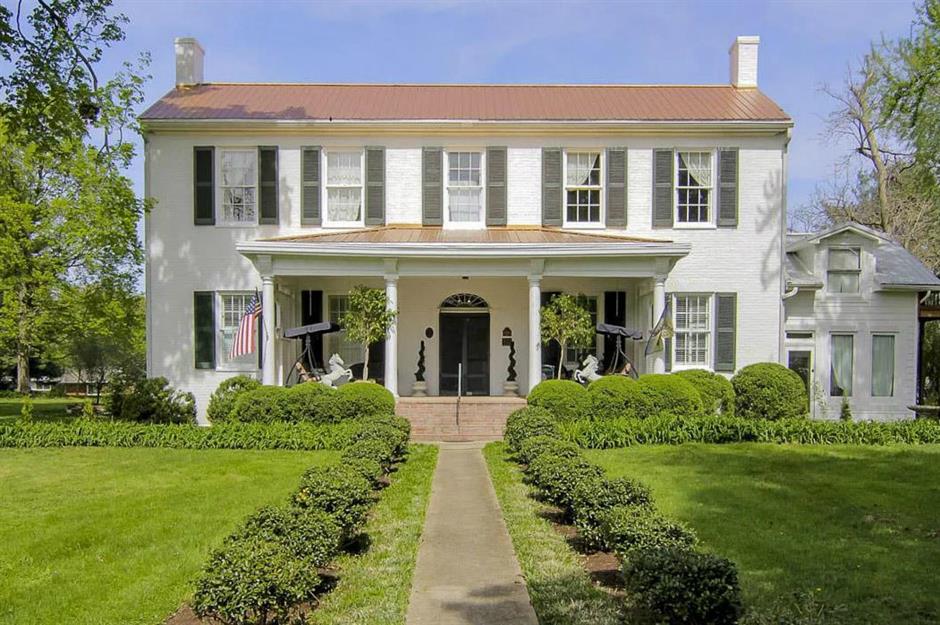
Colonial Style Home
Generally when I think about “American Architecture,” I think about Colonial style architecture and homes. The colonial style of architecture premiered during the colonial period of American history and were used as a stencil from some of the most well known American buildings known today. Those buildings include The White House, President George Washington’s Home on Mt. Vernon, and so on. This style creates a symmetrical facade with primarily a rectangular shape, a pitched roof, central chimney, multi paned windows, and a centered covered front porch. The colonial style is an example of timeless and elegant design encapsulating the history of America.
I also wrote about the same architecture style for “American Architecture.” I think that housing is one aspect that set America a part from the rest of the world. I understand that colonial style homes are timeless in a way but I think its also quite interesting that when I think of the colonial home, I think of the burden of our history. These houses to me also represent the idea of slavery and plantations, its a symbol of power and not elegant to me, it’s a monumental reminder of our dark past that we think so highly of. I think it is also a symbol of whiteness, these homes are throughout the South and colonial America, and hardly ever on the West Coast. As a minority, I think that this house comes with its own symbolization that America stands for colonization, hatred, and white supremacy.
This stance is quite the opposite of what we learned as the American style in lecture. As this home takes some elements of Greek architecture through the columns, pitched roof, and entryway. That architecture was in support of a revolution/overturn as a means of solidarity. That this house meant democracy as a symbol of America. Not only was this seen in public buildings, but also very prominent in domestic architecture as well as shown in the photo.
I think that while this domestic style of America stands as democracy, it’s built upon values made by white men for white men. Because of this, white superiority will always be deeply rooted in American culture. It is related to the overturn however in how we broke off on our own from England, but that really led into the foundation of our own nation state. Democracy as a symbol of independence I think can be shown in the more positive way through this house, but it is quite the opposite from being anything positive in my eyes.
I completely agree with this comment. The perspective on American architecture raises crucial points about the embedded symbolism in colonial-style homes and the idea of American Architecture. And I think that it’s also true that this stance doesn’t coincide with what we learned in the lecture. I think it’s important to acknowledge their connection to historical injustices and systematic issues. This is a great encouragement for the critical examination of the narratives that surround these historical structures. It’s always important to challenge these traditional viewpoints and create an understanding of the difficult layers of our architectural history.
In Wednesday’s lecture, we talked about the revival of American Architecture and the idea of democratic ideals. Columns, pitched roofs, and entryways that resemble that of Greek temples. This style can be seen in many political buildings today like how Amaya explained in the comment below.
All of these ideals go together to form what we call and see today as “American Architecture”, although, understanding where these ideals and historical structures were built for and have resolved into what we see today.
I entirely agree with this statement. In my essay, I made a reference to this type of residential architecture, often thought of as the “white picket fence” home that is common in the American suburbs. This specific style greatly represents American architecture not only in residential structures but political buildings as well, like you’ve mentioned, the White House.
Referencing Wednesday’s lecture, the Greek revival of American architecture had a lot to do with the idea of democracy. We can see this idea and style reflected in political buildings such as the White House, and the United States Capitol. As this was a major revelation for American architecture, I believe that’s why we see many of the same features and stylistic approaches in residential exteriors as well.
Furthermore, I agree with the comment above, how they mentioned the values of this type of building style, especially in residences. The idea of white superiority in men and how it reflects in other areas of our society. It’s interesting to perceive this idea take many forms, as this style isn’t only prominent in homes, but in political buildings that represent a stance of “power” and “superiority”
I also thought of colonial-style homes when envisioning “American architecture.” It is fascinating to look at the subtler domestic side of architecture as it is so common and a part of daily life. Most people see architecture similar to this much more often than they would see huge, famous, public buildings. This style has evolved, in part, from the influences of the Greek Revival, which gives it many of its telling features.
In the 19th century, the Greek Revival became a popular architectural style. In the United States, using this style created the association of the idea of democracy, which the ancient Greeks invented. This emulation was most prominent in public buildings, but was also present, yet subtler, in domestic architecture. Rectangular buildings with emphasized pedimented roofs and projecting porches supported by columns were the manifestation of this style in American domestic architecture.
The colonial architecture style has taken these Greek Revival elements and adapted them into simpler, everyday architecture. The building form is very rectangular and boxy, front porches protrude with emphasized pediments or triangles, columns create a colonnade, and elements are often detailed in Greek style. The example discussed here exemplifies all of these features at least in some way and truly epitomizes what many people see as “American architecture.”
I agree this is a very American style home. Although I did not know many people growing up living in houses like this ( PNW) I still see this as an American style. I feel like this is an idealized American house in many tv shows and movies. To me it was an imaginary house for an imaginary perfect family. The kind of house with a nice dog and a Christmas tree perfectly decorated in the window. The lectures solidified it like you said that it is a colonial style and has a symmetry to it that is very traditional. While it looks nothing like an ancient Greek house, It does have classical columns in the entrance. After hearing the lectures I would also add that it is eclectic as it is pulling pieces of classical architecture to make a new form.
I think colonial-style architecture is also very representative of American architecture, while the style of suburban houses is more like modern American houses. Colonial American houses appear to be a bit older. They usually evolved from the Greek Revival and retained certain features of Romanesque architecture.
In the lecture, Kive discussed with us that the main reason for the Greek Revival in American architecture in the 19th century was the pursuit of Greek style in reference to the idea of democracy. Its design is similar to the American Georgian style, and both adopt a symmetrical structure, and the building form is very square, with a prominent front porch and pillars, and a very large front yard in front of the door.
The style of this building is also very close to the American Georgian style. They have a symmetrical structure, an emphasized entrance, and the door frames and windows are all white. In today’s modern American suburban houses, many parts still retain the characteristics of the colonial style, such as large front yards and backyards, white door frames and windows, and some have extremely symmetrical structures. However, there are also many new buildings that are completely divorced from the colonial style.