
May 8, 2025 | reaction paper, Week 6
Summary
In her article, Despina Stratigakos examines Hollywood’s persistent portrayal of architects as idealized white men, often intelligent, creative, and morally upright. These characters, from classics like The Fountainhead to modern films like (500) Days of Summer, reinforce a narrow stereotype that excludes women and people of color. Stratigakos argues that this idealized image reflects and perpetuates real-world biases in the architecture profession, where white men still dominate the upper ranks. Hollywood’s erasure of diverse architects, she suggests, both mirrors and sustains the barriers others face in gaining recognition and visibility. By repeatedly romanticizing a singular archetype, film limits the public’s understanding of who architects are and who can become one. Stratigakos calls for broader, more inclusive representations that reflect the diverse reality of the profession and help break down long-standing stereotypes in both media and practice.
Critical response
Despina Stratigakos’s critique of Hollywood’s portrayal of architects as white men resonates deeply with the ongoing reality of the profession. Despite efforts toward inclusivity, architecture is still largely perceived—and often practiced—as a male-dominated field. I’ve experienced this personally. After a few years in interior design, I decided to pursue architecture, but I struggled with imposter syndrome. The dominant image of the “real” architect didn’t look like me, and for a long time, I subconsciously accepted the idea that I might never truly be an architect—only someone who works around architecture. Stratigakos’s argument highlights how media representations aren’t harmless; they shape cultural perceptions and reinforce professional hierarchies. When architecture is repeatedly portrayed as a man’s world, it quietly pushes others to the margins. We need more diverse, visible role models—in media and in practice—to shift this perception and make space for broader definitions of who belongs in architecture.
White male of Modern American Architecture
We can say with certainty that Frank Lloyd Wright was America’s favorite architect during the mid-20th century. He was featured in House Beautiful more than six times, and the entire November 1955 issue was devoted to him. Several articles described his architecture in great detail, praising his masterful handling of spatial planning, integration with the landscape, and visionary style. One article particularly caught my attention: it was titled “One Man’s House.” Not one family’s house—but one man’s. This framing suggests that Wright’s architecture was seen as best suited for men, constructing the image of a cultured, intellectual figure in need of a private retreat for reflection and solitude. This portrayal stands in stark contrast to the image of women in House Beautiful, whose interests were largely confined to domesticity and interior decoration. Interestingly, the article “One Man’s House” was written by a woman, revealing the complex gender dynamics at play in architectural discourse.

Figure 1 One man`s image created by woman
“House Beautiful December 1946 p. 186”
original caption
Women in contemporary architecture
Marianne McKenna and Shirley Blumberg, founding partners of Toronto-based KPMB Architects, have been awarded the 2025 Royal Architectural Institute of Canada (RAIC) Gold Medal, the organization’s highest honor recognizing individuals whose work and influence have made an enduring contribution to Canadian architecture. McKenna is celebrated for her ability to create architecture that resonates with culture, community, and the arts, leading projects such as the transformation of The Royal Conservatory of Music, including Koerner Hall in Toronto, and the expansion of Toronto’s historic Massey Hall. Blumberg is known for her commitment to socially responsible architecture, contributing to projects like the Fort York Branch Library and the Centre for International Governance Innovation. Both architects have been recognized for their design sensitivity, technical excellence, and foresight in sustainability. The RAIC Gold Medal will be formally presented at the RAIC Conference on Architecture in June 2025.

Figure 2 Outstanding achievements by outstanding women
https://www.archdaily.com/1029245/marianne-mckenna-and-shirley-blumberg-awarded-the-2025-raic-gold-medal-by-the-royal-architectural-institute-of-canada?ad_campaign=normal-tag
I would be deeply interested in reading more about the contributions of women architects to 20th-century architectural history, particularly given their involvement—often overlooked—in the development of the modern movement. Despite their talent and dedication, women were significantly underrepresented during this period and frequently not taken seriously within the profession. Many faced the difficult choice between pursuing a career and fulfilling societal expectations around family life. While progress has been made, and today women have greater opportunities to engage in architecture and a broader range of professional fields, the historical gender imbalance continues to shape the discourse. Personally, I maintain a list of women architects whose work I find particularly inspiring, and I believe their projects deserve broader recognition both in academia and in public awareness. Highlighting their stories is crucial not only for honoring their legacy but also for challenging enduring biases within architectural history and practice.

May 8, 2025 | 1990s, reaction paper, Week 6
Summary:
Over time, Hollywood has played a part in upholding gender and race stereotypes of architects. The white man was the by far the predominate choice when casting/creating an architect character. Underrepresentation is not new in Hollywood but when casting architects the numbers are exacerbated in relation to women and POC. Even in the current state of architecture, which currently has around 20% of licensed architects being women, compared to 1.2% in the 1970s, there is still little to no depiction of women as architects in movies. When a role is cast for a woman architect or an architect of color, there is usually some sort of inner conflict that the woman or person of color faces often involving the intersection of their gender or race with their profession. It has also played a role in the personality stereotypes of architects, referring to the men depicted as “sensitive but not girly”.
Connection #1: House Beautiful(Fig. 1)
This is one example of a project designed by a male architect. As I flipped through the magazines from the 1990s, I struggled to find women architects, seeing a lot of white male architects, while also seeing loads of advertisement promoting women to be decorators and go to school for that.
Connection #2: Article: Women in Construction: Breaking Barriers(Fig. 2)
This article not only talks about the breaking of barriers by in the architectural field, but in the construction field from architects to site managers and engineers. The author talks about her experience as an architect, and receiving discouragement for her interest in architecture due to her gender. She also describes how positive and encouraging reinforcement from male colleagues helped to build her confidence, and how having men and women working together can create a balance of perspectives and skills. She talks a lot about confidence, the importance of it and her struggles with it. I think that this relates to the article because it is showing that women are breaking these stereotypes that are upheld by Hollywood.

Fig. 1 Exterior view of a house designed by architect Hugh Jacobsen.
House Beautiful 1990 April p. 62
Caption: With gabled pavilions and a sea view, this new Long Island house by Hugh Newell Jacobsen evoked old New England tradition.

Fig. 2 A construction team of men and women https://medium.com/modern-women/women-in-construction-breaking-all-the-barriers-3ff95bdd7b58

Apr 30, 2025 | 1920s, 2010s, 2020s, reaction paper, Uncategorized, Week 4
Summary
During a time when architecture (along with the majority of professional fields) was male-dominated, House Beautiful and other “Shelter Magazines” gave women a medium to contribute to the field of design. In the 1920s, women were beginning to attend architecture schools, including Lin Huiyin. Lin Huiyin was the first Chinese woman to study architecture in the United States and completed her education at the University of Pennsylvania. While women were able to attend school, it was not yet socially acceptable for them to work, restricting Lin and similar women from directly applying their education. Instead, many women took to writing and worked for architectural publications like House Beautiful as a means of influencing and interacting with the field of architecture. It is not known if Lin herself read House Beautiful; however, some of the women in her circle did and took part in writing the and in some capacity influenced Lin’s career. House Beautiful played a vital role in providing a space for women to contribute to and work in architecture and paved the way for future women to enter the workforce.
Historical Case – House Beautiful Volume 56

The case from House Beautiful comes from the July 1924 issue and was written by Ethel Power. At the time Power was the editor in chief of House Beautiful and she serves as a key example of a woman in architecture during the 1920s. While she could not practice at a firm, she was able to contribute through writing and critique.
Figure 1. Commentary on a prominent home renovation project in House Beautiful written by Ethel Power. House Beautiful 1924, no. 56, p. 462.
Current Case – Kazuyo Sejima
Kazuyo Sejima is a Pritzker Prize-winning architect from Japan. Sejima, who began her career in 1981, has worked on numerous celebrated projects in and out of Japan, including the Glass Pavilion in Toledo, Ohio, the Sumida Hokusai Museum in Tokyo, and the New Museum in New York City. Her acclaim and accolades are indicative of how the role of women in professional settings has changed significantly. From previously being restricted from architecture firms to now running their own, women have come a long way in architecture, in part thanks to early efforts from women like Ethel Power and publications like House Beautiful that established a place for women in the field.

Figure 2. Kazuyo Sejima’s Grace Farms River Building in New Canaan, CT; An example of her modern, dynamic, and innovative style. Image courtesy of: ArchDaily.
Apr 25, 2025 | 1920s, 2020s, reaction paper, Uncategorized, Week 3
Summary
In the article Elsie de Wolfe and her female clients, 1905-15, Penny Sparke asserts that Elsie de Wolfe helped to create the female-dominated profession of interior decoration as we know it today by providing wealthy, upper-class women with distinctly feminine and refined spaces. She utilized her professional connections with elite women to grow her network and develop her reputation as a tasteful decorator, eventually expanding her career and influence and enabling women to be paid for their traditional jobs as decorators of the home. While she may not have fought against feminine design stereotypes, she still inspired a professional environment where femininity was appreciated. A key example of this was her work for the Colony Club from 1905 to 1907, where she designed and curated a new interior for the all-women social club. She was then able to use this momentum to undertake more professional projects for women and gain notoriety in high society for her elegant taste, turning her former hobby into a successful career.
Historical Case
“Rooms Exhibited by the Women Decorators’ Club.” House Beautiful, Aug. 1929, pp. 146–147.
The interiors shown in House Beautiful by the Women’s Decorators’ Club utilize a geographically and historically varied blend of styles with a lighter palette, a key signature of Elsie de Wolfe’s projects. The spread was composed for the August 1929 issue —just shortly after the height of de Wolfe’s career— making it likely influenced by de Wolfe’s style. The role of women as the chief decorators of this project was also likely impacted by de Wolfe’s professional and public presence.

Figure 1 – An interior designed by the Women Decorators’ Club with a variety of textiles and styles. House Beautiful Aug. 1929, pg. 147.
Current Case
Sheila Bridges is a modern example of a female interior designer creating unique, sophisticated, and expressive spaces. Her interiors feature a variety of styles and references, usually with vibrant pops of color and bold patterns. Bridges often incorporates pieces from numerous eras of design and references to her African American identity —seen in her own personal home, The Hay House. During her career she has worked with numerous influential public figures, including former president Bill Clinton and former vice president Kamala Harris.

Figure 2 – Sheila Bridge’s “Hay House” in Hudson, NY; Eclectic furnishings with vibrant pops of color. Image courtesy of: The New York Times.
Comparison
Both examples come from prominent designers that intelligently incorporate several historical references and their own identities. In the case of the Women Decorators’ Club, the female designers followed the example of de Wolfe, incorporating their femininity into their work through their use of a brighter palette and floral patterns. In the case of Sheila Bridges, she frequently refers to historicist styles as well as her Black identity, shown by her use of Black art. In some aspects, this expression of personal identity in interior design also goes back to de Wolfe, albeit in a different, more complex and nuanced way distinct to her.

Apr 24, 2025 | 1980s, 2010s, Week 4
Summary:
This reading describes the transition of women into the world of architecture through the influence of the magazine House Beautiful. This transition included literature(writing about architecture and interior design) to eventually women becoming architects and integrating themselves into a male dominated field. Writing and journalism was a field available for women. For example, Ethel Power was an editor for the magazine House Beautiful. In this magazine, women heavily contributed to this magazine, with over 500 writers. Often, women choose to stay ambiguous relating to gender, often using pseudonyms or just going by their initials. In these articles, women often used the word “we” helping women to see themselves in these designs/houses. This help women to understand European antiquities, and promote the idea of social mobility. House Beautiful also often promoted women who were practicing architecture. An example of this was Lois Howe who featured in the magazine, while leading a all woman firm. Her success was helped by her familial connection. She was involved in many women organizations, and was an example of how women can excel in this profession.
Application:
Current: In terms of application, I wanted to look at the current gender demographics in architecture. Their continues to be improvements regarding equality in the architecture field but there is still work to be done. The article, Where are the Women? Measuring Progress on Gender in Architecture, describes progress made but also talks about the continued challenges and barriers. I enjoyed the infographics used because they really help to understand the continued challenges. Especially the graphic of women climbing, and the progress, towards equality but the limited integration of women the higher you go (based on prizes, awards, jobs, etc.)
House Beautiful: This ad for furniture promotes the design of a woman Kaylea Bakker. The promotion of women in design is something that is described in the reading, and this ad features the design outright, showing her name, and her within her design. This is different that the past where names were often not stated. I assume that over time as women became more prominent in design fields, it became more normalized to the public allowing women to be more open when claiming designs.
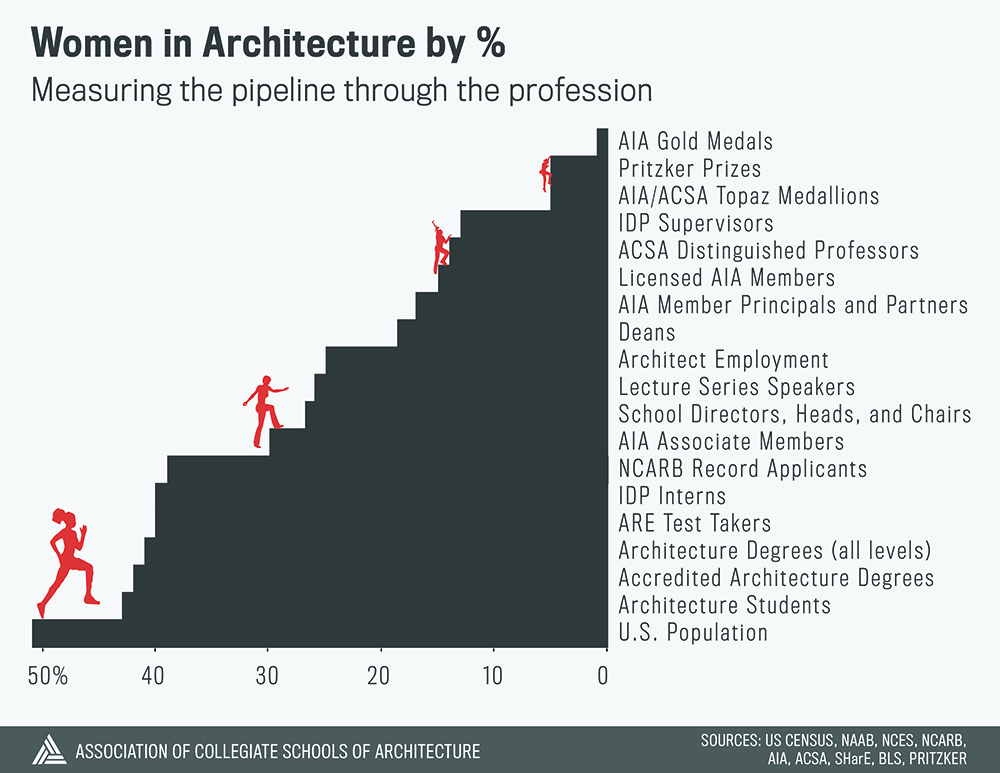
Figure. 1 Graphic representing the percentages of women participation within different aspects of the architectural field. Link: https://www.acsa-arch.org/resource/where-are-the-women-measuring-progress-on-gender-in-architecture/

Figure. 2: Promotion of the Century furniture through the design of Kaylea Bakker House Beautiful 1980, Jan – Jun, Pg. 144 Original Caption: ““One look at the rich architectural detailing, and you know that this San Francisco mansion dates back to the 1890’s. When I designed the interior I had to consider the ornate molding. Furnishings had to be beautifully restrained in design. Then, of course, I wanted personality of the owner to come through . So I incorporated many of their favorite momentos. Finally everything works together, that’s always my goal.”

