
May 1, 2025 | 1930s, 2020s, reaction paper, Week 5
Reading Takeaway
Through reading “Leaving Traces’: Anonymity in the Modernist House” by Hilde Heynen, the main argument that was revealed to me is how the shift to modern interiors changed the “coziness” feel of many spaces at the time to ones that were more open and transparent, encouraging sociality. This had many mixed reactions, where some said it would negatively impact interiors while others thought it was the next step in its evolution. There were two arguments that further discuss each stance while further showing vast change in interior design during these periods.
One of the arguments against this shift toward modern interiors was how they lacked so much character to them that they were completely unfitting for personal use. This was seen in the spaces having an overall less emphasis on furniture and decoration, prioritizing flexibility first. This leaves it to the owner of the home to leave their own “traces” on the space to make it their own home. The stance on modern interiors being a good change mentions how these spaces can be highly customizable and tells a story of the life that happened in them. This was shown in the example of the Schroder House, which could be customized based on the user’s needs.
Application
Current Case

Figure #1: Image showing a modern style living room with many minimalistic elements.
Photo by Oded Smadar
The current case that I have chosen is a modern residential interior designed by Orly Deckter. This example shows many of the features discussed in the article, like adaptable furniture that can be moved around the space to accommodate different needs of the user. One element that also caught my attention is the shelving along the wall. This shows the concept that was also discussed in the article, which is the house owner leaving their trace on the space. Without the additional objects placed along these shelves, they would only be empty spaces that don’t add any character to the interior.
Past Case

Figure 2. “’American Modern’ Connecticut Home”, House Beautiful, Summer 1939, p. 31
The past case I chose is a living room that also shows a beginning in the shift to more minimalistic use of furniture and decoration. It can also be seen that the furniture being used is very modular, allowing for customization of use. However, one difference is that there isn’t as much character being provided to the space as with modern examples. This shows the success of these modern designs fitting that middle ground, where they are able to push the boundaries of interior design without it feeling soulless and providing the owner with a sense of home.

Apr 13, 2025 | 1940s, 1960s, 1990s, 2020s, week 2
Question: What role do plants/garden play in homes?
This is about the relationship and evolution of plants, and their relationship with the home. Through time, the interior has changed and so has the use of plants.
Hypothesis: The change I observed was the increase in the use of plants within the home. I saw plants become more important, and more of an emphasis was put on them with homes. I also noticed that there was more living plants in more contemporary examples compared to flowers in older examples.
Pattern: This pattern is shown as many of the contemporary examples almost turn living rooms into an interior garden. In the older examples, there was often just flowers on a table or a singular plant.
- 1940s: This image is promoting Coca-Cola but shows and describes a flower arrangement as a centerpiece while also describing different flower arrangements, showing their importance at this time.
- 1960s: This is an image of a cabin with a combination of plants and flowers within the living room space. This is a space that blends the interior with the exterior with the use of wood and plants.
- 1990s: This image is of a sun room/living room, with lots of plants and flowers surrounding the furniture, serving as a sort of transition from the interior to the garden or backyard.
- 2020s: This image is of a contemporary dining almost overgrown with interior plants and foliage.

Figure. 1(1940s) A flower arrangement of roses as a centerpiece for a table. (a part of Coca-Cola advert) House Beautiful 1940, May, p. 4 Caption: Roses and Bouvardia, one of a series of flower arrangements illustrated and diagramed in the book offered below

Figure. 2(1960s) A cabin design with many plants and wood accents
House Beautiful 1960, February, p. 88-89
Caption: This view is what you see first after coming from the dark cave-like entrance hall. The contrast is vastly enchanting. Even though you see you are very high up, the a-shaped space conveys security as though the slanting walls were leaning against the mountain behind you for safe stance.

Figure. 3(1990s) Living room/sun room with an abundance of plants and flowers
House Beautiful 1991, February, p. Cover
Caption: N/A

Figure. 4 (2020s) Dining room with wood accents, and various types of plants and flowers House Beautiful 2025, March, p. N/A Caption: Sleek furniture maintains an airy atmosphere

Apr 6, 2025 | -week 1, 1940s, 1960s, 1970s, 2020s, reaction paper
Question: How have different flooring types come in and out of favor by the American public?
This is about the evolution of flooring. This has to do with style and preference but also with technology and the introduction of new flooring materials.
Hypothesis: I noticed a move away from carpet as a flooring, instead opting for different types of wood flooring, with rugs used in living areas.
Pattern: This pattern is shown throughout with the older examples using carpet. The more contemporary examples used hard wood with soft flooring used through rugs on top of this wood.
- 1940s: Red carpet lining a living room, with upholstered furniture, and no wood materials.
- 1960s: Use of wood flooring to complement wood furniture in a dining room.
- 1970s: Wood flooring with wood furniture, as well as the incorporation of a rug within this dining room.
- 2020s: This image is of a contemporary living room with various wood accents complementing the wood flooring and a blue rug to go with the upholstery and pillows.
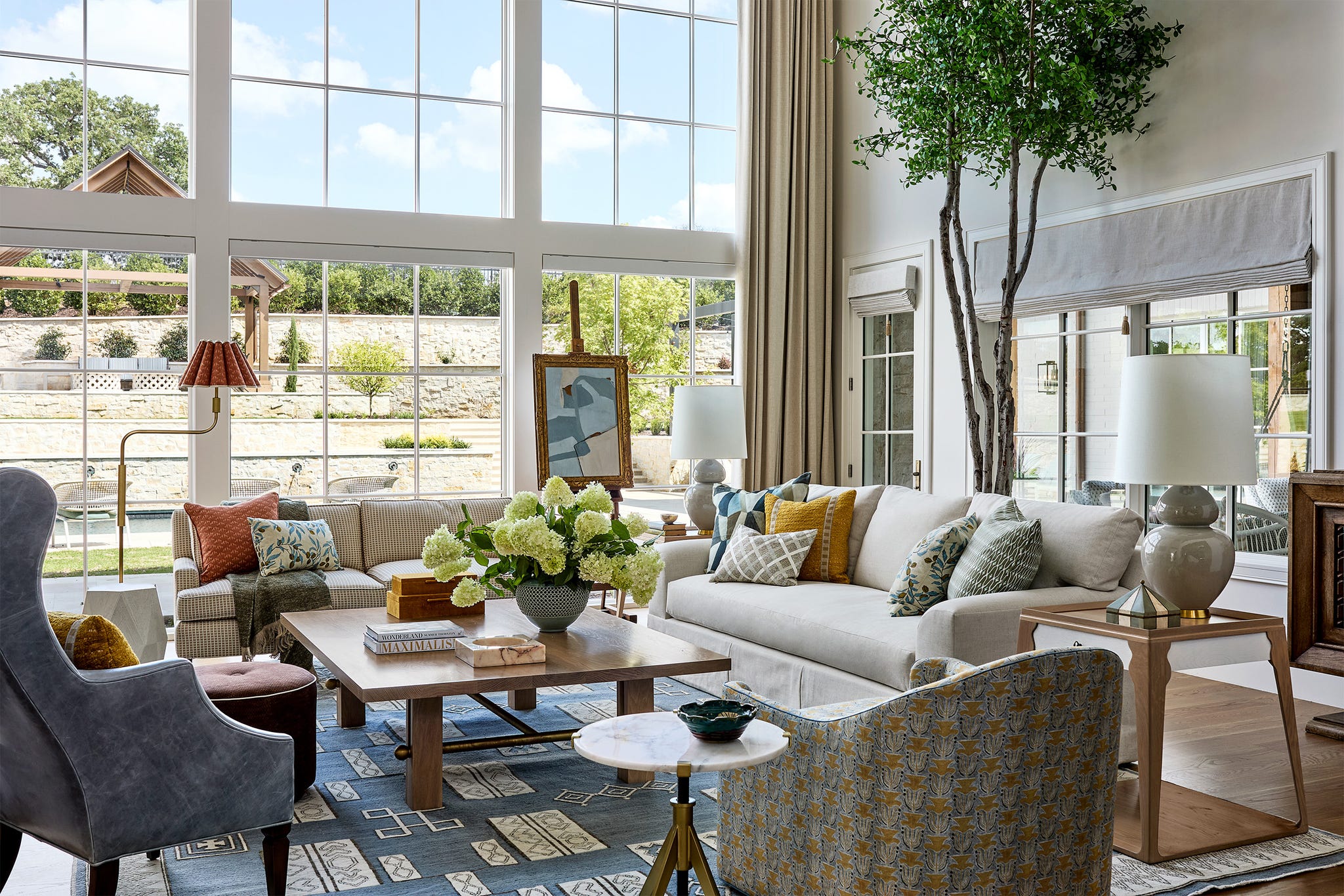
Year: 2025 Article: A Hidden Play Room and More Clever Details Make a “Modern-English-Cottage-Mansion” Feel Cozy Caption: Living Room

Year: 1970 Volume: July-Dec Pg. 100 Caption: Spanning the centuries from Queen Anne to see-through-a Long Island, NY, dining room designed by Blaine and Booth, right. Chairs, in the unexpected Vibrance of cherry red are just as unexpectedly upholstered in contemporary chintz and set Upon A needlepoint rug that might have carpeted Jane Austen’s parlor. A brace of gilded palm trees Parks back to the Brighton Pavilion and Regency fantasy. and the whole ensemble has an inevitably made-for-each-other look, fresh as its garden terrace backdrop. .Acrylic table by Selig. chairs and are by Hickory chair

Year:1961 Volume: “Americana” frequently misinterpreted to mean only the naive country style Furnishings of the earliest settlers refers to all things of American inspiration regardless of date. Prototypes of the pieces above were made at different times in different places. Still, a knowing eye would spot them as Americana because of the consistent simplicity of line and the fact that they are functional as they are graceful the round, drop-leaf mahogany table, and chairs from Secretary House originated in early 18th century Rhode Island. the pine hunt board, dated 1800, belongs peculiarly to the South. The generous mahogany Buffet with its separate, glazed hutch is from Pennsylvania. all together compatibly in a traditional setting or in a modern room.

Year: 1941 Volume: Jan-Jun Pg: 9 Beauvais “Cathedral Pines” pattern (No. 1673) was the inspiration for this lovely Modern room, which was created for you by McCALL’S Magazine. The color scheme and furnishings are clever and imaginative, but moderately priced, in scale with the rug.