
Jun 13, 2025 | 1900s, 1910s, 1920s, 1930s, 1940s, 1950s, 1960s, 1970s, 1980s, 1990s, 2000s, 2010s, 2020s, grad- paper
Background
Nostalgia, and how it presents
In 1688, the term nostalgia was coined by Johannes Hofer, a Swiss physician, who defined it as a “morbid longing to return to one’s home or native country, severe homesickness considered as a disease” (Etymonline). In the years since then, nostalgia has lost its association with mental illness, and its definition has greatly expanded in scope. Per current understanding, nostalgia refers to a sentimental yearning for the past, and a desire to return to the perceived happiness of an earlier place or time (Dictionary.com, 2019). This is a complex and powerful psychological phenomenon, which can stem from a wide variety of experiences and ideologies. Generally, though, characteristics of nostalgia include a constructed vision of some facet of the past, and a belief that it was better, in at least some respect, than the present (Smith and Campbell 2017).
In their 2003 book Beyond the Ruins: The Meanings of Deindustrialization, authors Jefferson Cowie and Joseph Heathcott describe the phenomenon they named “smokestack nostalgia.” In its original context, smokestack nostalgia refers to the phenomenon observed in regards to the immediate aftermath deindustrialization, wherein former industrial workers would romanticize and historicize the work done in factories, mines, and other industrial job sites. With the romantic veneer of nostalgia, workers focused on their memories of job security, laborer camaraderie, and working class pride, seemingly disregarding the fact that it was hard, grueling, and often dangerous work which destroyed people’s health, and resulted in many laborer deaths (Strangleman 2013).
Academic discourse on the subject of nostalgia largely paints it in a negative light, as maudlin and often reactionary. Certainly, conservative politicians frequently appeal to nostalgia and a perceived values of the past, seen with Margaret Thatcher, Ronald Reagan, and Donald Trump, among others (Gentry 2014, Behler et al. 2021). Like the former industrial workers and smokestack nostalgia, this reactionary nostalgia stems from economic anxiety, and the perceived threat of out-groups. There is also, parallel to this, a strong element of nationalism in these reactionary appeals to the past, seen most obviously with Donald Trump’s recent presidential campaign slogan: “Make America great again.”
On its own, however, nostalgia is a neutral, or frequently positive emotion. A 2006 study by Wildschut et al. concluded that nostalgia “bolsters social bonds, increases positive self-regard, and generates positive affect.” A connection to the past can promote cultural identity, provide comfort, and provide context for navigating the world.
To this point, if nostalgia can stem from reactionary politics, can it also be used to push progressive social values and political agendas? Smith and Campbell (2017) discuss the idea of progressive nostalgia in their paper ‘Nostalgia for the future’: memory, nostalgia and the politics of class. The authors describe progressive nostalgia as critically contextualizing the present through an understanding of the past. To return to the idea of smokestack nostalgia, the glorification of an industrial past might result in xenophobic and anti-immigrant reactions, seen with the “stealing our jobs” line of rhetoric common in conservative politics. However, it might also result in a critical response to comparative lack of bargaining power that labor unions currently have, or the financial stability that many families were able to maintain in the postwar era, in the face of a skyrocketing cost of living.
Both of these ideas ultimately stem from an idealization of the past (often disregarding, for example, the racism and exclusionary policies of the 1950s), and Smith and Campbell acknowledge that there is not a sharp line dividing reactionary and progressive nostalgia, and that the two are often intertwined. However, the way they divide the two is by determining if the root of the sentiment is simply to return to a “better” past, versus using aspects of the past as a framework for looking to the future.
The focus of this analysis is not industrial heritage, but interior design, and how products are marketed to consumers using nostalgia. However, having a framework of understanding of where nostalgia stems from, emotionally and psychologically, and the ways it can manifest are crucial for understanding the decisions and marketing strategies at play.
Nostalgia marketing and interior design
The original goal of this analysis was to examine the commonly observed belief that interior design products, including appliances, decor, and especially furniture are not made as well as they were in the past, and the ways nostalgia flavors this impression (Hartman 2023, Singh 2024, Vlamis 2024). In many cases, the decline in furniture manufacturing quality is empirically measurable, as seen with Cooper et al’s 2021 analysis, Furniture lifetimes in a circular economy: a state of the art review, which pointed to the use of less durable materials and marketing decisions to favor short product lifespans, prompting consumers to buy replacement products more frequently than they would with furniture which was made from more durable, repairable material. This is in contrast to the common production processes used up until about the 1980s, wherein furniture was largely manufactured domestically (Mullin 2020), and used more durable, high-quality materials such as solid wood or wood veneer, even for pieces which were mass manufactured and targeted at the middle class demographic (Cooper at al. 2021).
On the other hand, the rhetorical talking point of “they just don’t make it like they used to” can easily blend into the much more reactionary “reject modernity, embrace tradition,” a sentiment which is primarily an internet meme (Know Your Meme 2020), but reveals a traditionalist, fascist-adjacent if not outright fascist ideology with regards to culture, gender, religion, art, and most relevant to this analysis, architecture and design, as seen in figure 1.
Figure 1. Image posted to r/GreatBritishMemes by a deleted user, titled “traditional architecture”

A goal of this analysis was to determine if there was a specific time period in which marketers began to use this nostalgia to evoke the past, both stylistically and in terms of quality, and how the type of marketing changed over time in response to the historical context of the advertisement. This also required a deeper look into nostalgia marketing, and the different ways this is achieved by marketing.
In the 2024 literature review by Dam, Hartmann, and Brunk titled Marketing the past: a literature review and future directions for researching retro, heritage, nostalgia, and vintage, the authors discussed different types of marketing which appeal to the past, and the strategies for each.
Their broad categories were:
1. Retro, which is a purely aesthetic fusion of past and present, and uses the visuals of the past, updated to be in line with present expectations of performance and functionality. A few contemporary examples of retro interior design products can be seen with Ikea’s revival of products from their past catalogues, or with the design of luxury kitchen appliances from brands such as Smeg, which uses an aesthetic reminiscent of streamline modern design.
Figure 2. Screenshot of Ikea.com, 2025, titled “Nytillverkad collection: vintage IKEA, reimagined”

Figure 3. Screenshot of Smeg.com, showing a product page for their retro-style refrigerator product

According to Dam, Hartmann, and Brunk (2024), the marketing appeal in retro product design is to provide comfort to consumers by appealing and connecting to the past that they know, “thus, retro marketing can momentarily reassure consumers by sending them back to an imagined space of moral certainty and romance while at the same time fostering feelings of uniqueness, newness, and exclusivity.” Retro products provide stability and resolution to the tension between past and present.
2. Heritage brands, broadly speaking, leverage brand reputation and the perception of authenticity. The longevity of the brand (or at least the brand name) carries an implicit assumption of quality and consumer trust (Dam, Hartmann, and Brunk 2024). A phenomenon more tailored to furniture is that heritage is used to refer to the style or design of the furniture, rather than the specific brand, though the two may often be intertwined (Ettema 1982). In either case, heritage furniture carries associations of quality craftsmanship, durable materials, and (often, but not always) a historicist design character. A few examples of contemporary heritage furniture marketing include high-end design companies such as Vitra, or tradition and craftsmanship-oriented pieces, such as the various distributors of Amish furniture, shown in figures 4-5.
Figure 4. Screenshot of Vitra.com, showing the product page for the 1959 chair by Verner Panton

Figure 5. Screenshot of Amishfurniturefactory.com, from the homepage

Heritage furniture, particularly in cases like Vitra’s, are associated with authenticity. An authentic Eames lounge chair from Herman Miller, for example, is considerably more valuable than a superficially similar knockoff, as seen in figures 6-7.
Figure 6. Screenshot of Hermanmiller.com, showing the product page for the Eames lounge chair

Figure 7. Screenshot of Wayfair.com, showing the product page for an Eames lounge chair knockoff

While part of this is certainly the quality of the materials and the craftsmanship, the perceived authenticity of the genuine Herman Miller chair also adds to its value. As a side note, the images for the knockoff listing appear to be AI-generated, adding to the perceptual gap in quality between the two.
An additional wrinkle in defining heritage, as it comes to furniture, is that brand names might be bought and sold, and manufacturers using lower-quality material and craftsmanship techniques might use the brand name recognition to establish consumer trust, while selling an inferior product to that which was produced under that brand name in the past. This can be seen with Broyhill. The company was a major player in the mid–century American furniture manufacturing business, and produced a number of very popular and well-known designs, one of which is depicted in figure 8.
Figure 8. Broyhill Brasilia walnut dresser, 1960

After a series of bankruptcies, the Broyhill brand name and trademark was sold multiple times, eventually coming to land with Big Lots in 2019 (Hartman 2023), which is now also undergoing bankruptcy and restructuring, leaving the future of even the brand name uncertain (Kroll Restructuring Administration 2024). Regardless, the quality and design character of Broyhill furniture which gained it its reputation in the mid 20th century is no more, and only the Broyhill name remains. A similar story can be seen with the Lane Furniture Company, another American furniture manufacturer founded in 1912, which has also declared bankruptcy and sold its name and trademark (Moss 2023). In these cases, as well as others, the heritage label is based on perceived brand quality, regardless of actual quality, and rely on the nostalgic idea of furniture being of generally better quality in the past.
3. Vintage, as a term, refers to pieces which were manufactured in the past, and carry a material connection to that time. Like heritage brands, vintage pieces are associated with authenticity, but to a greater degree, and with the added perception of being unique, or even “the original” as opposed to a replica – even an authorized replica. Returning to the example of the Eames Lounge Chair, seen in figures 6-7, even the authentic piece from Herman Miller, produced new to order, carries less value than an “original,” period-produced piece, which is listed for approximately 2x the price of a new chair, shown in figure 9.
Figure 9. Screenshot of 1stdibs.com, showing a listing for an Eames lounge chair produced in the 1970s.

According to Dam, Hartmann, and Brunk (2024), vintage pieces allow the consumer to have a personal, meaningful relationship to the past. Sentimentality and exclusivity are common tactics used in the marketing of vintage items. Due to the nature of vintage pieces as, by definition, out of production and limited, the nature of vintage marketing is very different from the new products which fall into the retro or heritage categories, and much less likely to be seen in the case studies from The House Beautiful. Nevertheless, this type of nostalgia marketing is culturally significant, particularly when examining the idea that people largely perceive furniture of the past as being higher quality than newly produced options from budget brands. In a similar vein, platforms such as Chairish or 1stdibs, for reselling vintage home goods have grown substantially since 2020, particularly among millennials, in part due to association with the sustainability of buying secondhand (The Ethos Editors 2023).
Objective and Methodology
This analysis examines several research questions:
- How is nostalgia leveraged in advertisements for interior design products?
- Is there an identifiable shift in how marketing uses nostalgia in response to current (for the time) events?
- Is there an identifiable difference between marketing which targets reactionary vs. progressive nostalgia?
- If so, can these also be tied to historical context?
Case studies consist of advertisements published in The House Beautiful magazine, spanning from 1905-2015. At least one ad per decade has been selected, more during particularly tumultuous periods during the 20th century (e.g. world war 2). Advertisements which were considered eligible for use as case studies had to meet at least one of the following criteria:
- Products designed using historicist style, wherein the historicism was a major part of the intended appeal
- Glorification/idealization of history
- References to craftsmanship of the past
- Sentimental appeal to the past
There is a caveat to criterion 1 in that ads which feature products designed in a historicist style, but do not explicitly harken to that history in the verbiage, have been excluded from analysis. An example of this kind of advertisement is shown in figure 10, for reference:
Figure 10. An advertisement from the January 1969 edition of House Beautiful

In this case, while the pictured piece of furniture is historicist in style, the text indicates that the intended appeal of the product is that is is French Provincial in style, rather than directly calling on the past as part of the marketing. While there is likely an element of idealization of history being leveraged in ads such as this, the selected case study ads reference the past in more direct ways.
The selected case study advertisements have been roughly categorized by the type of nostalgia marketing that seems to be the most prominent element in design and presentation (retro, heritage, vintage, or general nostalgia) and analyzed within their historical context.
Case Studies and Analysis
1900s
Figure 11. An advertisement from the October 1905 edition of House Beautiful

Category: Heritage
This advertisement calls out specific events in American history, and glorifies that history by declaring that the products are “reproduction[s] … of the furniture used by the forefathers.”
This ad, as well as many others which were observed during research but not selected for analysis, depicts reproductions of 18th century furniture, and ties this style directly to what seems to be interpreted as a golden age of American history, and leveraging both nostalgia and nationalism in these types of ads.
1910s
Figure 12. An advertisement from the June 1911 edition of House Beautiful

Category: Heritage
This advertisement, interestingly, directly compares their material (“old hickory”) with popular material choices of the day (wicker, willow, painted wood), stating that it is more durable than these new materials. This is at least one case of the “they just don’t make it like they used to” sentiment going back at least as far as 1911.
Figure 13. An advertisement from the April 1916 edition of House Beautiful

Category: Heritage
This ad emphasizes fidelity and authenticity in their reproductions of historical designs, leveraging one of the hallmarks of heritage design. The desirability of these historical designs is taken as a given.
1920s
Figure 14. An advertisement from the November 1923 edition of House Beautiful

Category: Heritage
This ad appeals to the consumer with a direct and personal connection to American history, promising an accurate reproduction of historical objects. It makes a stong association between owning a piece of this history and the idea of being perceived as “cultured.”
Figure 15. An advertisement from the November 1923 edition of House Beautiful

Category: Heritage
This advertisement calls on the historical applications of walnut, and associates the material with tradition, a connection to a lost (idealized) history, and quality.
1930s
Figure 16. An advertisement from the February 1935 edition of House Beautiful

Category: Heritage
This ad romanticises the past, with specific attention to the idea of the Grand Tour, creating an association between historicist styles and the perceived luxury of the English upper class during the 18th century.
Figure 17. An advertisement from the March 1935 edition of House Beautiful

Category: Heritage
This ad highlights a perception of artisans of the past as producing higher quality work than current craftspeople/manufacturers (present company excluded, of course). This reinforces the idea that the “they just don’t make it like they used to” sentiment is not a new phenomenon.
1940s
Figure 18. An advertisement from the January 1942 edition of House Beautiful

Category: Heritage
Much like the ad shown in figure 14, makes a direct emotional appeal to the consumer’s nationalist feelings towards a constructed ideal American history, framing the product as something that was used by “heroic” historical figures (George Washington, Paul Revere).
Figure 19. An article featuring furniture products from the February 1942 edition of House Beautiful

Category: General nostalgia
This article is not an ad placed by the manufacturer, but does feature and highlight specific products, and showcases an interesting perspective, and as such was included in these case studies as an exception. It demonstrates a desirability of the functionality of modernist design, in terms of modularity, efficiency, and flexibility of layout, while also calling out to traditional design aesthetics, describing them as “warm and cheery.” This attitude displays anxiety regarding modernity and the war, and an implication of longing to return to what might be seen as friendlier or simpler times.
Figure 20. An advertisement from the November 1942 edition of House Beautiful

Category: Retro
This ad depicts a product which romanticizes the antebellum south, as well as specifically referencing the confederacy. In a phenomenon similar to smokestack nostalgia, the perceived sophistication and charm of the south are highlighted, while the negative aspects (vast inequality, widespread poverty, and enslavement) are not part of this constructed past.
Figure 21. An advertisement from the March 1944 edition of House Beautiful

Category: Heritage
This ad appeals strongly to nationalism, referencing the war effort, and uses the tag line “keep up the American way of living” to call back to an idealized “normalcy” of pre-war American life, which this product, according to the ad, is consistent with.
Figure 22. An advertisement from the March 1944 edition of House Beautiful

Category: Heritage
This ad appeals to tradition through the use of specific references to Christianity. It calls out craftsmanship of the past and brand history as being associated with morality and steadiness, in contrast to current times, which are tumultuous and frightening.
The ads published in House Beautiful during the years that the USA was involved in world war 2 are not unique in their heavy push toward nationalism in addition to nostalgia, but the amount of nationalism on display, as well as the general concentration of nationalistic ads both increased. This type of advertising, combined with the glorification of the past, specifically appeal to reactionary nostalgia.
1950s
Figure 23. An advertisement from the April 1956 edition of House Beautiful

Category: Heritage
There are a few pieces to unpack with this ad. First, whereas in the first half of the 20th century, historicist styles and period reproductions tended to focus on furniture of the 18th century. Here, furniture from the early 1900s is seen as desirable and nostalgic instead. Furthermore, some of the verbiage, emphasizing the advertised product’s solid wood construction, may be a reaction to the increase use of engineered materials and mass production, and a perceived decline in quality in the furniture industry.
1960s
Figure 24. An advertisement from the August 1967 edition of House Beautiful

Category: Heritage
The reference to “old time values” in this ad indicate a preference for a past in which things were more affordable, or at least perceived so. This, combined with the reference to early American history and heritage, may be a reaction to a quickly changing society, and economic anxieties associated with the time period (U.S. Bureau of Labor Statistics 2024).
1970s
Figure 25. An advertisement from the January 1972 edition of House Beautiful

Category: Retro
The visual juxtaposition between the Greek-inspired product and an elegant, classical interior conflates the two, with the aim of having the consumer project their positive associations with a constructed/idealised version of the past onto the product.
Figure 26. An advertisement from the February 1972 edition of House Beautiful

Category: Heritage
This ad associates historicist styles with sophistication and maturity, and presents the product as timeless, in opposition to being trendy. It is during this time period that advertisements begin to use “timelessness” as a point of appeal more frequently, particularly for products with a historicist design, leveraging a romanticised and consistent past in opposition to an ever-changing, confusing present.
1980s
Figure 27. An advertisement from the January 1981 edition of House Beautiful

Category: Heritage
The 1980s show a swing back into nationalism in advertising, consistent with marked economic, social, and political conservatism in the USA, concurrent with the Reagan administration (Encyclopedia.com 2019). In this ad, reproductions of 18th century furniture return to the spotlight, highlighting authenticity and the perceived superior craftsmanship of the past.
Figure 28. An advertisement from the March 1981 edition of House Beautiful

Category: Heritage
Similarly to the product depicted in figure 20, this ad romanticizes the “grace and elegance” of the antebellum south, emphasizing aesthetics and disregarding and of the negative aspects of this time period.
Figure 29. An advertisement from the April 1981 edition of House Beautiful

Category: Heritage
This ad leverages ideas of authenticity and tradition, and shows a designs of an Art Nouveau style, among others.
Figure 30. An article featuring products from the June 1986 edition of House Beautiful

Category: Heritage
The products featured in this article use ideas similar to those seen in the arts and crafts movement, with a perceived superiority of traditional methods of craftsmanship, including artistic expression and material quality. This may be a reaction against increased use of synthetic materials and mass production. It was during the 1980s that American manufacturing began to steadily decline, with more manufacturing being outsourced (U.S. Bureau of Labor Statistics 2024).
Figure 31. An advertisement from the July 1988 edition of House Beautiful

Category: Heritage
Consistent with the increase in observed nationalism in advertising during the 1980s, this ad creates an emotional appeal to the consumer by forging a connection between their products and a “heroic” figure of American history, Thomas Jefferson.
1990s
Figure 32. An advertisement from the July 1991 edition of House Beautiful

Category: Heritage
Much like ads of previous decades, the manufacturer of colonial-era inspired historicist furniture here uses nationalism and the perceived elegance of the past to appeal to consumers.
Figure 33. An advertisement from the July 1991 edition of House Beautiful

Category: General nostalgia
In addition to the type of advertising for historical styles seen throughout these case studies, the 1990s show the beginning of a trend towards leveraging personal nostalgia – in this case, sentimentality for family members.
2000s
Figure 34. An advertisement from the July 2006 edition of House Beautiful

Category: General nostalgia
Many people associate their childhoods with less complexity in their lives, and more whimsy and wonder. This ad uses that personal nostalgia, targeting consumers who want to experience those feelings again.
While it is difficult to prove a negative, it is worth mentioning that ads which leveraged a glorified depiction of the past became harder to find in House Beautiful, beginning in the 2000s. This may indicate a broader shift in marketing during this time period, or it may be more specific to how interior design products.
2010s
Figure 35. An article featuring products from the April 2015 edition of House Beautiful

Category: Retro
This article features a design motif, and calls out several historical applications of it, including Elsie de Wolfe in American history. This posits this design feature as being “timeless,” similarly to how the historicist style in figure 26 is depicted in opposition to trend cycles. A similar marketing strategy can be seen in figure 36 as well.
Figure 35. An advertisement from the October 2015 edition of House Beautiful

Category: Retro
This ad leverages the past and the idea of timelessness by directly juxtaposing historicist and contemporary imagery.
Figure 37. An advertisement from the October 2015 edition of House Beautiful

Category: Retro
In contrast to previous decades, for which the historicist styles most heavily depicted as worthy of nostalgia were those of the 1700s, the 2010s show a marked increase in appealing to mid-century Modernist styles, including references to a perception of better quality construction during that time. This further emphasizes the idea that “they just don’t make it like they used to” is a persistent idea with regards to nostalgia and perception of the past, and that this idea shifts with the times to incorporate a changing world.
Conclusions
The first research question for this analysis regarded how nostalgia is used in advertising for interior design products. Overall, at least during the 20th century, the overwhelming majority of these ads featured products which fell into the “heritage” category of nostalgia marketing, capitalising on a glorified view of the past, particularly American history, and often highlighting a perception that craftsmanship was superior during previous eras. Somewhat in contrast with initial expectations, the sentiment of “they just don’t make it like they used to” did not emerge in response to the measurable decline in the quality of furniture during the past several decades (Cooper et al. 2021), but has been present throughout the examined time periods. This validates the idea of nostalgia as being sentimental, and based on a constructed and idealized version of the past, which shifts as the present progresses.
While some types of nostalgia-leveraging advertisements were quite consistent throughout most of the case studies, specifically those for 18th century reproduction furniture, there were certainly observable trends and shifts in the depiction of nostalgic products over time, most notably going into the digital era of the 2000s and beyond. During this time period, overt historicism and idealization of history declined, and it became more common to see historicist styles be labeled as “timeless.”
With regards to the framework of reactionary vs progressive nostalgia, many ads which appeal to reactionary nostalgia can be identified, particularly during periods of intense nationalism and conservative ideology, such as world war 2, and the 1980s. It is not easy to identify any cases which specifically call on progressive nostalgia, though many of the ads examined might be considered neutral in this regard. Certainly, nostalgia is not a psychological phenomenon belonging to only one side of the political aisle.
An interesting direction for future analysis might be to compare the broad trends in interior design products to other types of advertising, such as fashion or technology, to better understand how nostalgia was used in marketing widely, versus in industry-specific ways.
References
1stdibs. 2017. “Alvar Aalto X600 Stool, Artek, 1960s.” 1stdibs.com. 2017. https://www.1stdibs.com/furniture/seating/stools/alvar-aalto-x600-stool-artek-1960s/id-f_34501262/.
Andersen, M. H., H. W. Hansen, and L. N. Laursen. 2022. “Designing Long-Lasting Interior Products: Emotional Attachment, Product Positioning and Uniqueness.” Proceedings of the Design Society 2 (May): 961–70. https://doi.org/10.1017/pds.2022.98.
Behler, Anna Maria C., Athena Cairo, Jeffery D. Green, and Calvin Hall. 2021. “Making America Great Again? National Nostalgia’s Effect on Outgroup Perceptions.” Frontiers in Psychology 12 (555667). https://doi.org/10.3389/fpsyg.2021.555667.
Cooper, Tim, J. Kaner, K. Furmston, and A. Cutts. 2021. “Furniture Lifetimes in a Circular Economy: A State of the Art Review.” PLATE: Product Lifetimes and the Environment, January. https://doi.org/10.31880/10344/10203.
Cowie, Jefferson, and Joseph Heathcott. 2003. Beyond the Ruins : The Meanings of Deindustrialization. Ithaca: Ilr Press.
Dam, Christian, Benjamin J Hartmann, and Katja H Brunk. 2024. “Marketing the Past: A Literature Review and Future Directions for Researching Retro, Heritage, Nostalgia, and Vintage.” MM. Journal of Marketing Management/Journal of Marketing Management 40 (9-10): 1–25. https://doi.org/10.1080/0267257x.2024.2339454.
Dictionary.com. 2019. “Definition of Nostalgia | Dictionary.com.” Www.dictionary.com. 2019. https://www.dictionary.com/browse/nostalgia.
Encyclopedia.com. 2019. “The 1980s Lifestyles and Social Trends: Overview | Encyclopedia.com.” Encyclopedia.com. 2019. https://www.encyclopedia.com/social-sciences/culture-magazines/1980s-lifestyles-and-social-trends-overview.
Ettema, Michael J. 1982. “History, Nostalgia, and American Furniture.” Winterthur Portfolio 17 (2/3): 135–44. https://doi.org/10.1086/496077.
Etymolnline. n.d. “Nostalgia | Origin and Meaning of Nostalgia by Online Etymology Dictionary.” Www.etymonline.com. https://www.etymonline.com/word/nostalgia.
Gentry, Kynan. 2014. “‘The Pathos of Conservation’: Raphael Samuel and the Politics of Heritage.” International Journal of Heritage Studies 21 (6): 561–76. https://doi.org/10.1080/13527258.2014.953192.
Hartman, Matt. 2023. “The Uncomfortable Truth about Why Buying Furniture Is so Miserable.” Edited by Jon Bortin. Www.consumeraffairs.com. March 22, 2023. https://www.consumeraffairs.com/homeowners/furniture-industry-trends.html.
Know Your Meme. 2020. “Reject Modernity, Embrace Tradition.” Know Your Meme. 2020. https://knowyourmeme.com/memes/reject-modernity-embrace-tradition.
Kroll Restructuring Administration. 2024. “ Big Lots, Inc. Case No. 24-11967.” Kroll.com. 2024. https://cases.ra.kroll.com/biglots/Home-Index.
Leone, Massimo. 2014. “Longing for the Past: A Semiotic Reading of the Role of Nostalgia in Present-Day Consumption Trends.” Social Semiotics 25 (1): 1–15. https://doi.org/10.1080/10350330.2014.950008.
Moss, Linda. 2023. “Lane Furniture’s Warehouses, Factories Sell for $65 Million in Bankruptcy.” CoStar. costar.com. August 31, 2023. https://www.costar.com/article/1487684150/lane-furnitures-warehouses-factories-sell-for-65-million-in-bankruptcy.
Mullin, John. 2020. “The Rise and Sudden Decline of North Carolina Furniture Making | Richmond Fed.” Www.richmondfed.org. 2020. https://www.richmondfed.org/publications/research/econ_focus/2020/q4/economic_history.
Rudacille, Deborah. 2015. “How Toxic Is Smokestack Nostalgia?” Aeon. Aeon Magazine. April 23, 2015. https://aeon.co/essays/how-toxic-is-smokestack-nostalgia.
Singh, Sahib Preet. 2024. “Looking for Affordable Furniture? Here’s Why You Might End up Compromising on Quality.” Https://Marketrealist.com. March 17, 2024. https://marketrealist.com/furniture-industry-faces-quality-crisis-the-impact-of-mass-production-on-durability/.
Smith, Laurajane, and Gary Campbell. 2017. “‘Nostalgia for the Future’: Memory, Nostalgia and the Politics of Class.” International Journal of Heritage Studies 23 (7): 612–27. https://doi.org/10.1080/13527258.2017.1321034.
Strangleman, Tim. 2013. “‘Smokestack Nostalgia,’ ‘Ruin Porn’ or Working-Class Obituary: The Role and Meaning of Deindustrial Representation.” International Labor and Working-Class History 84: 23–37. https://doi.org/10.1017/s0147547913000239.
The Ethos Editors. 2023. “Vintage or Not, Furniture Is Finding a New Home in the Sustainable Secondhand Trend.” Ethos. November 16, 2023. https://the-ethos.co/secondhand-vintage-furniture-sustainable/.
U.S. Bureau of Labor Statistics. 2024. “U.S. Bureau of Labor Statistics.” Bls.gov. U.S. Bureau of Labor Statistics. August 29, 2024. https://www.bls.gov/.
Vlamis, Kelsey. 2024. “It’s Not Just You — Furniture Is Garbage These Days. Here’s What You Can Do about It.” Business Insider. Insider. February 3, 2024. https://www.businessinsider.com/furniture-quality-declined-shop-vintage-custom-2024-2.
Wildschut, Tim, Constantine Sedikides, Jamie Arndt, and Clay Routledge. 2006. “Nostalgia: Content, Triggers, Functions.” Journal of Personality and Social Psychology 91 (5): 975–93. https://doi.org/10.1037/0022-3514.91.5.975.
Image Sources
[deleted user]. 2023. “R/GreatBritishMemes Traditional Architecture.” Reddit.com. 2023. https://www.reddit.com/r/GreatBritishMemes/comments/12devx6/traditional_architecture/.
1stdibs. 2017. “Herman Miller Mid 70’S Brazilian Rosewood Eames Lounge Chair 670 671 in LONDON.” 1stdibs.com. 2017. https://www.1stdibs.com/furniture/seating/armchairs/herman-miller-mid-70s-brazilian-rosewood-eames-lounge-chair-670-671-london/id-f_44946412/.
“Amish Furniture Factory | 100% Real Amish Made, Solid Wood.” n.d. Www.amishfurniturefactory.com. https://www.amishfurniturefactory.com/.
EPOCH furnishings. 2018. “Vintage 60’S Broyhill ‘Brasilia’ Walnut High Dresser – EPOCH.” EPOCH. April 7, 2018. https://epochfurnishings.com/2018/04/07/vintage-60s-broyhill-brasilia-walnut-high-dresser/?v=0b3b97fa6688.
Herman Miller. n.d. “Eames Lounge Chair and Ottoman – Herman Miller.” Store.hermanmiller.com. https://store.hermanmiller.com/living-room-furniture-lounge-chairs-ottomans/eames-lounge-chair-and-ottoman/5667.html?lang=en_US&sku=100077567.
House Beautiful Magazine, various issues (cited in text), courtesy of archive.org
IKEA. 2024. “Nytillverkad Vintage IKEA Collection.” IKEA. 2024. https://www.ikea.com/us/en/cat/nytillverkad-collection-62094/.
Smeg. 2025. “Refrigerator Retro-Style.” Smeg.com. 2025. https://www.smeg.com/us/products/FAB50URPB3.
Vitra. 2018. “Panton Chair Classic | Official Vitra® Online Shop US.” Vitra.com. 2018. https://www.vitra.com/en-us/product/details/panton-chair-classic.
Wayfair. 2025. “Wayfair.” Wayfair. 2025. https://www.wayfair.com/furniture/pdp/corrigan-studio-genuine-leather-swivel-lounge-chair-with-ottoman-and-solid-wood-frame-mid-century-modern-accent-chair-for-home-w112030791.html?piid=68408672.

Jun 13, 2025 | 1900s, 1920s, 1940s, 1960s, 1980s, 2000s, 2020s, grad- paper
KITCHENS: SHIFTING FROM A
SERVICE TO A SERVED SPACE IN AMERICAN HOMES FROM 1900s – 2020s
HANNAH PETKAU
PREPARED FOR SOLMAZ KIVE
HISTORY OF INTERIOR ARCHITECTURE III
UNIVERSITY OF OREGON – SPRING 2025
Through how kitchens are visually showcased, or not, in House Beautiful magazine home features and advertisements from the 1900s to the 2020s, we can trace the hierarchical position of kitchens shift within upper-middle class American homes. In architectural design dialogue, there is a delineation between service spaces and served spaces, a concept defined by architect Louis Kahn. Historically kitchens were a place of service, a room behind the scenes in support of the house and not one seen or experienced by guests. From prioritizing concealed function, the modern kitchen emerged as a site to showcase technological advancements and mass-produced equipment, storage systems, and finishes. Post WWII the kitchen began to cross the threshold into a served space, initially in a standardized way and then to one that was an expression of the individual. In contemporary examples of houses, kitchens are highlighted as a central feature of a home, not necessary attached with cooking, but one that is a signifier of status, the ultimate served space. My research traces how this shift in perception took place and what social and cultural factors influenced the representations of kitchens in print media using the House Beautiful magazine home features and advertisements as case studies.
SERVANT (SERVICE) + SERVED SPACES
Architect, Louis Kahn, developed a theory for architectural spatial arrangement that designated spaces as either servant (what I will refer to as service) and served spaces. For Kahn, service spaces were defined by the structure of the building and supported the function, and utility of the rest of the building for its occupants. The types of spaces that are typically defined as service spaces are bathrooms, storage, mechanical electrical and plumbing spaces and to a certain regard, offices and administrative spaces. When applied to the domestic space, served spaces are the primary ones: living rooms, bedrooms, dining rooms, spaces that are designed for habitation, living, and leisure.
In a 1957 speech Louis Kahn delivered at the Royal Architectural Institute of Canada, Kahn set out his concept of served and servant space:
The nature of space is further characterized by the minor spaces that serve it. Storage rooms, service rooms, and cubicles must not be partitioned areas of a single-space structure, they must be given their own structure. The space order concept must extend beyond the harboring of the mechanical services and include the “servant spaces” adjoining the spaces served. This will give meaningful form to the hierarchy of spaces.1
Kahn applied this design principle in his design for the Trenton Bath House (constructed in 1959), in which a central atrium is bordered by four square rooms, clearly articulating his notion of the organizational relationship between served (the central atrium) and service spaces (the surrounding rooms) to demonstrate the effectiveness of this approach.2 By making use of this structural organizational strategy, Kahn attempted to express the functional differences by making the relationship between these spaces physically defined, and positioned as primary and secondary relationships.
In contemporary design programming and space planning, adjacency matrixes are common as a way of defining primary, secondary, and undesired relationships between spaces. Kahn’s theory of service and served spaces aligns with this, as does the hospitality industry’s long-standing vocabulary and practice of delineating spaces between “front of house” (served) and “back of house” (service).
Historically kitchens were a place of service, a behind the scenes support to the house and not one seen or experienced by guests or even the owners of a house. In more contemporary depictions of houses, kitchens are highlighted as a central feature of a home, not necessary attached with cooking, becoming a served space. I argue that between the 1900s and 2020s the position of kitchens shifted from a service to a served space. When examining floor plans and photos from issues of House Beautiful, there is a clear shift in the kitchen’s position in the house from back to central to front, and adjacencies, from proximity to a secondary back entrance, cellars, servant quarters, to a more centrally located positioned, with visual and physical adjacency to dining rooms, living rooms, and areas of kids playing and leisure (Figure 1). Through how kitchens are represented (or not) in home features and advertisements in the House Beautiful magazine, we can trace how people associated with kitchens and desired for them to be perceived.

Figure 1. Sample floor plans from House Beautiful, 1900 – 2020, with kitchens highlighted.
1900s + 1910s
Looking through issues of House Beautiful from the early 1900s, the homes featured are ones occupied by upper-middle class Americans, based on grand scale and luxurious furnishings. As was typical of these homes, the floor plans had distinct zones for different activities, with a clear separation between the public facing formal social space, the kitchen and workspace, and the private rooms upstairs (Figure 2). In almost all examples, the kitchens are situated near the back and on opposite ends from the main entry, usually with their own service road or path. These kitchens were small compared to the footprint of other rooms, typically fully enclosed with a doored passage to the rest of the house. Within or adjacent to these kitchens were pantries for bulk storage and a cellar for cool storage, reflecting the involvement of food preparation work still done by women in the 1900s suburban home.
In some floor plan examples, there was a servant room adjacent to the kitchen however by the 1900s, the presence of a live in servant had decreased to 20-25% in the United States, which was still far above the national ratio.3
Even with the help of a cook or maid, it was the housewife and her daughters that fulfilled the regular kitchen tasks and other domestic labour.3 At this time there were still social expectations to be upheld such as multi-dish meals which were depicted in the House Beautiful sample menus, which would be considered elaborate today.
Interestingly, I did not come across a single House Beautiful home feature from the 1900s that included a photo of a kitchen, calling to attention that these rooms were not celebrated as visual features, rather situating their position in the home as a service space. Despite being small and compact, these kitchens were becoming increasingly well planned. Kitchens were well situated to be the site of modernization as women contended with their domestic responsibilities and looked to scientific and technological advancements as a model for the kitchens of the future.

Figure 2. Sample floor plans from House Beautiful, 1900 – 1910s, with kitchens highlighted.
1920s + 1930s
By the 1920s the kitchens featured in House Beautiful are still situated near the back of the house, however we start to see more reference to these spaces beyond being noted on a plan In July 1924 we see one of the earliest examples of a home feature that includes photos of the kitchen, which is referred to as “this small but very compact kitchen lacks no essentials in the equipment necessary to expedite housework”, emphasizing a shift toward efficiency (Figure 3).4 [2]

Figure 3. Home feature with a floor plan and photo. House Beautiful, July 1924.
In 1919 Christine Frederick’s Household Engineering: Scientific Management in the Home was published, have a wide impact on kitchen design. This home-economics guide was written in a way that was accessible and practical for housewives to implement in the home, afforded them to “save time and effort and money in my business – the ‘home’”.5 Fredrick’s introduced home improvement strategies that were based on the scientific model of standardization such as reducing unnecessary steps, a principle that domestic scientists adopted from Taylorism, which was grounded in im-proving labor productivity.3 In the 1920s work on optimizing kitchen layouts was at the forefront of research by Lillian Moller Gilbreth, an industrial psychologist and engineer. Gilbreth was responsible for the popularity of the L-shaped layout, which she referred to as “circular routing” which later became the highly recognized “kitchen work triangle”.6
Advertisements in House Beautiful portrayed a range of equipment and furnishings to support modern kitchen conveniences such as the Hoosier Cabinet, suggesting a focus on organization, order, and hygienic food storage and preparation facilities. Writen by the director of the Hosier Test Kitchen, Lois M. Wyse, this advertisement from series of Hoosier adverts caters to the women’s desire to make the kitchen a more functional and visually appealing space, “Bringing the kitchen up to date – with no remodel and little cost”.7

Figure 4. Bringing the kitchen up to date – with no remodel and little cost”. Hoosier Cabinet Advert from House Beautiful, July 1924.
The efficiency model of scientific management for industry that was adopted for the domestic housewife still prioritizes the service of this space, and the woman operating within it, lead to the development of the fitted kitchen. An early model of a fitted kitchen, characterized by it’s built in case work, oppose to stand along units like the Hoosier, was the Frankfurt Kitchen, designed by Austrian architect, Margarete Schutte-Lihotsky, in the mid 1920s. While designed and initially implemented in Europe, the idea of the kitchen as a “purpose-built work laboratory”, with fixtures arranged and positioned with a heightened attention to detail and positioned at the optimum adjacency and distance from one another.8 The formal qualities of kitchens like these invited an abundance of equipment and accessories, tailored to the kitchen, aligning with the growing consumerist culture of the time.
1940s + 1950s
In the 1940s home features not only showcase the kitchen, but entire articles are devoted to celebrating their modern efficiencies and associated equipment and accessories. One such House Beautiful article even claims the title of kitchens being the “best room in the house” and ”Win this Kitchen” pieces elicited feedback and opinions on new kitchen amenities in exchange for a chance to win the featured kitchen. We see that kitchens are being judged for their performance, time saving efficiencies and aesthetics (Figure 5).
During the war years, the American kitchen was heavily influenced by advances in technology which introduced equipment and appliances such as fridges, electric ranges, and electric washing machines. In the spirit of the fitted Frankfurt Kitchen, furniture manufactures saw the potential for standardized modes of production which resulted in modular kitchen units consisting of upper and lower cabinets of a set dimensions to create a unified effect.9 Kitchens of this time were the site of modernization, where new materials, equipment and layouts were being implemented in the domestic realm.
It was not until the 1940s and 1950s that House Beautiful home feature photos includes people, specifically the “housewife”, suggesting the kitchen is becoming a visual status symbol, though still a space that is concerned with servicing the livability of the rest of the home.

Figure 5. (L-R) Home feature with a floor plan. House Beautiful, January 1946. “Fewer Hours for Housekeeping”, House Beautiful, January 1946. The Best Room in the House” House Beautiful, January 1946.
1960s + 1970s
By the 1960s kitchens were widely featured in House Beautiful: showcased across advertisements, home features, and speciality articles such as one from May 1964, titled, “Your Love Affair with Kitchens” (Figure 6). This multi-page article showcased a range of kitchen trends including a dining table in the kitchen, islands, pass throughs and folding doors between the kitchen and living space, all accompanies with full page color images. This highlights a major shift in the way kitchens were positioned, emphasising greater visual and physical connection to the rest of the house, and a developing a reputation as a room that was more than its function, becoming a served space.

Figure 6. “Your Love Affair with Kitchens”, House Beautiful feature article, May 1964. (L-R) “Now you see it, now you don’t”, “A table can be a kitchen’s best friend”, “No longer a room apart”.
The residential shift to the suburban environment increased in the years following the war, with the hope of making a “dream house” a reality, and with it, the desire to portray domestic normality and traditional family values. This move out of urban centers and professional hubs made the home the woman’s domain, and the kitchen, “stuff of dreams”, declared by House Beautiful in May 1964:
Kitchens are truly the stuff of dreams. A good kitchen can make a woman feel like an angel instead of a drudge, can turn hot-stove slavery into creative cookery. No wonder the women who run America’s homes dream about kitchens. What are the dreams made of? New appliances, better floor plans, enough storage, or maybe just the one little idea to solve the one big problem. They’re all here in this issue – 53 pages of dreams that can come true.10
The kitchen became the hub of activity, with its position within the home changing to account for new adjacency requirements, largely to do with visibility, surveillance and safety. The mass housing development, Levittown, could be seen as responsible for moving the kitchen to the front of the house, a concept borrowed from Frank Loyd Wright, but applied to create a direct connection to the front porch and street beyond, for eyes on the happenings outside, be it children, neighbours or strangers.11 The 1960s also introduced a more open concept floor plan, in which the kitchens became centrally located, with other rooms funneling toward it. The removal of wall barriers between activity zones in the house allowed for the mother to see and know everything: to watch her children play, or refill a guests drink or appetizer tray. Something I noticed in all the “…Love Affair with Kitchens” trends, was that something still seemed to be being back, a need for partial separation, suggesting the tension between the kitchen being a service or a served space.
1980s + 1990s
By the 1980s the kitchens featured in House Beautiful were highly staged, however in a utilitarian way, with food in a phase preparation, something partially chopped, or flour on the counter ready to be mixed. Floor plans from this time suggest an acceptance of openness and transparency, as does the display of pots and pans and dishware, which previously would have been hidden away (Figure 7).
Americans in the 1980s were facing an economic and housing crisis, which was reflected in changing social patterns.12 For example, in 1980, only 13% of households consisted of a working father and a stay-at-home mother, with more than one child.12 The typical American family was being replaced with unattached individuals, co-habitations, and other types family units. Through this, women were increasingly working out of the home, a drastic change from prior decades. There was also a very different reality of home ownership, with the overwhelming majority unable to afford to buy a home.
Despite being post American dream-house, people still lived in homes, and worked in kitchens. While we see less advancements and changes to layout and systems, the way these kitchens were depicted in House Beautiful, signifies an attachment to objects and desire to display them. Whether residents owned or rented these houses, the idea of the “living-kitchen” developed as a way to create material conditions to support domestic life.13 The “living-kitchen” was not part of the professional design discourse, but rather “intermeshed technological efficiency with kitchen décor which reads as hear of the home”, which colloquially could be read as clutter.13 This is easy to identify, even in the staged House Beautiful photos, the shelves are arranged with miscellaneous platters and baskets, presumably fake flowers are arranged in vases and bowls of fruit sit on the counter, always fresh. These accessories where less about increasing efficiency, as was seen in kitchens from previous decades, and more about being served a dose of consumerism.

Figure 7. Floor plan and photos from House Beautiful home features. (L-R) April, 1984. “A handsome new kitchen is top priority for this family of accomplished cooks and hosts. Each drawer, shelf, countertop, and cabinet has been planned for efficiency and ease of storage.”, January 1984. February 1984.
2000s + 2010s
By the 2000s the pages of House Beautiful magazine are laden with glossy images of kitchens and advertisements for high-end appliances and finishes. In contrast to issues from prior decades it was notable that floorplans are no longer included, rather homes are showcased solely though highly staged images (Figure 8). While there are staged objects that suggest cooking, it is less explicit than it was in home features from the 1980s and it is notable that usable kitchen counter space is decreasing. In the selected décor, especially lighting, these kitchens feel more like living rooms, suggesting the transition to them being served spaces.
House Beautiful features from the 2000s leaned heavily into DIY (Do It Yourself) cosmetic upgrades rather than full on renovations. This aligns with the rise of white, an easy paint over fix, and evokes the feeling of a clean bright space, harkening back to the fitted kitchens of prior decades. The DIY trend was about the appearance of the kitchen façade, and less about the efficiency or function.
A common feature in most kitchens by this time is the island. Initially this central counter gained popularity in the 1960s as an architectural strategy to reduce steps, tightening up the reaches of the work triangle.14 The island, or peninsula, also flipped the position of the person working in the kitchen, back no longer turned from the action, but facing it. The difference between these early islands and those ubiquitous in the 2000s is that the perspective has flipped once again. Regardless of the layout or what space it is set in, the island is always the eye-catching focal point that attention is placed on from the rest of the space.15 The perspective towards the island is readily featured in House Beautiful issues, supporting my argument that kitchens are no longer viewed from the service perspective in the domestic space, rather they are served.

Figure 8. Kitchens from House Beautiful home features, suggesting the rise of the white kitchen. (L-R) “dairy fresh kitchen”, February 2004. May 2004. March 2004.
2020s –
Today, the kitchens we see online in digital editions of House Beautiful are highly staged visual consumables, prioritizing the aesthetics of the space over its function. Floor plans remain absent from House Beautiful features, suggesting that the formal spatial layout is less of a concern than the visual surfaces. The large islands seen in these and many other kitchens are the focal point and the feature of the home. Differing from the stagged photos from the 1980s and 2000s, these kitchens all have bouquets of flowers, bowls of fruit and often an open book (Figure 9). These kitchens are not designed for optimal efficiency, but rather for presentation, food is not cooked here, rather it is prepared with pre-assembled meal kits or carried out from a restaurant.

Figure 9. Kitchens featured in online House Beautiful features. (L-R) “vanishing vents”, January 2024. “Top 10 Kitchen Trends of 2024”, July 2024. “neutral and bright”, July 2024.
How people ate changed dramatically with the Covid-19 pandemic. With dining out at restaurants no longer an option, the culinary market was flooded with chef-quality at home meal kits offering convenient and easy-to-follow recipes for busy individuals and families. Meal kits of this nature had already gained popularity in the 2010s as a time-saving solution for the primary meal provider, which is predominantly still the woman.16 Restaurant takeout also sky-rocketed starting in the early months of 2020, with the average monthly revenue nearly doubling during the pandemic.17 In the years since worst of the pandemic upheaval, consumer habits associated with food consumption has remained.17 The kitchens that support this activity are not servicing, they are served.
KITCHENS – A SERVED SPACE
Upon analyzing kitchen trends between 1900s – 2020s, I found that a shift from service to served began to occur after WWII, and predominantly in the 1960s. The kitchen crossed the threshold into a served space, initially in a standardized way and then to one that was an expression of individuality, and now a product of uniformity. In contemporary examples of houses, kitchens are highlighted as a central feature of a home, not necessary attached with cooking, but one that is a signifier of status, the ultimate served space.
FOOT NOTES
1 Shih, Chih-Ming, and Fang-Jar Liou. “Louis Kahn’s Tectonic Poetics.” Journal of Asian Architecture and Building Engineering, vol. 9, no. 2, 2010, pp. 286.
2 Shih, Chih-Ming, and Fang-Jar Liou. “Louis Kahn’s Tectonic Poetics.” Journal of Asian Architecture and Building Engineering, vol. 9, no. 2, 2010, pp. 286.
3 Wright, Gwendolyn. Building the Dream: A Social History of Housing in America. MIT Press, 1983, pp. 255.
4 Gillespie, Harriet Sisson. “A House of Character Within and Without”. House Beautiful, July 1924, pp. 23.
5 Freeman, June. The Making of the Modern Kitchen : A Cultural History. Berg, 2004, pp. 30.
6 Lange, Alexandra. “Why Your Kitchen Looks the Way It Looks.” Slate Magazine, Slate, 25 Oct. 2012.
7 Wyse, Lois M. “Bringing The Kitchen Up To Date – With No Remodeling And Little Cost.” House Beautiful, July 1924, pp 97.
8 Mielke, Rita. The Kitchen: History, Culture, Design. Feierabend, 2004, pp. 19.
9 Mielke, Rita. The Kitchen: History, Culture, Design. Feierabend, 2004, pp 24.
10 Calkins, Carroll C. “Your Love Affair with Kitchens”, House Beautiful, May 1964, pp147-238.
11 Wright, Gwendolyn. Building the Dream : A Social History of Housing in America. MIT Press, 1983, pp. 368-69.
12 Wright, Gwendolyn. Building the Dream: A Social History of Housing in America. MIT Press, 1983, pp. 380.
13 Freeman, June. The Making of the Modern Kitchen : A Cultural History. Berg, 2004, pp. 155-167.
14 Calkins, Carroll C. “Your Love Affair with Kitchens”, House Beautiful, May 1964, pp. 159.
15 Mielke, Rita. The Kitchen: History, Culture, Design. Feierabend, 2004, pp. 167.
16 Marchesi, Keenan, et al. “Food-Away-from-Home Acquisition Trends throughout the COVID-19 Pandemic.” Economic Research Service, Washington, DC, 2023. AP ; 113.
17 Fraser, Kylie, et al. “Meal kits in the family setting: Impacts on family dynamics, nutrition, social and mental health.” Appetite, vol. 169, 2022, pp. 105816–105816, https://doi.org/10.1016/j.appet.2021.105816.
IMAGE CREDITS
All images courtesy of the University of Oregon Library Archive complete collection of print House Beautiful magazines.
Figure 1. House Beautiful, June 1913, pp. 125. House Beautiful, July 1924, pp. 23. House Beautiful, January 1946, pp. 90. House Beautiful, May 1964, pp. 195. House Beautiful, April 1984, pp.164. No floor plans found in House Beautiful from 2000s – 2020s.
Figure 2. House Beautiful, June 1913, pp. 39. House Beautiful, September 1913, pp. 125, 153.
Figure 3. “A House of Character Within and Without”. House Beautiful, July 1924, pp. 23.
Figure 4. Hoosier Cabinet Advertisement. House Beautiful, July 1924, pp. 96.
Figure 5. House Beautiful, January 1946, pp. 90. “Fewer Hours for Housekeeping”, House Beautiful, January 1946, pp. 56. The Best Room in the House” House Beautiful, January 1946, pp. 60.
Figure 6. “Your Love Affair with Kitchens”, House Beautiful, May 1964, 147-238.
Figure 7. House Beautiful, April 1984. House Beautiful, January 1984. House Beautiful, February 1984.
Figure 8. House Beautiful, February 2004, pp.66. House Beautiful, May 2004, pp.105. House Beautiful, March 2004, pp.109.
Figure 9. “12 big kitchen trends for 2024”, House Beautiful, January 2024. “The Top 10 Kitchen Trends of 2024, According

May 29, 2025 | 2000s, Uncategorized, Week 9
Defensive or unpleasant design serves to homogenize public spaces, and leaves vulnerable populations, like the unhoused and disabled, unsupported. Outdoor areas with designed “zones”, encouraging or discouraging certain activities in the space, can either be inclusive or exclusive to varying social groups. In the article by Binnington and Russo, they include the unhoused in a category they call “highly dependent spatial users” and argue that designing with the intention to exclude this group is unsustainable. They also mention skateboarders, another group that defensive design often targets.
They note two varieties of barriers, physical and symbolic. Physical barriers include completely enclosed trash bins, spikes where people might sleep on the ground, or sharp-angled armrests or dividers on benches where a person might lie down or skate. Symbolic barriers include CCTV cameras, and signs prohibiting specific behaviors.
These barriers all serve to limit the activities and therefore the categories of people who might use the space; a middle-class tourist doesn’t necessarily want to lie down in a park, so they feel welcomed, while an unhoused person would avoid those areas. Liberal middle-class patrons may feel unsettled by the presence of spikes, and more comfortable with a less violent-looking barrier, but that doesn’t necessarily mean that they want to share the spaces with people who appear to be unhoused, or even skateboarders. (Despite the perception of criminality, in Love Park, Philadelphia, skateboarders created a community and deterred criminal activity.)
I don’t expect to find any examples of defensive architecture in House Beautiful, but I did find a post on Quora from a user named “Luise”, with photos of ancient “pissots” or corner stones, in Venice. They are meant to prevent men from urinating in the corners by splashing the urine back on their legs and feet. The idea of controlling people’s behavior with architecture is not new, by any means.

If someone tried to urinate on one of these “pissots” or corner stones in Venice, they would be splashed with their own urine.
One of my favorite examples of inclusive urban design is Gabriel Park in Portland. Their entire playground was remodeled a few years ago to include wheelchair accessibility, sensory areas, and eco-friendly materials. They also installed a 10,000 skatepark in 2008, which has become an attraction for kids of all ages.

Girl at Skate Park, Gabriel Park in Portland, OR
Inclusive Playground at Gabriel Park, Portland OR

May 29, 2025 | 1930s, 2000s, 2010s, 2020s, Week 9
Reading Summary/Takeaway: In this article, Chris Binnington and Alessio Russo examine how defensive landscape architecture has evolved and explore best practices to ensure inclusion and safety in public spaces. Defensive or hostile architecture has been designed over time, but it experienced a rise in America in the 1900s when it was used as a tool to enforce racial segregation in projects such as the “Robert Moses” Eastern Motor Parkway Bridge. In the modern day, Binnington and Russo argue that “defensive landscape architecture elements are being redesigned to become seamlessly integrated within public space, becoming artistic features within the landscape attempting to mask their intended purpose (Borden, 2019, p. 232).” While defensive landscape architecture often denies the fundamental human rights of marginalized groups, it is usually rationalized with promises of improving safety and reducing crime. In the present day, the privatization of public domains has led to urban public spaces that are becoming increasingly focused on capitalist and consumer society. The privatization of public domains has enabled the curation of a desired image or environment, often excluding individuals such as the unhoused, who do not fit in the “ideal society.” Binnington and Russo suggest that to design successful inclusive public spaces, designers must move away from defensive landscape architecture to inclusive design in which “cultural spaces are accessible, inviting and exciting to use.”
Binnington and Russo offer multiple examples of public spaces that ensure inclusion and safety. The first example, Oppenheimer Park in Vancouver, designed by Space2Place, celebrated the “park’s historical significance while also welcoming the disadvantaged and homeless.” Through the creation of clear sightlines, all users have a sense of safety without isolating the homeless from the community. Another example is Griffiths Gardens in Auckland, New Zealand, which serves as a “multi-functional space where local office workers can eat lunch, children can play, and educational events” can take place. The design team also considered the experience of the homeless community, as seen in the presence of common planting boxes and a community fridge.
Application:
Historical Case: The “Robert Moses” Eastern Motor Parkway Bridge (Figure 1) is a prime example of hostile architecture that enforced racial segregation in America. Built in 1931, the bridge had a low clearance, restricting the size of motor vehicles that could drive underneath it to individual cars. The low clearance meant that buses, the main form of transportation for much of the African American population, could not fit underneath the bridge and further could not access certain parts of New York and Long Island. The demolition of the bridge in the late 1960s allowed for the construction of an updated bridge with a higher clearance, which could accommodate buses and other tall vehicles.

Figure 1. Photograph of “Robert Moses” Eastern Motor Parkway Bridge, which only had a tall enough clearance to accommodate individual cars, not public transportation.
Cannato, Vincent J. “A Bridge Too Far.” City Journal, 23 Mar. 2023. https://www.city-journal.org/article/a-bridge-too-far-2
Current Case: The Signal Station North Project (Figure 2) in Baltimore, Maryland, was a collaborative effort between the Neighborhood Design Center (NDC), local stakeholders, artists, and designers to develop a lighting plan for the Station North Arts District. By inviting community members into the design process, NDC was able to think beyond the functional aspects of light to create a lighting plan that prioritizes visibility for the comfort of all user groups, with the goal of building social interaction and community.

Figure 2. Rendering of Signal Station North lighting design project.
“Signal Station North: An Arts District’s Plan for Equitable Lighting.” The Neighborhood Design Center, ndc-md.org/case-study/signal-station-north-an-arts-districts-plan-for-equitable-lighting.
Comparison: The “Robert Moses” Eastern Motor Parkway Bridge (Figure 1) and the Signal Station North Project (Figure 2) illustrate the shift away from defensive landscape architecture and towards inclusive design, as Binnington and Russo argue in the article. The “Robert Moses” Eastern Motor Parkway Bridge was a project from the early 1930s that was intended to exclude a specific group. In comparison, the Signal Station North Project was designed with input from all stakeholders to create an inclusive environment for all users, further demonstrating the shift towards universal design in the twenty-first century.

May 28, 2025 | 2000s, 2020s, reaction paper, Week 9
Summary
There has been a shift in the design of landscape architecture toward being in line with Oscar Newman’s idea of “defensible space,” which describes the use of surveillance, clear sight lines, and environmental design to promote security. Defensive landscape architecture, as analyzed by Bennington and Russo, incorporates these ideas, along with the design of landscaping elements which are intended to control public behavior.
This can be seen with hostile architecture, which includes elements which discourage, either overtly or implicitly, undesirable (but not illegal) activities, like rough sleeping or skateboarding. This has drawn criticism for being exclusionary by design, and there have been grassroots movements to increase accessibility by altering these designs. Additionally, some designers have taken the approach to be as inclusive as possible, including accomodating the unhoused.
Critical response
It’s interesting that when discussing hostile architecture and the accessibility of public space, one group who tend not to come up much are the disabled. The curb cut effect is a clear example of how designing for accessibility benefits more than just the disabled – the curb cuts also benefit parents with strollers, people with rolling suitcases, et cetera.
With hostile architecture, there’s almost a sort of reverse curb-cut effect. When benches are designed to be uncomfortable to sit on, or are removed altogether, it may be unpleasant and inconvenient for able-bodied people, but it can make these spaces completely inaccessible to people who have limited mobility, chronic pain, fatigue, or other disabilities which would cause them to need to be able to stop and rest frequently. There are other design choices which are intended to target unhoused people which also affect disabled people (and to be clear slash state the obvious, the two categories are very much not mutually exclusive), like the increasing scarcity of public bathrooms.
Application
I read a quote by Sigrid Ellis in a now-deleted Twitter post years ago that’s always stuck with me: “Americans are really good at acute compassion, but pretty bad at chronic empathy. We, without question, haul strangers out of a raging flood, give blood, give food, give shelter. But we are lousy at legislating safe, sustainable communities, at eldercare, at accessible streets and buildings. It is the long-term work that makes the disasters less damaging. But we don’t want to give to the needy, we want to save the endangered. We don’t like being care workers, we want to be heroes. The world does not need more heroes. We need more care.”
The discussion of hostile architecture and the exclusionary design of public space fits very neatly into this framework. Figure 1. shows the “acute compassion” part of this, while figure 2 shows a failure of “chronic empathy.”
Figure 1. Red Cross Ad from House Beautiful, January 2000

Figure 1. Image from the January 2000 edition of House Beautiful; an American Red Cross ad titled “There’s no such thing as a small disaster.”
For Americans with a disposable income, it’s very easy to feel empathy for people impacted by natural disasters – they come across as innocent victims, and being able to donate to help is very ethically uncomplicated, generally speaking. And then, it’s just as easy to pat themselves on the back and put it out of mine. This ethical uncomplicatedness is important for US Americans, who are all, consciously or unconsciously, affected by the foundational puritanism in US culture and values, which often lead people to (again, consciously or unconsciously) believe that many hardships are a result of personal and moral failings.
A good example of this can be seen in figure 2, showing the aftermath of a referendum from my hometown, which criminalized camping, rough sleeping, and panhandling in public.
Figure 2. Texas Tribune Article from August 2022

The cover image and headline for an article in the Texas Tribune, August 2022, titled “Austin voters banned homeless people from camping in public spaces. The city is creating housing for them but not fast enough.”
URL: https://www.texastribune.org/2022/08/31/texas-austin-homeless-camping-ban/
For a bit of context, the previous mayor, Steve Adler, had decriminalized camping in 2019, a decision which was so unpopular that he received threats to cut funding from the governor. In 2021, a petition to reverse the decision gained enough signatures to be put to a vote, and the proposition passed.
But it didn’t do a single thing to help the unhoused people – it just made it so that other people wouldn’t have to feel bad about seeing them. Exclusionary design and hostile architecture are, ethically and fundamentally, no different from that proposition. Pretending an issue doesn’t exist, or making it exist somewhere else, out of sight, doesn’t do anything to actually fix the issue in question.
Maybe more Americans, and designers in particular, should learn to sit with that discomfort, and really examine their values, because these are the kind of things that designers bring into their work, whether they mean to or not.
May 28, 2025 | 2000s, reaction paper, Week 9
Summary:
In their article Defensive Landscape Architecture in Modern Public Spaces, Binnington, Chris, and Alessio Russo argue that the design of modern public spaces increasingly incorporates elements of defense and control. This trend reflects a broader societal shift towards heightened security measures in the wake of urban violence, terrorism, and civil unrest. The authors note how certain design features, such as barriers, gates, and surveillance infrastructure, are being integrated into the public landscape under the guise of “defensive design.” They argue that, while these features serve a practical security purpose, they also have the potential to disrupt the social and aesthetic functions of public spaces.
Current Case: The 9/11 Memorial and Museum, New York City
One example of defensive landscape architecture in a modern context is the 9/11 Memorial and Museum in New York City. The design incorporates both security and remembrance, demonstrating the delicate balance between protection and public accessibility. Large, robust barriers are strategically placed around the site, providing safety while maintaining an open, reflective space for visitors. The Memorial’s water features and twin reflecting pools in the footprints of the Twin Towers convey a sense of calm remembrance, yet the surrounding barriers and surveillance elements remind visitors that safety is still a paramount concern.
The defensive aspects of this space are evident through the controlled entry points, which ensure safety for visitors. The Memorial’s design maintains an openness that allows for quiet reflection and interaction, yet the invisible but pervasive security measures ensure that the site is protected from potential threats. This balance highlights how modern landscape architects incorporate defensive strategies while preserving the function of public spaces as sites of reflection and commemoration.

Figure 1. Aerial view of twin pools in place of Twin Towers
Credit: National September 11 Memorial and Museum – Birds Eye View – modlar.com
Historical Case: The Palace of Versailles Gardens, France
In contrast, the Palace of Versailles gardens in the 17th century offer a fascinating historical example of defensive landscape architecture. While these gardens were not designed for public safety in the way that modern spaces are, they nonetheless served defensive functions for the French monarchy. The expansive gardens, with their meticulously designed pathways, fountains, and walls, were intended to project power and control over both the natural environment and visitors. The large-scale design also provided visual and physical barriers between the palace and the outside world, ensuring that access to the royal court was highly controlled.
The gardens of Versailles reflected the absolute authority of Louis XIV, who used the landscape as a tool of political dominance. While not explicitly designed with modern security concerns in mind, the grandeur and formality of the space acted as a physical manifestation of power and control over nature and people. The strategic use of barriers and gates reflected the monarch’s desire to maintain control over who could access the palace and its grounds, which can be seen as an early example of how landscape architecture has always intertwined with social control.
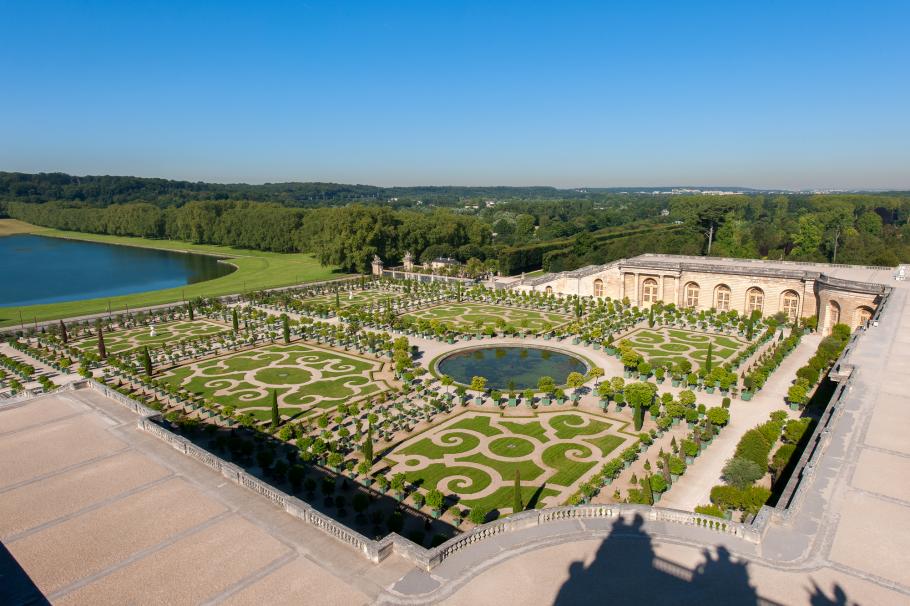
Credit: The Orangery | Palace of Versailles
Comparison
Both the 9/11 Memorial and the Palace of Versailles Gardens show how landscape architecture serves defensive purposes, though in vastly different historical and cultural contexts. In the case of the 9/11 Memorial, the defensive elements are integrated with a clear focus on public safety, reflecting contemporary concerns about security in public spaces. The barriers and surveillance present a visible and pragmatic approach to defense. At the same time, the design elements, such as water features and open spaces, continue to allow for social interaction and reflection.
On the other hand, the gardens of Versailles used design to reflect political control and reinforce the monarchy’s dominance. However, the defensive aspect was not directly linked to safety but to the notion of power. The expansive, formal gardens were designed to demonstrate the absolute authority of the king, limiting access and ensuring that visitors were constantly aware of the authority they were in the presence of. The Versailles example showcases a more symbolic approach to defense in landscape architecture, in contrast to the more functional security measures in modern spaces like the 9/11 Memorial.
While the two cases differ in their motivations and applications, both serve to highlight the long-standing relationship between landscape design and control, whether that control is about securing a site, demonstrating political power, or protecting the public. The key takeaway is that defensive landscape architecture is not a new concept, but has evolved to address the changing needs of society and the public spaces we inhabit.


