Introduction
Since it was officially published, the novel of Frankenstein by Mary Shelley has undergone many changes. We mainly focus on analyzing the differences between the 1818 version of the novel and the 1831 version. When discussing the first iteration of the novel written by Shelley, it will always continue to remain as a great piece of work. The influence it had in literary culture is still prevalent in today’s day and age, and its relevance backs that up even more. When the novel was revised by Shelley, she made sure to undergo multiple stylistic changes as she thought they were necessary in fulfilling her vision on what the novel was meant to be. In this post, I will be accessing Literature in Contexts’ 1818 version and the 1831 version through the Frankenstein Variorum in order to analyze the similarities and differences of each version, while also highlighting the value that each version holds.
Impact of different versions on the reader
In my opinion, when first looking into the 1818 edition, it is clear that it shows Shelley’s writing in a very raw form. She does a great job at bringing the characters, environment, and emotion of the novel to life. She was extremely young during this time. At only 18 years old, she was able to bring the chaos and horror that the monster of the novel encapsulates while creating sympathy for Victor Frankenstein, his closest friends and family members. What I noticed about looking into the 1818 version is that the structure is more concise, in the sense that it is not as long as the revised version. Obviously, both versions go as far into depth as any good novel would, but the fact that the first version is slightly shorter makes it more comprehensive in a shorter amount of words. However, this does not mean that the second version is shallow by any means. Shelley decided to add more to her second version in order to make the story flow better along with giving more depth to the reasoning behind Victor’s actions. Also, on the topic of the novel’s flow, the 1831 version has a major change that benefits the way readers are able to tackle reading the novel. Instead of having three different volumes like the original version, Shelley revised it to be from chapter 1-24 with no changes in between. In my experience, when touching on both versions I feel that a direct start to finish benefits my reading more, hence me saying that the revised version has a better flow to it. On the other hand, what I believe the 1818 version does efficiently is highlight the tool of pure storytelling. When separating the text into 3 different volumes, it gives a better sense of perspective to the reader. Although it may obstruct some readers’ attention when seeing that a new set of chapters is upon them, they are placed strategically by Shelley in order to give the reader a better perspective into where exactly the characters are emotionally and what the environment of the story will be looking like after the separation of volumes.
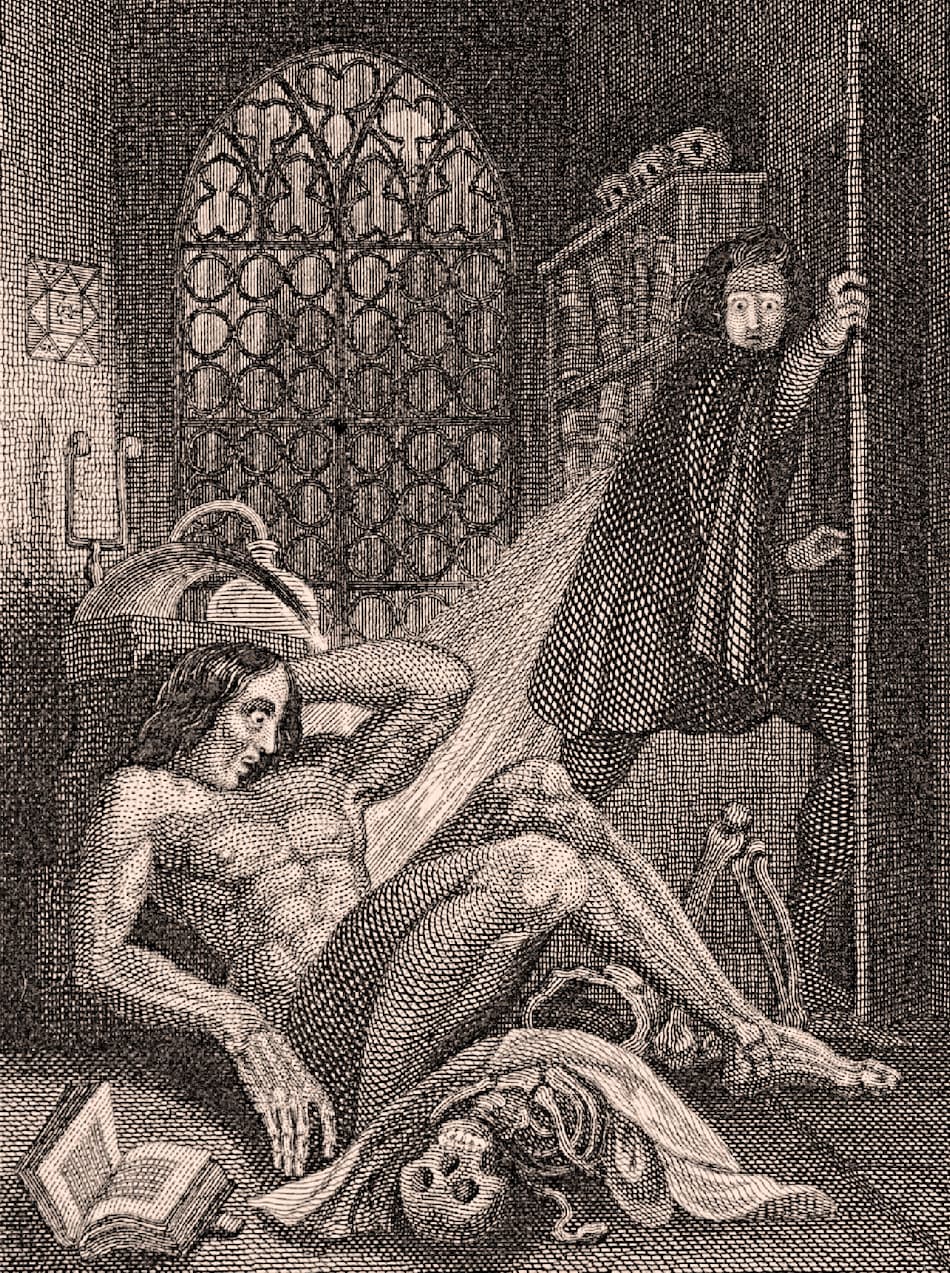
Did I request thee, Maker, from my clay To mould me man? Did I solicit thee From darkness to promote me? — PARADISE LOST https://frankensteinvariorum.org/
What do these different versions mean for the novel?
Since we’ve discussed the implication of the different versions on the audience, it is important to realize what these different versions do for the text itself. When looking at Victor Frankenstein’s implications in the first version in 1818, the narrative follows the lines of Victor’s morality and how the creature punishes him for his wrongdoings. This is mainly highlighted when Victor neglects the creature and treats it terribly. Shelley is able to incorporate the idea of free will into this, showing that Victor’s decisions are completely up to him. The 1818 version efficiently tells the story of how Victor is in control of his own destiny, and the choices he makes will either benefit him or make him suffer for the rest of his life. When discussing the 1831 version, this idea of free will is changed to make it Victor’s mission to create life, after he becomes fascinated with his studies at his University. This is a massive change, to the point where Victor is not in control nor can decide his ultimate fate. Shelley portrays Victor’s actions as being decided by external influence rather than resulting from his own conscious decisions. To expand upon this, it makes the audience feel more sympathy for Victor even though he is still in the wrong for a number of actions. It gives him a more humane feeling, knowing that he makes mistakes just like everyone else does. He ultimately pays the price for these fatal mistakes, and Shelley describes his downfall to perfection in both versions of the novel.