Malmö to Utrecht

Day thirteen. Today was travel day from Malmö to Utrecht, in the Netherlands. We first took a train to the Copenhagen Airport where we then took a plane to Amsterdam. From Amsterdam we took a train to Utrecht. The whole process took five and a halve hours, arriving around 11:30 am at our hostel. The convivence of taking the train to and from the airport couldn’t have been any easier. Both airports had train platforms steps away from baggage claim, making it very accessible and convenient. The ticketing system for the trains is I hadn’t seen before for a regional train. Instead of getting a ticket punched by a conductor, the used gets a card similar to one used for a metro. The user scans the card when boarding the platform and when exciting the station. This is a good way of gathering data on how the network is used throughout the regional network.


The rest of the day I was watching how the Dutch used their bikes on their road infrastructure and the differences to Malmö and Copenhagen. So far, the Dutch are a bit crazy not really following traffic lights. The mentality is more like, if no one is there I will cross. They also have less road markings then in Copenhagen. Tomorrow I will have my chance to experience it for myself as well as touring the city.


-Chip

Malmö

Day twelve. Today in Malmö the group attended a meeting at Malmö City Hall with two planners one focusing on mass transit and the other in bicycle planning. We sat in a on presentation, which was followed by a biking tour, looking at the different types of infrastructure in use. I will go over the key points that I learned from the presentation.


Malmö has set standards for itself, by not increasing car use for the next 20 years. Instead focusing on increasing pedestrian, public transit, and bicycle use. Because of this goal Malmö has created a new prioritization for new projects that focus on carless infrastructure, placing pedestrian infrastructure projects first. Currently Malmö is in the works of receiving a stimulus package called Big City Package, from the Swedish government which would allow for a lot of these carless projects to be built as well as build a high-speed rail line that would connect to Stockholm and other major cities within Sweden. Malmö received the Big city Package because of its commitment to build 26,500 homesites. This is a new way of receiving funding, by agreeing to construct homes, which in turn would generate tax money back to the Swedish government. I also learned that Malmö and Copenhagen are in the design stages of creating a new metro line between the two cities, currently 80,000 people commute between the two and this new line would increase economic development for both sides. The new metro line would also lower the commute to under 20 minutes, allowing for easier and quick transport.

When designing new projects, city officials are focused on creating a grid structure in Malmö which helps relieve congestion on streets but wouldn’t allow every street to have a bike lane. Malmö is not focused on creating a super bike city such as Copenhagen, mainly because they don’t have the funding that Copenhagen has and because it is a growing city is focusing more on housing development.


Biking specific facts I collected was that Malmö has all sorts of campaigns throughout the year. A few that caught my attention were; “No more silly car trips”, adult bike school, cycling without age, and e-bike rentals. The first campaign” No more silly car trips” focuses on having people confess silly trips they make with their car, like going to grab a coffee or newspaper. This They collect all these confessions and raffle a bike. The second, adult bike school, focuses on getting adults that never learned how to ride a bike, or immigrated from a country that doesn’t have heavy bike, allowing them to learn with police officers who teach them the rules of the road. The third, cycling without age is a program dedicated to getting elderly to go on a bike ride where they are sitting in a special cargo bike, while a volunteer pedal. This allows the elderly to have a chance to get outdoors, while still being comfortable. Lastly, e-bike rentals allow citizens to rent a e-bike for 7 weeks, to see if an e-bike can be used instead of taking a car to commute to work. We were told it has a 50% success rate. All these programs were developed to allow people to switch over to bicycling for transportation. This is how Malmö plans on getting more people to bicycle, as well as providing the necessary infrastructure.


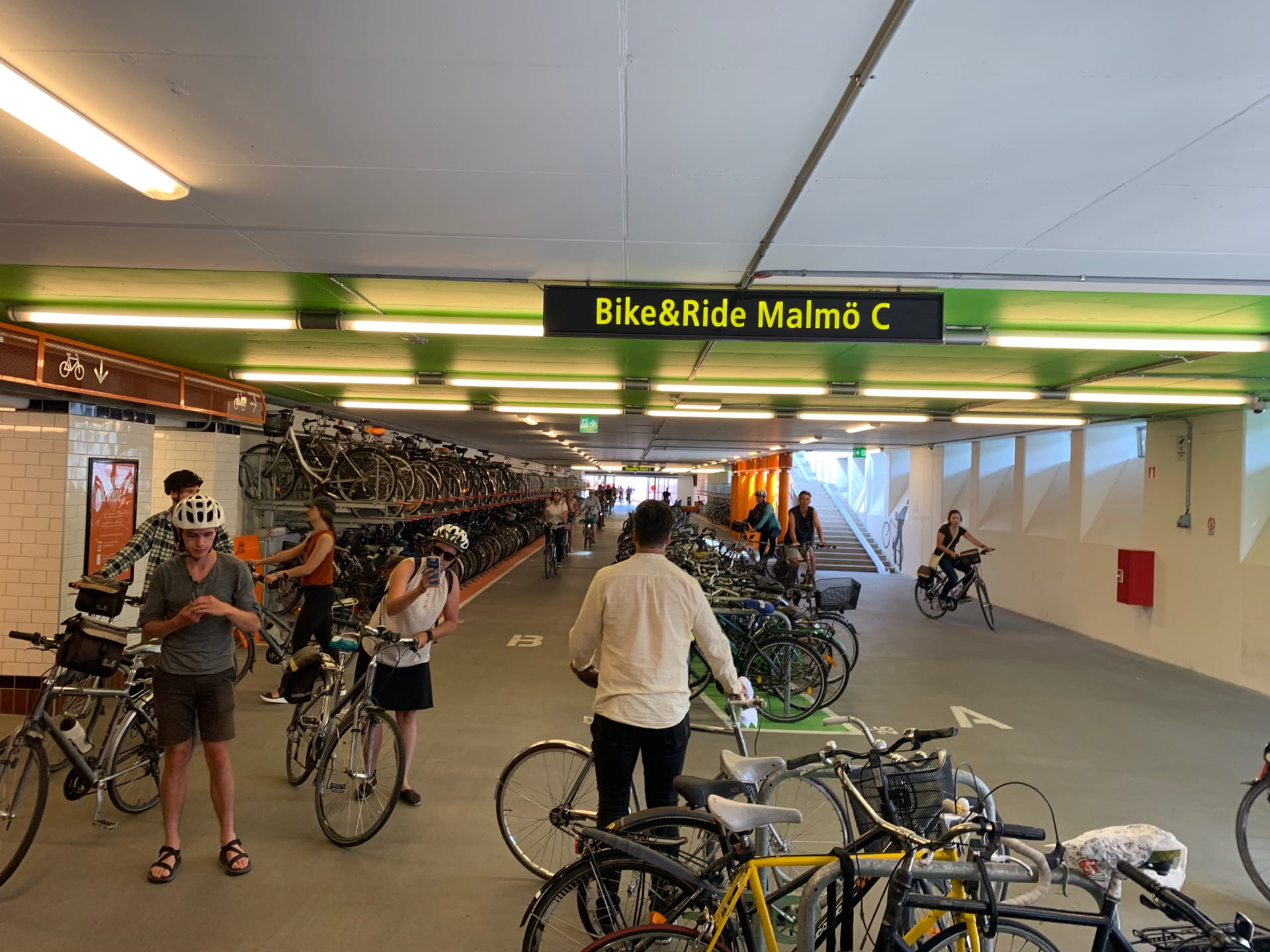
After the presentation we were able to go on a tour of the city with one of the city planners. He took us to a bike round-about, bike parking at the train station, bike boulevard (bike only street) and a bike service station. All these forms of infrastructure help promote the use of cycling, allowing the public to feel comfortable getting around on a bike. I have included photos to better describe what I saw.

At the end of our long day, we celebrated Marc’s 50thBirthday. Marc is the professor leading this trip, so of course it had to be special. Our guide Adam recommended we throw a progressive block party. What is that you ask? A progressive block party is when you start at one room or home and work your way down the street. We started with drinks then went to appetizers, to bigger bites, finally ending with dessert. I took charge for my room, since there were only two of us, making a caprese salad. We included some almonds, dried apricots, and prosciutto as well. I also decided to be the decorator of party, finding random lobster themed flags and party hats. Everyone pitched in and before we knew it the whole side of the building had all sorts of things hanging from the trees and lobster flags hanging. But truly was not where the excitement stopped. My phone miraculously managed to fall into the crack of the porch. This turned into a squabble of calling the hotel reception (who didn’t happen), the non-emergency hotline number (which was un-available), and the fire department. Eventually the fire apartment got ahold of the owner of the hotel who got a hold of the receptionist. While the multiple phone calls where taking place my fellow peers where poking various skinny narrow objects such as forks, knives, chop sticks, and spatulas. All trying to retrieve my phone. After 30 minutes of struggling the hotel receptionist finally made it. He then got the drill and unscrewed the plank to reach in and grab the small device that put my life in turmoil. The rest of the night consisted of dancing and singing. In the morning we will be departing to the Netherlands to start the next halve of the trip.


Here are some photos!


-Chip


Ven to Malmö

Day Eleven! Today I made it to Malmö, Sweden. Getting here I was able to take the train which in itself was an experience. I noticed differences from taking a train in Denmark, which made it a bit of an inconvenience at times. The first thing that I noticed was at the station platform, in Denmark they had marking on the ground with a bike so the cyclist would know which car to get into (certain train cars have bike stands). In Sweden that was not the case, we had to quickly look at the passing cars finding the right car to sprint over too. As we frantically boarded the right car we noticed once inside, that the aisles were not too big for bikes, especially when there are already bikes there. We had to wait one stop until we could tether our bikes to the pole then sitting down. Once sitting down the journey was pleasant, I cannot express how lovely the Swedish countryside. Once arriving at Malmö Central Station, the three of us made it to the street level. The level was pretty easy, with a slanted walkway, no problem with a bike, the next one was a staircase with a wheel ramp. This posed a problem because of the bags we had on our bikes and this was the only one on that side of the station, instead we took the elevator. Once we made it out, we noticed a large amount of bike parking on the street level. It made me think that maybe the commuters leave their bikes when taking the train and walk to their final destination. Who am I to know? Once biking in the street, we quickly noticed that our accustomed bike infrastructure of Copenhagen was no more, instead we had wide sidewalks that seemed ok to ride on, two-way bike traffic on either side of the street, and no signaling. The hardest thing for me to get used to is the no designated area for bicyclist. Biking today t finally hit me I was in a different country. The rest of the day I checked out the modern art museum, the old part of the city and swimming in the ocean. As I am writing this, I am sitting out of my hotel room, watching bikes and people going back and forth. It’s truly amazes me how this part of the world operates; this fascination has given so much inspiration in how I want to live and the environment that I build for myself.


As always, here are some photos.


-Chip


Elsinore to Ven

Day ten! Today I left Elsinore, took a ferry to Helsingborg, cycled down to Landskrona, and took another to ferry to the Island of Ven. This was an adventure, using a different form of transportation, a ferry. A ferry comes handy when crossing a large body of water, especially when the nearest bridge is 40 miles away. Both ferries we took today had car ports, a sun deck, and restaurant. Getting on the first ferry was interesting, mainly because there wasn’t a true bike entrance, we had to use the car entrance, which in itself was a laugh. Once we made the journey, we arrived in Helsingborg, Sweden. We spent an hour and a half there exploring, all I managed to do was to stop at a café. The next leg of our journey was a 15 mile stretch along the Swedish coast line with some parts in the countryside. There was a bike path, but it was not as continuous as the ones in Denmark. It felt a bit like America at times, sharing the road with car traffic. I will say the journey was a lovely one, wild flowers lined the road creating a border from the road and the wheat fields. I caught myself staring off into the distance, allowing my face to bask into the sun. As the wheat fields started to fade, we were entering Landskrona. Once we arrived, we went to the ferry terminal where we waited for the rest of the group to catch up. I will say the legs seemed to have jolt of energy and made it far faster than anticipated giving me time to explore the town with a fellow student. Once the others came, we boarded the next ferry to Ven, an island between Sweden and Denmark. We made it the Island which is easiest to maneuver with bicycle. The day was nice, and the ferry rides were enjoyable. I will say that Ven is a nice quaint island but, has only one grocery store. When we arrived in the afternoon it had looked apocalyptic, we managed to scrounge up some food for dinner but should of boughten groceries before boarding the ferry. I will upload a photo of what we managed to crank out. Let’s just say wasa bread is forever my love but the rest of the group does not share the love. I guess that’s what happens when you’re in Scandinavia. Tomorrow we will be off to Malmö, a city know for its sustainability…

Here are some photos of the route, the ferry, and where I    am staying tonite.

– Chip


58487408813__87ABC686-A1CD-43AD-9782-67A264D4F797

Elsinore

Today, day nine, was a day of relaxation. The last couple of days I have been sick and wanted to chill out a bit. I still went to town; I just took my time in the morning, leaving at 11:30 by bike. I visited the Danish Maritime Museum and the Kronborg Castle, both significant in their own ways.


The Maritime museum was focused around Denmark’s and the world’s history with ships. The exhibit shared about the history of the sailor, engineering feats, world wars, and how the modern economy is very reliant on shipping. My favorite bit was the how the modern economy is affected by shipping. Another fun fact is that this museum was designed by BIG. They made the whole museum in an old dry dock. Here is the link for the project. https://big.dk/#projects-sof.


The next place I visited, which was conveniently right nearby, was the Kronborg Castle. This is the castle that Shakespeare used to set Hamlet. They had actors throughout the castle reenacting scenes from the play. It was a modest castle, the interior was simple with tapestries on some walls, the furniture, even in the middle ages it is possible to root to see how Danish design has been inspired. I explored the Kings apartment all the way down to the barracks. Afterwards I set back to the hostel to relax some more and take a swim in the ocean.


To end the evening I shared with my group something that I started in Eugene with a group of friends. Simply put it’s a potluck. To me it’s a way to bring people together to enjoy food from others and share their stories. It ended with smores and the agenda for tomorrows plans.


Tomorrow I will be on the ferry to Sweden, goodbye for now Denmark. Here are some photos from my day.


-Chip


Copenhagen to Elsinore

Day eight. The day I have personally been waiting for the most, touring day. Today I traveled from Copenhagen to the northern part of Denmark, to an area called Elsinore. This is a town that is located at a narrow straight between Denmark and Sweden. I got up at 7:00 am this morning and bringing my belongs downstairs to get loaded into the van and briefed on the day ahead. We were told there would be some stops along the way, the new Nordhavn district, Bakken amusement park, and the Louisiana Museum of Modern Art. I will share all my experiences with each stop.

The first stop, Nordhavn is an old shipyard that is transforming into a new neighborhood, which, when completed, will have; a population of 60,000, a new metro line, swimming areas, schools, and retail areas. The whole group explored the area with two long term residents that purchased apartments before their building was even built. They mentioned how this new area is very prized by the Copenhagen city officials, because it is being designed to be the “perfect neighborhood” using all the latest technologies and designs, making it very energy efficient and enjoyable to live in. This past week I have been going to various architecture and planning firms, so, being able to be in it physically helped me grasp these ideas and see what is possible, it was a full circle moment for me.  As we wrapped up the tour on a playground, located on top of a parking garage, it was so nice to see how the community members embraced their new community. They mentioned how they volunteer at a lot of community engagement groups, allowing them to feel even more connected with their new upcoming community.

The second stop on the tour was the oldest amusement park in the world. Which so happens to be in Denmark. I did not spend too much time here mainly because I wanted to go to the modern art museum up the road.  The amusement park was only assessable by walking, bike, or horse. It felt as if I was in a fairy tale with small Danish cottages dotted around the forest. After a half hour I decided it was time to leave and move on up the road.

The third stop,  I was excited for the most. The Louisiana is a modern art museum that focuses on Danish artists.  Of course they have a Picasso and Andy Warhol, but it was the Danes I was more concerned about.  So many times, I go an art museum, which have so many collections by big name artists. I feel there isn’t enough stress for the local artist showings. The museum its self is all over the place, with exhibits on the ground and some underground. They had a very explicit exhibit on the great refugee crisis into the EU, sharing stories of refuges in an artists perspective. This made me think of how art is a form of communication that can be used in public spaces to provoke ideas and pass on information. This is something that I  have noticed in a lot of the parks in Copenhagen.


Later in the evening we made it to Elsinore. This was a lot later then what I first expected but with the stops along the way and relaxed attitude of it all it made it much more enjoyable. The place I am staying at is right on the water and has a lovely atmosphere. I will say that the bike infrastructure is not as good as Copenhagen’s but has a much-lowered population. Less people on the street in cars is a good thing as well. Well it is late; I am tired and I plan on sleeping in tomorrow. It will be a very relaxed day tomorrow, I am looking forward to it .


A photo of the route and a couple of photos from Nordhaven.


-Chip


Copenhagen

It has now been a week in Copenhagen. Today I was able to visit the office of Bjarke Ingles Group also known as BIG. This was a big deal for some the architecture students on the trip, the man that started the group is known as the Elon Musk of the architecture world. The group is known for breaking down the walls and high-profile clients it serves. From the new sea wall that will surround NYC to EXPO 2020 in Dubai. We had a short presentation from the business affairs employee, who shared more about the company and some projects. One of the projects that we focused on was a tower in Vancouver Canada. Because of where the lot was and the specific zoning laws in place, BIG created a building that appears to be top heavy. The zoning laws only apply to a certain height, after that height is reached the rules don’t apply. This has led to a building that looks almost “top heavy”. Here is a link for what the building looks like https://big.dk/#projects-van.


After the presentation I headed over to the Danish Architecture Center where I visited the BIG exhibit that I had learned about during the presentation. Here I was able to learn more about the current and past projects that BIG is designing. I learned there that when the company starts a project, they first do modeling and then go into the nitty gritty details of rendering and then engineering. This allows the designs to play with the overall design. They also are fond of  Lego, making replicas of the buildings to display to clients and display in there reception area. The main goal of BIG is to create an AI system for architecture that would allow more immersive experiences when designing their structures. This would allow staff to fully understand what the structure will look like before being built. The whole exhibit was very mind blowing and made me realize how building design can really create a mood for an urban area.


Later in the evening I was able to catch up with some friends I have made over the years. It was a lovely last night in Copenhagen and I sure do hope I will find myself here one day. Tomorrow I  start my first stretch of bicycle touring up to Northern Denmark, heading to Elsinore.


Here are some photos, from the offices at BIG, the BIG exhibit, and my lovely friend Anne.


-Chip


Copenhagen

Day six of being in Copenhagen, it was a playful day. Today we meet with Randa, a coordinator for a staffed play ground in Copenhagen. What is a staffed playground you ask? Well, a staffed playground is a playground that has 2-4 staff to make it the most enjoyable time for children as well as parents. The job comprises of caring for children that get hurt,  being the one that caters communication  to break up conflicts, giving educational lessons, creating activities, and caring for the park. Staffed playgrounds allow children six and over to come without their parents, allowing the parents to feel comfort about letting their children be independent. If the child is under six it is required they have a parent with them. The staffed playgrounds also are places where schools can come and partake in educational activities, like learning how to bike or learning about animals. I was able to go to five different staffed playgrounds which were all different and  unique, with the same purpose. All the playgrounds I visited had a staff house which the staff which have play equipment, a community garden, and a fence with secure  childproof doors.


The first playground that I visited is named “Trafiklegepladsen” (traffic garden). This playground was set up as a miniature version of various streets one would find in Copenhagen, allowing children to learn how to interact with street infrastructure on a bike. Little kids ages 4-6 buzzed around with ease, stopping and looking, as well as waiting for the lights to change all in a protected area learning what signals meant what and where to ride a bike on the road. This tool is very valuable, especially to a biking city like Copenhagen. We later found out that Eugene is in the process of getting funds to build one as well, something that will help promote bike education. We also found out that the Police do exercises with adults from underrepresented areas to teach them the ways of the road, a way of reaching out and helping them be better integrated into Danish society.

The second playground was a petting zoo. They had chickens, goats, guinea pigs, and rabbits. We were able to enter the enclosures and pet the animals, I was a bit worried about the goats, but they did not budge at all. There was also a green house on the other side of the park which had various birds, baby chicks, and snakes. The green house was a multipurpose room set up to have crafts and make snacks. The staffers shared how this playground allows children to care for animals. They also mentioned how children can take ownership for the animals by “adopting” them, coming to feed them and give their furry friend a good pet. This allows the child to learn responsibility and care.

The third playground I visited was a tower playground. The playground was made up with the famous landmarks and their towers. There was a big skate park too, which had adult skaters as well as young children. This park allowed kids to climb and ring bells at the top of the towers, and go inside the towers. I thought the architecture used in this park was typical Danish, minimal and edgy. But seemed to work for the use of children.

The fourth playground was themed Old Western aka stereotypical cowboy and indians. They had a massive zipline, an old western main street, steam engine, and teepees dotted around. This was in the most southern part of the city so getting there took some time. This one seemed to have older children in it. There was also a basketball camp in session, when we arrived rap music was playing and a fellow American leading the camp. The kids were energized and ready to play some ball. Most of the area was under construction, they are creating a larger park to allow for more capacity and engage more of the population in the surrounding areas.

The fifth playground I visited was more of a conventional playground, one that you would find in America. It was not staffed and did not have as many children at it. It also did not have an overall theme, which made it look quiet boring compared to the others. Because of how accessible everything is here; it is easy to pick and choose which playground to visit. This is probably why it was not as busy as the others I got to visit.

Visiting these playgrounds opened my eyes to how important it is to design an area for children to experience. One of the main things that has stuck to me so far is that idea of designing places for the public. If it is too boring and minimal, it is a complete waste of space. Instead, a public space should be a place you want to spend your time outside of your living area. This concept of making the public spaces, a living room, is something the Danish have perfected.

-Chip

Copenhagen

It is day five today in Copenhagen, day nine of me having left the country. I am finally getting used to the new time zone. Being on day six with the group, we were able to ask the professionals questions on what they were taking in and their comments so far. This was nice because one of the main reasons the professionals came was to be surrounded with this new functional infrastructure and realize that it is possible to be replicated into a new environment, such as Eugene. This was also a time when we could as the simple question, why is it talking so long? After the professionals introduced themselves one by one the questions started rolling in. The questions seemed more critical, asking them; is there any collaboration between you all, what are stalling some of the projects, is there a way to prioritize bicycle infrastructure, and why isn’t Eugene doing more pilot projects? All these questions as you can see have a common theme, what’s taking so long and how can we fast forward this process? The professionals seemed just to be giving answers that lead to more explaining, sending us to a downward spiral of more questions. There is no simple answer to any of the questions that were asked but I feel that it did start allowing gears to start turning in the right direction. The areas covered were bike infrastructure and parking, parking seems to be the heated a topic it is in Eugene right now. The parking is relevant, but I would have liked to see them discuss more about bike infrastructure. If it is safer to ride your bike into town you would not require a parking place, thus the parking can same or lowered. After the discussion we were able to meet with an alum from UO. She spent an hour asking our questions about what it was like to live in Copenhagen. Generally speaking, it is a very easy place to live that is enjoyable and efficient. This is something that I prefer in a place. I mean how great would it be if you were able to live somewhere and not have to worry about paying for transportation costs, no car/car insurance/ car payment/parking/fuel, no metro ticket, and the most important is no traffic. The rent is a bit higher than Eugene and no need to worry about health care. She did mention that her payroll takes a 40% tax cut, but she does not mind because she does not have to worry about anything. This was really nice being able to talk to someone my age about living in a different country. It also made me think of the possibilities I personally have and what choices I can make in the future years.  Well I am off to a very interesting place for dinner tonight that focuses on sustainable vegetarian food, it will be interesting to try out.

A photo of a Kanelsnegle (cinnamon roll).

-Chip


Copenhagen

Hej or hey in English. It is day five in Copenhagen, and the sun is finally out. Today we had the opportunity of touring and hearing a presentation from Gehl Architects. This was a very rewarding presentation, which focused on the beginning of the company, projects the company has worked on, Copenhagen’s evolution into a bicycling city, and a walking tour. The presentation was given by Karolina, a native from Vienna that has spent time in Latin America and Southern China. She shared how Gehl architects focuses on researching the space between buildings. This space makes up 20-30% of a city, with 80% of that used up by streets. But that 20-30% of space is what we use and interact with the most. This is also an area where the public is interacting with each other on a daily basis from driving vehicles to walking on the street. Gehl examines an area in the following hierarchy; life, space, then buildings. Studying human behavior, Gehl will learn on how the area is being used and look for patterns. The presentation consisted of examples of cities worldwide looking at New York City, Brighton Beach, and Moscow. The presentation wrapped up and we were then led around the office.

We then headed outside where we started a walking tour, going over projects that Gehl has worked on. This was really nice to see the physical spaces that they created. The first stop was a staffed playground in an old shooting range, which when we arrived was packed with kids. This was an example of how a space can be transformed to create a sense of community. We then toured a park that was created in middle of the road. It used to be a 4-lane road, but after studying the area, two lanes were removed, creating less road noise for residents and making it safer for the young children in the area. The last place we visited was a square that had originally been a parking lot and soccer stadium, it was then transformed into an underground parking area with a modernist playground with a fountain. The guide mentioned how even though the grass is gone, the children from the neighboring school seem to have even more fun than when it was a plain field.

These photos seemed worth sharing. Enjoy.

-Chip