All posts by aolson8

References

Voyager 2 in depth from NASA https://solarsystem.nasa.gov/missions/voyager-2/in-depth/

Voyager 2 Instruments from the NASA Jet Propulsion Laboratory https://voyager.jpl.nasa.gov/mission/spacecraft/instruments/

Voyager Overview from NASA
https://www.nasa.gov/mission_pages/voyager/overview

Voyager 2: Sailing Among Giant Planets by Elizabeth Howell https://www.space.com/17693-voyager-2.html



Voyager 2 Today

Voyager 2 is still in space and relaying data back to NASA. In December of 2018, Voyager 2 entered interstellar space (considered by NASA to be outside of our solar system). In July of 2019, only five of the probe’s instruments were still working, and eventually, none of them will be functional. The engineers who built Voyager 2 anticipated this and equipped it with a golden record of music and greetings in over 60 different languages for any extraterrestrial beings who might find the probe after it fully stops functioning.

File:The Sounds of Earth - GPN-2000-001976.jpg - Wikimedia Commons
Photo of “The Sounds of Earth” record taken by NASA https://commons.wikimedia.org/wiki/File:The_Sounds_of_Earth_-_GPN-2000-001976.jpg

Discoveries

Between 1979 and 1989, Voyager 2 completed a flyby of each giant planet in our solar system. Below are summaries of the discoveries made during each flyby:

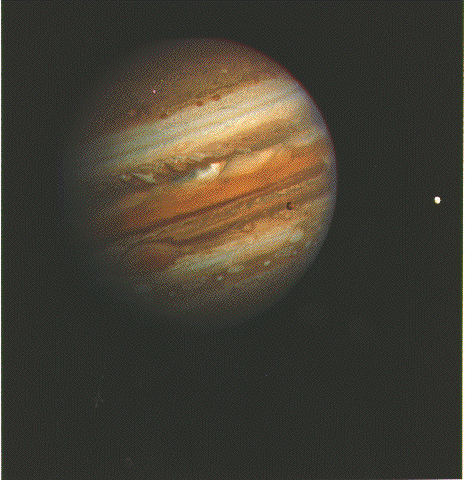
Jupiter // July 9, 1979

Photo taken of Jupiter by Voyager 2 https://voyager.jpl.nasa.gov/galleries/images-voyager-took/jupiter/
  • A 14th moon
  • A third component of the planet’s rings

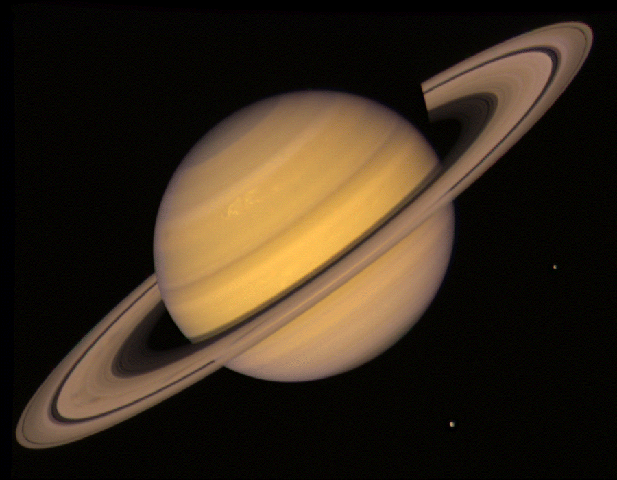
Saturn // August 26, 1981

Photo of Saturn taken by Voyager 2 https://voyager.jpl.nasa.gov/galleries/images-voyager-took/saturn/
  • Offered higher resolution views of Saturn’s rings
  • Discovered many new ringlets
  • Provided new photos of the F ring and shepherd moons

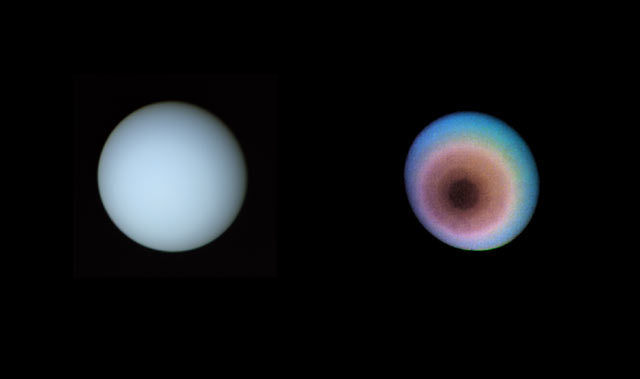
Uranus // January 24, 1986

Photo taken of Uranus next to a false-color composite by Voyager 2 https://voyager.jpl.nasa.gov/galleries/images-voyager-took/uranus/
  • discovered evidence of an ocean of boiling water
  • 10 new moons
  • 2 new rings

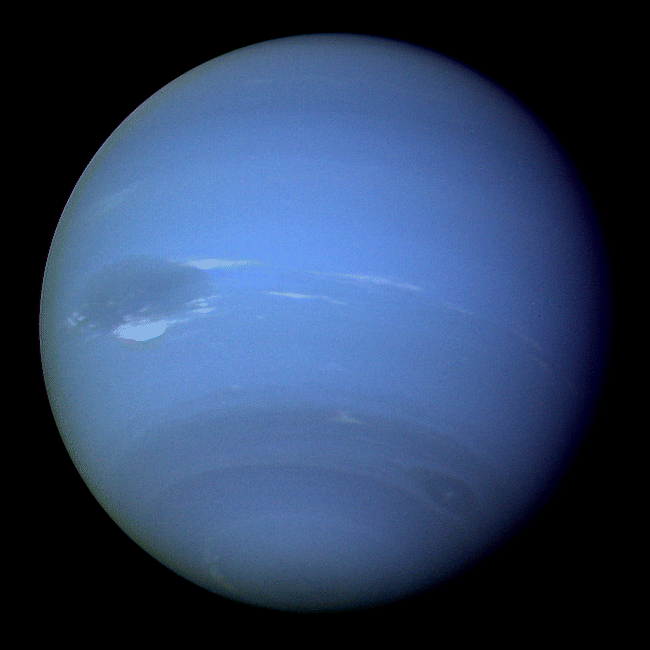
Neptune // August 25, 1989

Photo of Neptune taken by Voyager 2 https://voyager.jpl.nasa.gov/galleries/images-voyager-took/neptune/
  • 5 new moons
  • 4 rings
  • great dark spot
  • nitrogen ice volcano on the surface of Triton

Mission Logistics

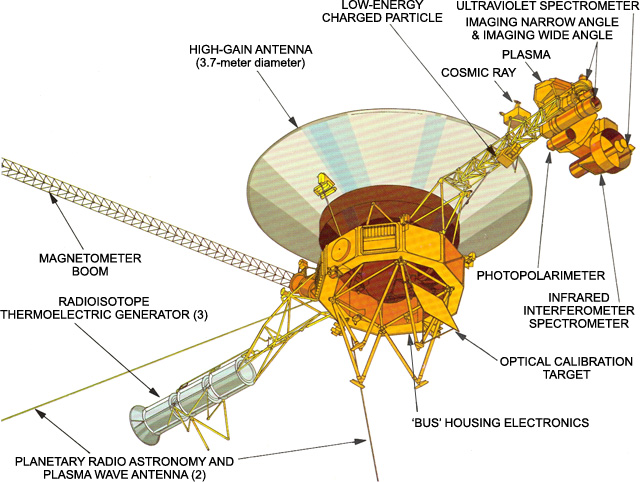
In order to effectively relay the data the spacecraft collected back to NASA, the probe was equipped with a number of technologies, including the following:

  • Imaging science system: a set of cameras with filters to capture images
  • Ultraviolet Spectrometers: senses ultraviolet light to determine height, depth, density, and other characteristics of planets and stars
  • Infrared Interferometer Spectrometer and Radiometer: serves as a thermometer while also measuring the elements present on a body and measuring ultraviolet, visible, and infrared light frequencies
  • Photopolarimeter System: a powerful telescope used to observe the particles that make up the atmospheres and rings of celestial bodies
A blueprint of Voyager 2 from NASA’s Jet Propulsion Laboratory https://voyager.jpl.nasa.gov/mission/status/

The craft also carried a number of experimental technologies, bringing the total cost to build Voyager 2 to 895 million US dollars.

Voyager 2’s Goals

Broadly, the goal of the Voyager missions was one of exploration. The spacecraft were intended to fly beyond the outer reaches of the solar system, exploring the outer-most planets along the way. Voyager 2, however, also had a more specific mission: to do a fly-by of all of the giant planets. Voyager 2 was also designated to serve as a backup for Voyager 1 that could change course and finish the mission if anything were to happen when it conducted the flybys of Saturn and Uranus.