The final design for my screen system is coming along. Unfortunately, I could not get the shape memory aspects of the nitinol to work properly. But luckily, nitinol also has super elastic properties. Im going to use this in conjunction with a nob in the middle of each panel to open and close the system. I bought some semi translucent rice paper and vellum to try out different textures. I also bought some watercolor. Below you can see the pattern I am going to paint. As the panel opens, it will show a different hue.
Monthly Archives: May 2011
Progress of installation/location
Progress has gone forward on my installation with a location determined between the gap of the staircase and the upper walkway on the second level of our studio space. There were two major factors that went into location selection:
Amount of light being distributed from the source(i.e. sunlight).
Amount of objects projecting shadows in front of the screen continuously.
The area right above the staircase provides a lot of foot traffic from people getting prints and using the kitchen. Also there is a large amount of bounced light from the reflective properties of the floor providing enough light to reach the screen. I intend for the screen to be experienced from below as people enter from the fourth floor. Shadows will be chamfered through the screens with the undulating surface projecting the contours as a 3d image.


James Carpenter Inspiration Presentation
For my inspiration presentation I studied the work of glass sculptor James Carpenter. What drew me to his work is his experimentation on using glass as a medium to perceive the environment in new and different ways. He seems to be more interested in the effects that he is creating on the material instead of thinking of glass as a transparency. With a successful body of work, I only chose 4 that I thought could apply to my project, or simply because I just found them interesting.
Periscope Window – Dayton Residence – Minneapolis Minnesota 1995-1997
An installation in a house to provide privacy and views to the outside using several layers of glass, reflective surfaces and periscopic mirrors. Different effects happen through different times of the day and you are able to see the sky and tree outside in new ways.

image source: http://mw2mw.com/periscope-window
Dichroic Light Field – Millennium Tower – New York – 1994-1995
Installed on the east side of the Millennium Tower to break up the facade, create depth and allow for a more pedestrian scaled environment. Glass tabs were mounted onto a reflective glass surface that change as the sun moves throughout the day, casting shadows from nearby buildings and giving the street a dynamic theatrical effect.

image source: http://www.aiany.org/eOCULUS/2009/2009-05-12.html
7 World Trade Center
Carpenter was commissioned as a consultant for the exterior skin, podium and lobby installation. The exterior skin is mirrored glass and spandrel units with depth creating an illusion that the parallelogram tower disappears into the sky. The podium, which houses large transformers, is 80′ high and allows for air ventilation. To break it down to pedestrian scale, Carpenter and team used a series of metal panels and triangular wires to diffuse and scatter light. At night, the podium glows blue and using a camera tracks the movement of pedestrians, projecting it onto the 80′ high podium. The lobby is a series of large luminescent panels with quotations scrolling through the inside and can be viewed from the outside.
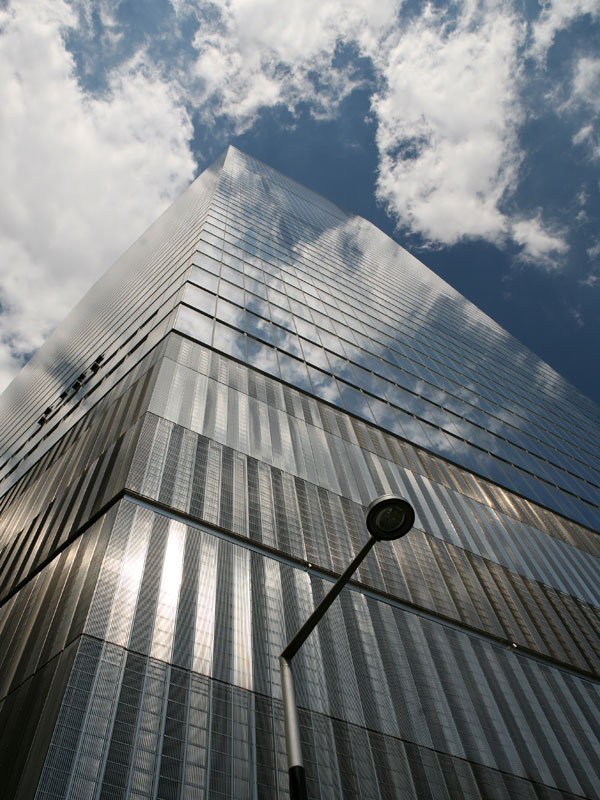
image source: http://wirednewyork.com/wtc/7wtc/

image source: http://www.jets.org/_delete/1106/extreme_engineer.htm

image source: http://www.greenbuildingsnyc.com/2009/07/08/leasing-activity-continues-at-leed-gold-certified-7-world-trade-center/
Fulton Transit Shelter – New York – 2004
The glass atrium – whose form mimics the rotation of the earth is designed to reflect light into the dark tunnels below. The oculus allows the users to follow the path of the sun throughout the day.

image source: http://www.downtownexpress.com/de_55/fultonsubwaydesign.html
Light Art
I found this video, and thought it was worth sharing.
Another sculptor working with light.
http://www.youtube.com/watch?v=EO_ClTEjsaI&feature=player_embedded
assignment.04 | Arduino
My components are ordered and are expected to arrive on Friday by the end of the day, so I thought I should take a stab at writing the Arduino sketch to control my luminaire. Having experience in both Processing and Arduino definitely helped me with this sketch as I do not yet have the hardware to test it with, I know it will need tweaking especially the delay and the number of steps, but I think I am at a good point with it for now until I can actually test it. All I have to do now is think of the actual guts of the lamp, and rethinking the overlap between the panels. I would like to light the lamp with an LED array of some sort because I could power it off of my Arduino, but I do not know if it will work correctly as LEDs tend to be pretty tight in their beam spread. I also need to figure out how I am going to get power to this lamp. Right now the Arduino runs off of a 9v source and the stepper motor off of a 12v source. Hence the reason I would like to use LEDs. Another idea I had for control would be to write into the code for the lamp to turn off at a certain time, but seeing as it won’t be attached to a computer I cannot determine the current time on the Arduino itself (without the implementation of another chip which I forgot to purchase). So my current solution to all of those problems is to get a long power strip (because they are legal in our building) and plug everything into the power strip within the luminaire itself.
Thoughts and problems that have yet to be resolved with very little time left…!
//Controlling a stepper motor with a PIR motion sensor.
//Written by Geoff Sosebee with example code from:
//Dan Thompson @ http://danthompsonsblog.blogspot.com  and
//TigPT @ http://lusorobotica.com

int dirPin = 2;
int stepperPin = 3;
int numSteps = 1600;
int timer = 500;
int PIRalarmPin = 0;
int PIRalarmValue = 0;
int alarmValue = 0;
int alarmValuePrevious = 0;
int ledPin = 13;

void setup() {
  Serial.begin(9600);
  pinMode(dirPin, OUTPUT);
  pinMode(stepperPin, OUTPUT);
  pinMode(ledPin, OUTPUT);
  pinMode(PIRalarmPin, INPUT);
  delay (2000);  //delay 2 seconds for PIR to scan area
}

void step(boolean dir,int steps){
  digitalWrite(dirPin,dir);
  delay(50);
  for(int i=0;i<steps;i++){
    digitalWrite(stepperPin, HIGH);
    delayMicroseconds(100);
    digitalWrite(stepperPin, LOW);
    delayMicroseconds(100);
  }
}

void loop(){
  PIRalarmValue = analogRead(PIRalarmPin);
  if (PIRalarmValue < 100) {
    alarmValue = 0;
  }
  else {
    alarmValue = 1;
  }
  if (alarmValue = alarmValuePrevious) {
    if (alarmValue = 0) {
      digitalWrite(ledPin, HIGH);
      Serial.println("motion");
      delay(10);
      step(true,numSteps);
      delay(500);
      alarmValuePrevious = 0;
    }
    else {
      digitalWrite(ledPin, LOW);
      Serial.println("no motion");
      delay(10);
      step(false,numSteps);
      delay(500);
      alarmValuePrevious = 1;
    }
  }
  delay(timer);
}


Final Installation Proposal


I am looking at installing a screen installation at the end for the 4th floor, middle, architecture bay. The installation would encompass the center window volume. The hight of the installation is a question that I haven’t answered, but I currently have the idea that I would install the screen over the lower window pain and possible the upper one too.


Final Project Thoughts


My last few studies have dealt with bouncing color, but some recent experiments with other materials (primarily wood) have caused me to put that thought on hold for awhile. I am now exploring the way light is transmitted through thin organic materials, such as wood, leaves, the body, etc… I particularly like the warm glow that is created from back-lit wood grain, and the way in which layering the wood and adjusting the positioning of these elements can change the luminosity of the panel.
I wired my first light socket for this project too. Within a minute after wiring it I quickly sent a small jolt of electricity through my body…I have since wrapped the leads in electrical tape!
There is more to come, surely. I like the direction that the project is heading in much more now, and some comments in class today will be helpful to bear in mind.
May 9 Agenda
I. Student Presentations
- Jerome Alemayahu
- Adam WIlson
- Arpad Takacs
- Ashley Koger
- Erika Malpaya
- Bob Carbaugh
II. Discuss Mary Guzowski’s Daylighting for Sustainable Design
- Name a key strategy for carbon neutral daylighting design. Can you give an example of how to use this strategy?
- How can concepts from today’s presentations or Light & Shadow project be used to make a building more energy efficient?
III. Review Final Projects in Process
Next reading: Olafur Eliasson Encyclopedia
See Facts > Leaf Through online preview of 100 pages and browse volume on reserve in AAA library under Cheng – Ho studio
assignment.04 | luminairePrototype
I have successfully processed and fabricated my first luminaire. I do not want to say the design is completed, but I learned more than I can ever hope for in this mock-up. The prototype is based on a 16″ diameter sphere which is about half as small as I am wanting, up it allowed to me to look at the individual connections and the connections at the top and bottom panels that I had been struggling with. This will allow me to go back and tweak my definition where it needs some attention. Attached are two videos, one of the strip assembly and the the other of the luminaire assembly. In the end, the fabrication and construction of the luminaire took about 3 hours. An hour of that is dedicated to laser cutting, about 90 minutes to the assembly of the strips, and thirty minutes to the actual construction of the lamp. Those times do not include the assembly and disassembly that had to take place as forgot to include the lamp inside.
This gets me to the points that need attention…
- Individual slots for tabs need to be taller to allow for a bit more pivot.
- Slots at the top and bottom panel need to be wider to accept the top and bottom pieces.
- The geometry of the top and bottom tabs needs to be redefined.
- Proper sizing for the lamp socket needs to be accounted for (this has been implemented, I just forgot to measure the socket and guessed).
- The connection of the top to the bottom needs to be re-thought. Do they need to be attached? It makes it easier to construct if they are. How do they attach to one another? Currently they are sewn together with spacing, but this drastically cuts down on space for the lamp and the electronics.
- A hole for the Motion Sensor to reside in on the bottom.
- Structure for all of the electro-goods inside.
- Re-evaluate the squishing motion. Overlap is too great currently. Does each strip twist at the bottom or top so it does not interfere with its neighbor? Or do I use an acrylic strip inside along each strip to control the motion more?
I have also placed my order for my electronics. I picked up a few stepper motors from Free Geek, for which I have found wiring diagrams. To that I have purchased a Stepper Motor Driver for my Arduino, a Proto shield also for my Arduino, a few PIR Motion Sensors and some other odds and ends. Still to come is my Arduino sketch which I hope will be pretty simple. I have sketched it out and I think it is pretty straight forward. I will be checking for motion underneath the lamp every 5 seconds, if their is motion the steppers will allow the lamp to extend, if their is no motion then the steppers will either contract it back up or keep it contracted, depending on its current state. So, I basically know how to write each piece of the code, I just have to put it all together. However, the last time I said I could do it without knowing if I could actually do it or not I spent a good 60 hours on the sketch, an amount of time I cannot afford to spend on this project as I have 3 weeks left for my Thesis.


Olafur Eliasson & Harvard – Fun Video full of Great ideas
I found this video recently posted on Archdaily.com (http://www.archdaily.com/132682/video-olafur-eliasson-three-to-now/) I’m sure some of you have seen in alreadly, but just case I thought I would reposted it. I really enjoy how Mr. Eliasson is playing with his ideas. He don’t seem to find or search for answers to his questions, he appears only interested in showcasing objects that are framiliar to us in a different way that provides us with a sense of wonder. The beauty of his work how simple the ideas are. I feel, as designers, we try too hard to be intellectual with our designs by having an answer already in our mind, and we forget to simply play with our thoughts.
Hopefully the Vimeo video will embed itself into the post. If not the link provided above should take you to the video.


