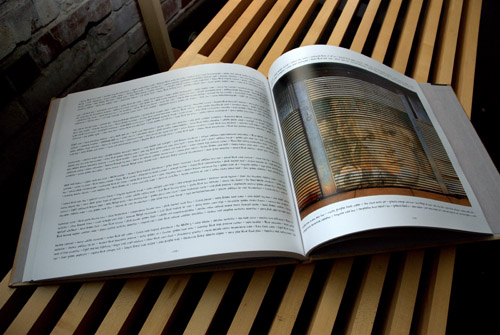
OXIDE is a work of fiction. Its world, like ours, accumulicates on its surfaces a record of human actions, ideas, successes and failures, modified by time and natural forces. You might think of this book as describing the setting for a larger fictional work that hasn’t been written yet. You are welcome to write it.
SUBMITTED LATE [stamped authoritatively on this statement card]
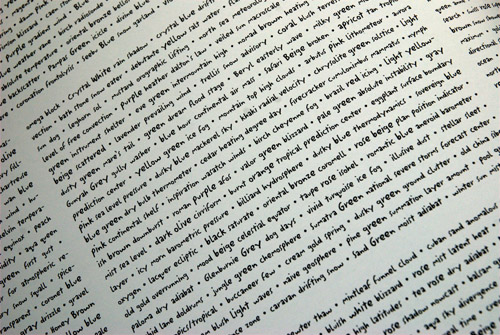
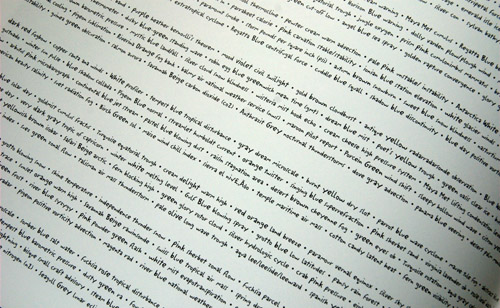
Open the fairy-tale like volume that is OXIDE (UO Digital Arts professor Craig Hickman’s latest literary and photographic endeavor) and, immediately, you are submerged in a flow of words and images, a suspended reality. What appears to be handwritten, minion-like text, line after line, bulletted listings of what are phrases inspired by paint chip color names (plumbago blue diablo winds, yellow green ice fog, eggplant sargasso sea, salmon pink mammatocumulus—words so deliciously descriptive I could go on and on… but I digress) methodically march in precise lines around photographs of cityscapes, open spaces, signage, sides of buildings—spaces author Craig Hickman sees as “open spaces waiting for something.” Into this void of open spaces, Hickman has slipped a sort of handwriting on the wall: a caveat of imposed and introduced (digitally, of course) words and images meant to provoke, inspire, and shift the viewer’s comfort level. It must be noted that the text is curiously peppered with an artistic license in which words like “accumulicates” and “ficticous” are brandished about with confidence. In addition, take, for example, the image of a glass store front that has “Department of Journalism” and the entire store front covered in newsprint. Or the building facade reading “City Hall” and below “School of Art and Pugilism” (pugilism is boxing). Things are not always as they appear, or at least, the addition of very carefully chosen words catapults a relatively lonely, quiet, and solitary image into something slightly odd, humorous, off tilt, perhaps mildly disruptive. And, that is intentional.
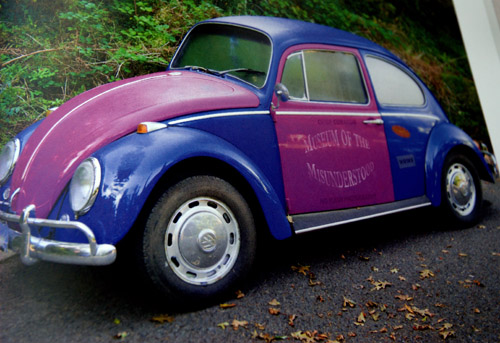
Sometimes a certain poignancy is revealed such as in the “College of Hard Knocks”: words superimposed on the driverside door of a rusting, abandoned, leaf-covered car. These are images meant to tell a story but in a quirky and “getting things a little wrong”-type way, says Hickman. OXIDE is a “collection of the misunderstood”, providing a pulchritudinous exploration of how the addition of words to a relatively commonplace image can provoke feelings and compel us to feel shifty, momentarily awkward, unsure or just plain pensive. You will see Hickman’s “Department of English | Classroom in a Box” (Hickman assures us the QR code on this absolutely works!) and you might concur with the author’s assertion that this work “relates to a consistency in the real world…and a level of comfort and recognition.” But at the same time, decidedly, and nostalgically, odd.
College of Hard Knocks from OXIDE
Misunderstood.
The handscripted phrases of color swarm though this book, relentlessly reminding us of what must relate to Hickman’s fascination with color, small bits, dimunitive pieces of information that contain volumes of meaning, digital-like, dare we say, even pixel-like. OXIDE falls in right along with Hickman’s one-book-every-ten-years pattern as this artist continues to delve into the complex and intriguing realm of combining and manipulating text, image, and thought. In OXIDE it is a computer program that hatched up the lines of paint chip fabricated color eloquence presenting it as simple lines of handwriting a deception that encourages us to question what we see, to examine what is put before us.
Small bits of information conveyed in a handwritten-like script.
Thus, the “ficticous” world author | artist Craig Hickman is so fond of exploring is created and we are so provoked as to scrutinize these pages—they are fascinating. Hickman who terms himself the “unreliable narrator”, has given us a murmuration-like experience with words. In OXIDE, Hickman’s fantasy world is as pretty as a picture, but with so much more meaning.
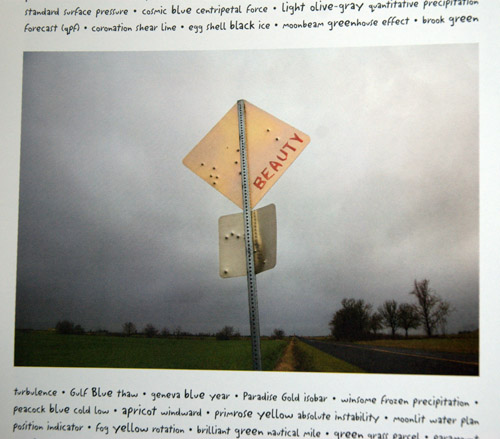
Is Hickman echoing Keats' "Beauty is truth, truth beauty..." Is that all we need to know?
The linear quality here ..... an OXIDE phenomena.
[Quotes in this article are from an interview with the author of this blog piece, Sabina Samiee and OXIDE author, Craig Hickman. Sabina is indebted to Professor Hickman for speaking with her about his new book.]
Craig Hickman is currently the primary professor in situ at the Portland location for the University of Oregon BFA Digital Arts Program at the School of Architecture and Allied Arts | White Stag Block.
He has said he will put a copy of OXIDE on view in the Library ….go check it out.
OXIDE
by Craig Hickman
Copyright 2011 by Craig Hickman
ISBN 0-9675894-0-3
DryReading Press
dryreading.com
Have a look around at some of Professor Hickman’s other projects on the following websites:
Get an in-depth introduction about graduate studies in architecture by coming to Grad Day at the UO Architecture Department’s Portland branch.
In Portland, University of Oregon connects Architecture students to professionals who are pioneering Eco-Districts, green buildings and design process innovation. Students can be immersed in sustainable communities where urban agriculture, composting, public transit and bicycling are the norm. They can work with national leaders in shaping how cutting edge-standards like the Living Building Challenge and Passive House can be applied to real-world situations. Instruction is at an advanced level as students arrive with basic architectural training completed at our main Eugene campus or other colleges or universities.
For those who are eager to change the world, our program gives the the concepts, examples and contacts to make it happen, in a supportive hands-on atmosphere. We invite potential graduate students to learn more about us in a special Grad Day open-house on Nov. 4, 2011 where we provide an in-depth introduction to the M.Arch. programs. Students will have the opportunity to learn about the curriculum, interact with faculty and students, then inspect design projects and facilities. The core activities occur 10:00am-2:30pm with lunch provided, additional touring and social opportunities follow. See draft schedule.
Plans to show Farsi’s work had been announced in January 2011 when Disjecta’s curator-in-residence, Jenene Nagy detailed her goal to present “risky, challenging work not usually found in mainstream museums or commercial galleries” with the selection of five West Coast artists. Nagy’s curatorial intent was to inspire regional conversation around contemporary art. The five artists Nagy selected show an immersion in the concerns and language of the contemporary art world.
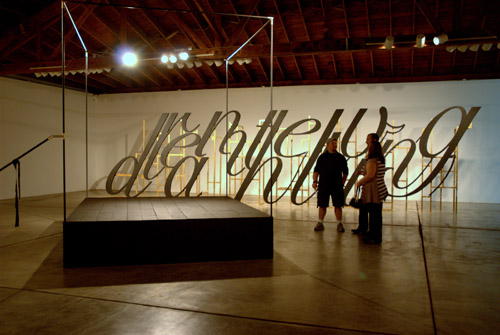
“Losing Themselves in a Distance to Far Away Heights” is Tannaz Farsi’s first solo exhibition in Portland. In the exhibit, Farsi addresses “what does it mean to live the dream?” from the Iranian, Canadian-Iranian, and Iranian-American perspective. Farsi asked her correspondants what it means to live the dream, their nationality, ethnicity and country of residence in hopes that something could be articulated through their answers that would address ideas of nationalism and cultural identity. Farsi also thinks that the idea of the American dream is complex; one marked by consumer culture, ideals of morality and normalcy, and the other of freedom to exist without constant state surveillance and yet another of component of Martin Luther King, Jr.’s dream ( a speech Farsi references in this work). She says, “Part of the lore surrounding the King speech is that Mahalia Jackson shouted out: ‘Martin, tell them about our dream.’ And, that part of his famous speech organically grew out of this request. I wanted to more show the dream’s complexity as well as the complexity of ethnicity and illuminate the fact that most of the people that have left Iran in the past 33 years fall under the category of exile or refugee.”
Farsi, herself an Iranian-American, conducted conversations via email with friends, relatives, and connections she was given by friends and family to individuals unrelated to her.
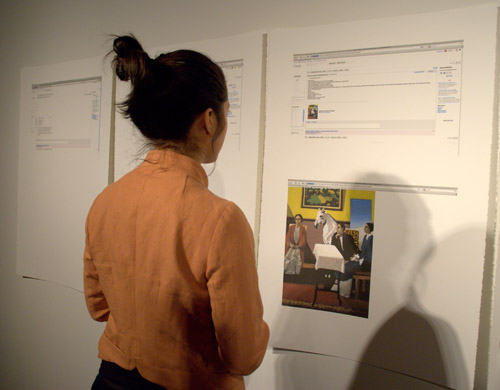
“The soul of that life is still with me…”–Gmail excerpt from Keyvan Mahjoor, Canada
A portion of Farsi’s exhibit is her record of communication, via gmail, with Iranians, Canadian-Iranians, and Iranian-Americans and their responses to her query: “what is ‘living the dream according to you'”? The Persian responses have been printed on large paper, the emails preserved in their original gmail form displayed poster size and hung side-by-side. Some emails are still in their native script beautifully left untranslated. One email is accompained by an image and words of the artist proclaiming, “I paint my dream and I live my dreams….” (Gmail excerpt from artist, Keyvan Mahjoor, Canada) The viewer is impressed by the simple eloquence of the writing: “the soul of that life is still with me….” and, “living my dreams means society respect me, my love, my privacy, and my need of freedom.” (Gmail excerpt from Shohreh Entekhabi.) Farsi says she was also using the gmail “to capture another form of tracking–to see what advertising suggestions would pop up in response to individual conversations.”
Tannaz Farsi seems to have a fascination for the relationship of objects as conflicting forces. That intrigue is well represented in “Losing Themselves….” The exhibit provides a compass directing us to gain a certain comfort in visually recognizable poem-like text that has been coupled with an elegant architectural and sculptural vastness occupying the reservoir-like space of Disjecta. Our vision of both the textual component juxtaposed with the structural staging reassures us with the familiar and challenges us with the unexpected.
“Living the Dream”
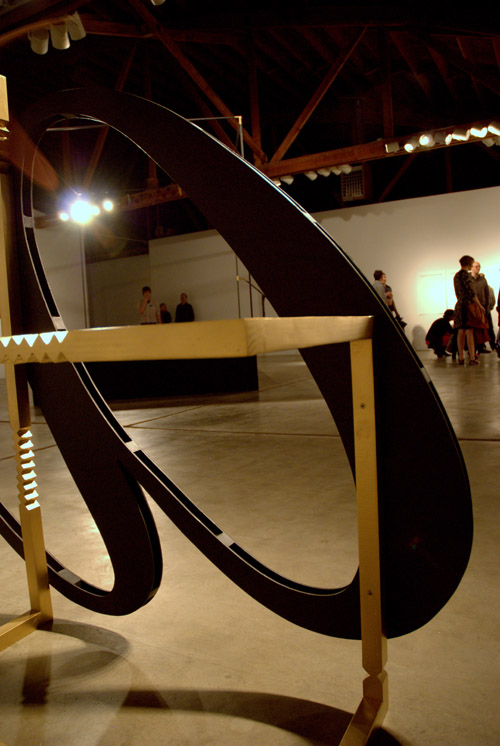
Farsi’s significant built installation curves and undulates in perfectly crafted cursive English words, so gentle and flowing in form yet the surface denies this soft delicacy with a tactile bite at once gritty, harsh and starless black. Farsi compels us to question the dicotomy of this pairing: it provides an attainable understanding with words and language we are familiar with and then snatches it away with a vastness and a jumbled complexity that leaves one struggling. Even the framework here, painted a gilt gold, is linguistically scaffold-like: how would one begin to surmount such skeletal casements? The shadows cast by this piece are just as entrancing from the front as from the back lending a voice to this persuasive sense of aching yearning, boundless struggle, and disappointment. It is a graceful statement of contemporary Iranian cultural experience.
The materials Farsi blends into her work are similar to memories echoing the very same sentiments her emails project to us: that which both represents the tension and binds felt by a refugee or an immigrant and the sense of lives left behind in a culture felt tangled in a civic and devotional experience.
Farsi adds: “[The pieces] are a scaled version of the kaaba and the colors of the letters and the cuboid are taken from the black and gold dictated by this structure. I was curious as to why this structure was covered, why it is a black cloth and the ritualistic associations to historical events. I came across the idea that this structure probably started as a tent with layers of cloth and I really loved what this would conjure. I was also interested in the actual site of mecca as one of the most privatized public spaces that exists today. ”
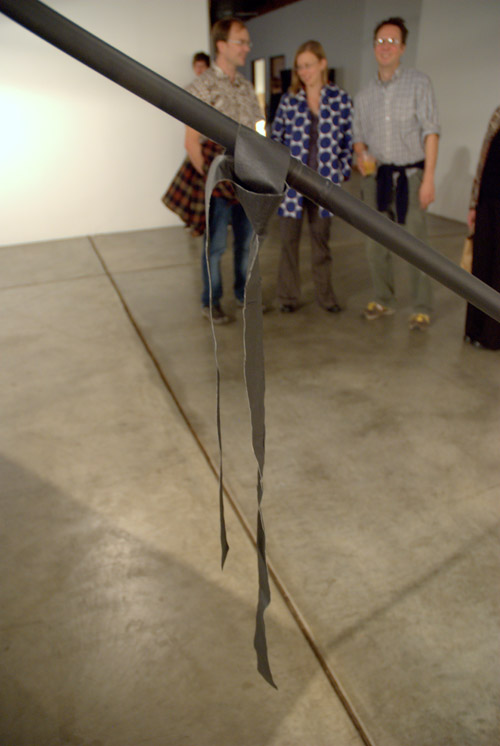
Concrete blocks, a tied ribbon-like tape, pipe, wood, paper, colors of gold and black taken as a direct reference to the kaaba—all adds to a sense of a culture left behind, an experience at once banal and yet quietly affording a glimpse through a portal to life “in a distance far away…”