Nudes and Nudities in Greek Art | A Lecture by Dr. Jeffrey Hurwit


© The Trustees of the British Museum 2012. All rights reserved

On October 28, 2012, Dr. Jeffrey Hurwit delivered his lecture, “Nudes and Nudities in Greek Art” to a public audience at the University of Oregon in Portland at the White Stag Block. Following his lecture, Dr. Hurwit led a tour of the newly opened exhibit at the Portland Art Museum, The Body Beautiful in Ancient Greece.  The lecture and tour were in collaboration with the Portland Art Museum and The Body Beautiful.


A world renowned expert in the field of ancient Greek art, Professor Hurwit had been asked by the University of Oregon in Portland School of Architecture and Allied Arts to lecture to a general audience and to focus on works of art on display in The Body Beautiful.

The Body Beautiful in Ancient Greece at the Portland Art Museum is an exhibit made possible by a collaboration with London’s British Museum. The exhibit, curated by Ian Jenkins and Victoria Turner, brings to Portland, Oregon what will be the only West Coast showing of the 120 objects usually on display as part of the British Museum’s collection of Greek and Roman art.

In what Professor Hurwit called “an extraordinary collection”, The Body Beautiful is an exhibit that has even managed to awe its curators with the striking majesty of its display at the Portland Art Museum.  Hurwit related hearing from the curator, Ian Jenkins that “‘Nowhere has this [exhibit] been displayed better than here in Portland.’ “  And, indeed, as Hurwit illustrated, taken together these works powerfully illuminate a breadth and depth of the Greek and Roman obsession with the human body.

Professor Hurwit’s lecture addressed specific works included in the exhibit and  introduced the topic of nudity in ancient Greek art as representational and containing differing meanings dependent upon context and the individual. Nudity, explained the professor is a costume used by Greek artists to depict a range of roles and connotation.   “In ancient Greek art,” commented Professor Hurwit, “there are many different kinds of nudity that can mean many different things….Sometimes they are contradictory.”

The content of the exhibit “speaks to us today” said Hurwit, and “reveals and celebrates our nature and physical being and bodies.”  Dr. Hurwit began by explaining how the pieces on exhibit in The Body Beautiful exemplify the ideals of the ancient Greek body.

In 440 BC the Greek philosopher, Protagoras wrote “man is the measure of all things.”  While much debate and discussion has surrounded this fascinating statement the general consensus is that judgments about qualities are subjective, truth is a relative thing, and the individual is the judge of all things.  To the ancient Greek mind, however, beauty was not relative.

Polykleitos Doryphoros. Image Courtesy of Professor Hurwit.

So comes the work of Polykleitos of Argos and his Doryphoros (made between 450-440 BC).  Polykleitos wrote a treatise on art called the Kanon and created the Doryphoros to demonstrate his theories.  The Kanon was based on the Pythagorean idea of symmetria, the notion that the parts of a form must have a proportional relationship to the whole, a mathematical formula that determines the perfect proportions of the ideal male body.

The Doryphoros is a study in contracts, in bent versus straight, right versus left, and in opposites.  Yet upon close study, all of these components are beautifully balanced in perfect equilibrium, right contradicts a flowing left, straight compliments bent, relaxed balances flexed, and stillness counters movement. This vision of highly charged repose collaborates to give the viewer a visual image of harmony.

The Doryphoros stands as a visual manifestation of the Greeks’ relentless obsession with structure and musculature, of the youthful male physique, and the male form defined by sharp lines and deep grooves counter-balanced with the exaggerated ridgey , almost-lovehandle-like quality of the hips (an interesting contradiction to the developed musculature of the rest of the form).  This is an idealized perception of what a man ought to look like.  It is the “perfect and the ideal,” a balance of curves and thick musculature.

But before the Doryphoros, Greek artists were producing Kouroi, those upright youthful males, perfectly idealized who blankly (except for that puzzling Archaic smile) and mindlessly stared past their observers and seemed to be all surface and restrained frozen movement.  The Kouroi and their neutral expression seemed to try to resist distracting the viewer by any indication of internal life of the mind.  Into this environment of  these Archaic era nudes, with their hands on their sides, left foot striding forward, arrived the Doryphoros and the impact was instanteous.

Even the marble sculptors working on the Athenian Acropolis began to alter their work—the youthful horsemen on the Panatheniac frieze of the Parthenon became more infused with movement, with the idealized and almost “Kanon”-like interpretation of the male body that we see in the Doryphoros. And, as Hurwit points out, it is an influence and a way of depicting the nude male figure that never really ends.  Just look at the Doryphoros-like stance in Durer’s the Fall of Man….

About a century after the Doryphoros was cast in bronze, a very different statue was made by Praxiteles of Athens.  Praxiteles was known for his depictions of the human body and for his figures’ elegant curved poses, relaxed appearance and a unique softness.  His Aphrodite of Knidos (330 BC) work stands as an innovative approach to the depiction of the female nude and set a precedent for the “ideal woman.”

For the most part, female nudity in ancient Greek art was unacceptable, shocking and somewhat revolutionary. As Professor Hurwit related, Praxiteles made two of these Aphrodite statues, one clothed, one nude.  One island, Kos purchased the dressed figure; the nude statue was bought by the island of Knidos.  The impact of this nude female figure, as Hurwit states, was “immeasurable.”

In the history of Greek art, the female form had previously been depicted with sparse detail or was clothed, in such pieces as the Folded Arm Figurines or the full-skirt wearing, bosom-bearing snake-goddess or abstractly on the surfaces of vases [Hirschfeld Krater, Athens, 990 BC].  And so begins what Dr. Hurwit refers to as a “double standard.”  The male body could be revealed but the female body would remain relatively hidden, clothed, abstract or only vaguely referenced.

And, of course, Greek artists were well versed in creating Kore or Korai, the definitive female representation.  Korai were always clothed, youthful, standing with one leg forward females.  When a female was depicted in the nude it was usually to denote slave girl, courtesan, or “call girl” status.  There existed a general banning or unacceptance of the female nude in most works, however, a notable exception existed in the depiction of the female nude in sculpture, for example with a work showing Apollo flanked by a nude Leto and Artemis [Relief from a temple at Gortyna, Crete, circa 640 BC].

With the study of the development of the nude in ancient Greek art, it is important to realize that Ancient Greece was not culturally homogeneous.  What was happening and acceptable in Athens, might not have been in Sparta, nor Crete.  However, it is Athens as a cultural center that helps us define the period from 600-340 BC.  From this era and a study of the works of art produced during this time, we can deduce that it was pretty much taboo to depict the female form naked.  Women, in art, are generally covered head to toe.

But in order to break through this taboo and this resistance to showing the female form au naturel, the artist, Praxiteles was very clever and thoughtful—he realized the necessity to create a narrative in order to justify the depiction of nudity.

Praxiteles’ Aphrodite of Knidos is shown bathing, modestly covering her pubis and blithely unaware of our presence.  We are in the position of approaching her, she knows not that we are there, watching her.  We are put in the position of voyeur, or voyeurese; we become the ones to blame for violating her privacy, seeing her in a compromising position, watching her while in the nude.

Voyeurs paid a heavy price in ancient Greek times.  Seeing a god or goddess without permission or consent or their knowledge was considered an anathema:  the violation would not go unnoticed nor unpunished.  The irresistible erotic power and sexuality of this statue was what lured viewers and made them its voyeurs.  A person approached this piece at his, or her, own risk (stories have been told of young men unable to resist the powerful sexual allure of this Aphrodite succumbing to and physically acting on their lust, and subsequently going mad, later throwing themselves from cliffs. )

The Aphrodite of Knidos was a liberating work as it essentially paved the way to release a torrent of female nudes and precipitated the onset of an acceptance of female form in Greek art as never before.  We see works like the Venus de Milo that explore how the addition of fabric can add a sensual layer to our view, enhancing the form within.

Suddenly the female form, post-Aphrodite of Knidos begins to experiment with a sense of allowable depictions that seem to encourage a sensual and sexual appreciation of the female form.  A winged Nike approaching Athena on the Temple of Athena Nike is in a full length clingy, dress-like garment, her body beautifully revealed by every thin fold of what must be a soft, flowing diaphanous fabric.  Curves of breasts and thighs seem almost celebrated beneath waves of revealing fabrics that cascade in anatomy clinging sensuality.  Dresses fall off bodies, and while these females are not completely naked, they might as well be—the sensuality and hedonistic visual we are given is nothing but entirely effective.  And, so the progression takes us from a cold, column-like hard, shaft clothed Kore to a new female nude defined as something almost always sensual, draped in folds and poses that accentuate her curves and softness. She bends to adjust her sandal.

The male nude remains another story and a much more complex one, at that.

Greek men strode about in the nude in private bedrooms, and at parties called symposia, sort of aristocratic drinking parties, if you will.  In the public sphere, male nudity was limited to the bathhouses, and the athletic games or gymnasia.  There was also the erotic nudity element in artistic depictions of homosexual and hetereosexual, both youth and adult liaisons—art limitating life, and vice versa.

In some cases, partial nudity of woman and girls was acceptable in the athletic games. In the Games of Hera, where virgins competed, females competed with one breast exposed but otherwise wearing a tunic. Hence, for the most part, full nudity was the privilege of men.
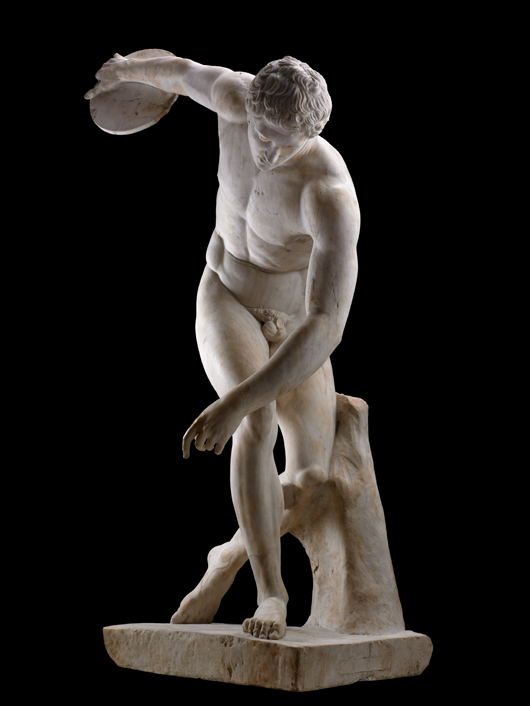
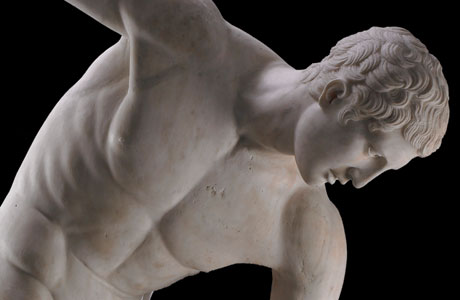
The Townley Discobolus. © The Trustees of the British Museum 2012. All rights reserved.

One of the centerpieces of The Body Beautiful exhibit, the Myron Diskobolos illustrates the aspect of nudity in athletics in ancient Greek art.   This nude body certainly asserts the beauty of the body and shows us an example of what is beautiful also being equated with what is good.  And, brings us further into our discussion of nudity in Greek art as having many different forms and meanings.

We have seen nudity with the male form as a way to define and show perfection and the ideal human form.  Nudity is also a custom of the gods, and therefore, a costume worn by god-like men.

The greatest of all civic heroes, we can say, is Pericles.  And our model of a hero par excellence, Theseus.  When we see these men depicted in the nude in war or battle, we can acknowledge that their physical prowess is being shown-off; but going into battle naked was not realistic, highly dangerous, and not the best way to fight.  Yet depictions of nudity in these battle-scenarios symbolizes an elevated and exhalted status, showing a sense of impending victory and courage, and of physical power.  This is “heroic nudity.”

We also see examples of “political nudity”—where political heroes are shown in the costume of democracy.  The removal of their clothes effectively distinguished them as “great leaders” and physically fit leaders in the political realm.

“Civic nudity” with the heroes as citizens (such as two brothers, The Tyrannicides, Harmodius and Aristogeiton, who plotted to murder and over throw the Peisistratid tyrant Hipparchus) are depicted in statuary nudes as heroes of the state, in a willingness to shed all, to trust all and to exemplify “democratic nudity.”

Common laborers can be depicted nude, as well.  Shown naked, their sweat and muscles revealing how hard they work.  Even nudity is used to show age from youth to the elderly: one nude illustrating the fresh, strength and slenderness of youth to the other revealing the sickness and weakness possible with the dead, dying and aged.  But both show us a vulnerablility, a fragility, if you will,—one of the young, one  of the old.

Nudity can give us a glimpse of suffering, defeat, and impending death as we see in Ajax as he prepares to throw himself on his own sword and take his own life: he is the fallen, isolated, tortured hero as nude.  [Black Figure Amphora, The Suicide of Ajax, Greek, 540 BC.]  Perhaps “pathetic nudity.”

We see a full frontal of a nude Cassandra in a Red Figure Hydria, [Naples, Kleophrades Painter];  or a naked Hector bound to Achilles’ chariot…both strong and emotional depictions of nudity.  [Attic Hydria, Achilles Dragging Hector, 520-510 BC.]

And, this brings us to the concept of the difference between sexual nudity, soft nudity, nudity for nudity’s sake and actual nakedness, as well as the comparison between male and female nudity.  Nudes and nudity in Greek art do not always divulge the same connotation or meaning.  We have the presentation of nude versus clothed and the revelation:  there is much more to a Greek nude than just perfect flesh and “heroic nudity.”

Following his lecture, Dr. Hurwit led a public tour of The Body Beautiful at the Portland Art Museum.  His tour continuing and illustrating points made in his lecture, provided insightful scholarly commentary on numerous works in the exhibit including the many iconic marble and bronze sculptures, vessels, and funerary objects most coming from the second and third millennium BC. For more information on the exhibit at the Portland Art Museum please refer to, The Body Beautiful.

[This article is a brief summary of the lecture Professor Hurwit gave on October 28.  A full recording of the lecture will be available shortly and will be linked to this article.

We extend a sincere thank you to Professor Hurwit for his lecture, Nudes and Nudities in Greek Art and his tour of The Body Beautiful in Ancient Greek Art.   Also, many thanks to the Portland Art Museum for their cooperation and assistance with this event.]

About Dr. Jeffrey Hurwit: Dr. Hurwit has degrees in Classical Languages and Literatures from Brown University and a Ph.D. in Classical Art and Archaeology from Yale.  He has taught at Yale, subsequently joining the UO faculty in the History of Art and Architecture.  He holds a co-appointment in the Classics Department and holds a Philip H. Knight Professorship.

A leading scholar of the archaic and classical periods in Greek art, Professor Hurwit has appeared in major documentary films and lectures at the world’s top universities, museums, and archaeological institutes.  The recipient of many prestigious awards, including a Guggenheim Fellowship and the University of Oregon’s Faculty Excellence Award,  Professor Hurwit is the author of many works on the art  and civilization of Archaic and Classical Greece. Among his many influential publications that are regarded as standards in the field, his recent book, The Acropolis in the Age of Pericles is considered the definitive work on the subject.

Professor Hurwit regularly conducts research in Greece and Italy, and has been selected four times to teach in the Northwest Council for Study Abroad programs in Siena and Athens.  He has spoken widely across the United States and Canada and has also served three times as a study leader for Smithsonian Institution tours of Greece and the Mediterranean. In 2000, he was appointed to the prestigious Martha S. Joukowsky Lectureship for the Archaeological Institute of America, and in 2003 became the inaugural Dorothy Burr Thompson Memorial Lecturer at University of British Columbia. He has also served on the editorial board of the College Art Association’s Art Bulletin and on the Publications Committee of the Getty Research Institute.

Professor Hurwit is also currently working on Palaeolithic cave-painting in addition to his studies in ancient art.

Read one of Dr. Hurwit’s articles on this subject, The Problem with Dexileos: Heroic and Other Nudities in Greek Art.

.
 

Picnic at John Yeon's Shire with Randy Gragg of Portland Monthly and Robert Melnick of University of Oregon

On July 15, 2012 Randy Gragg, editor-in-chief of Portland Monthly magazine and Robert Melnick, director of the Yeon Center, co-hosted Picnic at The Shire. The Shire is a 75 acre property designed by and formerly owned by John Yeon, one of the Northwest’s most celebrated designers.  Completed in 1989, it is in a style reminiscent of an 18th century English landscape garden.

Picnic at The Shire was a benefit to raise funds for the Yeon Center at the University of Oregon. The Yeon Center owns The Shire in addition to Yeon’s Portland-located Watzek House, and Cottrell House. After Yeon died in 1994, The Shire was donated in 1995 by the John Yeon Trust, the Watzek House the same year by Richard Louis Brown, and the Cottrell House in 2008 from the Cottrell family.  The University of Oregon took full responsibility for the Watzek House in 2010. Yeon Center director, Robert Melnick notes,

“The Yeon Center provides a great opportunity for students and the general public to understand not only John Yeon’s extraordinary work, but the importance of regionalism is design. John’s work – whether in architecture, landscape design, environmental activism, and furniture making – was inextricably tied to the Pacific Northwest.  He understood the essential integration of those efforts.”

Melnick goes on to illuminate the responsibilities and role of the Yeon Center,

“The properties under the responsibility of the Yeon Center provide us with a unique opportunity to practice the best preservation efforts, and to teach those to our students.  At times, this includes long-range preservation and conservation planning, while at other times it requires immediate responses to pressing problems that any homeowner or property owner might have, such as minor leaks, or plumbing or heating issues.  Our goal is to complete these projects using the very best and very latest preservation principles and practices, thereby ensuring protection of the properties for generations to come. It is truly an honor to be able to care for such remarkable and important places.”

Tours of The Shire were held throughout the mid-July weekend. Together with the tours, Picnic at The Shire was a collaboration between Randy Gragg’s Portland Monthly magazine and University of Oregon School of Architecture and Allied Arts. In a generous gesture of support and collaboration, Portland Monthly and Randy Gragg are donating all proceeds from the weekend to the Yeon Center.

Frances Bronet, Dean of the University of Oregon School of Architecture and Allied Arts responded to this collaboration observing,

The Yeon Center can be seen as a leader connecting those extraordinary visceral experiences specific to the Pacific Northwest, and epitomized by Yeon’s work…connecting elements of the built and transforming environment.  Taking on both Robert Melnick’s and Randy Gragg’s charge to both steward the intersection of landscape and building, as well as inspire a seamlessness of beauty and ecological care.

When asked to comment on the collaboration, Melnick expressed gratitude to Gragg and the Portland Monthly connection.

“Portland Monthly, and especially it’s editor-in-chief Randy Gragg, have been great supporters of the Yeon Center’s efforts to expand the knowledge and appreciation of John Yeon’s pioneering effort, both at the Watzek House and The Shire.”  Melnick continued,  “Randy has been especially generous with his ideas and initiatives.”

What follows is the story of the event, a glimpse into what was a truly amazing evening. 18th century poet, William Mason wrote several works about the wonder of the English landscape garden and was influential in advancing the idea of the picturesque in a landscape.  His sonnet below begins our discussion of Yeon’s Shire, as it sets the stage for our foray into a landscape design philosophy that is both “liberal though limited, restrained though free.”

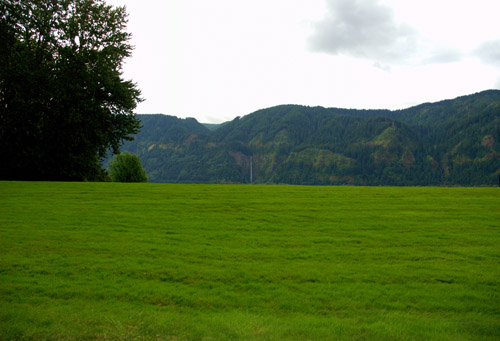
John Yeon's Shire, Columbia River Gorge, view from southwest facing amphitheater feature.

Smooth, simple path! Whose undulating line,
With sidelong tuffs of flowery fragrance crowned,
“Plain, in its neatness,” spans my garden ground;
What, through two acres they brief course confine,
Yet sun and shade, and hill and dale are thine,
And use with beauty here more surely found,
Than where, to spread the picturesque around,
Cart ruts and quarry holes their charms combine!
Here, as thou leads’t my step through lawn or grove,
Liberal though limited, restrained though free,
Fearless of dew, or dirt, or dust, I rove
And own those comforts all derived from thee!
Take then, smooth path, this tribute of my love,
Thou emblem of pure legal liberty!

— A sonnet by William Mason, from The Oxford Book of Garden Verse, reprinted in Perspectives on Garden Histories


The July 15th mid-summer afternoon spread out upon John Yeon’s Shire with a myriad of weather possibilities. Glorious Gorge sunshine was tempered by billowly, smoke-gray clouds reaching into shades of navy, while a soft breeze blew that anyone with Gorge-savvy knows could switch to gale force in minutes. Roughly a half hour drive eastward on Highway 14 out of Washougal, Washington, The Shire is carefully tucked away behind a screen of thick forest and a lone, single bar metal gate. This modest entry draws you down a path-like driveway that winds its way brushing by lush bracken, below cathedral canopies of tree foliage, and along surprise reveals of capricious meadows, streams and ponds. Anticipation for what awaits builds. This suspense yields to curiosity as the driveway, with a Gorge-like windy rush, gives way to an expansive lay of grass, an elevated horizontal berm.  In almost art historical text-book form, and in a brilliantly planned moment of design genius, a ground line is formed by the top of this berm catching Multnomah Falls, a small perpendicular vision far away across the Columbia.  Walking to the top of this knoll and captivated by the view, remembrances of  English poet William Mason’s  “one ample theatre of sylvan grace” (English Garden:  A Poem in Four Books, Book 1, line 548, 1786) comes to mind, an essential feature of the 18th century English landscape garden. Into this autochthonous scene (a term used to describe indigenous aspects of the 18th century English landscape garden), The Shire is a landscape garden furnished with countless features of a natural landscape only one of which is this first introduction to the theater.  The “amphitheater” [from Gragg’s Portland Monthly article, The Long View] is  an en plein air setting, a strappingly thick arc of land inviting the river to smoothly swirl in and approach visitors. This is your first indication that The Shire will unfold like a painting, gloriously saturated with Arcadian charm, a place where reality and the ideal seamlessly blend.

A ground line is formed by the top of this berm catching Multnomah Falls, a small perpendicular vision far away across the Columbia.

This afternoon, The Shire looked nothing short of basking in promise—freshly primped and trimmed. I arrived expecting greatness, and was greeted by Randy Gragg, co-host of the Picnic; I was also welcomed by a bustling staff from the Art of Catering who were fully mobilizing to create the fabulous evening meal. Bouquets of fresh flowers, bottles of uncorked wine, and the epicurean smells of what lay ahead made it clear no stone had been left unturned, this was definitely about to be an extraordinary event.

Gragg wandered off to, as he put it, “get reacquainted” with nearby recently mowed walks and I got the distinct feeling he was in a nostalgic mood eager to enjoy a landscape that to him was like an old, dear friend. Somewhat pleased at being left alone, I turned my attention to the swelling knoll of green laid out before me.

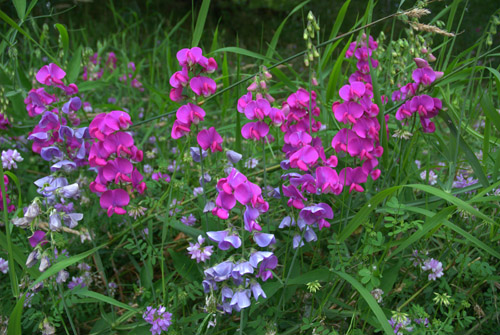
Under the afternoon’s tenuous skies, presided over by Washington’s craggy south-facing basalt-striated precipice and Oregon’s north-facing Gorge cliffs down which cascade the misty Multnomah Falls, a bashful Bridal Veil Falls and delicate wispy of a falls with a name I do not know, sits The Shire. As a landscape, The Shire appears quiet, calm and self-assured. Its prominent features available to explore via politely trimmed paths and a kind consideration to all blooming plants. Equal prominence is given to the lace cap baby blue hydrangea as is to the wild sprawling hot pink sweet peas. Every growing thing has space to express an individual beauty. The prevalent sense was that Yeon had an appreciation for nature’s habit of embracing variety, excess, and a lovely sense of balanced disorder.

Equal prominence is given to the hydrangea as to the wild sweet pea.

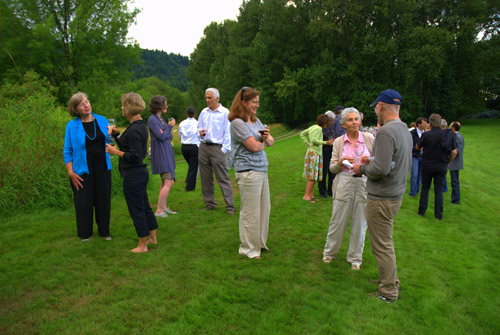
The curving composure of The Shire’s most prominent feature, that gorgeous arcing riverbank lies almost as if in wait, comfortably content to be rediscovered, to be appreciated for its languishing splendor. This was four o’clock in the afternoon. Within the next hour and as the sun played with the idea of appearing and disappearing, about 70 guests, would arrive to converge on this pristine riverbank and experience The Shire, many discovering this place for the first time.

The gorgeous curve, a strappingly thick arc of the amphitheater.

There is an important heritage to The Shire site that helped propel guests to attend the exclusive event. Gragg describes it as “the heritage of everyone who enjoys the Gorge.” Taking his cue from the women of the Portland Garden Club who originally gathered for the first Yeon picnics at The Shire in the 1980s (organized to garner support for the Columbia River Gorge environment), Gragg conceived the idea of the Picnic event and initiated the attendance of seven of those original PGC women who had been part of that first “Committee to Save The Columbia River Gorge.”  Gragg comments, “it’s imperative to bring these kinds of histories to life….in a phrase, [Picnic at The Shire] was a celebration of elders.” It had been these women supporters who two decades ago would come to play a key role in ensuring the Gorge would thrive. Gragg describes this group of conservation activists as, “the proto-version of Friends of the Columbia River Gorge.” This afternoon, Mary Bishop, Susan Bodin, Nancy Frisch, Betsy Smith, Marie Hall, Dottie Schoonmaker and Pat Wall were the esteemed seven. Their participation substantially enriched the evening’s conversation.


A celebration of elders....and all guests.

Among others in attendance were Anthony Belluschi, son of Yeon contemporary, Pietro Belluschi, (another true Oregon luminary); Brian Ferriso, director of the Portland Art Museum; Zari Santner, former director of Portland Parks and Recreation; Tom Manley, president of Pacific Northwest College of Art; Kate Wagle, interim vice provost of UO Portland and director of the UO School of Architecture and Allied Arts in Portland; and landscape architects Doug Macy and Steve Koch; not to mention newcomers and outliers such as brand consultant Chris Riley and venture capitalist Steven McGeady. Everyone was particularly thrilled to see Lewis MacArthur, editor of Oregon’s Geographic Place Names.


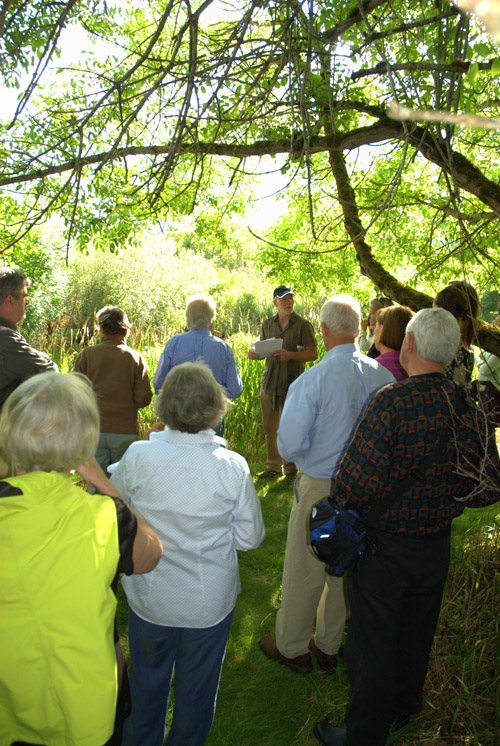
Randy Gragg leads a tour of The Shire.

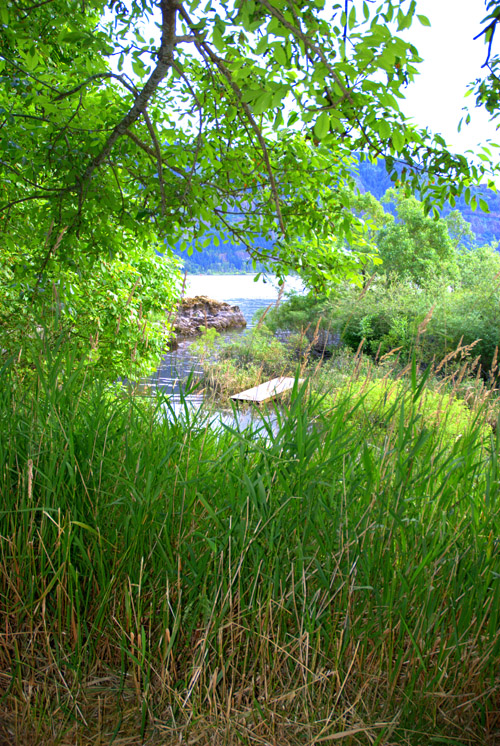
With the guests having arrived, we turned all attention to our guides, Randy Gragg and Hannah Bryant, current Yeon Center graduate teaching fellow.  I was allocated to Gragg’s group and so we moved in the direction of the setting sun finding ourselves on a path that ended with a curving tree branch right at eye level and a surprising view directly behind of the river, a yellow floating bridge and a creek gurgling into the vast Columbia. We were introduced in that very moment to Yeon’s captivating penchant for ‘garden folly’….and as the group collectively became mesmerized by this clever manipulation of our view, Gragg began to enlighten us.

A surprising view of the river.

Gragg explained Yeon’s sensitive touch that brought to the landscape a sense of the “inverted picturesque” and a wistful “nostalgia.” Experimental in carefully and subtly diverting streams to create creekside walks that culminate in viewpoints, Yeon has given us a place to pause and notice the natural: places Gragg refers to as “the follies,” reminiscent of the term “folly” as it applies to a traditional English landscape garden, a feature within the landscape used primarily for decoration.  At The Shire Yeon shaped the land with less-than-delicate tools, a bulldozer, a chainsaw, adding plantings along the way.  But even with these machines of modernity and ruggedness, Yeon’s vision created a picturesque landscape and elevated natural, not architectural, features to the status of folly.

"An ode to the Gorge."

Each thoughtfully crafted peek of waterfall or framed vista of landscape, is an “ode to the Gorge,” continued Gragg. In other words, this is a garden where each view confides an aspect of enlightenment and wisdom. If we are to examine The Shire as Yeon intended, we need to look at this, suggests Gragg, as “a metaphor for how Yeon thought the Gorge should be treated.” Gragg gently prompted us to see in these crafted spaces, open to the sky, a testimony and appeal for the care and consideration Yeon so desperately longed to happen for all the Gorge. Yeon’s mission, Gragg pointed out, was to ask Portlanders, and beyond, to think about the landscape as a canvas that if painted upon needed to be done so with great consideration and thought for both what would be changed and what would remain untouched.

Gragg continued explaining Yeon’s theory: “if you are going to touch the land at all you need to design it.” Yeon’s great aspiration for his Shire was for this landscape and the Gorge to be a national park. But this dream proved quixotic as Gragg touched upon: the Washington side of the river would remain more about industry not environmental preservation.

As our little group walked, commented, and wondered aloud, Gragg talked, encouraging and responding to individual questions with the knowledge and expertise given to him by his connection to the designer and years spent lecturing and writing about Yeon. Gragg painted a vivid picture of Yeon, the consummate gentleman, intellectual, handsome, with piercing blue eyes, a striking figure. The vision was one of the slightly eccentric, English country squire-like, educated, creative, outspoken but reserved, appreciative of his surroundings, an arts and culture partisan able to appreciate the unusual as well as the commonplace; and to embrace both Western and Eastern cultures, (Yeon called the Columbia River Gorge “my Chinese landscape”).

"Yeon's design was very much about compression and release," said Gragg.

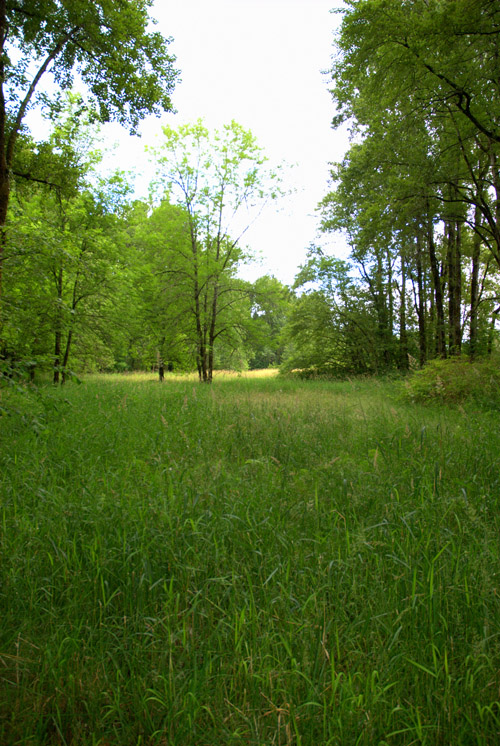
With a new understanding of the person that was Yeon, Gragg prompted us to move on to new discoveries in the landscape. Stopping at a small meadow, Gragg gestured to the flaxen colored grasses and turned to address Yeon’s design aesthetic. “See,” Gragg explained, “Yeon’s design was very much about compression and release.” First, we are suppressed by a Tolkien-like forest-winding walk heavy with trees overhead and dark with overhanging foliage, and restricted light;  then we are liberated by a flowing meadow expansive in all directions. As a comprehensive work of art, The Shire shows a sense of liberty balanced by a sense of restraint;  perhaps providing a moral stage as if to lecture on the story of preservation and conservation.

"The folly is the falls."

Gragg concluded his tour by leading the group into yet another meadow, this time we stood expectantly ready to admire the beauty of the simple, vegetation-surrounded, circular meadow. But, in customary Yeon form, we should have realized there would be so much more. Gragg said to us, “Now if you would all turn around,” he cast his gaze behind us. Turning to the south, we saw a well-trimmed, tall and precariously narrow key-hole parting of the trees revealing a perfect view of Multnomah Falls clear across the river—a long view to the Oregon side of things and an insightful opening up of the possibilities and relationship between both sides of the river. Showing us this snipet of perfection, the last piece of The Shire completed in 1989, Gragg quietly declared, with a nostalgic smile, “The folly is the falls.” And as numerous smartphone cameras were raised by their holders in silent capture of this last meaningful drama of The Shire, we were confronted with the realization that this precious resource is fragile, in constant need of well-planned maintenance and care if Yeon’s painterly vision is to be sustained. Indeed, it befalls upon us as guardians of our great Northwest environment to recognize Yeon’s contribution and keep it as he would have wished, as he was the ultimate caretaker with purely selfless visions for the Gorge. Yeon was instrumental in forming this priceless painting of his Columbia River hideaway, it is has been trusted to the Yeon Center to preserve and protect.

A long view to the Oregon side of things, a relationship between both sides of the river.

I discussed future of The Shire with a few of the original garden club women looking to discover their thoughts about the landscape. Some remembered it differently than it was today. Having picnicked in this landscape years ago and having a sense of the nostalgia for the place, the original group expressed great affection for the memory of Yeon’s touch on the landscape.  Yeon’s own keen aesthetic sense guided the clipping, pruning, and cutting that cultivated this place and that might be lost forever without listening to those who have experienced this place in its prime. One woman commented with a bit of melancholy, that she recalled how Yeon used to mow the grass so as to produce a beautiful woven pattern in the cut lines. She hoped this would be remembered and done again; it was the little details that seemed to matter the most in the memories of The Shire’s early days.

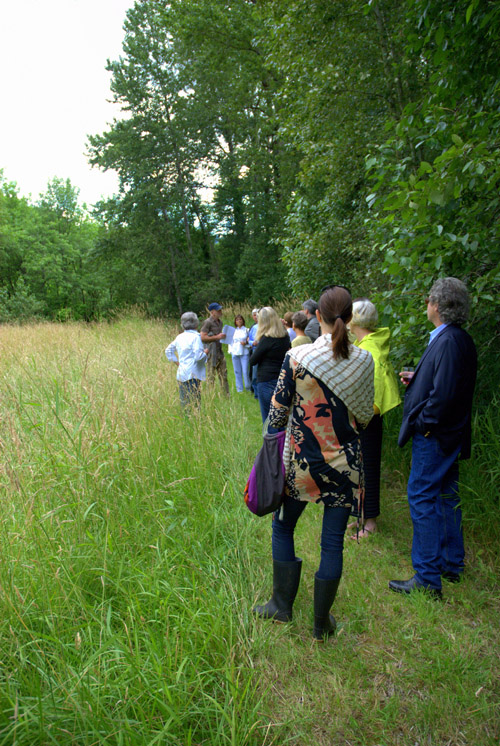
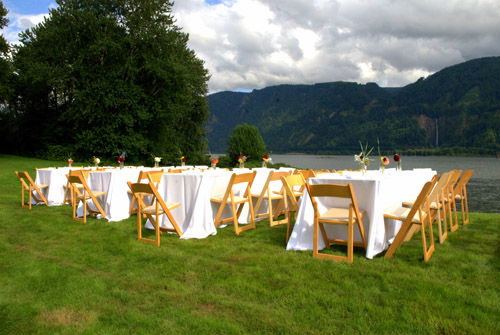
Guests at Picnic at The Shire, July 15, 2012.

Our evening wound down while the river played catch-up with the sea, the sun played hide-and-seek with a heavenly cumulus, and a few drops of rain nourished The Shire’s flora and fauna.  The privileged guests of the first Picnic at The Shire, 2012 sat down to dinner at white-clad tables, the clink of cutlery and dishes, and the warm tones of content conversation filling the balmy evening.

As guests enjoyed the beautiful meal, merely across the river, and barely audible on The Shire side, the hum of summer traffic on I-84 was an inescapable reminder of the fight Yeon had led to transform the highway department’s planned straight, rigid road to curve and flow with the contours of the river, being ever respectful to the existing river path. Due to Yeon’s efforts, the road that exists today is much more sensitive to the river’s countless years’ journey carving out a path of least resistance.

Part of Yeon’s vast creative genius lies in his acute awareness of what it takes to get us to stop and notice a simple framing of a scene that reveals information about a place. The Shire’s vistas of far-off waterfalls, panoramas of meadows, hobbit-like wanderings through lushly mysterious forest—these are all features shown to us in enchanting ways, the “follies” of Yeon’s landscape. When you visit The Shire these vistas of pure brilliance and escape are, like Gragg so aptly describes, a landscape of “compression and release” with focal points designed to inform.  The Shire is where Yeon in his craft and artful ways, with great enlightenment but never missing the drama and the magnificence, and like William Mason’s garden sonnet, always “liberal though limited, restrained though free” shows us just how great this place is. The Shire is one of our region’s finest treasures, a garden, “the purest of human pleasures; ….the greatest refreshment to the spirits of man.” [William Mason, English Garden: A Poem. In Four Books, 1786].

Taking the quips and conversation overheard from the original seven supporters, the Shire, might even be said to have offered similar enchanting sights and smells on the July 15 Picnic that it had each day, of each season since 1989—just enough to evoke the nostalgic conversations of the garden club ladies, and, indeed, that of our tour guide as well. Yeon was an impeccable expert on this tutelage of the natural, and sensitivity to the environment.   So beautifully does he guide us to awareness, compassionately revealing that sometimes nature has to be sculpted, crafted, or framed in such a way as to be put on display. The Shire is a sanctuary of crescent river banks, flourishing meadows, meandering footpaths and charming reminders of how to appreciate the magnificence of nature. Into this landscape,  Yeon’s legacy seems carried on the winds of the Gorge, with the potential to be either fleeting or strong and steady. We can wonder how it used to be those 20+ years ago when Yeon invited his first, and perhaps most influential guest, Nancy Russell to the evening picnic that launched a wave of conservation effort [read about Yeon’s connection to Nancy Russell and his Columbia Gorge preservation efforts in The Long View]. Does the river smell the same wet, sweet earthen? Did the ospreys glide overhead on river drafts?  Did similar soft breezes explore the Gorge’s craggy cliffs and the same robust green of freshly cut grass infuse the air?  The same grasses growing that once supported the Persian rugs laid down to comfort Yeon and his picnic guests? Were the liberating spaces in the trimmed trees as wide, as long, or perhaps even more revealing?  What can we do to ensure this places thrives yet remains true to Yeon’s vision?  With the existence of the Yeon Center,  we have the ability to recreate, or as Gragg encourages, to revive the Yeon aesthetic and keep it pristine. I asked Gragg to comment on the need to plan, preserve and protect The Shire and the existence of the Yeon Center as a vehicle to make that happen.  Gragg said,

“The Yeon Center is very much a work in progress. Robert Melnick did a great job of landing the properties, figuring out how the university could be stewards, and getting the Watzek House listed as a National Historic Landmark. Programming is the obvious next step. I think there are two questions: how does it enrich the university community and AAA’s pedagogy? But also how can it inspire the region? Every fiber of John Yeon’s will was devoted to designing and advocating for Oregon’s beauty and sustainability—two words that, to him, were synonymous. That seems like a mighty fine mission statement for some organization because, right now, none exists. Maybe its the Yeon Center.”

The meadow beneath Washington's craggy south-facing basalt precipice.

The University of Oregon’s Yeon Center has in Professor Melnick and Randy Gragg invaluable resources and champions of all things Yeon.  As Dean Frances Bronet commented, the Yeon Center “[takes] on both Robert Melnick’s and Randy Gragg’s charge to both steward the intersection of landscape and building, as well as inspire a seamlessness of beauty and ecological care.”  Through the Yeon Center, both Melnick and Gragg have made a significant difference in educating the public and academically oriented university students about Yeon’s legacy and have successfully worked to keep this highly creative design genius in an Oregon, and, indeed national spotlight.

During his years as an art and architectural critic and, now as Portland Monthly editor-in-chief, Gragg has magnanimously devoted great quantities of ink to championing Yeon as an icon of the Northwest designed  environment. In seeking to open our eyes to Yeon’s design philosophy and aesthetic, Gragg effectively has helped to preserve and promote key Yeon spaces and places consistently reminding his audience that Yeon has had an incredible positive impact on our region that can continue if we are educated of Yeon’s work and legacy.  Gragg met Yeon in 1992, visiting both The Shire and the Watzek house with Yeon as his tour guide and confidante.  The respect and admiration Gragg feels for Yeon and the understanding he has for Yeon’s design aesthetic is nothing short of impressive and translates well in Gragg’s lectures, writings and, indeed, heartfelt remembrances of Yeon, both in general fact and anecdotal detail.  Perhaps a meeting of mutual admiration, the Yeon and Gragg camaraderie established in those early visits, seems destined to help preserve Yeon’s fundamental greatness and lasting heritage.  In Gragg, Yeon would connect with an empathetic and attentive listener and gain the attention of someone passionately devoted to sustaining and understanding Yeon’s significant contributions to the Northwest region. Gragg comments about his initial 1992 meeting with Yeon and his involvement with the Yeon Center,

“I became fascinated with [Yeon’s] work and story—and increasingly over the years with his lesser-known early work in planning and his life-long behind-the-scenes advocacy for landscape design and historic preservation. I’ve written and lectured about him numerous times over the years. I served on advisory board to the Yeon centers at UO for two years.”

Well-connected and well-informed, Randy Gragg is in a springboard position to advocate, promote, and educate, not to mention connect and network for topics he feels are of relevance to this region.  With his commanding post at Portland Monthly, and with the significant distribution of the magazine to an enthusiastic and receptive audience, Gragg found he could truly make a difference in providing information about our history, our icons, our places, and our community. Appreciating this opportunity and with a willing publisher, Gragg realized an occasion to offer to partner with the University of Oregon to help benefit the Yeon Center and bring his passion for Yeon advocacy to a broader audience.  It would be a collaboration that would educate his PM readers about something truly special in their environment, something of great relevance to Gragg, himself,  and help solidify the well-deserved place of Yeon in Northwest history and culture, not to mention financially benefit the Yeon Center, all Picnic proceeds going to the center. The UO Portland Monthly collaboration has helped to increase knowledge and awareness of Yeon’s work and reached out to embrace an hospitable, and new, perhaps younger audience.  It was by no means a coincidence that the Picnic event arrived shortly after Portland Monthly released an issue focused on the Columbia Gorge featuring an article written by Gragg on John Yeon and specifically addressing The Shire, (see The Long View).

As Gragg explains,

“When we have opportunities, I like to extend [Portland Monthly’s] content into the world by inviting people to experience the places we write about. What better match to a cover-feature on the Columbia Gorge and the role the Shire played in its preservation than tours and a dinner at the Shire!”

I asked Robert Melnick to offer a comment on the Yeon Center as a closing to this post looking both to the future and to the past, and in the words of Randy Gragg, across the river to the long view:

“The dinner on July 15 was just one example of the work of the Yeon Center.  The Center has a primary responsibility to protect and preserve the Watzek House, The Shire and the Cottrell House, but also to educate others about these remarkable designs.  We do this first at the University of Oregon, for students studying architecture, landscape architecture, interior architecture, product design, art, and historic preservation, through tours, lectures and publications.  We also open the Watzek House and The Shire to public tours, through which interested professionals and the general public can fully understand and appreciate this work.


[The author expresses many sincere thanks to Randy Gragg for his insightful tour of The Shire and his comments for this post, and to Robert Melnick; as well as to Portland Monthly staff and the UO AAA for her seat at the Picnic at The Shire table.]

Read more about John Yeon:

PortlandModern’s John Yeon biographical sketch

John Yeon, The Oregon Encyclopaedia

Randy Gragg’s article in Portland Monthly, The Long View

Brian Libby’s Portland’s Secret Eden in the blog, Portland Architecture

Sources:

Randy Gragg, email responses to questions prepared by the author.
Robert Melnick, email responses to questions prepared by the author.

Conan,(ed.), Michael.  Perspectives on Garden Histories, Dumbarton Oaks Colloquium on the History of Landscape Architecture, XXI. 1999.  (Web)

John Yeon Interviews (conducted by Mariam Kolisch), 1982 December 14-1983 January 10,  Archives of American Art, Smithsonian Institution.  Web transcript.

Gragg, Randy.  “Against Nostalgia The Roots of A New Direction for Architecture and Planning in Oregon, A Lecture by Randy Gragg” for the Oregon Council for the Humanities, Commonplace Lectures. February 24, 2007.  (Web).

Gragg, Randy. “Architect & Preservationist John Yeon Creating a Lasting Impression,” Oregon Cultural Heritage Commission, 2000. (Web).

Mason, William, M.A., English Garden: A Poem. In Four Books, 1786. (Web)

About Randy Gragg:  For over a decade Gragg wrote on architecture for the Oregonian before becoming editor in chief of Portland Monthly. A 2005-06 Loeb Fellow at Harvard University’s Graduate School of Design, he has long championed Yeon’s place in Northwest history: as an architect, but also as a historic preservationist, a conservationist, and one of the primary players in the protection of the Columbia Gorge.


About Robert Melnick:  Professor Melnick is the first director of the Yeon centers. He was dean of the School of Architecture and Allied Arts from 1994-2005 and was responsible for securing the donation of the Yeon properties and its endowment for the school. Melnick is a nationally respected expert on cultural landscapes and preservation issues. He has been on the UO faculty since 1982.

UO Architecture Students Make Models for Oregon Historical Society's Exhibit "Architecture and Legacy of Pietro Belluschi"

Anthony Belluschi
At the Oregon Historical Society's exhibit, the Architecture and Legacy of Pietro Belluschi, Anthony Belluschi stands in front of a model of his father's Belluschi House, Portland, Oregon.

A Summer to Celebrate Jewels in Oregon’s Crown


On May 17th, 2012 the Oregon Historical Society’s History Museum opened the exhibit, The Architecture and Legacy of Pietro Belluschi, a collection showcasing the work and life of Oregon architect, Pietro Belluschi, FAIA.   Belluschi is known as one of the most important architects to have lived and worked in Oregon, his designs and aesthetic influencing the emergence and development of Pacific Northwest Regionalism.  The exhibit brings to OHS an overview of Belluschi’s architectural contributions and tells a story through the display of personal mementos, an actual wood “room within the room” constructed in the museum gallery, and eight architectural models of Belluschi buildings in Oregon.  One of the most crucial components of the exhibit is the models.  As Oregon Historical Society Director of Museum Services Marsha Matthews explains,

Any exhibit is enhanced by 3-dimensional objects. In the case of architectural exhibits it is extremely useful as it renders a 2-dimensional plan or photograph into a “real” building. It is difficult for many to see the building in their mind’s eye when they look at a plan. Seeing a model can inspire a visitor to go see the real building, become interested in learning more about Pietro Belluschi or Northwest Style architecture.


The exhibit is a careful and thoughtful collection designed, curated, and collaborated on by Belluschi family members. Pietro Belluschi’s son, architect Anthony Belluschi, FAIA, and his wife, Martha Belluschi worked together to present an exhibit that would “showcase [Pietro’s] architecture, life and legacy,” commented Anthony Belluschi.  He continued, “My father would be very proud of what we have done to honor his legacy….I have often said that I think he left me all of his archives because he would want us to do something like this on his behalf.”    Pietro Belluschi was an architect for over 60 years and practiced in 25 states and a number of countries overseas.  He is lauded as one of the foremost definers of and contributors to Northwest Regionalism in the 1930s and 1940s.   He was a respected design consultant and was also involved in educating, lecturing, and writing in the field of architecture spanning the years from 1950-1990.  He not only worked in and operated his own 25-person firm in Portland (1950) but progressed to hold the appointment of Dean of Architecture and Planning at MIT.  In a 1963 essay written by Pietro Belluschi, the architect commented on his design philosophy and his preference for  “those simple qualities that are the basis or at the basis of all enduring architecture”— architecture he commented that “imparts a serene quality, a simplicity that avoids dullness, and an architecture that requires humility on the part of the architect.” [Oral history interview with Pietro Belluschi, 1983 Aug. 22-Sept. 4, Archives of American Art, Smithsonian Institution.]

In the fall of 2011, OHS had approached the Belluschis and advised them of a plan to exhibit Pietro Belluschi’s work in the spring of 2012.  To begin the process of putting together the exhibit, Anthony Belluschi embarked upon a search to find any existing suitable models of his father’s architecture that could be included in the show.  Pietro Belluschi’s son realized that the success of an exhibit of his father’s work would reside, in large part, in the display of accurate and beautifully rendered models. According to Anthony Belluschi, he approached the Portland AIA (an exhibit of Belluschi’s work had been displayed here in 1993) for previously exhibited models but found little he felt was appropriate, except two models that were in need of repair.  A subsequent request to the architecture department at Portland State University also yielded nothing suitable.  Anthony next ventured down to the UO campus in Eugene to see if the Pietro Belluschi collection would have anything appropriate to include.  He even inquired with a former colleague of his father’s, Joachim Grube.  All to no avail.  It seemed as if there were very limited existing, exhibit-quality models of Pietro Belluschi’s architecture.


Upon hearing of the need for models, the head of the UO AAA Department of Architecture, Christine Theodoropoulos quickly stepped forward, and generously offered to create a special course to make models that would have the specific intent of display in the Oregon Historical Society History Museum exhibit.  Anthony Belluschi, a part-time resident of Portland, requested that, if at all possible, the models be built at the University of Oregon in Portland at the White Stag Block;  keeping a Portland connection seemed logical as Belluschi planned on taking an integral role in production of the models and participating in the class itself.   The University contacted Dave Collins, a professional model-maker and owner of Architectural Prototypes.  Collins was available to work with the students and, consequently, became the instructor who would lead this venture. The new course emerged early in 2012 and offered to students in Portland a chance to work with the designs of a Northwest architectural icon.

Thus also began the collaborative approach to the exhibit that would involve the partnership between students in the University of Oregon Department of Architecture program in Portland and the Oregon Historical Society under the guidance of the Belluschis and Dave Collins.  Matthews comments on the collaboration:

All exhibits are a collaborative effort. Tony Belluschi facilitated the collaboration between OHS, himself, and the university to offer the model-making course. The OHS library provided plans from which the students were able to develop the plans for the models, Tony provided insight and inspiration regarding Pietro Belluschi’s designs, Dave Collins needs to be commended for teaching the course and providing his model-making expertise to the students – this joining of resources and talent is a good example of the kind of collaborative effort that it takes to create exhibits.

The beginning of the course introduced Pacific Northwest Regionalism to the students with Anthony Belluschi, himself, providing lectures about his father’s life and work, and conducting tours of the Sutor House and the Belluschi House to the students.  Belluschi fondly recalls the excitement he felt translated from the students, most, but not all, of them newly exposed to his father’s architecture: “I felt that the students were quite impressed with mid-century architecture and they found it very enlightening to discover Pietro’s work.  I noted that, with their building of the models for the OHS exhibit, they would all then become part of the Belluschi legacy.”

Student Scott Kosmecki offered his opinion on working with Anthony Belluschi,

It has been a great pleasure to work with Anthony.   His ability to coalesce the parts of the exhibition into an orchestrated and unified whole was wonderful to be a part of.   He directed the work on the models at many of the Saturday morning meetings and really brought a sense of purposefulness to the exhibit.   Because of his personal involvement, the projects felt as if they were important work and more than just a modeling class.

The process to get to a complete exhibit with exceptional models that would accurately inform and educate a public audience many of whom might not yet be aware of Pietro Belluschi nor of architectural terms like mid-century modern, Pacific Northwest Regionalism, or International Style became the goal of both the students, their instructor Dave Collins, Anthony and Martha Belluschi and the Oregon Historical Society.  The exhibit certainly illustrates and provides an introduction to Pietro Belluschi’s simple elegance in design and his ability to integrate art, science, and culture in his buildings.   As a representation of Belluschi’s built legacy, the models in the exhibit beautifully exemplify Belluschi’s design intelligence both visibly and tangibly on a diminutive scale bringing the realities of the buildings indoors and to an approachable scale.  Details such as the presentation of the models is well-thoughtout adding to the overall experience of the exhibit and aiding in the chronological explanation of Pietro Belluschi’s legacy. One very intriguing placement is of the Equitable Building.  Anthony and Martha Belluschi carefully situated the model of the Equitable Building in front of a large west-facing, light-filled window within clear site of the Portland Art Museum building, (another of Pietro Belluschi’s designs).  It is perhaps intentional how the model of the Equitable Building, with all that glass (and at the time of its actual 1948 completion, quite innovative), captures the essence of the architect’s own words referring to the original building as bouncing, reflecting and reacting to changes in the light and sky outside:


… the first thing that came on the Equitable Building with all that glass, new use of glass, we found how the sky was reflecting. The clouds moving through the sky– you could see it, and the building looked like it was moving, because the clouds were moving….It’s very exciting….[Oral history interview with Pietro Belluschi, 1983 Aug. 22-Sept. 4, Archives of American Art, Smithsonian Institution.]


In the 1983 oral history interview with Pietro Belluschi referenced above, he had observed aspects of his philosophy on style, aspects that the students who were involved in the model making experienced themselves while working on the models:


I still believe that style comes from understanding all the elements of a problem: space, access, view, sun, scale, intimacy, even love. And if you are a poet or an artist, then architecture will have real style in an authentic not artificial way. Not try to introduce a gable or other features because they are fashionable and have no bearing with the experience of living. To be an architect, you have to study, study, and live with a problem, suffer with it, and lay awake at night. If you’re aesthetically oriented, aesthetics will come out, not by preconceived things or something you have seen or by copying some kind of feature which may have caught your eye. [Oral history interview with Pietro Belluschi, 1983 Aug. 22-Sept. 4, Archives of American Art, Smithsonian Institution.]


The Belluschis visualized the exhibit as an opportunity to introduce and celebrate  Pietro Belluschi’s contribution to Northwest Regionalism and Modernism to both young emerging designers, such as students studying architecture, as well as to the larger, metropolitan audience of museum visitors.  Citing that “since [Pietro Belluschi] died over 18 years ago, many [young students of architecture] had never heard of him,” Belluschi sought to provide an exhibit that displayed “information about [Pietro’s] career and his numerous buildings in Oregon and around the country, particularly in his early career.”  Anthony relates “there is a better appreciation of who he was and what he did, especially locally, because of this exhibit.  [Martha] and I chose the title carefully to give the public a new awareness of Pietro.”  To accomplish this, the models of the buildings that were of significant importance to explain the life and work of Belluschi had to be included.  It became the opportunity of the group of University of Oregon students to make these models that would epitomize Pietro Belluschi’s most significant works.


The course was an incredible learning experience in model making. We were given free-rein over how we were going to construct our models, which allowed us to experiment with different materials, joints, and adhesives. With every mistake [model-making partner Alice Peterson] and I made we were able to better understand how everything would fit together and where we messed up. We were taught many different techniques that would have never crossed my mind before. I am extremely proud of our work and the work of everyone else in the course.”  –Kate Fehrenbacher, a student in the studio commented on her experience.


The six models that were ultimately created by University of Oregon in Portland Department of Architecture students under the guidance of UO adjunct instructor, Dave Collins and Anthony and Martha Belluschi are currently on display at OHS.  The models of Pietro Belluschi’s buildings crafted by the UO students are:   Federal Reserve Bank of San Francisco by Brett Santhuff and Scott Kosmecki;  the First Presbyterian Church, Jacob Spence and Liz Manser; the Sutor House, Alice Peterson and Kate Fehrenbacher; the Belluschi House, Dan Scofield; the Zion Lutheran Church, Alex Jackson and Sitabha (Mimi) Songsermsawas; and the Equitable Building, Ryan Tyni and Greg Swift.  Photos of the models may be viewed on the University of Oregon:  School of Architecture and Allied Arts Facebook page.

The models will all remain part of the OHS permanent collection.  The success of the students’ work to showcase Pietro Belluschi’s design genius is evident as the students were meticulous and observantly aware of the architect’s design philosophy. Matthews speaks to the models’ exceptional craft and creativity:

These models are extremely well-done – they are sited in a landscape approximating the terrain and plantings, they provide clean lines without the coloration of building materials so that the design is what is the most apparent allowing a better understanding of Northwest Style. The models are beautiful and the skill with which they were made enhances the rendering of the architectural design of the buildings themselves. A visitor can imagine that they’ve seen the building by looking at the models because of the skill with which they were made. They are all very impressive works of art.


After the exhibit closes in September at the Oregon Historical Society, Belluschi and his wife are optimistic that all or part of the collection, including the models, will travel to other locations.  Belluschi has made contact with the University of Oregon Jordan Schnitzer Museum of Art, Syracuse University Department of Architecture, MIT Department of Architecture and Planning and the University of Bologna, Italy. All institutions have expressed a keen interest in hosting the exhibit.  Belluschi will remain involved with coordinating the exhibit and the move of the models on behalf of Oregon Historical Society.  Taking the exhibit for display internationally will provide “an opportunity to educate [on a global scale] about the significance of Pacific Northwest Regional Modernism,” says Belluschi.


The importance of the models to this exhibit cannot be underestimated.  Early in its inception when OHS asked to discuss the exhibit with the Belluschis, the question arose as to how the exhibit should begin.  It was at the suggestion of Anthony Belluschi, himself an architect for over 40 years, that the need for architectural models was imperative.  The models once made, quickly became the “jewels” of the exhibit literally making, as Belluschi says, “the exhibit complete….[the students’] hard work and dedication creating the highest quality models.” The models effectively contribute to the “exhibit [as] a beautiful, serene space” says Marsha Matthews.  “The ‘room-within-a-room’ along with the models provide insights into Pietro Belluschi’s architectural genius that could not be as easily conveyed otherwise.”  It is the models, however, Matthews points to as  “evok[ing] an emotional response to the use of space and the space that buildings occupy….;”   Matthews continues,  and in a most complimentary comment sums up her thoughts, “[and] that to me is the purpose of architecture.”


The presentation of this University of Oregon, Oregon Historical Society and Belluschi family collaboration and the celebration of Pietro Belluschi’s architecture comes at a time when there is a renewed interest in and revival of mid-century architecture.  It is perhaps fitting that this is also the summer we are celebrating another Northwest great, John Yeon.  And while the models that the students created for the Belluschi exhibit are, undoubtedly, as Anthony Belluschi says, “jewels,” the work of both Pietro Belluschi and John Yeon embellishes the Northwest as indisputable  “jewels in the crown” of our built environment.


Much has been written on both Belluschi and Yeon by scholars, critics, and those simply enamored with regionally-inspired architecture.  Helping to awaken a more public awareness of regionally significant design was the recent attention given to the Aubrey Watzek House.  In 2011, John Yeon’s Aubrey Watzek House (1937, Portland, Oregon) was approved for historic landmark status thus becoming Oregon’s 17th site and only the seventh building to receive this national honor.  Credited with the design of several other Portland-located and architecturally important buildings, Yeon had also been the visionary behind his glorious Columbia Gorge property, The Shire, a unique picturesque designed landscape.


This summer you have a chance to immerse yourself in the life and legacy of Pietro Belluschi and to enjoy and learn about his contribution to architecture and design by visiting the OHS exhibit.  The season is also an opportunity to experience more of the Northwest’s exquisite built and designed environment, perhaps at its splendiferous best during mid-summer, by taking a tour or joining an exclusive dinner experience at The Shire. Come rain or shine, The Shire picnic promises to be enlightening  with two key leaders, experts in landscape design and the study and critique of Northwest architecture:  Robert Melnick (Director of the John Yeon Center) and Randy Gragg (editor-in-chief of Portland Monthly and longstanding champion of Yeon’s place in Northwest history).  Melnick and Gragg will welcome you to the en plein air garden folly and natural grandeur of The Shire’s mid-summer glory.   The Shire events are a collaboration between the UO John Yeon Preserve for Landscape Studies and Portland Monthly magazine, both joining forces to help promote the vitality of the John Yeon Center at the University of Oregon.


Whether you chose to wander the cool and shaded exhibit at the Oregon Historical Society or relish the shimmering summer sunlight at The Shire, the options to appreciate and educate one’s self in the ways of designing for Northwest environment and to discover the genius of two of our region’s iconic masters of design and fundamental pioneers in sustainability rest at our doorstep.  The sun is high, the days are long, proving an ideal time to languish in the greatness that is the legacy of Pietro Belluschi and John Yeon.  We hope you join us in celebrating our collaborations this summer.

[The author wishes to thank both Anthony and Martha Belluschi for their time and comments for this article as well as Marsha Matthews of Oregon Historical Society for taking the time to so generously comment on the exhibit and this collaboration.]

Author’s Note:  There exists another University of Oregon School of Architecture and Allied Arts connection to Pietro Belluschi, the The Pietro Belluschi Distinguished Visiting Professorship in Architectural Design.   This is a Distinguished Visiting Professorship created at the University of Oregon School of Architecture and Allied Arts in 1993 as a perpetually endowed fund to foster and promote education in architectural design. The endowment supports a short-term appointment for a prominent architect to teach and lecture.  You may read about the two most recent recipients of this position on our blog, Johnpaul Jones, FAIA and Edward Ford.