Metropolis’ Susan Szenasy Presents Metropolis LIVE! In conversation with Frances Bronet
Szenasy, appointed Publisher of Metropolis, engaged in a series of national conversations during the spring of 2014 exploring issues of design advocacy and ethics while celebrating the release of Szenasy, Design Advocate – a collection of writings and talks from the past 30 years. Szenasy participated in a conversation with UO School of Architecture and Allied Arts Dean Frances Bronet, in Portland on May 22, 2014 at the University of Oregon in Portland.
The event was live broadcast to an audience at the UO campus in Eugene (177 Lawrence Hall). Szenasy was available for book signing after the talk. Key phrases and ideas from the conversation between Szenasy and Bronet were live tweeted by @johnhenrytweets.
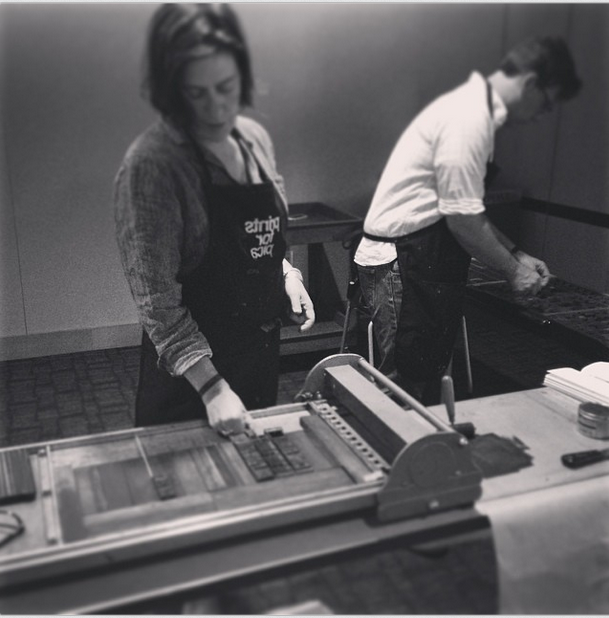
At work tweeting broadsides made in real time. @johnhenrytweets with @tschlapp at Metropolis LIVE! With Susan Szenasy.
The following is the press release issued by Metropolis magazine to announce Szenasy’s new post and her book launch.
This April 2014, Metropolis magazine announced the appointment of Susan S. Szenasy as publisher of the magazine, sharing a dual role with her long-standing position as editor-in-chief. The appointment, made by the founder, Horace Havemeyer III, one month prior to his passing from complications associated with CIDP, a chronic neurological disorder, sets in motion a new chapter in the life of this celebrated magazine of architecture, culture and design.
Concurrent to this appointment is the release of Szenasy, Design Advocate, a collection of writings and talks from the past 30 years, released by Metropolis Books and distributed by ARTBOOK | D.A.P. This volume – the first published collection of Szenasy’s writings – brings together editorials, reviews, stories, profiles, industry event presentations, classroom lectures, commencement addresses and more.
Szenasy’s honest, thought-provoking and often-challenging opinions are present in all of these pieces. So, too, is her ongoing commitment to informed dialogue, which has influenced and guided generations of design professionals, architects, journalists, retailers, manufacturers, legislators, educators and the next generation of designers.
Through this collection of writings, the organic development of a social activist is revealed. Szenasy’s capacity to anchor her inquisitive nature and her reflective reasoning in a foundational belief in human and civil right established her as a pioneer in the advocacy of sustainable design.
In celebration of the launch of the book and her recent appointment, Szenasy has embarked on a series of national conversations exploring issues of design advocacy and ethics. From New York to Los Angeles, Boston to Grand Rapids, Atlanta to Chicago, Providence to Seattle and cities in between Szenasy will be engaging with members of the design community to gain a broad understanding of the issues and topics pertinent to the built environment and design in today’s culture.
According to Szenasy, “Metropolis offers us the freedom to really explore design, culture, talent, people, creativity, materials, policy, everything. It really is a conversation. And when I am on the road engaging with the design community, I don’t give talks anymore. It’s a two-way conversation. A dialogue.”Susan’s active involvement with all of the design community has become legendary. Her tough, but constructive criticism has created an indispensible dialogue in an industry that, like every other area of society, is redefining itself to meet the needs of growing populations in our tech-rich, environmentally compromised, global-local world.
“The two of us were in agreement about our vision for Metropolis” stated Horace Havemeyer III in his announcement of Szenasy to publisher. “From the beginning, we have felt that architecture and design are essential to a humane and progressive society. We have championed, when no one else did, the design community’s obligation to serve all of society’s needs, not just the upper two percent. And now, the growing interest in socially and environmentally relevant design–by a new generation of young professionals – is just one more validation of our long-held vision.”
## #
Metropolis, founded in 1981, Metropolis, the magazine of architecture, culture and design, has earned itself a reputation as a publication of distinction. It has led the conversation on sustainability, technology and accessibility as these issues relate to and reshape the built environment. Long considered a significant voice in the fields of architecture, interior design, graphic design, product design, urban planning and historic preservation, the magazine and its electronic content is recognized as being in the vanguard of the discourse of architecture and design to a dedicated following.
Susan S. Szenasy is publisher/editor in chief of Metropolis, the award-winning New York City–based magazine of architecture, design and culture. Since 1986, she has led the magazine in landmark design journalism, achieving international recognition. A respected authority on sustainability and design, she served two terms on the boards of the Council for Interior Design Accreditation and the Landscape Architecture Foundation, the FIT Interior Design board, and the NYC Center for Architecture Advisory Board.
She has received two IIDA Presidential Commendations, is an honorary member of the ASLA and AIA NYC, and the 2008 recipient of the ASID Patron’s Prize and Presidential Commendation. Along with Metropolis magazine founding publisher Horace Havemeyer III, Szenasy received the 2007 Civitas August Heckscher Award for Community Service and Excellence. She holds an MA from Rutgers University and honorary doctorates from the Art Center College of Design, Kendall College of Art and Design, the New York School of Interior Design, and the Pacific Northwest College of Art.
Michael Graves Live: A Conversation About Recent Designs, Change, and the Future of the Portland Building
Alessi teapots, Target clocks, Disney Dolphin Hotels and the Washington Monument restoration—Michael Graves has influenced a generation of American design with a breadth few architects in history have matched. But it was the cream, salmon and blue-colored Portland Building, published on a 1982 cover of Time magazine, that first introduced Graves and the architectural movement of postmodernism to the wider world.
Arguably Portland’s most demonstrative contribution to architectural history, the Portland Building also has been an equally notorious problem: long-loathed by city employees who work inside and plagued with structural problems and leaks. The City of Portland is pondering the landmark’s future. Who better to ask what should happen than its designer?
The University of Oregon’s John Yeon Center and the Portland Art Museum collaborated to present, “Michael Graves Live” on Thursday, October 9 at the museum’s Fields Ballroom. This event was organized in conjunction with Design Week Portland 2014.
In a live, sold-out, on-stage chat with journalist and Yeon Center director Randy Gragg, Graves explored two topics: 1) his career’s evolution since the Portland Building, and, in particular, since an infection rendered him a paraplegic in 2003 inspiring a turn to designing everything from wheelchairs to housing for disabled veterans; and 2) what of the Portland Building should be preserved and what might change during its upcoming renovation. The lecture is available to view on the Portland Art Museum online recording.
Completed in 1981, the Portland Building became an instant icon of the Postmodernist break from the cookie-cutter corporate modernism that had come to dominate architecture, particularly in public buildings. It was successfully listed on the National Historic Register in 2012. Yet built for less than a common commercial office building of the era, the cut-rate budget led to dreary interiors and devastating leaks. After considering several options for the Portland Building—among them demolishing it, the City of Portland will soon solicit proposals from developers, architects and contractors for a remodel.
Few architects might understand the need for adaption better than Graves, now 80, winner of the Presidential Medal of the Arts in 1999 and the American Institute of Architects Gold Medal in 2001. Ignoring what he thought to be a minor sinus problem in 2003, he woke up to find himself paralyzed from the chest down by an infection that had invaded his brain and spine. But soon after, Graves turned to designing different tools and surroundings for those living with disabilities, from the Prime TC, a replacement for the traditional hospital wheelchair, to the “Michael Graves Active Living Collection,” which includes showerheads, collapsible canes, walkers, and bath seats.
With an introduction by the John Yeon Center’s executive director, Randy Gragg, Graves also held an exclusive discussion at the University of Oregon in Portland on October 8 at the White Stag Block’s Event Room. Speaking to alumni from the University’s Product Design Program and currently enrolled UO students in Portland, Graves discussed current projects and answered questions about his career. Available online to listen here.
A short essay on the work by Sara Huston and Jennifer Wall in Ruf•fle
Detail of Permanently Liminal, Sara Huston
Ruf•fle
Open at the White Box July 13-August 24, 2013
Open from July 13 to August 24, 2013 at the University of Oregon in Portland School of Architecture and Allied ArtsWhite Box Visual Laboratory, Ruf•fle presents plenty of opportunity for White Box visitors to engage in an examination of perception, identity, and the meaning of objects, complete with psychological and cultural aspects. The exhibition features work from a group of Portland-based women traversing opportunities uniquely afforded to interdisciplinary art and design dialogue. The work in Ruf•fle explores individual inquiry within an overarching collective and shared conversation. It is at once thought-provoking, unfamiliar and recognizable.
The inclusion of work in this exhibition by individuals Sara Huston and Jennifer Wall brings to the forefront the dynamic proximity of conversation and the representation of what it can mean to “ruffle.” Huston and Wall, both UO adjunct instructors in the Portland Product Design Program presented pieces that authentically represent the “diversity and value of collaborative analysis through cross-disciplinary insight” in exhibited pieces, Tiny Parametric Ruffles by Wall and Permanently Liminal by Huston.
Wall’s pieces, painstakenly and metaphorically hung as if 2-dimensional with miniscule brass pins driven into predrilled holes in the four corners of fine book paper, present objects that “chase down the ruffled relationship between parametric modeling software and adornment.” (Wall, White Box Ruf•fle catalogue). Indeed, Wall proclaims herself to be “both metalsmith and designer, both maker and designer” which is a dichotomy that informs her work translating with material eloquence into her designs. One might say, Wall’s work blends the rich and diverse worlds of modernity and antiquity simultaneously transitioning and questioning methods and process both ancient and contemporary. Her works soar from the mere designation of “jewelry” although on first glance what one sees is exactly that: objects in shapes traditionally and culturally recognized as rings, necklaces, small keepsakes, perhaps. But that is the peripheral, shallow view—look closer and see the materials ranging from the brilliant metallic allure of gold and silver, to white ABS plastic, to bronze, to aluminide and the natural, soft, shale-like layers of cuttlefish bone: all materials utilized to explore and push the idea of functionality of the design.
Tiny Parametric Ruffles, Jennifer Wall
Wall begins her pieces within the technology of a CAD file using Grasshopper, she then moves to the 3-D printer (quite often using the equipment available in the UO PDX FabLab) creating her pieces in metals and plastics. She also works with the ancient technique of cuttlefish casting advocating for the “relationship between the cuttlefish bone texture and the 3-D print.” Wall sees in this collaboration an ambiguity hovering between the two—a pairing of “how things are made and how things appear.” Upon close inspection, the layers of each technique are visible, drawing an almost daring comparison between the two methods. This contrast between process and production as well as the final product, provides the tangible and visual representation of “ruffle”, says Wall, the “use of the 3-D printer and the use of the cuttlefish casting: it’s modernity and antiquity; the ruffles are in the layers; even the cuttlefish, as a living thing, ruffles its fins to propel itself through water.”
Detail of work in Tiny Parametric Ruffles, Jennifer Wall
This play between the textures and the surfaces of the work, encouraged Wall to explore scale and the relationship between culturally-anticipated sized pieces, and pieces diminished or expanded beyond traditionally accepted norms. She also found a means to traverse the concept of adornment and how it functions as a symbol being both mediator and communication device between the wearer and the viewer.
Detail of work in Tiny Parametric Ruffles, Jennifer Wall
Wall’s work has been grounded in this method of exploration for some time. She comments that she sees this body of work “….not as a departure but as pieces energized by the quality and diversity of 3-D printing. These are pieces that gain identity from materials—the color and reflectivity bringing a definition to the form.” Wall envisions her future work as propelled forward from her venture into scale with the pieces exhibited in Ruf•fle . She sees the potential for future work to embrace larger scale and to investigate kinetics and the adornment of space and buildings, as well as humans. Ruf•fle has also prompted her to observe her inherent fascination with two dimensional representation and the possibility of pieces made purely for the sake of display. As Wall says, “the role of the arts is to shape culture, and as a jeweler I can shape culture….I can work with personal identity and shifting of scale.” She continues, “I have a great interest in how culture can shift off the body, how adornment can be shifted from the body to the built environment, and onto buildings.”
Detail of Tiny Parametric Ruffles, Jennifer Wall
Jennifer Wall’s work represents an elegant dance between two worlds, one of cutting-edge technology and one of ancient techniques. Her blending of these elements enhanced by a quintessential relationship to the materiality of each piece, places her work into a dialectic process of method and understanding. Discernable within her work are the mindful topics of change and interaction between form, shape, size, substance, and cultural meaning. It is through a process of abstraction that meaning is attributed to her work, or the process by which we think about how her work changes and interacts with us and our expectations.
Burrowing deep into the questions of change, interaction, and how all things relate to or define other things (including her work and her own self image and identity), merges Sara Huston, whose work also graces the White Box Ruf•fle space. Part of a self-professed “collaborative, interdisciplinary, avant-garde studio called ‘the last attempt at greatness,” Huston saw her integration into the Ruf•fle exhibition, (an exhibition she was instrumental in securing and curating for the group), as an opportunity to investigate her own feelings of struggle. Huston talks of a dichotomy between the interdisciplinary discussion: the idealistic yet not fully embraced concept of interdisciplinary work. She asserts “there has never been a separation between art and design, in my own work. . . .and this exhibition was a chance “to look into talking about this discussion, exploring it and how to validate it to [her]self and others.” Huston explains her work is “about [her] identity and how [she] identifies as a creative individual” resisting the public penchant to label her as either a designer or an artist—labels she feels she does not neatly fit into. Ruf•fle gave her a chance “to examine the space inbetween artist and designer and to push [her]self with a new medium.”
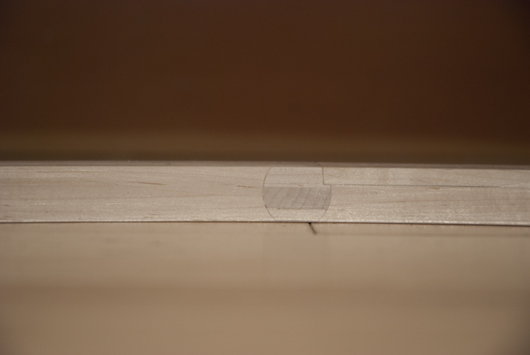
Detail of Permanently Liminal, Sara Huston
Having been involved in furniture (from the very literal and naïve definition) “making” projects, Huston’s work, Permanently Liminal was sparked by a sense of frustration from being called a “furniture maker” and the thought that she desired to reach far beyond the limitations of standard creative labeling or as she puts it, “I needed to exorcise or remove the theme of ‘furniture designer’ so as not to be pegged as one or the other.” Indeed, from her work (some viewable on her website), pieces such as Expectation 01 come across as what most would define as “furniture.” But the failure of her audience to look above and beyond the design aspect and not recognize the artistic component, was driving Huston to want to “rediscover how art and design and the space in between are like a religion and a mantra to [her].” Huston says, with a shy smile, “I am a provocateur.” A sense of wanting to question who she is and what she does, prompted her to create Permanently Liminal, a work that makes strong use of audio to get Huston’s point across.
Detail of Permanently Liminal, Sara Huston
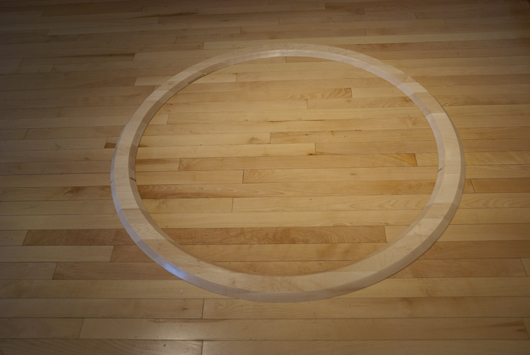
Permanently Liminal demands a closer inspection. The circular threshold, at once familiar and yet oddly inappropriate, confronts the viewer with conflicting invitations: can one step over this threshold? And, to do so, where are you except in a confined and very limited space? Have you traversed some boundary or simply caged yourself within the halo of Huston’s finely sculpted sphere? This element of the circular liminality echoes back to a state of being on the precipice, existing in-between two or more acknowledged, perhaps, unclear, difficult, complex, and real situations. The threshold creates an environment for the individual to experience uncertainty, to be ruffled, to question what happens next, to be temporarily uncomfortable.
Permanently Liminal, Sara Huston
In one sense, Huston compels us to think about reality and what we need to do to break it down into comprehendable parts. She puts us in a static ring, unnervingly similar in color and material to the White Box floor, and subjects us to an audio and physical redundancy of her voice telling us what she is and is not; the circumference facing us with the same position from all positions. Huston boldly questions her surroundings by separating out specific features and focusing on and categorizing them in ways she wants her audience to pay attention to.
This confrontational method of abstraction, (“abstract” is from the Latin “abstrahere” meaning “to pull from”) diligently gives us a slice of her, at this stage, somewhat sullen art and creative angst. Huston comments that Permanently Liminal “completely disrupted [her]” and “confirmed [her] senses of who [she] [is].” The creation of this work forced her to examine how she “relates to the professional fields, the idea of interdisciplinary work, and what ways [she] can work with both industry and marketing to create a space for [herself] that is new.”
Maybe yet undefined, Huston’s own arcadian space without the classifications of artist, designer, or furniture-maker but confined only by the blonde circlet defining the grounded component of her installation, compels her to seek clarity by confrontation. Constructed into this installation are the elements of audio, visual, textural as the senses are called upon to test the limits of understanding and tolerance. Permanently Liminal is a collaboration of disciplines, a mélange of experiences. The multidisciplinary approach Huston show us has led her to a “whole new sense of [her]self, blown away the boundaries of media and audio and made [her] comfortable enough to want to manipulate and work within the digital realm.” Installing Permanently Liminal and reacting to it in the White Box space, Huston asserts that she now considers audio to be “a material” and she hopes to explore the medium as a tangible, physical experience “integrating it into the human psyche and conscious as well as subconscious.”
Both Huston and Wall expressed the sentiment that from experiencing their work and the work in the Ruf•fle exhibition, they anticipate their audiences being ruffled enough to gain new ways of looking at the world, at themselves, and at the boundaries, or lack thereof, in artistic and design disciplines. Presenting work like this in an environment receptive to change and experimentation creates opportunities for discovery of the arts and design as socially and environmentally anchored. And, as Huston reminds us, we must never forget the crucial human component and its importance to art and design, and life, influencing our reactions and how we interact and react to work. While we might abstract to attain meaning and relevance from this exhibit, the utmost value of challenging norms and experiencing situations that compel thought and contemplation, is to remember the Socratic philosophical mantra and remind ourselves, “the unexamined life is not worth living.” It is with exhibitions like Ruf*fle that we are provided the moments, spaces, objects and time to question, to pursue answers, to think to the best of our ability, to examine our lives.